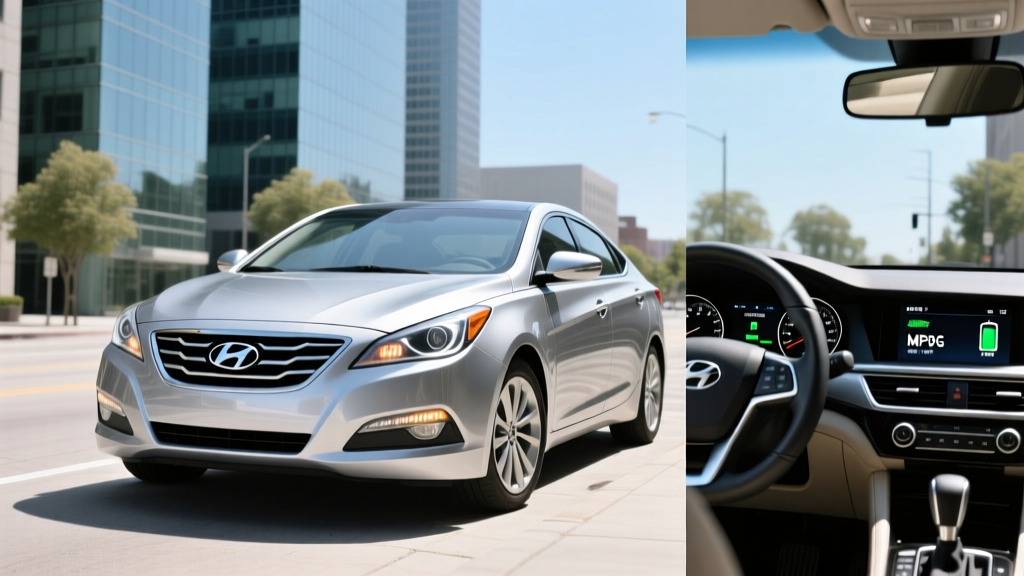
The 2011 Hyundai Sonata Hybrid was the brand's first entry into the mainstream hybrid sedan market, going head-to-head with the Toyota Camry Hybrid and Ford Fusion Hybrid. More than a decade later, it remains a popular fixture on the used-car market thanks to low entry prices and strong city fuel economy. If you're researching a 2011 Hyundai Hybrid Sonata as a budget-friendly commuter, this guide covers the exact MPG figures, battery longevity expectations, and ownership economics you need before signing the paperwork.
One critical distinction up front: the 2011 Sonata Hybrid is a conventional hybrid electric vehicle (HEV). It does not plug in. Hyundai did not introduce a plug-in hybrid (PHEV) Sonata until the 2016 model year. That means no electric-only range, no charging cord, and no federal tax credit — but also no range anxiety and no dependency on charging infrastructure.
HEV vs PHEV: What the 2011 Sonata Hybrid Actually Is
Conventional Hybrid (HEV) — 2011 Sonata Hybrid
- Plug-in required: No — the battery charges via regenerative braking and the gas engine
- Electric-only driving: Very limited, low-speed creeping only (under ~1 mile)
- Battery size: 1.4 kWh lithium-polymer (not usable for sustained EV mode)
- Federal tax credit: None (expired long ago; only qualifying new PHEVs/BEVs eligible under current §30D rules)
- Refueling: Gas station only, same as any conventional car
Plug-In Hybrid (PHEV) — For Comparison
- Plug-in required: Yes — charges via Level 1 or Level 2 AC
- Electric-only driving: Typically 25–45 miles depending on model
- Battery size: Typically 10–20 kWh usable
- Federal tax credit: Up to $7,500 if new and meeting §30D sourcing/income/MSRP rules
- Refueling: Gas station + electric outlet or charger
If you want a Sonata that can commute on electricity alone, you'd need to look at the 2016–2020 Sonata PHEV (approximately 27 miles electric-only EPA) or a newer Hyundai like the Tucson PHEV or Ioniq PHEV. The 2011 model is purely an HEV.
Fuel Economy: EPA Ratings and Real-World MPG
| Metric | EPA Rating | Real-World Expectation |
|---|---|---|
| City | 35 MPG | 33–38 MPG (hybrids often exceed EPA in stop-and-go) |
| Highway | 40 MPG | 36–39 MPG (aerodynamic drag reduces hybrid advantage at speed) |
| Combined | 36 MPG | 34–38 MPG depending on driving mix |
Source: EPA Fuel Economy Guide — 2011 Hyundai Sonata Hybrid
How many MPG does the 2011 Hyundai Hybrid Sonata get? The EPA combined figure is 36 MPG, with 35 city and 40 highway. In practice, owners who drive predominantly in the city often see numbers at or slightly above the EPA city rating because regenerative braking recaptures energy at every stoplight. Highway-heavy commuters should expect numbers closer to 36–38 MPG, as the electric motor provides less assistance at sustained high speeds.
For context, a comparable 2011 Sonata with the 2.4L gas-only four-cylinder was rated at 22 city / 35 highway / 26 combined. The hybrid delivers roughly a 38% improvement in combined fuel economy — a meaningful difference at today's fuel prices.
Powertrain Specs: Engine, Motor, and Combined Output
| Specification | Detail |
|---|---|
| Gas Engine | 2.4L Atkinson-cycle 4-cylinder, 169 hp / 159 lb-ft |
| Electric Motor | 30 kW (40 hp) permanent-magnet synchronous |
| Combined System Output | 206 hp |
| Transmission | 6-speed automatic (no CVT) |
| Hybrid Battery | 1.4 kWh lithium-polymer, 270V |
| 0–60 mph | ~8.5 seconds (est.) |
| Curb Weight | ~3,455 lbs |
| Fuel Tank | 18.5 gallons |
| Total Driving Range | ~666 miles (EPA combined) |
Hyundai's decision to use a conventional 6-speed automatic rather than a CVT was a deliberate differentiator. Drivers who dislike the rubber-band feel of a CVT will appreciate the familiar shift behavior. The trade-off is slightly less seamless electric-motor blending compared to the power-split devices in Toyota and Ford hybrids of the same era.
The 206 combined horsepower figure was competitive for 2011 midsize hybrid sedans. The Sonata Hybrid feels adequately quick in daily driving, with the electric motor providing immediate torque fill at low RPM before the gas engine reaches its power band.
Battery Lifespan, Warranty, and Replacement Cost
Hybrid Battery Warranty (Original)
- Original coverage: 8 years / 100,000 miles (10 years / 100,000 miles in CARB states including CA, CT, ME, MA, NJ, NY, OR, RI, VT, WA)
- Capacity threshold: Hyundai warranted against defects and excessive capacity loss
- Current status for 2011 model: Original warranty has expired for all 2011 vehicles as of 2019 (or 2021 in CARB states)
Is the 2011 Hyundai Sonata Hybrid reliable, and what does battery replacement cost? The lithium-polymer pack in this model has proven reasonably durable, but at 13–15 years of age, any original battery is operating on borrowed time. Here's what to expect:
- Typical hybrid battery lifespan: 150,000–200,000 miles or 12–15 years, whichever comes first. Heat and deep cycling accelerate degradation.
- Replacement cost (aftermarket/remanufactured): $2,000–$3,500 installed through an independent hybrid specialist.
- Replacement cost (OEM dealer): $3,500–$5,000+ installed.
- Cell-level repair: Some hybrid shops can replace individual modules for $800–$1,500 if only a few cells have failed.
When evaluating a used 2011 Sonata Hybrid, request a hybrid battery health check. A scan tool can read the battery's state of health (SoH) and individual cell voltage variance. Wide variance between modules (more than 0.2–0.3V difference) indicates impending failure. Budget $2,500–$4,000 as a contingency if the battery hasn't been replaced and the car has over 130,000 miles.
Beyond the hybrid battery, the 2011 model year carried some known issues unrelated to the hybrid system, including early-production Theta II engine concerns. Verify that the vehicle's engine has been inspected or recall-repaired under Hyundai's extended engine warranty program. Check the NHTSA database at nhtsa.gov/recalls for open recalls by VIN.
Pricing and Tax Credit Eligibility in 2026
The 2011 Sonata Hybrid originally started around $26,400 MSRP. In the current used market (2026), expect to pay:
- Fair/poor condition (150k+ miles): $3,500–$5,500
- Good condition (100k–140k miles): $5,500–$8,000
- Excellent/low miles (under 90k): $8,000–$10,500
Does the 2011 Hyundai Sonata Hybrid qualify for any tax credit? No. The federal §30D Clean Vehicle Credit applies only to new qualifying plug-in electric vehicles (BEVs and PHEVs) that meet battery sourcing, critical mineral, MSRP cap ($55,000 sedans), and buyer income limits as defined by the IRS. A 2011 conventional hybrid does not qualify for any federal incentive. The used EV credit (up to $4,000 under §25E) also requires the vehicle to be a plug-in EV or fuel cell vehicle — conventional HEVs are excluded.
Some states previously offered hybrid purchase rebates, but most have expired or shifted focus to plug-in vehicles. Check your state's current energy office or DMV for any remaining hybrid incentives, though they are increasingly rare.
Who Should Buy This Hybrid vs. a Full EV or Gas Car
Pros
- Strong city MPG (35 EPA, often 36–38 real-world)
- No plug-in dependency — works anywhere with gas stations
- 6-speed automatic avoids the CVT feel some drivers dislike
- Spacious midsize cabin with 16.4 cu ft trunk (only 0.8 cu ft less than gas model)
- Low used-car entry price ($4k–$8k typical)
- Proven, well-understood hybrid system with strong aftermarket support
Cons
- Hybrid battery likely at end-of-life; $2,500–$4,000 replacement budget needed
- Highway MPG (40 EPA) is only modestly better than some modern turbo gas sedans
- No electric-only driving capability
- No federal or state tax credits available
- 2011 model year carries Theta II engine risk — verification essential
- Outdated infotainment and safety tech vs. modern vehicles
Decision Framework: Is the 2011 Sonata Hybrid Right for You?
- Choose this HEV if: You need a budget commuter under $8,000, drive mostly in the city, have no access to home or workplace charging, and want maximum fuel savings without plug-in logistics.
- Choose a used PHEV (e.g., 2017–2020 Sonata PHEV, Prius Prime) if: You have home charging access, want 25+ miles of electric-only commuting, and can stretch your budget to $12,000–$18,000.
- Choose a used full EV (e.g., 2018–2021 Bolt, Leaf, Model 3) if: You have reliable home Level 2 charging, your daily commute is under 150 miles, and you want zero tailpipe emissions with lower per-mile fuel cost.
- Choose a modern gas car if: You drive predominantly highway miles, want the latest safety tech (AEB, lane-keep), and prefer a newer vehicle with remaining factory warranty over a 15-year-old hybrid.
Hybrid vs PHEV vs EV: Which Powertrain Fits Your Situation?
The 2011 Sonata Hybrid occupies a specific niche: it's a bridge technology for drivers who want better fuel economy without changing their refueling habits. Here's how the three powertrain types compare for a typical buyer in 2026:
| Factor | HEV (this car) | PHEV | Full EV (BEV) |
|---|---|---|---|
| Plugs in? | No | Yes (Level 1 or 2) | Yes (Level 2 + DC fast) |
| Electric-only range | Negligible | 25–50 mi typical | 200–370 mi typical |
| Fuel cost per mile | ~$0.10–$0.13 | ~$0.04–$0.12 (depends on EV vs gas ratio) | ~$0.03–$0.06 |
| Maintenance | Standard + hybrid system | Standard + hybrid + EV system | Minimal (no oil, fewer fluids) |
| Tax credit eligible? | No | Yes (if new & qualifying) | Yes (if new & qualifying) |
| Home charging needed? | No | Strongly recommended | Essential |
For a used-car buyer spending under $10,000, the HEV is often the only electrified option that doesn't require a home charging setup. If you rent an apartment without charging access or park on the street, a conventional hybrid like the 2011 Sonata Hybrid remains the most practical way to cut fuel costs.
Frequently Asked Questions
How many MPG does the 2011 Hyundai Sonata Hybrid get?
The EPA rates it at 35 city / 40 highway / 36 combined MPG. Real-world results typically fall between 34 and 38 MPG combined, with city-heavy driving sometimes exceeding the EPA city figure thanks to regenerative braking.
Does the 2011 Sonata Hybrid need to be plugged in?
No. It is a conventional hybrid (HEV), not a plug-in hybrid (PHEV). The small 1.4 kWh battery charges entirely through regenerative braking and the gasoline engine. There is no charging port.
How far can it drive on electric power alone?
Effectively zero miles in any practical sense. The electric motor can propel the car at very low speeds (under ~25 mph) for short distances on flat ground, but it cannot sustain highway speeds or meaningful distances on battery power alone. This is normal for conventional hybrids of this era.
What does a replacement hybrid battery cost?
Expect $2,000–$3,500 for a remanufactured battery installed by a hybrid specialist, or $3,500–$5,000+ for an OEM replacement at a Hyundai dealer. Individual cell-module repair may be possible for $800–$1,500 if only partial failure has occurred.
Is the 2011 Sonata Hybrid reliable?
The hybrid system itself is generally durable, but the 2011 model year overlaps with Hyundai's Theta II engine issues. Verify that any applicable engine recalls or extended warranty repairs have been completed. The hybrid battery, at 15 years old, should be tested for cell balance and capacity before purchase.
Does the 2011 Hyundai Sonata Hybrid qualify for a tax credit?
No. The federal §30D credit applies only to new qualifying plug-in vehicles (BEVs and PHEVs). The used EV credit (§25E, up to $4,000) also excludes conventional hybrids. No federal tax incentive is available for this vehicle.
How does it compare to a 2011 Camry Hybrid or Fusion Hybrid?
The 2011 Camry Hybrid was rated at 33 city / 34 highway / 33 combined — slightly lower than the Sonata Hybrid on paper, though Toyota's hybrid system had a longer track record at that time. The 2011 Fusion Hybrid was rated at 41 city / 36 highway / 39 combined, edging out the Sonata in city driving. The Sonata's advantage was its 6-speed automatic (no CVT) and class-leading interior space.