The 2011 Ford Escape Hybrid was one of the first mainstream compact SUVs to pair a gasoline engine with an electric motor for real fuel savings — no plug required. More than a decade later, it remains a popular entry on the used-hybrid market for buyers who want SUV utility without the complexity of plug-in charging. But with a 15-year-old nickel-metal hydride (NiMH) battery pack and aging powertrain electronics, is it still a smart buy in 2026? This guide breaks down every number that matters: EPA fuel economy, real-world MPG, battery health, replacement costs, and where the Escape Hybrid fits against modern PHEVs and EVs.
HEV vs. PHEV: Where the 2011 Escape Hybrid Fits
Before evaluating the numbers, it's essential to understand what the 2011 Ford Escape Hybrid is — and what it isn't.
Conventional Hybrid (HEV) — 2011 Ford Escape Hybrid
- No plug. The battery recharges via regenerative braking and the gasoline engine.
- No electric-only driving range beyond very low-speed, short-distance creep (under 1 mile at roughly 25 mph or less).
- No home charging equipment needed — you simply fill up at the gas station like any other car.
- Fuel economy benefit: The electric motor assists the engine and enables engine-off coasting and idle stop.
Plug-In Hybrid (PHEV) — e.g., 2026 Toyota RAV4 Prime, Ford Escape PHEV
- Requires plugging in to access its full electric-only range (typically 30–42 miles on modern models).
- Larger battery pack (13–18 kWh usable) charged via Level 1 (120V) or Level 2 (240V) outlets.
- Operates as an EV for daily commutes, then switches to hybrid mode when the battery depletes.
- May qualify for federal tax credits under IRS §30D (up to $7,500 for new purchases, subject to income, MSRP, and sourcing rules).
The 2011 Escape Hybrid is strictly a conventional HEV. If you're looking for plug-in electric driving, you'll need to consider the current-generation Ford Escape PHEV (introduced for the 2020 model year and still available in 2026) or a competing PHEV.
Fuel Economy: EPA Ratings and Real-World MPG
Fuel economy is the primary reason buyers choose the Escape Hybrid over its gasoline-only sibling. Here are the official EPA figures for the 2011 model year, sourced from fueleconomy.gov:
| Configuration | City MPG | Highway MPG | Combined MPG |
|---|---|---|---|
| FWD (Front-Wheel Drive) | 34 | 31 | 33 |
| AWD (All-Wheel Drive) | 31 | 29 | 30 |
| Gas-only 2011 Escape (2.5L, FWD) | 22 | 28 | 24 |
Real-World MPG: What Owners Actually See
Like most conventional hybrids, the Escape Hybrid tends to exceed its EPA city rating in stop-and-go driving because regenerative braking recaptures energy that a gas-only vehicle wastes as heat. However, highway efficiency is where the hybrid advantage narrows — at sustained speeds above 65 mph, the gasoline engine does most of the work.
- City driving (real-world): 32–36 MPG for FWD; owners in moderate climates with gentle acceleration habits often report 35+ MPG.
- Highway driving (real-world): 28–31 MPG for FWD; sustained 75+ mph speeds and hilly terrain reduce this further.
- Cold-weather penalty: Expect a 5–10% MPG drop in winter. The engine runs more frequently to provide cabin heat and maintain battery temperature, reducing electric-motor assist.
- Aged-battery effect: A degraded NiMH pack (common on 15-year-old vehicles) can reduce city MPG by 2–4 MPG as the system relies more heavily on the engine.
Powertrain Specs: Engine, Motor, and Combined Output
| Specification | 2011 Ford Escape Hybrid FWD | 2011 Ford Escape Hybrid AWD |
|---|---|---|
| Gasoline Engine | 2.5L Atkinson-cycle I4 | 2.5L Atkinson-cycle I4 |
| Engine Horsepower | 156 HP @ 6,000 RPM | 156 HP @ 6,000 RPM |
| Electric Motor | Permanent-magnet AC synchronous | Permanent-magnet AC synchronous |
| Combined System HP | 177 HP | 177 HP |
| Transmission | CVT (planetary e-CVT) | CVT (planetary e-CVT) |
| Hybrid Battery | NiMH, ~1.8 kWh total | NiMH, ~1.8 kWh total |
| 0–60 MPH (est.) | ~9.5 seconds | ~10.0 seconds |
| Towing Capacity | 1,000 lbs | 1,000 lbs |
The 2.5-liter Atkinson-cycle engine sacrifices some peak power for higher thermal efficiency — a hallmark of hybrid powertrains. The planetary e-CVT (functionally identical in principle to Toyota's Hybrid Synergy Drive, which Ford licensed for this generation) provides seamless power blending between the engine and motor. There are no fixed gear ratios, so acceleration is linear but unexciting.
Battery Health, Warranty, and Replacement Costs
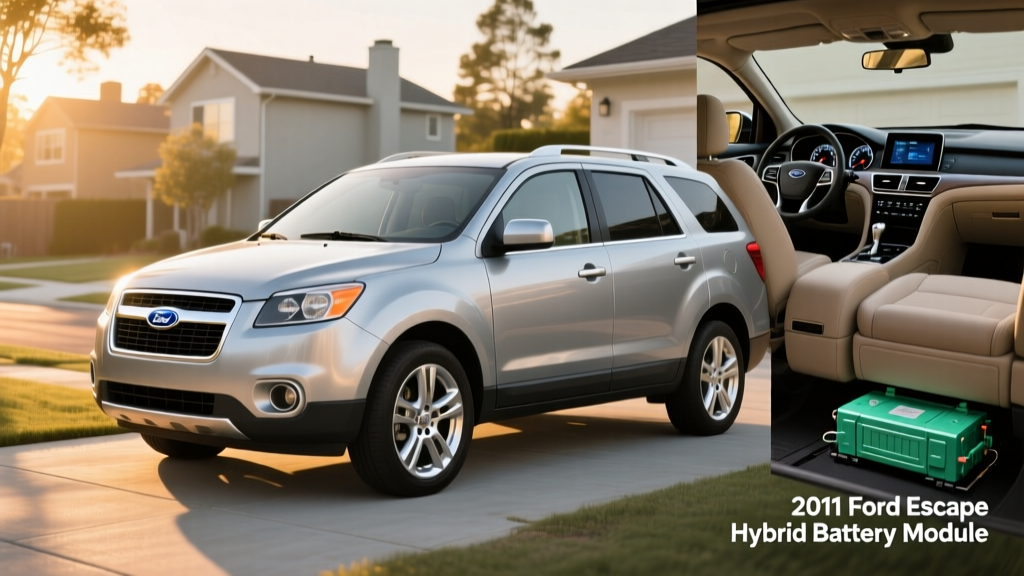
The high-voltage NiMH battery pack is the single biggest concern for anyone buying a 2011 Escape Hybrid in 2026. Ford originally warranted the hybrid battery for 8 years / 100,000 miles (extended to 10 years / 150,000 miles in California-emission states). By 2026, every original warranty has expired.
Expected Battery Lifespan and Degradation
NiMH packs in the Escape Hybrid typically last 120,000–180,000 miles before significant capacity loss, though many have failed earlier in hot climates (Arizona, Texas, Florida) where sustained high temperatures accelerate cell degradation. Signs of a failing pack include:
- Noticeable MPG drop (3–5 MPG below expected)
- Engine running more frequently at stops
- Reduced regenerative braking feel
- Dashboard hybrid-system warning light
- State of Charge (SoC) gauge fluctuating erratically
Battery Replacement Costs in 2026
- OEM new battery (Ford dealer): $3,500–$5,000 installed (parts + labor). Availability may be limited as Ford has reduced production of this generation's pack.
- Remanufactured battery: $2,000–$3,200 installed from hybrid specialists (e.g., GreenBean, Hybrid Battery Solutions). This is the most common route for a vehicle of this age.
- Individual cell/module replacement: $500–$1,500 if only a few modules have failed. Requires a technician with NiMH diagnostic equipment to identify weak cells.
- DIY reconditioning: Not recommended for most owners; NiMH packs require precise balancing and carry high-voltage shock risk.
When evaluating a used 2011 Escape Hybrid, ask for documentation of battery replacement. A recently replaced remanufactured pack with a 1–3 year warranty adds significant value. If the original battery is still in place at 150,000+ miles, budget for an imminent replacement.
Pricing and Tax Credit Eligibility in 2026
The 2011 Ford Escape Hybrid is only available on the used market. As of early 2026, typical asking prices are:
- 80,000–110,000 miles, good condition: $5,500–$7,500
- 110,000–150,000 miles, average condition: $3,800–$5,500
- 150,000+ miles or needs battery: $2,500–$4,000
Federal Tax Credit: Does It Qualify?
No. The 2011 Escape Hybrid does not qualify for any federal tax credit. Here's why:
- The IRS §30D New Clean Vehicle Credit (up to $7,500) applies only to new vehicles with plug-in capability (PHEVs and BEVs) meeting battery-sourcing and critical-mineral requirements. Conventional hybrids have never qualified.
- The Previously-Owned Clean Vehicle Credit (§25E, up to $4,000 or 30% of sale price) applies only to used PHEVs and BEVs — not conventional HEVs. The Escape Hybrid's lack of a plug excludes it entirely.
- Some states offer used hybrid rebates or registration discounts, but these vary widely. Check your state's energy or DMV website for current programs.
If tax-credit eligibility is a priority, consider a used Ford Escape PHEV (2020–2024 model years, $18,000–$28,000 on the used market), which may qualify for the §25E used-EV credit if the sale price is under $25,000 and your income falls below IRS thresholds ($75,000 single / $150,000 joint for used-vehicle credits). Consult IRS.gov §30D guidelines for current rules.
Reliability and Common Issues Beyond the Battery
The 2011 Escape Hybrid shares its platform and many components with the conventional Escape, so general reliability is well-documented. The hybrid-specific components add a few considerations:
Known Problem Areas
- Hybrid battery cooling fan: Located behind the rear seat. Dust and pet hair clog the filter, causing overheating and accelerated battery degradation. Clean the filter every 15,000 miles.
- Brake actuator assembly: The electrohydraulic brake system (which blends regenerative and friction braking) has a known failure mode around 100,000–140,000 miles. Replacement runs $1,200–$1,800. A firm or unresponsive brake pedal is the primary symptom.
- e-CVT reliability: The planetary gearset itself is robust and generally outlasts conventional automatics. Fluid changes every 60,000 miles are recommended but often neglected.
- 12V auxiliary battery: Like any vehicle, the standard 12V battery needs replacement every 3–5 years. A dead 12V battery will prevent the hybrid system from starting, even if the high-voltage pack is fully charged.
- Rust: Check the rear subframe and rocker panels, particularly on vehicles from the Rust Belt.
Overall, the hybrid powertrain has proven more durable than the conventional Escape's 6-speed automatic transmission, which had its own failure issues in this generation. The Escape Hybrid's e-CVT eliminates the traditional transmission entirely, removing a major failure point.
Who Should Buy the 2011 Escape Hybrid in 2026?
Pros
- Strong city MPG (34 EPA, often 35+ real-world)
- No plug-in charging required — ideal for apartment dwellers
- Low purchase price ($3,800–$7,500)
- SUV cargo space (29.2 cu ft behind rear seats, 67.2 cu ft folded)
- Simple to maintain; no specialized EV service required
- Proven e-CVT durability
Cons
- Original battery warranty expired; replacement costs $2,000–$5,000
- No electric-only driving range to speak of
- Modest 177 HP — slow acceleration by modern standards
- Outdated infotainment (no Apple CarPlay/Android Auto)
- No federal tax credit eligibility
- 1,000-lb towing limit (lower than gas-only Escape)
Choose the 2011 Escape Hybrid If:
- You drive primarily in the city and want 33+ MPG without plugging in.
- Your budget is under $8,000 and you need an SUV.
- You lack access to home or workplace charging (apartment, street parking).
- You're comfortable budgeting $2,000–$4,000 for a battery replacement within the next few years.
Consider a Modern PHEV Instead If:
- You have access to Level 2 charging at home or work.
- Your daily commute is under 35 miles — a PHEV can cover it entirely on electricity.
- You want modern safety tech (automatic emergency braking, lane-keeping) and infotainment.
- Tax credit eligibility matters to you (used PHEVs can qualify for up to $4,000 under §25E).
Choose a Full EV (BEV) If:
- You want zero gasoline use and the lowest per-mile fuel cost.
- You can install a Level 2 home charger (typically $500–$2,000 installed).
- Your daily driving is under 200 miles and you're comfortable with public DC fast charging for road trips.
Frequently Asked Questions
How many MPG does the 2011 Ford Escape Hybrid get?
The FWD model is EPA-rated at 34 city / 31 highway / 33 combined MPG. The AWD model drops to 31/29/30 MPG. Real-world city driving often yields 32–36 MPG for the FWD, while highway driving at 70+ mph typically returns 28–31 MPG. A degraded battery will reduce these figures, particularly in city driving.
Can the 2011 Escape Hybrid drive on electric power alone?
Only in very limited circumstances — at speeds below about 25 mph for less than a mile, such as creeping through a parking lot. This is a conventional hybrid (HEV), not a plug-in hybrid. It cannot be plugged in, and it has no meaningful electric-only range. If you want 30+ miles of electric-only driving, you need a PHEV like the current Ford Escape PHEV (37 miles EPA electric-only) or a full EV.
Is the 2011 Ford Escape Hybrid reliable?
The hybrid powertrain itself — the e-CVT and motor/generator assembly — is generally reliable and often outlasts the conventional Escape's automatic transmission. The primary reliability concern is the NiMH battery pack, which is now 15 years old on all examples. Budget for a remanufactured battery replacement ($2,000–$3,200) if the pack hasn't been replaced. The brake actuator assembly is another known failure point around 100,000–140,000 miles.
How much does it cost to replace the hybrid battery?
In 2026, expect to pay $2,000–$3,200 for a remanufactured NiMH battery installed by a hybrid specialist, or $3,500–$5,000 for a new OEM battery from a Ford dealer (if still available). Individual module replacement can cost $500–$1,500 if only a few cells have failed. Always get a hybrid battery health scan before purchasing a used Escape Hybrid.
Does the 2011 Escape Hybrid qualify for any tax credits?
No. The 2011 Escape Hybrid is a conventional HEV and does not qualify for the federal §30D New Clean Vehicle Credit or the §25E Previously-Owned Clean Vehicle Credit. Both credits are restricted to plug-in vehicles (PHEVs and BEVs). Some states may offer minor registration or inspection discounts for hybrids, but these vary by jurisdiction.
Hybrid vs. PHEV vs. EV — which is right for me?
A conventional hybrid (HEV) like the 2011 Escape Hybrid is best if you can't plug in at home, want lower fuel costs with zero behavior change, and are on a tight budget. A plug-in hybrid (PHEV) is ideal if you have Level 2 charging access and a commute under 35 miles — you'll drive mostly on electricity but keep a gas engine for road trips. A full EV (BEV) makes sense if you want the lowest operating costs, have reliable charging access, and your daily driving fits within the vehicle's range. For a deeper comparison, see our fueleconomy.gov hybrid comparison tool.