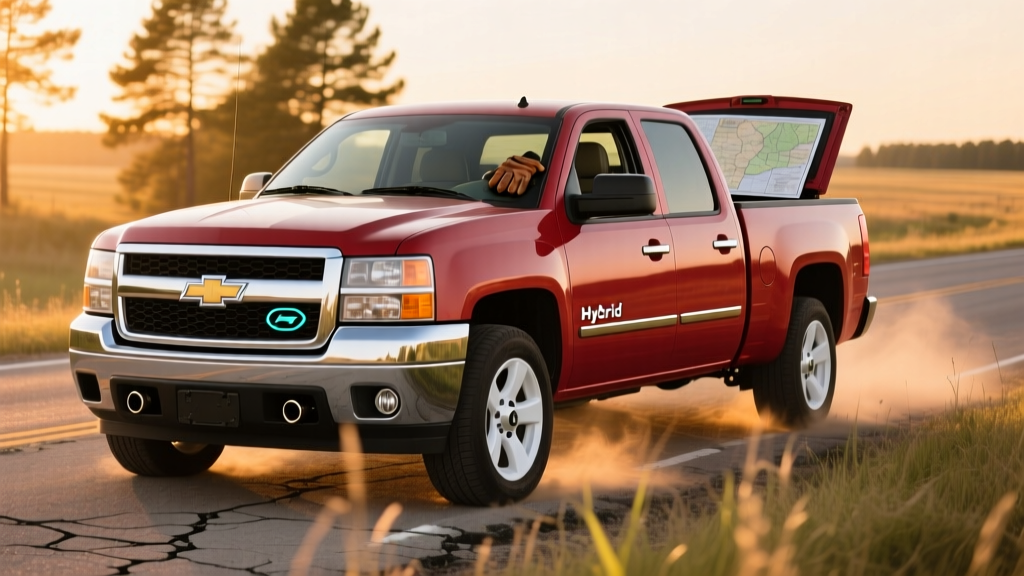
The 2011 Chevrolet Silverado Hybrid was a bold experiment: a full-size, body-on-frame pickup using GM's sophisticated Two-Mode hybrid system to squeeze meaningful fuel savings out of a 5,800-pound truck. More than a decade after its final model year, it remains one of the only true hybrid pickups ever sold in the U.S., and a tempting used-market proposition for buyers who need truck capability but want to trim their fuel bills. This guide covers exactly what you're getting — EPA numbers, real-world MPG expectations, the 300-volt NiMH battery's longevity, and whether this aging HEV still makes sense in 2026.
HEV, Not PHEV: What the Silverado Hybrid Actually Is
The 2011 Silverado Hybrid is a conventional hybrid electric vehicle (HEV). It cannot be plugged in. It has no electric-only driving range in any practical sense. The hybrid system recovers energy through regenerative braking and uses a small battery pack to assist the gasoline engine, enable brief low-speed electric-only movement (under ~1 mile at very low speeds), and shut the engine off at stops.
HEV vs. PHEV — Quick Distinction
HEV (this truck): No plug. Battery charges only from the engine and regenerative braking. MPG improvement is modest but consistent. No electric-only highway driving.
PHEV (e.g., modern plug-in trucks/SUVs): Plugs into a wall or charger. Larger battery (typically 15–30+ kWh) provides 20–50 miles of electric-only range before the gas engine starts. Requires charging access to realize full benefit.
The Silverado Hybrid is firmly in the HEV camp — think of it as a gas truck with a built-in efficiency assist, not a vehicle you'll ever plug in.
Fuel Economy: EPA Ratings and Real-World MPG
The headline number for the 2011 Silverado Hybrid is its EPA rating, which was remarkably good for a full-size 4WD truck of its era. According to fueleconomy.gov, the 4WD Silverado 1500 Hybrid achieved:
| Metric | EPA Rating |
|---|---|
| City | 21 MPG |
| Highway | 22 MPG |
| Combined | 21 MPG |
| Annual Fuel Cost (est.) | ~$2,950 |
For context, the conventional 2011 Silverado 1500 4WD with the 5.3L V8 was rated at 15 city / 21 highway / 17 combined. The hybrid's 21 city rating represented a 40% improvement in city driving — exactly where hybrid systems shine, thanks to frequent stops, regenerative braking, and engine-off idle.
Real-World MPG: What Owners Actually Report
Owner-reported data on Fuelly and enthusiast forums clusters around 18–21 MPG combined in mixed driving, with city-heavy commutes sometimes touching 22–23 MPG and highway-only road trips dipping to 18–19 MPG. This is a common hybrid pattern: city MPG meets or exceeds the EPA sticker, while highway driving sees less benefit because the engine runs continuously at cruise speeds and regenerative braking opportunities are minimal.
Powertrain: The Two-Mode Hybrid System Explained
The 2011 Silverado Hybrid used GM's Two-Mode Hybrid system — a complex, engineering-forward design co-developed with BMW and Chrysler (DaimlerChrysler at the time). It paired a 6.0L Vortec V8 with two electric motors inside a specially designed electronically variable transmission (EVT).
| Specification | 2011 Silverado 1500 Hybrid |
|---|---|
| Engine | 6.0L V8 (Vortec, Atkinson-cycle capable) |
| Engine HP | 332 hp @ 5,100 rpm |
| Electric Motors | Two 60-kW motors (inside EVT) |
| Combined System HP | 379 hp |
| Transmission | 2-Mode EVT (electronically variable) |
| Drivetrain | 4WD (standard on Hybrid trim) |
| Hybrid Battery | ~1.8 kWh NiMH (300V, sealed) |
| Towing Capacity | 6,100 lbs (4WD Hybrid) |
| Payload | ~1,400 lbs |
| Curb Weight | ~5,800 lbs |
The Two-Mode system's brilliance was its ability to operate in two distinct hybrid modes: one optimized for low-speed city driving (where electric assist dominates) and one for higher-speed highway cruising (where the mechanical path through the EVT is more efficient). This is why the Silverado Hybrid's highway MPG (22) was nearly equal to its city MPG (21) — unusual for a hybrid, which typically shows a much larger city advantage. The trade-off was complexity: the EVT contains two planetary gearsets, three clutches, and the two electric motors, all requiring precise electronic coordination.
Hybrid Battery: Lifespan, Warranty, and Replacement Cost
The 2011 Silverado Hybrid's battery pack is a ~1.8 kWh nickel-metal hydride (NiMH) unit operating at 300 volts. It's located under the rear seats and is air-cooled via a dedicated ventilation duct. Because this is an HEV with a small battery that never deeply cycles (it typically operates between 20% and 80% state of charge), the pack experiences less stress than a PHEV or BEV battery.
Hybrid Battery Warranty (When New)
Original coverage: 8 years / 100,000 miles (10 years / 150,000 miles in CARB states including CA, NY, MA, and others).
What it covered: Battery capacity loss below a defined threshold and defects in the hybrid system components (inverter, electric motors, EVT hybrid-specific parts).
Current status (2026): The 8-year/100k warranty has expired for all 2011 models. The 10-year/150k CARB-state warranty expired at the end of 2021 at the latest. Any battery replacement is now an out-of-pocket cost.
Battery Replacement Cost and Longevity
NiMH hybrid batteries in GM's Two-Mode system have proven reasonably durable. Many original packs have lasted 150,000–200,000+ miles, though some have required replacement between 100,000 and 150,000 miles, particularly in hot climates where thermal stress accelerates cell degradation.
As of 2026, replacement options include:
- OEM-remanufactured pack (dealer): $3,000–$4,500 installed
- Aftermarket refurbished pack: $1,800–$2,800 installed
- Individual module replacement (specialty hybrid shops): $600–$1,200 for one or two failed modules out of the pack's ~30 modules — a cost-effective option if only a few cells have degraded
The Two-Mode system's hybrid-specific components — the EVT, inverter, and electric motors — have a mixed reliability record. The EVT itself is robust when maintained (fluid changes matter), but the 300V power inverter has been a known failure point on higher-mileage examples, with replacement running $1,500–$3,000.
Reliability and Known Issues
The 2011 Silverado Hybrid's reliability story is mixed, and this is the single biggest factor used buyers should weigh:
Pros
- 40% city MPG improvement over gas V8 Silverado
- Strong 379 combined HP — no power sacrifice
- Genuine truck capability: 6,100-lb towing, 4WD standard
- Small NiMH battery rarely needs full replacement
- Engine auto-stop at idle saves fuel in traffic
- Unique HEV truck — no direct competitor existed
Cons
- Complex Two-Mode EVT is expensive to repair if it fails
- 300V inverter failures reported at 100k–150k miles
- Highway MPG advantage is modest (22 vs. 21 for gas)
- No plug-in capability — zero electric-only range
- Out of all factory warranties as of 2026
- Limited dealer familiarity with aging Two-Mode systems
- Only available as Crew Cab 4WD — no regular cab option
Common issues reported by owners and documented on NHTSA's database (nhtsa.gov) include:
- Hybrid system warning lights: Often related to the battery cooling duct becoming clogged or the inverter overheating. Keeping the under-seat ventilation duct clean is critical maintenance.
- Active Fuel Management (AFM) lifter failures: The 6.0L V8 uses cylinder deactivation, which has been linked to lifter collapse on high-mileage examples. This is an engine issue, not hybrid-specific, but it affects this truck.
- EVT whine or shudder: Can indicate worn clutch packs inside the transmission. Fluid should be changed every 50,000–60,000 miles using the correct Dexron Ultra LV fluid.
Pricing on the Used Market (2026)
The 2011 Silverado Hybrid was discontinued after the 2013 model year, making all examples at least 13 years old in 2026. Used-market pricing varies heavily based on mileage, condition, and hybrid system health:
- High-mileage (150k+ miles), as-is hybrid system: $5,000–$8,000
- Average condition (100k–140k miles), functioning hybrid: $8,000–$12,000
- Low-mileage, well-maintained examples (under 90k miles): $12,000–$16,000
Original MSRP when new was approximately $40,500–$44,000 depending on options, meaning these trucks have depreciated 65–80% from their sticker price.
Tax Credit Eligibility
The 2011 Silverado Hybrid does not qualify for any federal tax credit in 2026. The IRS §30D Clean Vehicle Credit applies only to new qualifying plug-in vehicles (BEVs and PHEVs with sufficient battery capacity). This truck was never eligible for the full $7,500 credit even when new — it qualified for a much smaller alternative motor vehicle credit that has long since expired. The federal used EV credit (up to $4,000 or 30% of sale price, whichever is less) also does not apply, as the Silverado Hybrid is a conventional HEV, not a plug-in vehicle. No state-level incentives currently target used conventional hybrids either.
Who Should Buy the 2011 Silverado Hybrid?
Decision Framework
Choose this hybrid if:
- You need a full-size 4WD truck with genuine towing/payload capability
- Your driving is primarily city/suburban with frequent stops (where the hybrid system delivers its biggest MPG advantage)
- You're comfortable with a 15-year-old vehicle and the maintenance that entails
- You can verify the hybrid system is fully functional before purchase (no warning lights, smooth EVT shifts, battery cooling duct clear)
- You want to reduce fuel costs without changing your driving habits or needing a charger
Look elsewhere if:
- You primarily drive highway miles — the MPG advantage over a gas V8 is small on the interstate
- You want electric-only driving or plug-in capability — you need a PHEV like the 2026 Ford F-150 PowerBoost (if available) or a conventional PHEV SUV
- You need a warranty — everything on this truck is out of coverage
- You want the lowest-risk ownership experience — a conventional gas Silverado is simpler to maintain
- You want a modern truck — the 2011 platform lacks modern safety tech (no automatic emergency braking, no lane-keep assist, basic stability control only)
Hybrid vs. PHEV vs. Full EV: Which Fits Your Truck Needs?
The 2011 Silverado Hybrid occupies a specific niche. Here's how it compares to the other electrified options available to truck buyers in 2026:
| Factor | 2011 Silverado HEV | Modern PHEV Truck/SUV | Full EV Truck (e.g., F-150 Lightning) |
|---|---|---|---|
| Plug-in Required? | No | Yes (for max benefit) | Yes (always) |
| Electric-Only Range | ~0 miles | 20–40 miles | 230–320 miles |
| City MPG / MPGe | 21 MPG | 50+ MPGe (elec), 20 MPG (gas) | 70–80 MPGe |
| Towing | 6,100 lbs | 6,000–10,000 lbs | 7,700–10,000 lbs |
| Federal Tax Credit | None | Up to $7,500 (if eligible) | Up to $7,500 (if eligible) |
| Used Price (2026) | $5k–$16k | $25k–$50k | $30k–$65k |
| Home Charging Needed? | No | Recommended | Essential |
If your budget is under $15,000, you need a truck today, and you don't have access to home charging, the 2011 Silverado Hybrid remains one of the only options that delivers meaningful fuel savings without requiring any infrastructure changes. But it's an aging, complex vehicle — buy with eyes open.
Pre-Purchase Checklist for Used Buyers
Before committing to a 2011 Silverado Hybrid, verify these items:
- Hybrid system health scan: Have a shop with GM hybrid diagnostic capability (Tech 2 or GDS2 tool) read the battery state of health (SoH), individual module voltages, and inverter temperature history. A healthy pack shows module voltage variance under 0.2V.
- Battery cooling duct: Physically inspect the air intake duct under the rear seat. It must be free of debris, pet hair, and dust. A clogged duct is the #1 cause of premature battery failure.
- EVT fluid condition: Check service records for EVT fluid changes. If there's no record, budget $300–$500 for an immediate fluid service using Dexron Ultra LV.
- Inverter warning history: Ask about any "Service Hybrid System" messages. These often indicate inverter or motor issues that are expensive to resolve.
- AFM system check: Listen for lifter tick on cold start. A ticking 6.0L V8 that doesn't quiet after warmup may have collapsed AFM lifters — a $2,000–$4,000 repair.
- Test drive in EV mode: On a flat surface at low speed, the truck should be able to move briefly on electric power alone. If it never enters electric-only mode, the battery may be degraded.
Frequently Asked Questions
How many MPG does the 2011 Chevrolet Silverado Hybrid get?
The EPA rates the 2011 Silverado 1500 Hybrid 4WD at 21 city / 22 highway / 21 combined MPG. Real-world owners typically report 18–21 MPG combined, with city-heavy driving sometimes reaching 22–23 MPG and highway-only driving dropping to 17–19 MPG.
Does the 2011 Silverado Hybrid need to be plugged in?
No. This is a conventional hybrid (HEV), not a plug-in hybrid (PHEV). The battery charges entirely through regenerative braking and the gasoline engine. There is no charging port and no electric-only driving range beyond brief low-speed movement.
How far can the Silverado Hybrid drive on electric power alone?
Effectively zero miles for practical purposes. The Two-Mode system can propel the truck on electric power alone for roughly half a mile at speeds under 25 MPH under ideal conditions. This is used for smooth stop-and-go transitions, not for meaningful electric driving. This is fundamentally different from a PHEV, which offers 20–50 miles of electric range.
Is the 2011 Silverado Hybrid reliable?
Reliability is mixed. The 6.0L V8 engine and the truck's conventional components are generally robust. The hybrid-specific systems — particularly the 300V power inverter and the complex EVT — have higher repair costs when they fail. The NiMH battery pack has proven reasonably durable (150k+ miles in many cases) but is now out of warranty. Budget $2,000–$4,000 in reserve for potential hybrid system repairs in the first year of ownership.
What does it cost to replace the hybrid battery?
A full OEM-remanufactured battery pack costs approximately $3,000–$4,500 installed at a dealer. Aftermarket refurbished packs run $1,800–$2,800. If only a few modules have failed, specialty hybrid shops can replace individual modules for $600–$1,200, which is often sufficient to restore full function.
Does the 2011 Silverado Hybrid qualify for any tax credit?
No. The federal §30D Clean Vehicle Credit and the used EV credit (up to $4,000) both require a plug-in vehicle — a BEV or PHEV with a minimum battery capacity. The Silverado Hybrid is a conventional HEV with no plug, so it is ineligible for any current federal or state electrification incentive. Consult the IRS Clean Vehicle Credit page for current eligibility rules.
Can I still get the Silverado Hybrid serviced in 2026?
Yes, but your options are narrowing. Most GM dealers can still service the conventional components (engine, brakes, suspension). However, hybrid-specific diagnostics and repairs require technicians trained on the Two-Mode system, and fewer dealers retain this expertise as the trucks age. Independent hybrid specialists and mobile hybrid techs are often better options for battery and inverter work. GM continues to supply some hybrid-specific parts, but availability may become limited over the next several years.