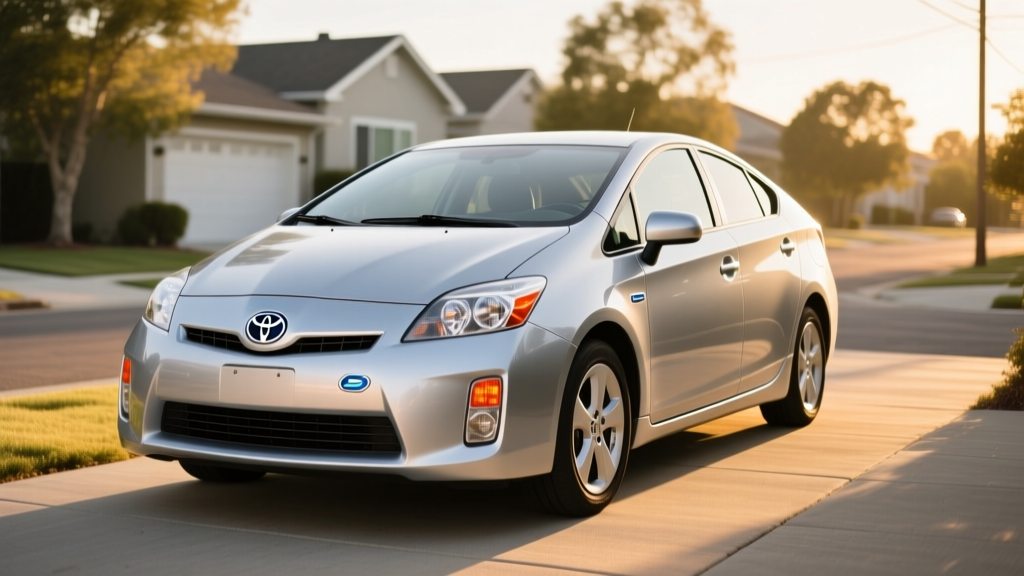
The third-generation Toyota Prius (model year 2010–2015) remains one of the most recognizable hybrid vehicles on the road. If you're searching through 2010 Toyota Prius hybrid reviews, you're likely considering a used purchase — or you already own one and want to understand what you're driving. This guide covers the 2010 Prius with the exact data that matters: EPA fuel economy, real-world MPG, hybrid battery longevity, replacement costs, and whether this 16-year-old HEV still makes financial sense in 2026.
Let's be direct: the 2010 Prius is a conventional hybrid electric vehicle (HEV). It has no plug, no electric-only range, and no federal tax credit eligibility. What it does offer is proven fuel efficiency, a massive used-parts ecosystem, and a track record that shaped the entire hybrid market.
HEV vs PHEV: Where the 2010 Prius Fits
Before diving into specs, it's essential to distinguish the two hybrid architectures buyers encounter in 2026:
| Feature | Conventional Hybrid (HEV) | Plug-In Hybrid (PHEV) |
|---|---|---|
| Plug-in charging? | No — self-charging via regenerative braking and engine | Yes — plugs into Level 1 or Level 2 outlet |
| Electric-only range | None (motor assists engine at low speeds only) | Typically 20–50 miles on battery alone |
| Battery size | 1.0–1.5 kWh (small, NiMH or Li-ion) | 10–25 kWh (larger, Li-ion) |
| Federal tax credit (2026) | Not eligible under §30D | Up to $7,500 if MSRP/income/sourcing rules met |
| Example | 2010 Toyota Prius | 2026 Toyota Prius Prime |
The 2010 Prius is firmly in the HEV column. You never plug it in. The gasoline engine and regenerative braking keep the small nickel-metal hydride (NiMH) battery charged. If you want plug-in capability from a Prius, you'd need to look at the Prius Plug-in (introduced 2012, later renamed Prius Prime) — a completely different vehicle.
Fuel Economy: EPA Ratings and Real-World MPG
The 2010 Prius was rated by the EPA at 50 MPG combined, making it the most fuel-efficient mass-market car sold in the US that year. Here's the breakdown from fueleconomy.gov:
| Driving Cycle | EPA Rating | Real-World Expectation |
|---|---|---|
| City | 51 MPG | 48–55 MPG (hybrids excel in stop-and-go) |
| Highway | 48 MPG | 43–50 MPG (aerodynamic drag and sustained speed reduce advantage) |
| Combined | 50 MPG | 45–52 MPG |
Hybrids often beat their EPA city estimates because regenerative braking recaptures energy during deceleration — the more stoplights, the better your MPG. Highway driving is where the 2010 Prius falls slightly short of its sticker number. At 75 mph, the 1.8L engine runs more frequently, and the car's aerodynamics weren't optimized for sustained high-speed travel the way a modern EV like the Tesla Model 3 or Hyundai Ioniq 6 is.
Cold-weather note: Expect a 5–10% MPG drop in winter. The engine runs longer to heat the cabin and bring the catalytic converter to operating temperature. In sub-freezing conditions, 42–46 MPG combined is typical.
Powertrain and Performance Specs
| Specification | 2010 Toyota Prius |
|---|---|
| Engine | 1.8L 4-cylinder Atkinson cycle (98 HP) |
| Electric motor | 80 HP (60 kW) permanent magnet AC |
| Combined net horsepower | 134 HP |
| Transmission | eCVT (planetary gearset, no belts) |
| Battery type | Nickel-Metal Hydride (NiMH) |
| Battery capacity | 1.3 kWh (nominal) |
| 0–60 mph | 9.8 seconds |
| Drivetrain | Front-wheel drive |
| Curb weight | 3,042 lbs |
| EPA combined MPG | 50 |
| Fuel tank | 11.9 gallons (regular unleaded) |
| Total range (est.) | ~550–600 miles |
The 2010 model was the first Prius to use the 1.8L engine (up from the 1.5L in the 2004–2009 second generation). The larger displacement actually improved highway fuel economy because the engine could operate at lower RPM during cruising. The eCVT isn't a traditional belt-driven CVT — it uses a planetary gearset to blend engine and motor power, which is why it's among the most durable transmissions Toyota has ever built.
Performance? Adequate, not exciting. The 9.8-second 0–60 time is perfectly fine for commuting and merging, but this is a car optimized for efficiency, not acceleration. If you want a quick hybrid, the 2026 Prius AWD-e does 0–60 in roughly 6.5 seconds — a different era entirely.
Hybrid Battery Lifespan, Warranty, and Replacement Cost
This is the single biggest concern for anyone shopping a 2010 Prius in 2026. The original NiMH hybrid battery is now 16 years old. Here's what the data shows:
Original warranty: Toyota covered the hybrid battery for 8 years / 100,000 miles (10 years / 150,000 miles in California and CARB-adopting states). This warranty has expired for all 2010 models.
Typical battery lifespan: Real-world data from fleet operators and owner surveys shows NiMH Prius batteries lasting 150,000–200,000 miles before significant degradation. Some exceed 250,000 miles; others fail around 120,000. Heat is the primary degradation factor — cars in Arizona and Texas see more battery failures than those in cooler climates.
Replacement options in 2026:
- New OEM Toyota battery: $2,000–$2,500 (parts only, before installation). Available through Toyota dealers.
- Refurbished/remanufactured battery: $800–$1,500 installed. Multiple companies (Green Bean Battery, Exclusively Hybrid, local hybrid specialists) offer rebuilt packs with 1–3 year warranties.
- Individual module replacement: $200–$500. Some hybrid shops replace only the failed modules within the pack rather than the entire assembly. This is a short-term fix — if one module has failed, others may follow.
- Used/salvage battery: $400–$800 from a junkyard. High risk — unknown remaining lifespan.
If you're buying a 2010 Prius today, budget $1,000–$2,500 for a battery replacement unless the seller can provide documentation of a recent replacement. A Prius with a freshly installed OEM or quality refurbished battery is worth a meaningful premium over one still running on the original 16-year-old pack.
Reliability and Common Issues Beyond the Battery
The 2010 Prius earns strong reliability marks overall. Toyota's hybrid synergy drive system is mechanically simpler than a conventional automatic transmission — there's no torque converter, no clutch packs, no shift solenoids. The eCVT planetary gearset is essentially bulletproof with basic fluid maintenance.
Known issues specific to the third-generation Prius (2010–2015) include:
- EGR valve clogging: The exhaust gas recirculation system can accumulate carbon deposits, leading to rough idle and head gasket stress around 120,000–160,000 miles. An EGR cleaning ($150–$300) is recommended preventive maintenance.
- Head gasket failure: Often a downstream consequence of a neglected EGR system. If caught early, repair runs $1,500–$2,500. This is the most expensive non-battery repair on this generation.
- Brake actuator recall: Toyota issued a recall for the regenerative braking actuator on 2010 models. Verify the recall was performed (check with any Toyota dealer using the VIN).
- Oil consumption: Some 2010 1.8L engines consume oil at higher-than-expected rates past 100,000 miles. Check the dipstick regularly and top up with 0W-20 synthetic.
- 12V auxiliary battery: Like any car, the 12V battery needs replacement every 4–6 years. The Prius uses a specific AGM-type 12V in the trunk area — expect $180–$250 for a replacement.
According to NHTSA records, the 2010 Prius received a 4-star overall safety rating (under the pre-2011 rating system). Standard equipment included stability control, seven airbags, and a driver knee airbag.
Pricing in 2026: What Should a Used 2010 Prius Cost?
The 2010 Prius originally started at an MSRP of $22,800 (base) to roughly $28,070 (Prius V trim with navigation and solar roof). In the 2026 used market:
- High mileage (150k+ miles), original battery: $3,500–$5,000
- Moderate mileage (100k–140k), original battery: $5,000–$7,500
- Lower mileage (under 100k) or fresh battery replacement: $7,000–$10,000
These prices vary significantly by region and condition. California and Pacific Northwest markets command a premium due to sustained demand for fuel-efficient used cars.
Tax credit eligibility: The 2010 Prius does not qualify for any federal tax credit. The IRS §30D new clean vehicle credit applies only to new PHEVs and BEVs meeting battery sourcing, MSRP, and buyer income requirements. The used EV credit (§25E, up to $4,000) applies only to used BEVs and PHEVs — conventional hybrids like the 2010 Prius are excluded. No state currently offers incentives for purchasing a used HEV. Check IRS.gov for current credit rules.
Who Should Buy a 2010 Prius in 2026?
Pros
- 50 MPG combined still competitive with 2026 hybrids
- Massive parts availability and hybrid-specialist shops nationwide
- Low annual fuel cost (~$900–$1,100/year at 12,000 miles)
- Proven eCVT durability — no traditional transmission failures
- Cheap to insure (averages $90–$130/month)
- Hatchback cargo versatility (39.6 cu ft with seats folded)
Cons
- 16-year-old hybrid battery is a $1,000–$2,500 liability
- No EV mode, no plug-in capability
- Outdated infotainment (no Apple CarPlay/Android Auto natively)
- EGR/head gasket risk if maintenance history is unknown
- Modest 134 HP — slow by modern standards
- No federal or state purchase incentives
Choose the 2010 Prius if: You need maximum fuel economy on a tight budget ($5,000–$8,000), you drive mostly in the city, you have access to a hybrid specialist for maintenance, and you're prepared to budget for a battery replacement.
Choose a newer PHEV (e.g., 2024–2026 Prius Prime) if: You can charge at home, you want 40+ miles of electric-only commuting, you want modern safety tech (automatic emergency braking, lane keeping), and you can leverage the $7,500 federal credit on a new purchase.
Choose a full BEV (e.g., Chevrolet Bolt, Hyundai Kona Electric) if: You have reliable home charging, you want zero tailpipe emissions, you want minimal maintenance (no oil changes, no EGR cleaning), and your daily driving is under 200 miles.
2010 Toyota Prius FAQ
How many MPG does the 2010 Toyota Prius get?
The EPA rates the 2010 Prius at 51 city / 48 highway / 50 combined MPG. In real-world driving, most owners report 45–52 MPG combined. City driving with frequent stops tends to push MPG above the EPA estimate, while sustained highway driving above 70 mph can drop it to the low-to-mid 40s.
Does the 2010 Prius need to be plugged in?
No. The 2010 Prius is a conventional hybrid (HEV), not a plug-in hybrid (PHEV). It charges its own battery through regenerative braking and the gasoline engine. There is no charging port and no electric-only driving range.
How much does it cost to replace a 2010 Prius hybrid battery?
A new OEM Toyota battery runs $2,000–$2,500 for parts alone. Refurbished batteries from reputable hybrid specialists cost $800–$1,500 installed and typically carry a 1–3 year warranty. Individual module replacement is possible for $200–$500 but may not be a long-term solution.
Is the 2010 Prius reliable at high mileage?
Yes, with proper maintenance. The eCVT transmission and hybrid system are extremely durable. The main risks at high mileage are EGR valve clogging (which can lead to head gasket failure), hybrid battery degradation, and normal wear items. A well-maintained 2010 Prius at 180,000+ miles is common.
Does the 2010 Prius qualify for any tax credit?
No. The 2010 Prius is a conventional hybrid and does not qualify for the federal §30D new vehicle credit or the §25E used EV credit. Both programs require plug-in vehicles (BEV or PHEV). No state incentives currently target used HEV purchases either.
How does the 2010 Prius compare to the current-generation Prius?
The 2026 Toyota Prius (5th generation) delivers 57 MPG combined (LE FWD), 196 HP, standard Toyota Safety Sense 3.0, and available AWD. The Prius Prime PHEV variant offers 44 miles of electric-only range. The performance, safety, and technology gap between 2010 and 2026 is substantial — but so is the price gap ($28,350+ new vs. $5,000–$8,000 used).
What should I check before buying a used 2010 Prius?
Verify hybrid battery health (a dealer or hybrid specialist can run a state-of-health check), confirm the brake actuator recall was completed, check for EGR maintenance records, look for oil consumption history, and inspect the 12V battery age. A pre-purchase inspection by a hybrid-knowledgeable mechanic is strongly recommended.