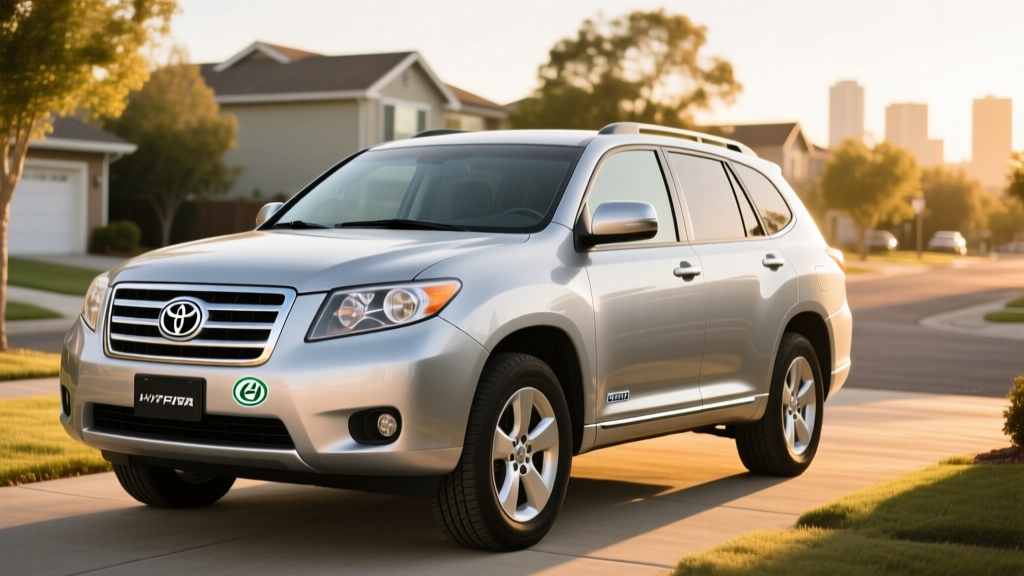
The 2010 Toyota Highlander Hybrid SUV occupies a specific niche in the used-car market: a three-row family hauler that delivers meaningful fuel savings over its gas-only siblings without requiring a plug, a charging routine, or any behavioral change from the driver. More than 15 years after it rolled off the line, this second-generation hybrid SUV remains a relevant option for budget-conscious families who want hybrid efficiency without the upfront cost of a new electrified vehicle.
This guide breaks down exactly what the 2010 Highlander Hybrid delivers in fuel economy, powertrain capability, long-term reliability, and ownership costs — so you can decide whether this aging but proven hybrid still earns a spot in your driveway in 2026.
2010 Toyota Highlander Hybrid SUV: Powertrain and Performance Specs
The 2010 Highlander Hybrid pairs a 3.3-liter V6 engine with Toyota's Hybrid Synergy Drive system — two electric motor-generators and a nickel-metal hydride (NiMH) traction battery. This was Toyota's heavy-duty hybrid architecture, shared in concept with the RX 400h and RX 450h of the same era.
| Specification | 2010 Highlander Hybrid |
|---|---|
| Engine | 3.3L V6 (3MZ-FE) |
| Combined System Horsepower | 270 hp |
| Electric Motors | 2 (front MG + rear MG for AWD) |
| Drivetrain | Electronic On-Demand AWD-i |
| Transmission | eCVT (planetary gearset) |
| Traction Battery | NiMH, ~6.5 kWh (gross) |
| 0–60 mph | ~7.8 seconds |
| Towing Capacity | 3,500 lbs |
| Seating | Up to 7 passengers |
The 270 combined horsepower figure was genuinely competitive in 2010 and still provides adequate passing power today. The rear electric motor enables all-wheel drive without a mechanical driveshaft — Toyota calls this AWD-i. It engages the rear wheels automatically when slip is detected, making it suitable for light snow and rain, though not a substitute for a dedicated off-road SUV.
Fuel Economy: EPA Ratings and Real-World MPG
The headline reason buyers chose the Highlander Hybrid over the gas V6 was fuel economy. The EPA rated the 2010 model at:
| Driving Cycle | EPA MPG | Real-World Expectation |
|---|---|---|
| City | 27 MPG | 25–28 MPG (hybrids often match or exceed EPA city) |
| Highway | 25 MPG | 23–26 MPG (less regen benefit at sustained speed) |
| Combined | 26 MPG | 24–27 MPG |
Source: fueleconomy.gov
For comparison, the gas-only 2010 Highlander V6 AWD was EPA-rated at 17 city / 22 highway / 19 combined. That's a 7 MPG combined advantage for the hybrid — translating to roughly 100–130 fewer gallons per year at 15,000 miles driven, or about $300–$450 in annual fuel savings at 2026 gas prices.
HEV vs. PHEV vs. EV: Where Does This Highlander Fit?
The 2010 Highlander Hybrid is a conventional hybrid (HEV). It does not plug in. It has no meaningful electric-only driving range. The small NiMH battery assists the gas engine during acceleration and captures braking energy, but the vehicle is always primarily powered by gasoline.
Understanding the Electrification Spectrum
| Feature | HEV (This Highlander) | PHEV (e.g., RAV4 Prime) | BEV (e.g., Tesla Model Y) |
|---|---|---|---|
| Plugs in? | No | Yes | Yes |
| Electric-only range | ~0.5 mi at low speed | 25–42 mi typical | 250–330 mi typical |
| Gas engine? | Yes (primary) | Yes (backup) | No |
| Home charging needed? | No | Recommended | Essential |
| Federal tax credit (new) | None | Up to $7,500 (§30D) | Up to $7,500 (§30D) |
| Used vehicle credit | Not eligible | Up to $4,000 (§25E) | Up to $4,000 (§25E) |
Toyota did not produce a plug-in hybrid (PHEV) version of the Highlander in 2010. The first Highlander PHEV never materialized in the U.S. market; Toyota eventually pivoted to the RAV4 Prime and the Sienna (hybrid-only from 2021 onward) for electrified family transport. If you need electric-only commuting capability with three rows, you'd need to look at newer vehicles like the Chrysler Pacifica PHEV or step up to a BEV such as the Kia EV9.
Hybrid Battery Health: Degradation, Warranty, and Replacement Cost
For any 16-year-old hybrid, battery condition is the single most important variable. The 2010 Highlander Hybrid uses a nickel-metal hydride (NiMH) pack — the same chemistry Toyota used in the Prius of that era. NiMH batteries degrade more gradually than early lithium-ion packs, but they do lose capacity over time and with heat exposure.
Original Battery Warranty
When new, Toyota covered the hybrid battery for 8 years / 100,000 miles (extended to 10 years / 150,000 miles in California Air Resources Board states). As of 2026, every original warranty on a 2010 model has expired.
What to Expect from a 16-Year-Old NiMH Battery
- Capacity loss: Expect 15–30% degradation from new, depending on climate and use history. Hot-climate vehicles (Arizona, Texas, Florida) tend to see more degradation.
- Symptoms of a failing pack: Reduced fuel economy (dropping to 20–22 MPG combined), the battery gauge cycling rapidly between full and near-empty, the engine running more frequently at stops, or a hybrid system warning light.
- Individual cell failure: NiMH packs consist of multiple modules. Often only one or two modules fail, triggering the warning. A hybrid specialist can test and replace individual modules for $500–$1,200 rather than replacing the entire pack.
Battery Replacement Costs (2026 Estimates)
| Option | Estimated Cost | Notes |
|---|---|---|
| New OEM Toyota pack | $3,000–$4,200 (parts + labor) | Available through Toyota dealers; best longevity |
| Refurbished/reconditioned pack | $1,500–$2,500 | Rebuilt with tested modules; 1–3 year warranty typical |
| Individual module replacement | $500–$1,200 | Hybrid specialist shops; depends on how many modules are bad |
| Used/salvage yard pack | $400–$900 | Highest risk — unknown remaining life |
Before purchasing, request a hybrid battery health report from a Toyota dealer or a qualified hybrid shop. Tools like Dr. Prius or Techstream can read individual module voltages and flag imbalances. A pack with all modules within 0.2V of each other is generally healthy.
Reliability, Safety, and Long-Term Ownership
The 2010 Highlander Hybrid benefits from Toyota's reputation for hybrid durability. The 3MZ-FE V6 engine is understressed and well-proven, the eCVT transmission has no traditional clutch packs or bands to wear out (it's a planetary gearset with no friction components), and the hybrid system has fewer moving parts than a conventional automatic drivetrain.
Common Issues to Watch
- Hybrid battery degradation (detailed above) — the most costly potential repair.
- Hybrid inverter coolant pump: Toyota issued recalls on some hybrid models for inverter coolant pump failures. Check whether recall work was completed on any specific vehicle.
- Brake actuator: The regenerative braking system uses an electro-hydraulic actuator that can fail on higher-mileage examples. Replacement runs $1,200–$1,800. Listen for unusual brake pedal feel or a buzzing sound from the brake accumulator.
- Rear electric motor: The AWD-i rear motor is generally robust, but water intrusion in the rear differential area has been reported on high-mileage examples in wet climates.
Safety Ratings
The 2010 Highlander earned strong crash-test scores for its era. The NHTSA gave it 4 out of 5 stars overall, and the IIHS rated it "Good" in frontal offset and side-impact tests. By 2026 standards, it lacks modern ADAS features — no automatic emergency braking, no lane-keeping assist, no blind-spot monitoring. These were not widely available on mainstream SUVs until the mid-2010s.
Used Market Pricing in 2026
The 2010 Toyota Highlander Hybrid was originally priced between approximately $34,000 and $40,000 MSRP depending on trim and options. In the 2026 used market:
| Condition / Mileage | Typical Price Range |
|---|---|
| Excellent, under 100k miles | $8,500–$11,000 |
| Good, 100k–150k miles | $6,000–$8,500 |
| Fair, 150k+ miles | $4,000–$6,000 |
| Needs hybrid battery replacement | $3,000–$5,000 (factor in $2k–$4k repair) |
Hybrid-command pricing premiums have softened as newer electrified options flood the market, but Toyota's reliability reputation keeps the Highlander Hybrid near the top of its segment for resale value among 2010-era SUVs.
Does It Qualify for Any Tax Credit?
No. The federal §30D new clean vehicle credit and the §25E used clean vehicle credit both require the vehicle to be a plug-in electric vehicle (PHEV with at least 7 kWh of battery capacity or a BEV). The 2010 Highlander Hybrid is a conventional HEV with a small NiMH pack and no plug. It does not qualify for any federal EV tax credit. Some states historically offered hybrid purchase incentives, but most have expired or shifted to plug-in vehicles only. Check your state's current incentive programs at afdc.energy.gov.
Who Should Buy the 2010 Highlander Hybrid — and Who Shouldn't
Choose the 2010 Highlander Hybrid If:
- You need three rows and AWD on a budget under $10,000
- You drive primarily in city/suburban traffic where hybrid efficiency shines
- You have no access to home or workplace charging (no plug required)
- You want proven Toyota hybrid reliability with widely available parts and hybrid-savvy mechanics
- You tow occasionally (3,500-lb capacity beats most compact crossovers)
Look Elsewhere If:
- You want modern ADAS safety features (AEB, lane-keeping, adaptive cruise)
- You have home charging access and could benefit from a PHEV's electric-only commute (consider a used RAV4 Prime or Pacifica PHEV)
- You drive mostly highway miles (the hybrid advantage narrows significantly above 70 mph)
- You need the latest infotainment (this generation predates Apple CarPlay/Android Auto)
- You're uncomfortable budgeting $2,000–$4,000 for a potential hybrid battery replacement
Pros
- 26 MPG combined — 7 MPG better than gas V6 Highlander
- 270 hp provides confident acceleration
- Standard electronic AWD (AWD-i) with no driver input needed
- Toyota hybrid durability with simple eCVT design
- 3,500-lb towing capacity
- No plug, no charging routine, no behavior change
Cons
- No federal tax credit eligibility (HEV, not PHEV/BEV)
- Hybrid battery replacement risk on a 16-year-old vehicle
- No modern driver-assistance features (AEB, lane-keeping)
- Dated interior tech and infotainment
- Third row is tight for adults on longer trips
- NiMH battery less energy-dense than modern lithium-ion packs
Frequently Asked Questions
How many MPG does the 2010 Toyota Highlander Hybrid get?
The EPA rates it at 27 city / 25 highway / 26 combined. In real-world mixed driving with a healthy battery, expect 24–27 MPG combined. City-heavy driving favors the hybrid system; sustained highway driving narrows the gap to the gas-only model.
Does the 2010 Highlander Hybrid need to be plugged in?
No. It is a conventional hybrid (HEV). The battery charges through regenerative braking and the gas engine. There is no plug, no charging cable, and no electric-only driving range beyond a brief low-speed assist.
How long does the hybrid battery last?
Toyota's NiMH packs in this era commonly last 150,000–200,000 miles or 12–18 years with gradual degradation. Many 2010 Highlander Hybrids are now at or beyond this window. A battery health check before purchase is essential. Replacement costs range from $1,500 (refurbished) to $4,200 (new OEM).
Is the 2010 Highlander Hybrid reliable?
Yes, with caveats. The powertrain — engine, eCVT, and hybrid system — is among the most durable Toyota has built. The main risk is age-related hybrid battery degradation and potential brake actuator replacement at high mileage. Regular maintenance and a pre-purchase hybrid health check mitigate most surprises.
How does it compare to a modern hybrid SUV?
A 2026 Toyota Highlander Hybrid achieves 35–36 MPG combined (a ~38% improvement) with a more efficient lithium-ion battery, standard AEB, lane-keeping, adaptive cruise, and modern infotainment. However, a new Highlander Hybrid starts around $42,000 — roughly 5× the cost of a used 2010 model. The value proposition depends entirely on your budget and feature requirements.
Does it qualify for any federal or state tax credit?
No federal tax credit applies. The §30D and §25E credits require plug-in capability. Conventional hybrids like this Highlander are ineligible. Some states may offer minor incentives — check afdc.energy.gov for current state-level programs.