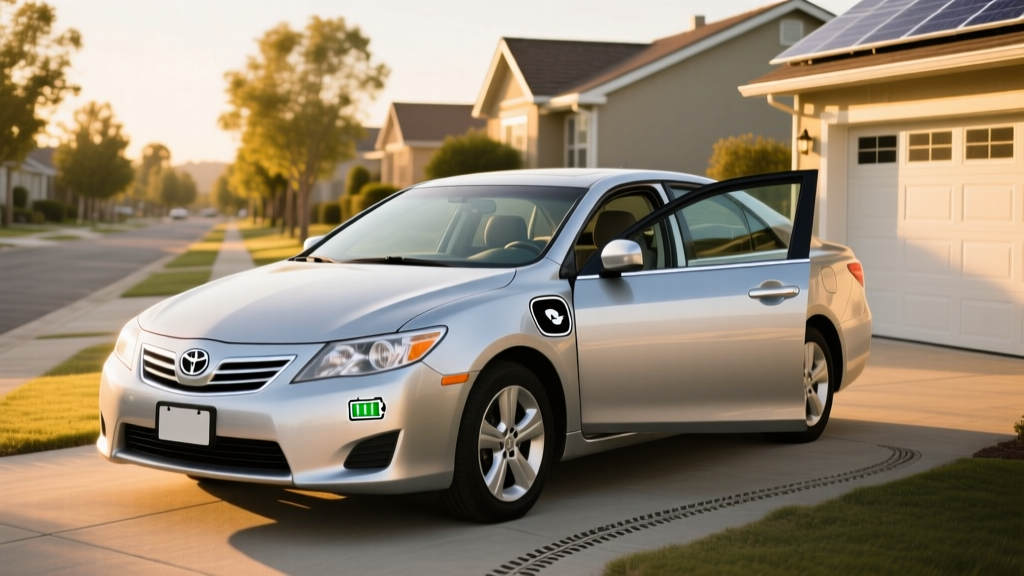
The 2010 Toyota Camry Hybrid occupies a specific niche in the used-car market: it is one of the last midsize sedans from Toyota's pre-Prius-dominance era to pair a four-cylinder gasoline engine with an electric motor in a conventional hybrid (HEV) package. For buyers in 2026 searching for an affordable, fuel-efficient daily driver without the complexity of plug-in charging or the range considerations of a full battery-electric vehicle, the 2010 Camry Hybrid remains a data point worth examining. This guide breaks down its EPA fuel economy, real-world MPG expectations, hybrid battery longevity, replacement costs, and how it stacks up against modern alternatives.
HEV vs PHEV vs EV: Where the 2010 Camry Hybrid Fits
Conventional Hybrid (HEV) — The 2010 Toyota Camry Hybrid is an HEV. It has a small nickel-metal hydride (NiMH) traction battery (approximately 1.6 kWh gross, ~0.9 kWh usable) that is charged exclusively by the gasoline engine and regenerative braking. You never plug it in. The electric motor assists the engine during acceleration and enables brief low-speed electric-only driving, but the car cannot operate as a pure EV for meaningful distances.
Plug-In Hybrid (PHEV) — A PHEV has a larger battery (typically 8–20+ kWh) and a charge port. You plug it in to gain 20–50 miles of electric-only range before the gas engine takes over. The 2010 Camry Hybrid is not a PHEV. Toyota did not offer a Camry PHEV in the US market for this model year.
Battery Electric Vehicle (BEV) — A BEV has no gasoline engine. It runs entirely on a large battery pack (50–100+ kWh) and must be charged from an external source. Range in 2026 BEVs typically spans 230–400+ miles EPA.
If you are cross-shopping a used 2010 Camry Hybrid, you are likely comparing it against other used HEVs (Prius, Ford Fusion Hybrid), older gasoline Camrys, or possibly entry-level used EVs. The decision framework is straightforward: if you want maximum fuel efficiency without changing your refueling habits, an HEV works. If you have home charging and a short commute, a PHEV or used EV may save more on fuel.
2010 Camry Hybrid Fuel Economy: EPA and Real-World MPG
| Driving Cycle | EPA Estimate | Real-World Expectation |
|---|---|---|
| City | 33 MPG | 33–38 MPG (hybrids excel in stop-and-go) |
| Highway | 34 MPG | 29–33 MPG (sustained high speed reduces hybrid advantage) |
| Combined | 34 MPG | 31–35 MPG (depends on driving mix) |
According to fueleconomy.gov, the 2010 Toyota Camry Hybrid earns an EPA rating of 33 city / 34 highway / 34 combined MPG. These numbers reflect the 2008–2019 EPA test cycle methodology.
Real-world note: Conventional hybrids like the Camry Hybrid often exceed their EPA city estimate because regenerative braking recovers energy in stop-and-go traffic. Highway driving, however, tends to fall below the EPA highway number because the electric motor provides less benefit at sustained speeds above 65 mph. Owners reporting data on fueleconomy.gov show an average real-world combined of approximately 31–32 MPG, with some drivers achieving 36+ MPG on predominantly urban routes. Expect lower figures (high 20s) if you drive mostly highway at 75+ mph or in very cold climates where engine efficiency drops and cabin heating demands continuous engine operation.
Powertrain Specs: Engine, Motor, and Combined Output
| Specification | 2010 Toyota Camry Hybrid |
|---|---|
| Gasoline Engine | 2.4L inline-4 (2AZ-FXE), Atkinson cycle |
| Engine Horsepower | 147 hp @ 6,000 rpm |
| Engine Torque | 138 lb-ft @ 4,400 rpm |
| Electric Motor | Permanent-magnet synchronous (3JM) |
| Motor Horsepower | 40 hp (30 kW) |
| Motor Torque | 199 lb-ft |
| Net System Horsepower | 187 hp (combined, not peak-sum) |
| Transmission | Electronically controlled CVT (eCVT / power-split device) |
| Drivetrain | Front-wheel drive |
| 0–60 mph | ~7.8 seconds (Car and Driver tested) |
| Traction Battery | NiMH, ~1.6 kWh gross / ~0.9 kWh usable |
The 2010 Camry Hybrid uses Toyota's Hybrid Synergy Drive (HSD) system with a power-split planetary gearset — not a traditional belt-driven CVT. This eCVT design is mechanically simple, with no belts or pulleys to wear, which contributes to its long-term reliability. The 2.4L 2AZ-FXE engine runs the Atkinson cycle, sacrificing low-RPM torque for improved thermal efficiency, and the electric motor fills in the torque gap off the line. The combined net output of 187 hp is not a simple sum of the engine and motor peaks (they peak at different RPMs); it represents the maximum system output the powertrain control unit allows at any given moment.
Hybrid Battery Lifespan, Warranty, and Replacement Cost
Original Warranty: Toyota covered the 2010 Camry Hybrid's traction battery for 8 years / 100,000 miles (10 years / 150,000 miles in California Air Resources Board states). As of 2026, the original factory warranty has expired on all 2010 models regardless of mileage.
Expected Lifespan: Toyota's NiMH hybrid batteries in this generation typically last 150,000–200,000+ miles with proper use. Many first-generation Prius and Camry Hybrid batteries have exceeded 200,000 miles. Degradation is gradual — you may notice a slight fuel-economy decline (1–3 MPG) and reduced electric-assist duration as the battery ages.
Replacement Cost (2026):
- New OEM Toyota battery: $2,500–$3,500 (part) + $500–$800 (labor) = approximately $3,000–$4,300 installed
- Remanufactured / refurbished battery: $1,200–$2,000 installed
- Individual module replacement (single bad cell): $300–$600 at a hybrid specialist shop
The NiMH chemistry in the 2010 Camry Hybrid is less energy-dense than the lithium-ion packs in modern hybrids and EVs, but it is well-understood, thermally stable, and relatively inexpensive to replace. The most common failure mode is cell imbalance rather than total pack death — a hybrid-specialist shop can often identify and replace just the weak modules for a fraction of a full pack swap. If you are buying a used 2010 Camry Hybrid, check the battery's state of health using an OBD-II scanner with hybrid-specific software (such as Techstream or Dr. Prius) to see the internal resistance delta between modules.
Pricing and Tax Credit Eligibility in 2026
The 2010 Toyota Camry Hybrid originally carried an MSRP of approximately $26,400 (base, before destination). In the 2026 used-car market, expect to pay:
- $4,500–$6,500 for an example with 140,000–180,000 miles in fair-to-good condition
- $6,500–$9,000 for a lower-mileage (under 120,000 miles) example in good-to-excellent condition from a dealer
- Below $4,000 for high-mileage or cosmetically challenged examples sold privately
Tax credit status: The 2010 Camry Hybrid does not qualify for the federal §30D new clean vehicle credit — that credit applies only to new vehicle purchases and has specific MSRP caps, income limits, and battery-sourcing requirements per IRS guidelines. It also does not qualify for the §25E used clean vehicle credit, which requires the vehicle to be a qualified plug-in electric vehicle or fuel cell vehicle; conventional hybrids (HEVs) are excluded.
Some states may offer registration incentives, HOV lane access (varies by state and often expired for older hybrids), or emissions-test exemptions for hybrid vehicles. Check your state's DMV or energy office for current programs.
2010 Camry Hybrid vs Modern Alternatives: What Has Changed
| Metric | 2010 Camry Hybrid | 2026 Toyota Camry Hybrid (LE) | 2026 Toyota Prius (LE) |
|---|---|---|---|
| EPA Combined MPG | 34 MPG | 51 MPG | 57 MPG |
| Powertrain | 2.4L I4 + NiMH | 2.5L I4 + Li-ion (5th-gen HSD) | 2.0L I4 + Li-ion (5th-gen HSD) |
| Net System HP | 187 hp | 208 hp (FWD) | 196 hp |
| 0–60 mph | ~7.8 sec | ~7.2 sec | ~7.0 sec |
| Base MSRP / Used Price | ~$5,500 used | $29,995 new | $29,445 new |
| Traction Battery | ~1.6 kWh NiMH | ~1.6 kWh Li-ion | ~1.3 kWh Li-ion |
The efficiency gap between the 2010 and 2026 Camry Hybrid is substantial — Toyota's fifth-generation Hybrid Synergy Drive, lighter lithium-ion batteries, improved aerodynamics, and a more efficient engine yield a 50% improvement in combined MPG. However, a 2026 Camry Hybrid costs roughly five to six times what a used 2010 model commands. The math depends on your annual mileage and ownership horizon.
Annual fuel cost comparison (15,000 miles/year, $3.40/gallon, 55% city / 45% highway):
- 2010 Camry Hybrid (33 MPG real-world combined): ~$1,545/year
- 2026 Camry Hybrid (51 MPG EPA combined): ~$1,000/year
- 2010 gas-only Camry 4-cyl (25 MPG combined): ~$2,040/year
The 2010 Camry Hybrid saves roughly $500/year over its gas-only counterpart. Compared to a 2026 Camry Hybrid, the older model costs about $545 more per year in fuel. At a $5,500 purchase price vs $30,000, the used 2010 hybrid breaks even against the new model in fuel savings alone in approximately 45 years — making the used car the clear financial winner unless you factor in repair costs, safety technology, and warranty coverage.
Reliability and What to Watch For
The 2010 Camry Hybrid's powertrain is among the most proven in Toyota's lineup. The eCVT power-split device has no friction bands, belts, or clutches to wear out, and the 2AZ-FXE engine is under-stressed thanks to Atkinson-cycle operation and electric-motor assist. Common maintenance items are no different from a conventional Camry: oil changes, brake pads (which last longer due to regenerative braking — often 80,000+ miles), coolant flushes, and cabin air filters.
Known issues to check before buying:
- 2AZ-FE/FXE oil consumption: Some 2AZ-series engines from this era consumed oil at higher-than-normal rates. Check service records for piston ring or oil-control-ring replacement. Toyota issued a warranty enhancement (ZE6) for certain 2007–2011 models; verify if the vehicle was serviced under this program.
- Inverter coolant pump: The hybrid inverter has a dedicated electric coolant pump. If it fails, the inverter can overheat. Listen for a humming sound from the inverter coolant reservoir under the hood when the car is in READY mode — absence of flow indicates pump failure. Replacement is $300–$500.
- Brake actuator assembly: The electro-hydraulic brake actuator (which blends regenerative and friction braking) can develop internal valve issues at high mileage. Symptoms include a stiff pedal, grinding noise at low speed, or brake warning lights. Replacement runs $1,200–$1,800 at a dealer.
- Hybrid battery cooling fan: Located behind the rear seat, this fan keeps the NiMH pack within operating temperature. A clogged or failed fan accelerates battery degradation. Check that the rear-seat vent is unobstructed.
Safety ratings from the era were acceptable but not class-leading by 2026 standards. The NHTSA gave the 2010 Camry (non-hybrid tested, structurally identical) a 5-star overall rating under the pre-2011 test protocol. It lacks modern ADAS features such as automatic emergency braking, lane-keeping assist, or adaptive cruise control — all standard or widely available on 2020+ vehicles.
Who Should Buy the 2010 Camry Hybrid (and Who Shouldn't)
Pros
- Low purchase price ($4,500–$7,000) for a fuel-efficient sedan
- Proven, simple hybrid system with widely available parts and knowledge
- No plug-in charging required — refuel at any gas station
- Comfortable ride quality and spacious rear seat for its class
- Regenerative braking extends brake pad life significantly
- Affordable hybrid battery replacement if needed ($1,200–$4,300)
Cons
- 34 MPG combined is modest by 2026 hybrid standards (new Camry Hybrid: 51 MPG)
- No modern safety tech (AEB, blind-spot monitoring, lane assist)
- Dated infotainment — no Apple CarPlay, Android Auto, or Bluetooth audio streaming on base trims
- NiMH battery is heavier and less efficient than modern Li-ion packs
- Original factory warranty fully expired; repair costs fall on the owner
- Known 2AZ engine oil-consumption risk requires verification
Choose the 2010 Camry Hybrid if: You need a cheap, efficient, no-plug-in daily driver for city and suburban commuting, you are comfortable with a 15-year-old vehicle's technology and safety profile, and you want the lowest total cost of ownership on a tight budget.
Look at a newer hybrid or PHEV instead if: You prioritize modern safety features, want better than 40 MPG, need Apple CarPlay / Android Auto, plan to keep the car for 10+ years and want remaining factory warranty, or have a commute that could benefit from PHEV electric-only range.
Consider a used EV if: You have reliable home Level 2 charging, your daily round-trip commute is under 80 miles, and you want zero tailpipe emissions with minimal drivetrain maintenance (no oil changes, no engine coolant, fewer moving parts). Used EVs in the $6,000–$12,000 range (such as a 2017–2019 Chevrolet Bolt or Nissan LEAF) offer 150+ miles of range but require charging infrastructure.
Frequently Asked Questions
How many MPG does the 2010 Toyota Camry Hybrid get?
The EPA rates it at 33 city / 34 highway / 34 combined MPG. In real-world driving, expect 33–38 MPG in city traffic (where regenerative braking shines) and 29–33 MPG on the highway. Owner-reported averages cluster around 31–32 MPG combined.
Does the 2010 Camry Hybrid need to be plugged in?
No. It is a conventional hybrid (HEV), not a plug-in hybrid (PHEV). The small traction battery charges via the gasoline engine and regenerative braking. You refuel it at a gas station like any other car.
How long does the hybrid battery last, and what does replacement cost?
Toyota's NiMH hybrid batteries in this generation commonly last 150,000–200,000+ miles. A new OEM replacement runs $3,000–$4,300 installed; a remanufactured pack costs $1,200–$2,000 installed. Individual module replacement for a single weak cell can cost $300–$600 at a hybrid specialist.
Does the 2010 Camry Hybrid qualify for any tax credit?
No. The federal §30D new clean vehicle credit and §25E used clean vehicle credit both require plug-in electric or fuel cell vehicles. Conventional hybrids (HEVs) do not qualify. Check your state for any local hybrid incentives, though most have expired for older models.
Is the 2010 Camry Hybrid reliable?
Yes, with caveats. The hybrid powertrain (eCVT, motor, inverter) is extremely durable. The main concern is the 2AZ-FXE engine's potential for elevated oil consumption — verify service history or check for the ZE6 warranty-enhancement repair. The brake actuator and inverter coolant pump are the other higher-cost items to watch at high mileage.
How does it compare to a Prius of the same era?
A 2010 Toyota Prius (third generation) achieves 50 MPG combined EPA — roughly 47% better fuel economy than the Camry Hybrid. The Prius is smaller, has less rear-seat and trunk space, and uses a 1.8L engine with a Li-ion battery. If passenger and cargo room matter, the Camry Hybrid wins on practicality; if maximum MPG is the priority, the Prius is the more efficient choice.
Can I still get parts and service for the 2010 Camry Hybrid?
Yes. Toyota continues to supply OEM hybrid components, and the third-generation HSD system is shared with the Prius, Highlander Hybrid, and Lexus models of the era. Independent hybrid specialists and many general mechanics are familiar with the platform. Aftermarket and remanufactured hybrid batteries are widely available.