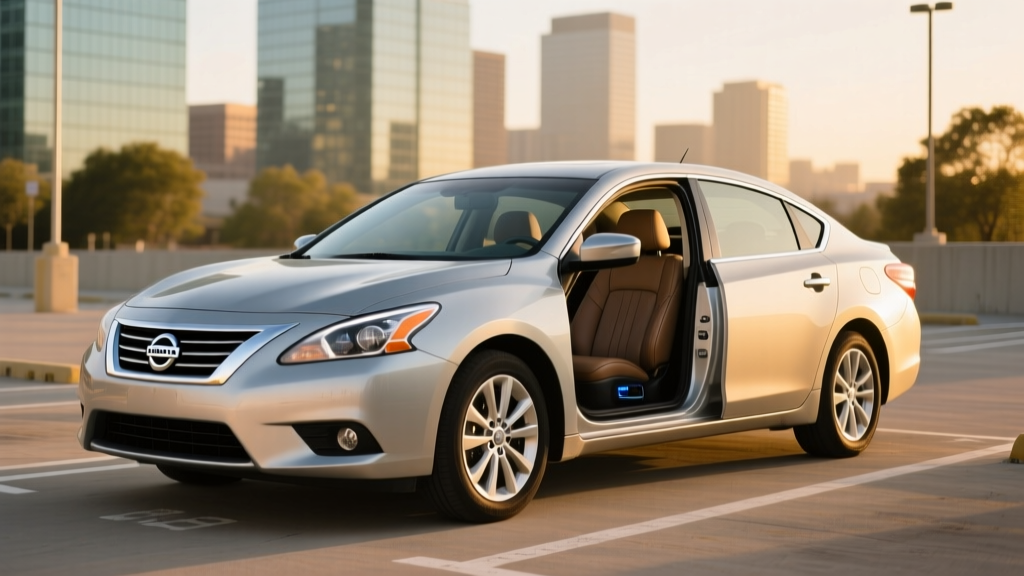
The 2010 Nissan Altima Hybrid sedan occupies a specific niche in the used-car market: it's one of the earliest mainstream midsize hybrids sold in the United States, built on Toyota's licensed hybrid synergy drive technology rather than Nissan's own. For buyers in 2026 browsing the used market, this car raises practical questions about real-world fuel economy, battery longevity on a 16-year-old hybrid system, and whether it still makes financial sense versus a newer conventional car or a modern EV. This guide breaks down every number that matters.
HEV vs PHEV vs EV: Where the 2010 Altima Hybrid Fits
Before examining specs, it's essential to classify what this car is — and what it isn't. The 2010 Nissan Altima Hybrid is a conventional hybrid electric vehicle (HEV). It has no plug, no electric-only driving mode of meaningful distance, and no external charging capability. The hybrid battery charges exclusively through regenerative braking and the gasoline engine.
HEV (This Car)
No plug. Gas engine + electric motor work together. Battery recharges via regen and engine. Typical efficiency gain: 30-50% over gas-only equivalent.
PHEV
Has a plug. 20-50 miles electric-only, then operates as a hybrid. Larger battery (8-25 kWh). Examples: Toyota RAV4 Prime, Jeep Wrangler 4xe.
BEV (Full EV)
Electric only. No gas engine. 200-400+ mile range. Requires home or public charging. Examples: Tesla Model 3, Hyundai Ioniq 6.
The 2010 Altima Hybrid's nickel-metal hydride (NiMH) traction battery is approximately 1.5 kWh — far too small for plug-in electrification but sufficient to assist the 2.5L four-cylinder engine during acceleration, enable idle stop-start, and capture energy during braking. You will never plug this car in. You will never see an "EV mode" that lasts more than a few hundred yards at low speed.
Fuel Economy: EPA Ratings vs Real-World MPG
| Metric | EPA Rating | Real-World Expectation |
|---|---|---|
| City | 35 MPG | 33–37 MPG |
| Highway | 33 MPG | 30–34 MPG |
| Combined | 33 MPG | 31–35 MPG |
Source: EPA Fuel Economy — 2010 Nissan Altima Hybrid
The 2010 Altima Hybrid earns its strongest numbers in city driving, where the electric motor handles low-speed propulsion and regenerative braking recaptures energy at every stop. This is the inverse of conventional gas cars, which are least efficient in stop-and-go traffic. Owners who commute primarily in urban or suburban conditions often report matching or slightly exceeding the 35 MPG city figure.
Highway efficiency is less impressive relative to the city number. At sustained 70-80 mph speeds, the gasoline engine does nearly all the work — the hybrid system's contribution drops significantly. Expect 30-33 MPG on long highway trips, which is comparable to a well-tuned 2010 four-cylinder Camry or Accord without hybrid assist.
Cold-weather impact: NiMH batteries lose efficiency in freezing temperatures, and the engine must run more frequently to maintain cabin heat. Expect a 5-10% drop in fuel economy during winter months in northern climates — roughly 29-31 MPG combined.
Powertrain Specs: Toyota Technology Under a Nissan Badge
| Specification | Detail |
|---|---|
| Gasoline Engine | 2.5L inline-4 (QR25DE), 158 HP @ 5,600 RPM |
| Electric Motor | Permanent-magnet synchronous, 40 HP (30 kW) |
| Combined System Output | 198 HP |
| Transmission | eCVT (electronically controlled continuously variable) |
| Traction Battery | ~1.5 kWh NiMH (nickel-metal hydride), 240V nominal |
| Drivetrain | Front-wheel drive |
| 0-60 MPH | ~7.8 seconds (est.) |
| Curb Weight | ~3,483 lbs |
Nissan licensed Toyota's Hybrid Synergy Drive architecture for the Altima Hybrid, which means the planetary gearset eCVT, motor-generator configuration, and power-split logic are fundamentally Toyota designs. This is significant for reliability: the same core hybrid architecture underpins the 2004-2011 Toyota Camry Hybrid, one of the most proven hybrid systems ever mass-produced.
The combined 198 HP output gives the Altima Hybrid adequate passing power and confident highway merging — noticeably more responsive than the non-hybrid 2.5L Altima rated at 175 HP. The eCVT eliminates shift shock entirely, though some drivers find the constant-RPM drone under hard acceleration disconcerting compared to a stepped automatic.
Hybrid Battery Lifespan, Warranty & Replacement Cost
⚡ Battery Warranty & Replacement Facts
- Original Warranty: 8 years / 100,000 miles (10 years / 150,000 miles in CARB states including CA, NY, MA, and others)
- Current Status (2026): Original warranty has expired on all 2010 models — even in CARB states, the 10-year/150k coverage ended by 2020 at the latest
- Battery Chemistry: NiMH (nickel-metal hydride) — more tolerant of heat and deep cycling than early lithium-ion, but heavier and lower energy density
- Expected Lifespan: 150,000–200,000 miles or 12-18 years under normal conditions before significant capacity loss
- Replacement Cost (2026): $2,000–$2,800 for a reconditioned NiMH pack; $3,000–$3,500 for a new OEM-equivalent pack including installation
At 16 years old, any 2010 Altima Hybrid you consider purchasing is living on borrowed battery time — unless the previous owner has already replaced the pack. NiMH batteries degrade gradually rather than failing catastrophically. Symptoms of a weakening hybrid battery include: reduced fuel economy (dropping below 28 MPG combined), the engine running more frequently at stops, and dashboard warnings for "Check Hybrid System."
The good news: the Toyota-sourced hybrid components in this car have an extensive aftermarket support network. Independent hybrid specialists and mobile reconditioning services can replace the NiMH pack for significantly less than a dealership quote. Companies like Green Bean Battery and Dorman offer reconditioned packs with 2-5 year warranties. A module-level repair (replacing only the weak cells within the pack) can cost as little as $500–$1,200 at a hybrid specialist shop.
Pre-purchase inspection tip: Ask a hybrid-qualified mechanic to perform a battery health check using an OBD-II scanner that reads hybrid battery voltage delta across modules. A healthy pack shows less than 0.3V variance between modules. A pack with 0.5V+ variance is approaching failure.
Pricing & Tax Credit Eligibility in 2026
The 2010 Nissan Altima Hybrid originally carried an MSRP of approximately $26,700 (before destination). In the 2026 used-car market, expect to pay:
| Condition | Price Range |
|---|---|
| Fair (high miles, original battery, cosmetic wear) | $3,500 – $5,000 |
| Good (moderate miles, maintained, battery tested OK) | $5,000 – $7,500 |
| Excellent (low miles, new battery, clean history) | $7,500 – $9,500 |
Federal tax credits: The 2010 Altima Hybrid does not qualify for the current IRS §30D Clean Vehicle Credit. That credit applies only to new qualifying plug-in vehicles (BEVs and PHEVs with ≥7 kWh batteries). As a conventional HEV with no plug and a ~1.5 kWh NiMH battery, it is ineligible for any federal purchase incentive.
The used clean vehicle credit (up to $4,000 under §25E) also requires the vehicle to be a qualified plug-in electric or fuel-cell vehicle. The Altima Hybrid does not meet this definition. There are no federal incentives available for purchasing this car in 2026.
Some states offer modest rebates for used hybrid purchases or emissions-reduction programs, but these vary widely by jurisdiction and change frequently. Check your state's energy or environmental agency website for current programs.
Reliability & Common Issues Beyond the Battery
The Toyota-sourced hybrid powertrain is the most reliable component in the 2010 Altima Hybrid. The eCVT has no traditional clutches, bands, or torque converter to wear out — failures are rare when fluid is maintained. The 2.5L QR25DE engine is well-proven in Nissan's lineup, though it has known issues independent of the hybrid system:
- Oil consumption: Some QR25DE engines consume oil at higher rates, particularly above 100,000 miles. Check oil level every 1,000-2,000 miles.
- CVT (non-hybrid models only): The standard Altima's Jatco CVT is notoriously failure-prone. The hybrid's Toyota eCVT is an entirely different, far more robust design — this is actually a reliability advantage of the hybrid model.
- 12V auxiliary battery: Like all hybrids, the Altima has a standard 12V battery for accessories and ECU power. If it dies, the car won't start even though the high-voltage traction battery is full. Replace every 4-5 years.
- Brake actuator: The electrohydraulic brake system can develop faults above 120,000 miles. Replacement runs $800–$1,500.
For NHTSA safety recalls and technical service bulletins, search the VIN at NHTSA.gov/recalls. The 2010 Altima had several recalls related to airbag inflators (Takata) and hood latch mechanisms — verify these were addressed.
Who Should Buy This Hybrid (and Who Shouldn't)
✓ Choose This Car If
- You need a sub-$8,000 commuter with genuine 33+ MPG efficiency
- Your commute is primarily city/suburban stop-and-go driving
- You have no access to plug-in charging at home or work
- You want Toyota hybrid reliability without paying Toyota used-car premiums
- You drive 8,000-12,000 miles/year and want to minimize fuel spend without a large upfront investment
✗ Look Elsewhere If
- You primarily drive highway miles (the hybrid advantage shrinks to ~2-3 MPG over a gas Altima)
- You want any electric-only driving capability (consider a used PHEV like the Chevy Volt)
- You're unwilling to budget $2,000-$3,500 for a potential battery replacement
- You want modern safety tech (AEB, lane-keep, blind-spot monitoring — none available on this generation)
- You want any federal or state EV/PHEV tax incentive
2010 Altima Hybrid vs Modern Alternatives
To put this car's value proposition in context, consider what $5,000-$9,000 buys in the 2026 used market:
| Vehicle | Type | Combined MPG / MPGe | Used Price (approx.) |
|---|---|---|---|
| 2010 Nissan Altima Hybrid | HEV | 33 MPG | $3,500–$9,500 |
| 2017-2019 Toyota Prius | HEV | 52-56 MPG | $12,000–$18,000 |
| 2017-2019 Chevy Volt | PHEV | 53 mi EV + 42 MPG | $13,000–$19,000 |
| 2018-2020 Nissan Leaf (40 kWh) | BEV | 150 mi range / 111 MPGe | $10,000–$15,000 |
| 2010 Honda Accord 2.4L (gas) | Gas | 25 MPG | $4,000–$7,000 |
The Altima Hybrid's advantage is purely financial: it offers meaningful fuel savings over a gas equivalent at the lowest entry price of any hybrid in its class. A used Prius will save significantly more at the pump, but costs $5,000-$10,000 more upfront. The math favors the Altima Hybrid only if you plan to own it 2-4 years and drive moderate miles.
Frequently Asked Questions
How many MPG does the 2010 Nissan Altima Hybrid get?
The EPA rates the 2010 Altima Hybrid at 35 MPG city, 33 MPG highway, and 33 MPG combined. In real-world driving, most owners report 31-35 MPG combined depending on driving mix, climate, and battery health. City-heavy commutes tend to produce higher numbers than highway-dominant driving.
Does the 2010 Altima Hybrid need to be plugged in?
No. This is a conventional hybrid (HEV), not a plug-in hybrid. The battery charges through regenerative braking and the gasoline engine. There is no plug, no charging port, and no meaningful electric-only range. You fuel it exclusively at gas stations, exactly like a conventional car.
Can the 2010 Altima Hybrid drive on electric power alone?
Only for very short distances at low speeds (under 25 mph, typically less than a quarter mile). The ~1.5 kWh NiMH battery is far too small for sustained electric-only driving. This is normal for conventional hybrids — the electric motor's primary role is assisting the gas engine, not replacing it.
Is the hybrid battery replacement expensive?
A reconditioned NiMH replacement pack costs $2,000–$2,800 installed at an independent hybrid shop. A new OEM-equivalent pack runs $3,000–$3,500. Module-level repairs (replacing only failed cells) can be as low as $500–$1,200. For context, this is comparable to a major transmission repair on a conventional car — a significant expense, but not a vehicle-totaling one at the car's current market value.
Does the 2010 Altima Hybrid qualify for any tax credit?
No. Under current IRS §30D and §25E rules, only plug-in electric vehicles (BEVs and PHEVs with sufficient battery capacity) qualify for federal clean vehicle credits. The Altima Hybrid is a conventional HEV with no plug and is ineligible for any federal incentive. Check your state's environmental agency for any local programs.
How does the 2010 Altima Hybrid compare to the Toyota Camry Hybrid of the same era?
They share the same fundamental Toyota hybrid powertrain architecture. The 2010 Camry Hybrid was rated at 33 MPG combined (identical to the Altima Hybrid) with a similar 192 HP combined output. The Camry Hybrid generally commands a higher used-car price due to Toyota's brand reputation, making the Altima Hybrid a potential value play for mechanically identical technology. The Camry Hybrid was available in all 50 states, while the Altima Hybrid was originally sold only in select states (CA, OR, WA, and a few others), limiting used inventory.
What should I check before buying a used 2010 Altima Hybrid?
Prioritize these inspections: (1) Hybrid battery health scan showing module voltage variance under 0.3V; (2) confirmation that Takata airbag recalls were completed; (3) oil consumption history — ask the owner how frequently they add oil between changes; (4) brake actuator function test; (5) standard pre-purchase inspection for suspension, tires, and body condition. If the hybrid battery hasn't been replaced and the car has over 130,000 miles, negotiate the price down by at least $2,000 to account for imminent replacement.