Quick Verdict: The 2010 Camry Hybrid in 2026
The 2010 Toyota Camry Hybrid occupies a specific niche in the used-car market: a midsize sedan that delivers genuine fuel savings without the complexity or range anxiety of a plug-in vehicle. With an EPA-rated 33 MPG combined and Toyota's proven Hybrid Synergy Drive, this second-generation Camry Hybrid remains a practical commuter and budget-conscious buy — provided you verify the health of its aging nickel-metal hydride (NiMH) traction battery.
This is a conventional hybrid electric vehicle (HEV), not a plug-in hybrid (PHEV). It charges its own battery through regenerative braking and the gasoline engine. You never plug it in. That simplicity is both its greatest advantage and its limitation in an era of 300-mile BEVs and 40-mile electric-only PHEVs.
HEV vs PHEV: What the 2010 Camry Hybrid Actually Is
Before evaluating this car, it is critical to understand the distinction between hybrid architectures, because buyers frequently confuse them:
Conventional Hybrid (HEV) — 2010 Camry Hybrid
- Battery: ~1.6 kWh NiMH (not usable as electric-only range in any meaningful way)
- Plug-in charging: None — the battery self-charges via regen and the engine
- Electric-only range: Less than 1 mile at very low speeds
- Fuel source: Gasoline only
- Federal tax credit: None (credits expired long ago; no used-EV credit applies to HEVs)
Plug-in Hybrid (PHEV) — e.g., 2026 Toyota RAV4 Prime
- Battery: 18.1 kWh lithium-ion
- Plug-in charging: Yes — Level 1 (120V) or Level 2 (240V)
- Electric-only range: 42 miles EPA
- Fuel source: Electricity + gasoline
- Federal tax credit: Up to $7,500 under IRS §30D (if eligible, subject to income/MSRP caps)
The 2010 Camry Hybrid is firmly in the HEV column. It uses a small battery buffer to assist the gasoline engine, capture braking energy, and enable brief electric-only creeping — but it cannot be plugged in, and it cannot sustain highway speeds on electric power alone. If you are looking for electric-only commuting, this is not the vehicle. If you want better MPG without changing your fueling habits, it delivers.
Fuel Economy: EPA Ratings and Real-World MPG
The EPA rated the 2010 Camry Hybrid at the following fuel economy figures:
| Driving Condition | EPA MPG | Real-World Expectation |
|---|---|---|
| City | 33 MPG | 34–38 MPG (hybrids often exceed EPA in stop-and-go) |
| Highway | 34 MPG | 30–33 MPG (hybrid advantage diminishes at sustained high speed) |
| Combined | 34 MPG | 32–36 MPG depending on driving mix |
Source: fueleconomy.gov — 2010 Toyota Camry Hybrid
Why real-world MPG often exceeds the EPA city rating: Conventional hybrids like this Camry benefit enormously from regenerative braking and engine-off coasting in stop-and-go traffic. The EPA city test cycle includes stops and low-speed segments where the electric motor does most of the work. In heavy urban commuting, owners routinely report 35–38 MPG. Conversely, sustained highway driving at 75+ MPH reduces the hybrid system's advantage, and real-world highway numbers can dip to 30–31 MPG, especially with a degraded battery or aggressive driving.
Cold-weather note: Expect a 5–10% MPG reduction in winter months. The engine runs more frequently to maintain cabin heat and battery temperature, reducing electric-motor assist time.
Powertrain Specs: Engine, Motor, and Combined Output
| Specification | 2010 Camry Hybrid |
|---|---|
| Engine | 2.4L inline-4 (2AZ-FXE, Atkinson cycle) |
| Engine horsepower | 147 HP @ 6,000 RPM |
| Electric motor output | 40 HP (30 kW) |
| Net combined system HP | 187 HP |
| Transmission | eCVT (electronically controlled continuously variable) |
| 0–60 MPH | ~7.7 seconds |
| Drivetrain | Front-wheel drive |
| Traction battery | NiMH, ~1.6 kWh gross (~0.9 kWh usable buffer) |
| Curb weight | ~3,680 lbs |
| Fuel tank | 17.2 gallons |
| Total driving range | ~570–585 miles (at combined MPG) |
The 2AZ-FXE engine uses the Atkinson cycle, which sacrifices low-end torque for higher thermal efficiency. The electric motor fills in the torque gap off the line, which is why the Camry Hybrid feels responsive in city driving despite its modest power figures. The eCVT is a power-split device — not a belt-driven CVT — and is among the most reliable transmissions Toyota has ever built.
Hybrid Battery Health: Lifespan, Degradation, and Replacement Cost
Original Battery Warranty
Toyota warranted the 2010 Camry Hybrid's traction battery for 8 years / 100,000 miles (10 years / 150,000 miles in California and states that adopted CARB emissions standards). As of 2026, all original warranties have expired based on age alone.
The NiMH battery pack in the 2010 Camry Hybrid is a known quantity after 16 years of real-world data. Here is what buyers need to know:
Expected Lifespan
NiMH packs in this generation Camry Hybrid typically last 150,000–200,000 miles or 12–18 years before significant degradation triggers a check-engine light or noticeable MPG loss. Many original batteries are still functioning at 2026, but they are operating on borrowed time. A 2010 model you buy today is a prime candidate for battery replacement within your ownership window.
Signs of Battery Degradation
- Noticeable drop in fuel economy (2–5 MPG below historical average)
- More frequent engine cycling (engine starts and stops more than usual)
- Reduced regenerative braking feel
- Hybrid system warning light or check-engine light with codes P0A80, P0A7F, or similar
- Battery state-of-charge display fluctuating rapidly on the dash
Replacement Costs
| Option | Cost Range (2026) | Notes |
|---|---|---|
| New OEM Toyota battery | $3,000–$4,000 (parts + labor) | Dealership; longest expected life |
| Refurbished/remanufactured pack | $1,500–$2,500 | Replaced weak cells; variable quality — choose a reputable vendor with warranty |
| Used salvage battery | $500–$1,200 | High risk; unknown remaining life; not recommended unless short-term ownership |
| Individual cell replacement | $300–$800 | Requires a technician who can test and balance individual modules; not all shops offer this |
Pro tip for used buyers: Before purchasing, have a hybrid-certified technician perform a battery health test using a scan tool that reads individual module voltages. A healthy pack shows all modules within 0.2V of each other under load. A spread greater than 0.3V indicates weak cells and near-term replacement need. Factor $2,000–$3,500 into your purchase budget as a contingency.
Reliability and Ownership Costs
The 2010 Camry Hybrid benefits from Toyota's reputation for durability, and the Hybrid Synergy Drive system has proven to be one of the most reliable powertrains in the industry. The eCVT has no belts, clutches, or traditional wear components — it is a planetary gearset that rarely fails. The gasoline engine is understressed and well-proven.
Common Issues to Watch
- Hybrid battery degradation (detailed above — the primary cost risk)
- Brake actuator assembly: Some owners report premature wear on the regenerative brake actuator. Listen for unusual grinding or a firm brake pedal. Replacement: $800–$1,500.
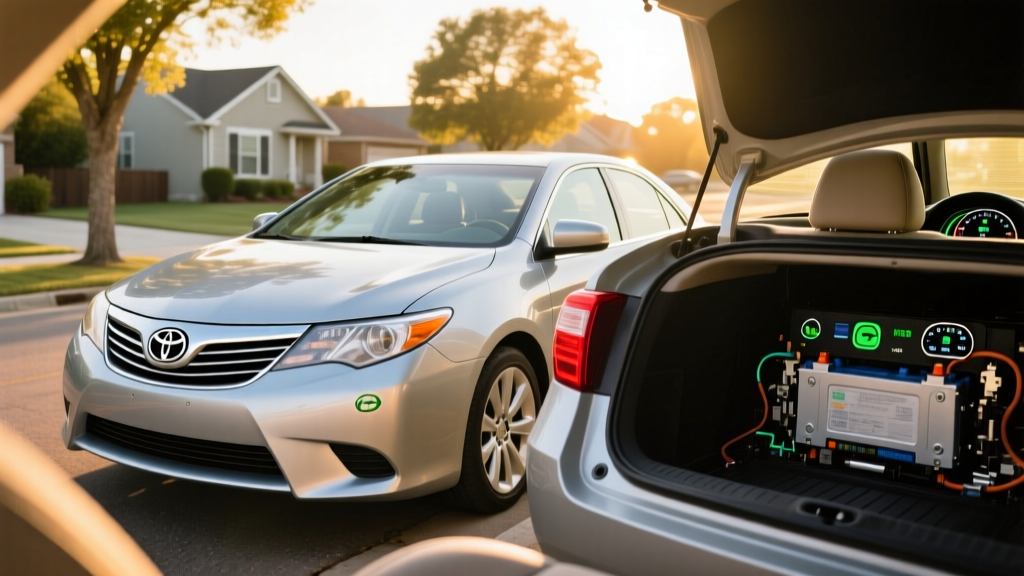
- 12V auxiliary battery: Located in the trunk. A dead 12V battery prevents the hybrid system from starting. Replace every 4–5 years with an AGM-spec battery (~$180–$250).
- Inverter coolant pump: Check for recalls and service history. Failure can overheat the hybrid inverter. Replacement: $400–$700.
- Oil consumption: The 2AZ-FE/FXE engine family is known for oil consumption at higher mileage. Check oil level monthly; budget for potential piston ring service above 180K miles.
Estimated Annual Operating Costs
At 34 MPG combined and $3.20/gallon regular unleaded (2026 national average), the 2010 Camry Hybrid costs approximately $1,130 per year in fuel for 12,000 miles of driving. A comparable 2010 Camry with the 2.5L gas engine (rated 22/32/26 MPG combined) would cost roughly $1,475 per year — a difference of about $345 annually in fuel savings.
Insurance, maintenance, and repair costs are broadly similar to the gas Camry, with the exception of hybrid battery replacement. Amortize a $2,500 battery replacement over 5 years, and the annual cost premium is ~$500 — which partially offsets the fuel savings. The math works best if you buy a car with a recently replaced battery or budget for one shortly after purchase.
Tax Credits and Incentives: What Applies in 2026
The 2010 Camry Hybrid qualified for a federal tax credit of up to $3,150 when it was new, but that credit phased out for Toyota in 2007 after the manufacturer reached 250,000 hybrid sales. As of 2026:
- Federal §30D new-vehicle credit: Not applicable — this is a used vehicle, and it is an HEV, not a PHEV or BEV.
- Federal used-EV credit (§25E): Not applicable — this credit applies only to used BEVs and PHEVs with a minimum 4 kWh battery, not conventional hybrids.
- State incentives: Most state hybrid incentives expired years ago. Some states offer HOV lane access for hybrids, but check your local DMV — many have sunset these programs or restricted them to PHEVs/BEVs.
- No plug-in requirement: Remember, the 2010 Camry Hybrid cannot be plugged in. There is no home charging setup, no Level 2 installation cost, and no electricity cost to budget for.
The absence of tax credits is a key factor in the purchase calculus. You are buying this car purely on its fuel-economy merits and Toyota reliability, not on incentive savings.
Who Should Buy the 2010 Camry Hybrid — And Who Shouldn't
Choose the 2010 Camry Hybrid If:
- You want 33+ MPG without changing your fueling routine or installing a home charger
- You drive mostly in city/stop-and-go traffic where the hybrid system shines
- Your budget is $5,000–$9,000 for a reliable used sedan
- You want a comfortable midsize sedan with a large trunk (14.5 cu ft) and smooth ride
- You plan to drive 8,000–15,000 miles per year and want to reduce fuel costs
- You value proven, simple hybrid technology with wide mechanic familiarity
Look Elsewhere If:
- You want electric-only driving or zero tailpipe emissions — consider a BEV or PHEV
- You primarily drive highway miles (hybrid advantage is smaller; a diesel or efficient gas car may match it)
- You want modern safety tech (no automatic emergency braking, no lane-keeping assist on the 2010 model)
- You need all-wheel drive (the 2010 Camry Hybrid is FWD only; AWD Hybrid arrived in later generations)
- You want to qualify for a federal tax credit — you need a new or used PHEV/BEV for that
- You cannot budget $2,000–$3,500 for a potential hybrid battery replacement
HEV vs PHEV vs BEV: Which Fits You?
- Choose HEV (2010 Camry Hybrid): If you lack home charging access, want the lowest upfront cost, and drive a mix of city/highway under 15,000 miles/year.
- Choose PHEV (e.g., used Prius Prime): If you have home Level 2 charging, commute under 25 miles round-trip, and want electric-only daily driving with gas backup for road trips.
- Choose BEV (e.g., used Tesla Model 3, Chevy Bolt): If you have reliable home charging, drive under 250 miles daily, want the lowest per-mile fuel cost, and want to eliminate oil changes and spark plugs entirely.
Frequently Asked Questions
How many MPG does the 2010 Camry Hybrid get?
The EPA rates it at 33 city / 34 highway / 34 combined MPG. In real-world driving, city-heavy commuters often see 35–38 MPG, while highway-dominant driving may yield 30–33 MPG. A degraded hybrid battery will reduce these numbers by 2–5 MPG.
Can I plug in the 2010 Camry Hybrid?
No. This is a conventional hybrid (HEV). The battery charges itself through regenerative braking and the gasoline engine. There is no plug, no charging port, and no electric-only range to speak of. If you want plug-in capability, look at a PHEV like the Toyota Prius Prime or RAV4 Prime.
How far can the 2010 Camry Hybrid drive on electric power alone?
Less than 1 mile at very low speeds (under 25 MPH), and only under light acceleration with a fully charged battery buffer. The engine engages almost immediately under normal driving. This is not an electric-commuting vehicle — it is a gasoline car that uses electric assist to improve MPG.
Is the 2010 Camry Hybrid reliable?
Yes, with one caveat. The Hybrid Synergy Drive powertrain (eCVT, motor, inverter) is exceptionally reliable and commonly reaches 250,000+ miles without major issues. The primary reliability risk is the NiMH traction battery, which at 16 years old is at or beyond its expected lifespan. Budget for replacement if the original battery is still in the car.
What does a hybrid battery replacement cost?
A new OEM battery from Toyota costs $3,000–$4,000 installed. A quality refurbished pack runs $1,500–$2,500. Used/salvage packs are $500–$1,200 but carry significant risk. Individual cell-level repair is possible for $300–$800 at a specialist shop.
Does the 2010 Camry Hybrid qualify for any tax credit in 2026?
No. The original federal hybrid credit for Toyota phased out in 2007. The current federal used-EV credit (§25E) does not apply to conventional hybrids — only to BEVs and PHEVs. No state-level hybrid incentives are widely available as of 2026.
How does the 2010 Camry Hybrid compare to the Prius?
The 2010 Prius (third generation) is rated at 50 MPG combined — significantly more efficient. However, the Camry Hybrid offers a larger cabin, more trunk space (14.5 vs 11.5 cu ft), a smoother ride, and more power (187 HP vs 134 HP). If maximum fuel economy is your only goal, the Prius wins. If you need midsize sedan comfort with meaningful MPG gains, the Camry Hybrid is the better fit.
What should I check before buying a used 2010 Camry Hybrid?
Have a hybrid-trained technician perform a battery module voltage balance test. Check for hybrid system warning lights. Verify the inverter coolant pump has been serviced or replaced. Inspect for oil consumption history (common on the 2AZ-FXE above 150K miles). Confirm the 12V auxiliary battery is less than 4 years old. And check the brake actuator for unusual noise or pedal feel.