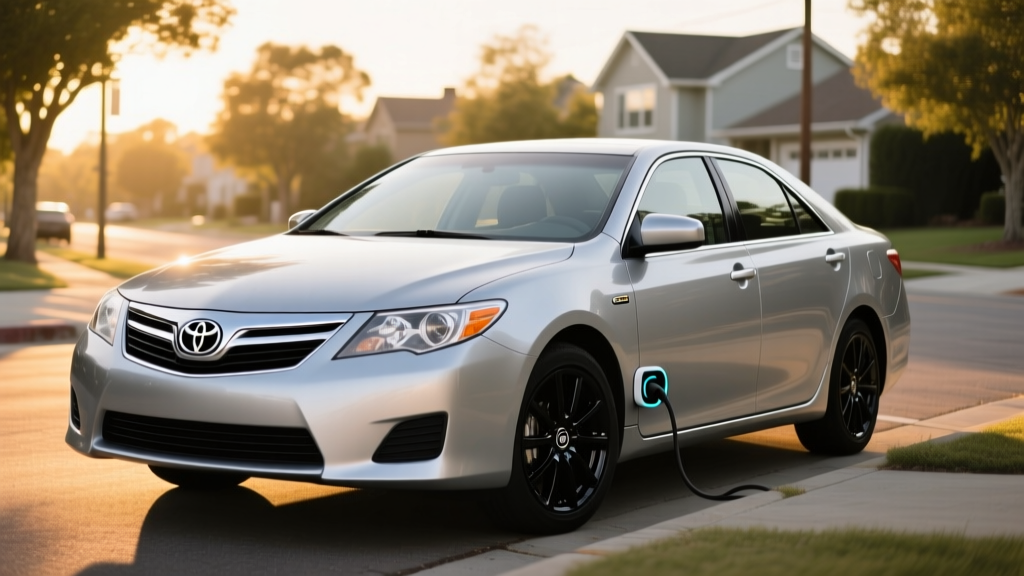
The 2009 Toyota Camry Hybrid was one of the first mainstream midsize sedans to prove that hybrid technology could deliver meaningful fuel savings without sacrificing daily usability. More than 15 years later, it remains a popular choice on the used market for budget-conscious drivers who want hybrid efficiency without a plug. If you're researching the 2009 Toyota Camry Hybrid sedan MPG figures before buying, this guide covers the EPA ratings, real-world expectations, battery longevity, and whether this first-generation hybrid still makes sense in 2026.
EPA MPG Ratings: What the Sticker Says
The 2009 Camry Hybrid carries EPA fuel economy ratings that were competitive for the late-2000s midsize segment. Here is the official breakdown from fueleconomy.gov:
| Metric | Value |
|---|---|
| City MPG | 33 |
| Highway MPG | 34 |
| Combined MPG | 34 |
| Annual fuel cost (est.) | ~$1,350 (15,000 mi/yr at $3.10/gal) |
| Fuel type | Regular unleaded (87 octane) |
For context, the conventional 2009 Camry with the 2.4L four-cylinder and automatic transmission rated 21 city / 31 highway / 25 combined. The hybrid's advantage is most pronounced in stop-and-go driving, where the electric motor shoulders a larger share of the load and regenerative braking recovers energy that a gas-only car wastes as heat.
Powertrain: How the 2009 Camry Hybrid Drives
The 2009 Camry Hybrid uses Toyota's Hybrid Synergy Drive (HSD), a series-parallel full hybrid system — classified as a conventional hybrid electric vehicle (HEV). It does not plug in. The battery recharges through regenerative braking and the gasoline engine.
| Component | Specification |
|---|---|
| Gasoline engine | 2.4L 4-cylinder Atkinson cycle (2AZ-FXE) |
| Engine output | 147 hp @ 6,000 rpm / 138 lb-ft @ 4,400 rpm |
| Electric motor | Permanent-magnet synchronous (3JM) |
| Motor output | 105 kW (141 hp) |
| Net combined system power | 187 hp |
| Transmission | eCVT (electronically controlled continuously variable) |
| 0–60 mph | ~8.4 seconds |
| Drivetrain | Front-wheel drive |
| Hybrid battery | Nickel-metal hydride (NiMH), ~1.6 kWh gross |
The eCVT is not a belt-and-pulley CVT like those in some competitors. Toyota's system uses a planetary gearset to blend power from the engine and motor seamlessly. The result is smooth, linear acceleration with no shift shock — though the engine drones under hard acceleration due to the eCVT holding steady RPMs.
HEV vs PHEV vs EV: Where the 2009 Camry Hybrid Fits
Understanding the distinction between hybrid types is essential when shopping for an electrified vehicle. The 2009 Camry Hybrid is a conventional HEV — it has no plug, no electric-only range to speak of (roughly 1 mile at very low speeds), and requires no behavioral change from a gas car owner.
| Feature | HEV (this car) | PHEV (e.g., 2026 RAV4 Prime) | BEV (e.g., 2026 Tesla Model 3) |
|---|---|---|---|
| Plugs in? | No | Yes | Yes |
| Electric-only range | ~0–1 mi | 25–42 mi typical | 250–360 mi typical |
| Battery size | ~1.6 kWh (NiMH) | 13–20 kWh (Li-ion) | 55–85 kWh (Li-ion) |
| Needs home charging? | No | Recommended | Essential |
| Tailpipe emissions | Reduced | Zero (EV mode) | Zero |
| Federal tax credit (new) | None | Up to $7,500 (§30D) | Up to $7,500 (§30D) |
If you're considering a modern plug-in hybrid or full EV as an alternative to a used 2009 Camry Hybrid, the trade-off is clear: PHEVs and BEVs offer dramatically lower per-mile energy costs and electric-only driving, but they demand a higher purchase price, access to charging, and — in the case of BEVs — acceptance of range planning on long trips. The 2009 Camry Hybrid asks nothing of you except filling it with regular gas.
Battery Lifespan, Warranty, and Replacement Cost
For any used hybrid, the traction battery is the single biggest ownership wildcard. The 2009 Camry Hybrid uses a nickel-metal hydride (NiMH) pack — chemically simpler and more thermally stable than modern lithium-ion, but heavier and lower in energy density.
Replacement cost in 2026:
- New OEM Toyota battery: ~$2,500–$3,500 (part) + $500–$800 labor = $3,000–$4,300 installed
- Remanufactured/reconditioned battery: $1,500–$2,500 installed (common for this model year from suppliers like Green Bean Battery)
- Individual module replacement: Some hybrid-specialty shops replace only failed NiMH modules for $400–$800, though this is a short-term fix
Before buying a used 2009 Camry Hybrid, request a hybrid battery health check. A Toyota dealer or hybrid-specialist shop can read the battery's state of health (SoH) via OBD-II. Look for voltage delta across modules — a spread greater than 0.3V under load suggests aging cells.
Used Market Pricing in 2026
The 2009 Camry Hybrid trades on the used market at prices that reflect its age, mileage, and battery condition:
| Condition / Mileage | Approximate Price Range |
|---|---|
| High mileage (160,000+ mi), fair condition | $3,500–$5,000 |
| Average (120,000–150,000 mi), good condition | $5,500–$7,500 |
| Low mileage (<100,000 mi), excellent, battery verified | $7,500–$9,500 |
Tax credit eligibility: The 2009 Camry Hybrid does not qualify for the federal §30D clean vehicle credit, which applies only to new plug-in vehicles (PHEVs and BEVs) meeting battery-sourcing, MSRP, and buyer-income requirements per IRS guidelines. As a used conventional HEV, it is also ineligible for the used clean vehicle credit (§25E), which requires a plug-in powertrain. Some states or local utilities have offered hybrid purchase rebates historically, but most have shifted incentives exclusively to plug-in vehicles.
Pros and Cons of the 2009 Camry Hybrid Today
- 34 MPG combined EPA — still competitive among used sedans
- No plug required — works for apartment dwellers and street parkers
- Toyota reliability reputation; simple NiMH battery chemistry
- Smooth eCVT with no traditional transmission wear items
- Regular unleaded fuel — no premium gas requirement
- Low purchase price on used market ($4K–$9K)
- Comfortable ride, spacious trunk (10.6 cu ft)
- Original battery warranty expired — replacement is a $1,500–$4,300 risk
- Highway MPG drops to ~29–31 at 75+ MPH
- No electric-only driving capability (not a PHEV)
- Dated interior tech: no standard Bluetooth audio, basic infotainment
- Heavier than gas Camry (~3,680 lbs) — affects braking distances
- No federal or state tax credits available
- NiMH battery less efficient in extreme cold vs modern Li-ion systems
Who Should Buy the 2009 Camry Hybrid — and Who Shouldn't
Choose this hybrid if:
- You commute in city or suburban traffic where regenerative braking maximizes MPG
- You cannot charge at home (no garage, no outlet access, apartment living)
- Your budget is under $10,000 and you want the lowest fuel cost in that range
- You want Toyota reliability with minimal hybrid-system complexity
- You drive under 15,000 miles per year, keeping battery stress moderate
Look elsewhere if:
- Your driving is predominantly highway (a clean-diesel or modern turbo sedan may match or beat its highway MPG)
- You want electric-only driving for short commutes — consider a used PHEV like the 2017+ Toyota Prius Prime or 2019+ RAV4 Prime
- You need the latest safety tech (the 2009 model predates Toyota Safety Sense; no automatic emergency braking, no lane-keeping assist)
- You drive 20,000+ miles per year and can charge at home — a modern BEV like a used Tesla Model 3 or Chevrolet Bolt EV may offer lower total cost of ownership over 5 years
Frequently Asked Questions
How many MPG does the 2009 Toyota Camry Hybrid actually get?
The EPA rates it at 33 city / 34 highway / 34 combined. In real-world driving, expect 30–36 MPG in mixed use, with city-heavy commuters sometimes seeing 35–38 MPG and highway-only drivers at 75+ MPH seeing 28–31 MPG.
Does the 2009 Camry Hybrid need to be plugged in?
No. It is a conventional hybrid (HEV), not a plug-in hybrid (PHEV). The battery charges through regenerative braking and the gasoline engine. You never plug it in — you simply fill it with regular 87-octane gasoline.
How much does it cost to replace the hybrid battery?
A new OEM battery costs approximately $3,000–$4,300 installed. A remanufactured battery runs $1,500–$2,500 installed. Many original NiMH batteries in the 2009 Camry Hybrid last 150,000–200,000+ miles before needing replacement.
Does the 2009 Camry Hybrid qualify for any tax credit?
No. The federal §30D new clean vehicle credit and §25E used clean vehicle credit both require a plug-in vehicle (PHEV or BEV). As a conventional HEV, the 2009 Camry Hybrid is ineligible for federal EV tax credits. Check your state and local utility for any legacy hybrid rebates, though most have shifted to plug-in-only programs.
Is the 2009 Camry Hybrid reliable compared to the gas version?
Yes, generally. The 2AZ-FXE engine and eCVT planetary gearset have fewer wear items than a conventional automatic transmission (no torque converter, no clutch packs, no traditional brake friction as heavy regen use reduces pad wear). The main risk factor is the aging NiMH battery. Per NHTSA records, the 2009 Camry Hybrid has no widespread hybrid-system recalls. Toyota's hybrid system in this generation is considered one of the most proven in the industry.
How does the 2009 Camry Hybrid MPG compare to the current-generation model?
The 2026 Toyota Camry Hybrid (5th generation) achieves an EPA-rated 51 city / 49 highway / 50 combined MPG — a dramatic improvement driven by a more efficient 2.5L Dynamic Force engine, lighter lithium-ion battery, and improved aerodynamics. If fuel economy is your top priority and budget allows, a newer Camry Hybrid delivers roughly 47% better MPG. However, the 2009 model remains a strong value proposition under $10,000.