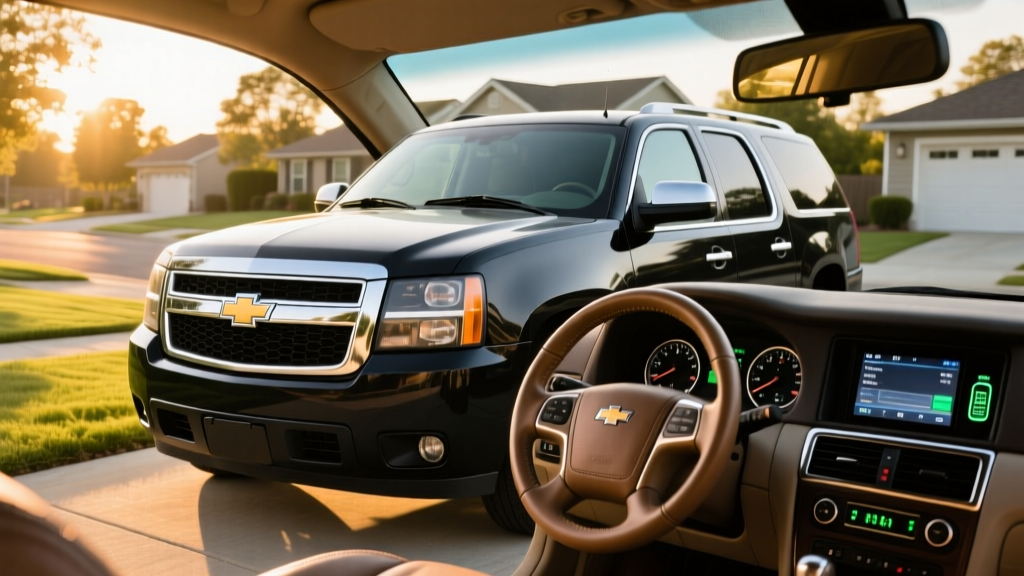
The 2009 Chevrolet Tahoe Hybrid was an engineering milestone — the first full-size SUV to pair a V8 engine with an electrically variable transmission for meaningful fuel savings. More than 15 years later, it remains a curiosity on the used market for buyers who need three-row SUV space but want to avoid the punishing fuel bills of a conventional Tahoe. This guide breaks down exactly what the 2009 Tahoe Hybrid delivers in MPG, how its two-mode hybrid system works, what battery replacement costs, and whether it still makes sense as a used purchase in 2026.
2009 Tahoe Hybrid Powertrain and Two-Mode System Explained
The 2009 Tahoe Hybrid uses GM's Two-Mode Hybrid system — a collaboration between GM, Chrysler, and BMW (sometimes called the "Global Hybrid Cooperation" powertrain). It pairs a 6.0-liter Vortec V8 with two electric motors integrated into a specially designed 4-speed Electrically Variable Transmission (EVT). This is not a simple mild-hybrid setup like Honda's early IMA system; it's a full parallel hybrid capable of moving the vehicle on electric power alone at low speeds.
| Specification | 2009 Tahoe Hybrid |
|---|---|
| Engine | 6.0L Vortec V8 (332 hp @ 5,100 rpm) |
| Electric Motors | Two 60-kW motors (inside EVT) |
| Combined System Output | 379 hp |
| Transmission | 4-speed EVT (Two-Mode) |
| Drivetrain | RWD or 4WD |
| Hybrid Battery | 1.8 kWh NiMH (Nickel-Metal Hydride) |
| Towing Capacity | 5,800 lbs (RWD) / 5,600 lbs (4WD) |
| Curb Weight | ~5,840 lbs |
The two-mode system operates differently depending on speed and load. In Mode 1 (low speed, light load), the Tahoe can drive on electric power alone up to roughly 25 mph, with the V8 shutting down via Active Fuel Management (cylinder deactivation) or shutting off entirely at stops. In Mode 2 (highway speed, heavy load), the system blends engine and motor power for optimal efficiency while maintaining full towing capability. The result is a full-size SUV that doesn't sacrifice utility for its hybrid badge.
EPA Fuel Economy and Real-World MPG
Fuel economy is the entire reason this variant exists. The 2009 Tahoe Hybrid posted a meaningful improvement over the standard 5.3L V8 Tahoe, which returned around 14 city / 20 highway / 16 combined.
| Configuration | City MPG | Highway MPG | Combined MPG |
|---|---|---|---|
| 2009 Tahoe Hybrid (2WD) | 21 | 22 | 21 |
| 2009 Tahoe Hybrid (4WD) | 20 | 20 | 20 |
| 2009 Tahoe Gas 5.3L (2WD) | 14 | 20 | 16 |
| 2009 Tahoe Gas 5.3L (4WD) | 14 | 19 | 16 |
Source: EPA / fueleconomy.gov
Real-World MPG Expectations
The EPA numbers for this hybrid skew heavily toward city driving, where the electric motors and regenerative braking do the most work. In real-world ownership, expect the following:
- City driving (suburban errands, school runs): 19–21 MPG. The hybrid system shines here, with frequent stops allowing regen to recharge the battery and electric-only creep to reduce fuel burn.
- Highway cruising (70+ mph): 18–20 MPG. At sustained highway speeds, the V8 does most of the work. The hybrid advantage narrows significantly compared to stop-and-go driving.
- Towing: 10–14 MPG. The hybrid system still helps, but towing a trailer near the 5,800-lb limit turns any Tahoe into a fuel hog.
- Cold weather: Expect a 10–15% drop. The NiMH battery is less efficient in freezing temperatures, and the engine runs more frequently to provide cabin heat.
Owner-reported averages on fuel-tracking sites typically land between 17–20 MPG combined for mixed driving, slightly below the EPA sticker but still a 20–25% improvement over the gas-only Tahoe of the same year.
HEV vs. PHEV vs. EV: Where the Tahoe Hybrid Fits
The 2009 Tahoe Hybrid is a conventional hybrid (HEV) — it does not plug in. It has no electric-only range beyond low-speed creep, and its 1.8 kWh NiMH battery recharges solely through regenerative braking and the gasoline engine. This is a fundamentally different architecture from a plug-in hybrid (PHEV) or a battery electric vehicle (BEV).
| Feature | HEV (2009 Tahoe Hybrid) | PHEV (e.g., 2026 Chrysler Pacifica Hybrid) | BEV (e.g., 2026 Rivian R1S) |
|---|---|---|---|
| Plugs In? | No | Yes (Level 1/Level 2) | Yes (Level 1/2/DC Fast) |
| Electric-Only Range | ~0 miles (low-speed creep only) | 32 miles (EPA) | 352 miles (EPA) |
| Battery Size | 1.8 kWh (NiMH) | 16 kWh (NMC lithium-ion) | 149 kWh (NMC lithium-ion) |
| Gas Engine? | Yes (6.0L V8) | Yes (3.6L V6) | No |
| Combined Efficiency | 20–21 MPG | 30 MPG + 82 MPGe | 73 MPGe (2.9 mi/kWh) |
| Home Charging Needed? | No | Recommended | Required |
| Tax Credit Eligible (New)? | No | Yes (up to $7,500 under §30D) | Yes (up to $7,500 under §30D) |
For buyers who cannot install a home charger, lack access to public charging, or regularly tow heavy loads, a conventional HEV like the Tahoe Hybrid remains practical. You never change your fueling habits — you just use less gas.
Hybrid Battery Lifespan, Warranty, and Replacement Cost
The biggest concern for any used-hybrid buyer is the battery. The 2009 Tahoe Hybrid uses a 1.8 kWh nickel-metal hydride (NiMH) pack — the same chemistry found in the Toyota Prius of that era. NiMH is less energy-dense than modern lithium-ion but has proven to be remarkably durable over time.
Battery Warranty (Original)
When new, GM covered the hybrid battery and related components for 8 years / 100,000 miles (extended to 10 years / 150,000 miles in CARB states including California, New York, Massachusetts, and others). This warranty has now expired for all 2009 models.
Real-World Battery Longevity
NiMH packs in GM's two-mode hybrids have shown strong longevity. Many Tahoe and Yukon Hybrids have surpassed 150,000–200,000 miles on the original battery pack. Unlike lithium-ion cells, NiMH degrades gradually rather than experiencing sudden capacity cliff failures. You'll notice reduced electric-assist contribution and slightly lower MPG before the battery fails entirely.
Battery Replacement Cost
- Remanufactured NiMH pack: $2,000–$3,500 installed (most common route for a 15+ year-old vehicle)
- Used/salvage pack: $800–$1,500 plus installation ($500–$800 labor)
- New OEM pack from GM: $4,500–$6,000+ (limited availability; likely not worth the cost on a vehicle of this age)
Independent hybrid-specialty shops and mobile hybrid battery services (like Green Bean Battery) offer remanufactured packs with 1–3 year warranties, which is the most cost-effective option for a 2009 model.
Reliability, Common Issues, and What to Watch For
The 2009 Tahoe Hybrid's powertrain is generally robust, but the vehicle's age and complexity introduce specific failure points that used buyers should inspect.
Known Problem Areas
- EVT transmission: The two-mode EVT is a complex unit. While generally reliable, repairs are expensive ($3,000–$5,000+) and require a specialist. Listen for unusual whining or clunking during mode transitions.
- Hybrid battery cooling fan: Located behind the rear seat, this fan can fail and trigger a "Service Hybrid System" warning. Replacement runs $300–$500.
- Electric power steering: The Tahoe Hybrid uses electric-assist steering (to eliminate the belt-driven pump). Some owners report premature rack failures, costing $1,200–$1,800 to replace.
- Active Fuel Management (AFM) lifter failure: The 6.0L V8 deactivates four cylinders under light load. AFM-related lifter collapse is a known GM V8 issue from this era. A telltale sign is a misfire code on cylinders 1, 4, 6, or 7.
- Standard Tahoe issues: Instrument cluster stepper motor failure, power door lock actuator failure, and transmission cooler line leaks — all common across the GMT900 platform.
Before buying, request a hybrid-system diagnostic scan from a shop equipped with GM's GDS2 tool or a capable aftermarket scanner. This will reveal battery state of health (SoH), cell voltage variance, and any stored hybrid-related fault codes that a basic OBD-II reader might miss.
Pricing and Tax Credit Eligibility in 2026
Used Market Pricing
As of early 2026, the 2009 Tahoe Hybrid trades on the used market in the following ranges:
- Fair condition (150,000+ miles, needs work): $3,500–$5,000
- Good condition (100,000–150,000 miles, functional hybrid system): $5,500–$8,000
- Excellent condition (under 100,000 miles, documented service history): $8,000–$11,000
Original MSRP when new was approximately $51,145 (2WD) to $53,810 (4WD), making depreciation substantial. The hybrid premium over a gas Tahoe was roughly $8,000–$10,000 at launch, but on the used market, the Hybrid commands only a modest premium of $500–$1,500 over an equivalent gas model.
Federal Tax Credit Status
No federal tax credit applies. The 2009 Tahoe Hybrid was never eligible for the federal hybrid tax credit that existed in the mid-2000s (that credit had a manufacturer cap that GM exceeded). Under current IRS §30D rules, the used EV credit of up to $4,000 applies only to battery electric vehicles and plug-in hybrids with at least 4 kWh of battery capacity. A conventional HEV like the Tahoe Hybrid does not qualify. Check the latest rules at IRS.gov.
Who Should Buy the 2009 Tahoe Hybrid?
Choose the 2009 Tahoe Hybrid If:
- You need a three-row, body-on-frame SUV with genuine towing capability (5,800 lbs)
- Your driving is primarily city and suburban, where the hybrid system delivers its biggest MPG advantage
- You cannot charge at home and don't want to depend on public charging infrastructure
- You're on a tight budget ($5,000–$8,000) and want maximum SUV for the dollar with lower fuel costs
- You're comfortable with the risk of aging hybrid components and can budget $2,000–$3,500 for a potential battery replacement
Look at a Modern PHEV or BEV Instead If:
- You want electric-only daily driving for short commutes (consider a used Chrysler Pacifica Hybrid or Toyota RAV4 Prime)
- You need the latest safety technology — the 2009 Tahoe lacks automatic emergency braking, lane-keeping assist, and modern ADAS features
- You want to qualify for federal or state EV/PHEV incentives
- Long-term reliability and warranty coverage are top priorities
Pros
- 21 MPG combined — 30% better than gas Tahoe of the same year
- Retains full towing (5,800 lbs) and three-row seating
- No plug-in charging required — zero lifestyle change
- NiMH battery has proven durable past 150k miles
- Low used-market entry price ($5,000–$8,000)
- Strong low-end torque from electric motor assist
Cons
- No electric-only range — this is not a PHEV
- Original hybrid warranty expired years ago
- EVT transmission repairs are costly and specialist-dependent
- Dated interior and infotainment by 2026 standards
- No modern ADAS (no AEB, blind-spot monitoring, or lane assist)
- AFM lifter issues on the 6.0L V8 are a known risk
- Highway MPG advantage over gas model is minimal
2009 Tahoe Hybrid FAQ
How many MPG does the 2009 Tahoe Hybrid get?
The EPA rates the 2WD model at 21 city / 22 highway / 21 combined MPG, and the 4WD model at 20/20/20. Real-world owners typically report 17–20 MPG combined in mixed driving. City MPG tends to be closer to the EPA sticker thanks to regenerative braking, while highway driving at 75+ mph can drop to 18 MPG or below.
Does the 2009 Tahoe Hybrid plug in?
No. The 2009 Tahoe Hybrid is a conventional hybrid (HEV), not a plug-in hybrid. Its 1.8 kWh NiMH battery charges exclusively through regenerative braking and the gasoline engine. You fuel it like any other SUV — just less often.
How far can it drive on electric power alone?
Effectively zero miles in any practical sense. The two-mode system can propel the Tahoe on electric-only power at very low speeds (under 25 mph, light throttle) for brief distances — such as creeping through a parking lot. It cannot sustain electric-only driving at road speeds. This is fundamentally different from a PHEV like the Toyota RAV4 Prime (42 miles electric-only) or a BEV.
What does it cost to replace the hybrid battery?
A remanufactured NiMH battery pack costs $2,000–$3,500 installed at a hybrid-specialty shop. Used/salvage packs run $800–$1,500 plus labor. A new OEM pack from GM (if still available) exceeds $4,500. Most owners opt for the remanufactured route, which typically includes a 1–3 year warranty.
Is the 2009 Tahoe Hybrid reliable?
The hybrid powertrain itself — the NiMH battery and two-mode EVT — has proven more durable than many expected, with numerous examples surpassing 150,000 miles without major hybrid-component failure. The primary reliability risks are the electric power steering rack, AFM lifter wear on the V8, and the high cost of EVT repairs if the unit does fail. A pre-purchase hybrid diagnostic scan is strongly recommended.
Does the 2009 Tahoe Hybrid qualify for any tax credit?
No. Under current IRS rules, the federal §30D clean vehicle credit and the used clean vehicle credit apply only to plug-in electric vehicles (BEVs and PHEVs) with sufficient battery capacity. Conventional hybrids (HEVs) are not eligible. Some states may offer minor incentives for hybrid purchases, but these are increasingly rare and targeted at new PHEVs/BEVs. Always verify current eligibility at fueleconomy.gov and IRS.gov.
How does it compare to a modern hybrid SUV?
A 2026 Toyota Grand Highlander Hybrid achieves 36 MPG combined — nearly double the Tahoe Hybrid's efficiency — with more interior space and modern safety tech. However, the Grand Highlander starts at ~$42,000 new and cannot match the Tahoe's body-on-frame towing capacity. The 2009 Tahoe Hybrid remains relevant for buyers who need truck-based capability on a very tight budget.