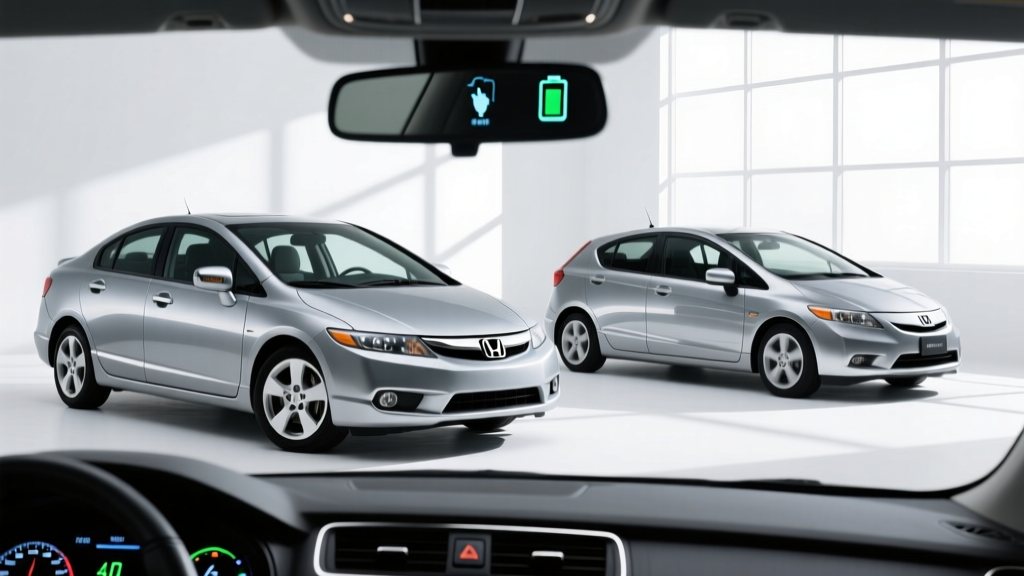
If you're researching the 2009 Honda hybrid lineup, you're likely looking at the used-car market — specifically the 2009 Honda Civic Hybrid and the 2009 Honda Insight (which launched in the U.S. for the 2010 model year but was in production and global sale during 2009). These vehicles represent Honda's second-generation Integrated Motor Assist (IMA) system, a mild-hybrid architecture that pairs a small electric motor with a gasoline engine to boost fuel economy without requiring a plug.
This guide breaks down real-world ownership data, battery longevity, replacement costs, and whether a 15+ year-old Honda hybrid is still a smart buy in 2026 — or whether you'd be better served by a modern hybrid, PHEV, or full EV.
2009 Honda Hybrid Models: What Was Available?
Honda offered two hybrid models for the 2009 model year in the United States:
- 2009 Honda Civic Hybrid — A compact sedan using the IMA system with a 1.3L i-VTEC inline-4 engine paired with a 15 kW electric motor sandwiched between the engine and CVT transmission.
- 2010 Honda Insight (sold starting early 2009) — A dedicated hybrid hatchback with a similar IMA powertrain but a smaller 1.3L engine and lower combined output, positioned as an affordable Prius competitor.
Both are conventional hybrids (HEVs) — they do not plug in. The battery recharges through regenerative braking and the gasoline engine. This is a critical distinction: neither vehicle has electric-only driving capability, and neither qualifies as a plug-in hybrid (PHEV).
A conventional hybrid (HEV) like the 2009 Civic Hybrid uses a small battery (roughly 0.3–0.5 kWh) charged only by the engine and regen braking. You never plug it in. A plug-in hybrid (PHEV) has a larger battery (typically 10–20 kWh) that can be charged from a wall outlet or charger, enabling 20–45 miles of electric-only driving before the gas engine takes over. Neither 2009 Honda hybrid is a PHEV.
EPA Fuel Economy: 2009 Honda Civic Hybrid vs Insight
| Model | City MPG | Highway MPG | Combined MPG | Fuel Tank (gal) | Total Range (mi) |
|---|---|---|---|---|---|
| 2009 Civic Hybrid | 40 | 45 | 42 | 12.3 | ~517 |
| 2010 Insight (sold 2009) | 40 | 43 | 41 | 10.6 | ~435 |
| 2009 Toyota Prius (comparison) | 48 | 45 | 46 | 11.9 | ~547 |
Source: EPA Fuel Economy
Real-World MPG vs EPA Estimates
The 2009 Civic Hybrid's EPA rating of 40/45/42 MPG was competitive for its era, but real-world results tell a more nuanced story. Owners on Fuelly and Edmunds forums report average real-world combined figures of 36–40 MPG, with several factors pulling numbers below the sticker:
- Highway-heavy commutes at 75+ MPH reduce the hybrid system's advantage — the IMA motor provides most benefit during city stop-and-go driving where regenerative braking recaptures energy.
- Aging hybrid batteries (more on this below) lose capacity over time, reducing the electric assist and forcing the gasoline engine to work harder.
- Cold weather reduces battery efficiency and increases engine idling for cabin heat, dropping winter MPG to the low-to-mid 30s in northern climates.
- Aggressive driving defeats the IMA system's efficiency optimizations — the CVT and hybrid system reward gentle, steady inputs.
In city driving, however, some owners report exceeding the EPA city rating — hitting 42–44 MPG in stop-and-go traffic where regen braking and auto-stop work hardest. This is a common hybrid trait: city MPG often beats highway MPG, the opposite of conventional gas cars.
Powertrain Specs: Honda's IMA System Explained
| Specification | 2009 Civic Hybrid | 2010 Insight |
|---|---|---|
| Engine | 1.3L i-VTEC I-4 | 1.3L i-VTEC I-4 |
| Engine HP | 93 hp | 88 hp |
| Electric Motor | 15 kW (20 hp) | 10 kW (13 hp) |
| Combined System HP | 110 hp @ 6,000 rpm | 98 hp @ 5,800 rpm |
| Combined Torque | 123 lb-ft @ 1,000–2,500 rpm | 123 lb-ft @ 1,000–1,500 rpm |
| Transmission | CVT | CVT |
| Hybrid Battery | NiMH, ~0.35 kWh (11 modules) | NiMH, ~0.35 kWh (7 modules) |
| Drivetrain | FWD | FWD |
| 0–60 MPH (est.) | ~11.5 sec | ~12.5 sec |
Honda's IMA system is a mild hybrid — the electric motor cannot propel the car on its own. Instead, it assists the gasoline engine during acceleration, enables auto stop-start at idle, and recaptures energy during braking. The motor is literally bolted between the engine's flywheel and the transmission, making it an integrated design rather than the power-split system used in the Toyota Prius.
This architecture is simpler and lighter than Toyota's full-hybrid system, but it delivers a smaller efficiency advantage. The Prius's ability to drive short distances on electric power alone (at low speeds) gave it a measurable edge in city MPG — a gap that persists in real-world driving.
Hybrid Battery Longevity & Replacement Costs
This is the single most important question for anyone considering a 2009 Honda hybrid today: how long does the IMA battery last, and what does replacement cost?
Honda warranted the IMA hybrid battery for 8 years / 80,000 miles (10 years / 150,000 miles in CARB states including California, New York, Massachusetts, and others that adopted California emissions standards). As of 2026, all original warranties on 2009 models have expired regardless of mileage.
Expected Battery Lifespan
The nickel-metal hydride (NiMH) IMA battery in the 2009 Civic Hybrid and Insight typically lasts 120,000–180,000 miles or 10–15 years before significant degradation forces replacement. Key failure patterns:
- Cell imbalance — The IMA battery consists of 11 individual NiMH modules (Civic) or 7 modules (Insight). When one or more modules degrades faster than the rest, the battery management system limits overall capacity, triggering the IMA warning light and reducing fuel economy by 5–10 MPG.
- Calendar aging — Even low-mileage examples suffer capacity loss over time. A 2009 model with 60,000 miles may still need a battery replacement simply due to 17 years of chemical degradation.
- Heat exposure — Vehicles in hot climates (Arizona, Texas, Southern California) tend to see earlier battery failure, as NiMH cells degrade faster at sustained high temperatures.
Replacement Cost Breakdown
As of 2026, IMA battery replacement options include:
- New OEM Honda battery: $2,000–$3,500 installed at a dealership. Honda has had intermittent supply issues for older IMA batteries, and availability may be limited.
- Aftermarket refurbished battery: $800–$1,500 installed at an independent hybrid specialist shop. Companies like Bumblebee Batteries and Hybrid Automotive offer reconditioned NiMH packs.
- DIY module replacement: $150–$400 for individual replacement modules if you're technically inclined. Several Honda hybrid forums document the process of replacing individual degraded modules rather than the entire pack, though this requires a grid charger to rebalance cells afterward.
- Grid charger + discharge cycle: $100–$200 for a Hack-a-Day-style grid charger setup that can sometimes restore enough capacity in a degraded (but not failed) battery to buy another 1–3 years of use.
For a 2009 vehicle with a market value of $3,000–$6,000 in 2026, a $2,500+ OEM battery replacement represents a significant percentage of the car's worth — a factor that must enter any purchase decision.
2009 Honda Hybrid vs Modern Alternatives: What Should You Buy?
If you're cross-shopping a used 2009 Honda hybrid, here's how the economics compare to modern options:
| Vehicle | Combined MPG | Typical 2026 Price | Battery Risk | Tax Credit |
|---|---|---|---|---|
| 2009 Civic Hybrid | 42 EPA (~38 real) | $3,500–$5,500 | High (17 yr old) | None |
| 2025 Toyota Prius LE | 57 EPA | $28,350 MSRP | Low (new warranty) | None (HEV) |
| 2025 Toyota Prius Prime (PHEV) | 52 MPG + 44 mi EV | $33,375 MSRP | Low (new warranty) | $3,750 (used)* |
| 2025 Hyundai Elantra Hybrid | 54 EPA | $26,250 MSRP | Low (new warranty) | None (HEV) |
*The $3,750 used PHEV/EV credit under IRS §25E applies to vehicles priced at $25,000 or less, sold by a dealer, with income caps. A new Prius Prime does not qualify for the new-vehicle §30D credit because it's a PHEV with insufficient battery sourcing compliance. Always verify current rules at IRS.gov.
Tax Credit Eligibility for 2009 Honda Hybrids
Neither the 2009 Civic Hybrid nor the 2009 Insight qualifies for any federal tax credit in 2026:
- New-vehicle clean vehicle credit (§30D): Only applies to new vehicles purchased new from a dealer. These are 17-year-old used cars.
- Used clean vehicle credit (§25E): This credit (up to $4,000 or 30% of sale price, max $4,000) applies to used EVs and PHEVs with at least 4 kWh of battery capacity that meet MSRP caps ($25,000), model-year requirements (at least 2 years old), and buyer income limits ($75,000 single / $150,000 joint). However, the 2009 Civic Hybrid and Insight have battery capacities far below the 4 kWh threshold — they are mild hybrids, not plug-in vehicles, and are not eligible.
- State incentives: Most state hybrid incentives have expired or were never retroactive. Some states offer emissions-based registration discounts, but these vary widely. Check your state's DMV or energy office for current programs.
The bottom line: you're paying full price for a 2009 Honda hybrid, with no tax relief to offset the purchase or any impending battery replacement.
Who Should Buy a 2009 Honda Hybrid — and Who Shouldn't?
- You need a cheap, fuel-efficient commuter car under $5,000 and can verify the IMA battery has been recently replaced or refurbished
- You're mechanically inclined and comfortable doing a DIY battery module swap or grid-charger reconditioning
- Your commute is city-heavy (stop-and-go traffic maximizes the IMA system's regen advantage)
- You want a simple, lightweight car with minimal electrical complexity compared to modern hybrids
- The IMA battery has never been replaced and shows warning codes — budget $1,000–$3,000 immediately
- You drive mostly highway miles at 70+ MPH — the hybrid advantage is minimal, and a conventional 2009 Civic (30/38 MPG) costs less to buy and maintain
- You want modern safety features — the 2009 Civic Hybrid lacks stability control on base trims, has no backup camera, and earned marginal ratings in some IIHS tests
- You have access to home charging and could consider a used EV like a 2017+ Chevy Bolt (238 mi range, often $8,000–$12,000 in 2026)
Hybrid vs PHEV vs EV: Which Powertrain Fits You?
If you're researching the 2009 Honda hybrid as a fuel-economy solution, here's a decision framework based on your situation in 2026:
Choose a used conventional hybrid (like this 2009 Honda) if your budget is under $6,000, you can't charge at home, you drive mostly city miles, and you're prepared for potential battery replacement costs.
Choose a new or recent-used hybrid (2020+ Prius, Elantra Hybrid) if you can spend $18,000–$28,000, want warranty coverage, and prioritize fuel savings without plug-in dependency. Modern hybrids achieve 50–57 MPG combined — a substantial improvement over 2009-era systems.
Choose a PHEV (Prius Prime, RAV4 Prime, Tucson PHEV) if you can charge at home (even a standard 120V outlet works overnight for 25–40 miles of EV range), want to run most daily trips on electricity, but need a gas engine for road trips. PHEVs offer the best of both worlds but cost $30,000–$45,000 new.
Choose a full EV (Bolt, Model 3, Ioniq 5) if you have reliable home Level 2 charging, your daily driving is under 250 miles, and you want the lowest per-mile energy cost (~$0.04–$0.06/mile on home electricity vs. ~$0.10–$0.12/mile for a 42 MPG hybrid at $3.50/gal).
Frequently Asked Questions
How many MPG does the 2009 Honda Civic Hybrid actually get?
The EPA rates it at 40 city / 45 highway / 42 combined. Real-world owners average 36–40 MPG combined, with city-heavy drivers sometimes exceeding 42 MPG and highway-heavy drivers seeing 34–37 MPG. Battery condition significantly impacts real-world numbers — a degraded IMA battery can drop fuel economy by 5–8 MPG.
Does the 2009 Honda hybrid need to be plugged in?
No. Both the 2009 Civic Hybrid and 2010 Insight are conventional hybrids (HEVs). The battery charges exclusively through regenerative braking and the gasoline engine. There is no plug, no charging port, and no electric-only driving mode.
How much does it cost to replace the IMA battery in a 2009 Civic Hybrid?
An OEM replacement at a Honda dealer runs $2,000–$3,500. Aftermarket refurbished batteries cost $800–$1,500 installed. DIY module replacement is possible for $150–$400 in parts but requires technical skill and a grid charger for cell balancing. Given the car's $3,500–$5,500 market value, battery replacement is a major economic consideration.
Is the 2009 Honda Civic Hybrid reliable overall?
The gasoline engine and CVT transmission are generally reliable with proper maintenance. The weak point is the IMA battery system, which is likely at or past its useful life on any unmodified 2009 example. The 12V auxiliary battery, starter motor, and hybrid system relays are also wear items at this age. Overall mechanical reliability is good; hybrid system reliability is the primary risk factor. Check NHTSA for recall and complaint history.
Does the 2009 Honda hybrid qualify for any tax credit?
No. The 2009 Civic Hybrid and Insight are conventional (mild) hybrids with battery capacities well below the 4 kWh threshold required for the used-vehicle clean vehicle credit (§25E). They also don't qualify for the new-vehicle credit (§30D) since they're used. No federal tax incentives apply. State incentives vary but are unlikely for a vehicle of this age.
Should I buy a 2009 Honda hybrid or a newer used Prius?
If your budget allows $8,000–$14,000, a 2013–2018 Toyota Prius offers significantly better fuel economy (50+ MPG combined), a more robust full-hybrid system, better safety features, and a hybrid battery that may still have useful life remaining. The 2009 Honda hybrid makes sense only at the very bottom of the budget spectrum (under $5,000) and only if the IMA battery has been addressed.
Sources: EPA Fuel Economy (fueleconomy.gov) · IRS Clean Vehicle Credits · NHTSA Vehicle Safety Data