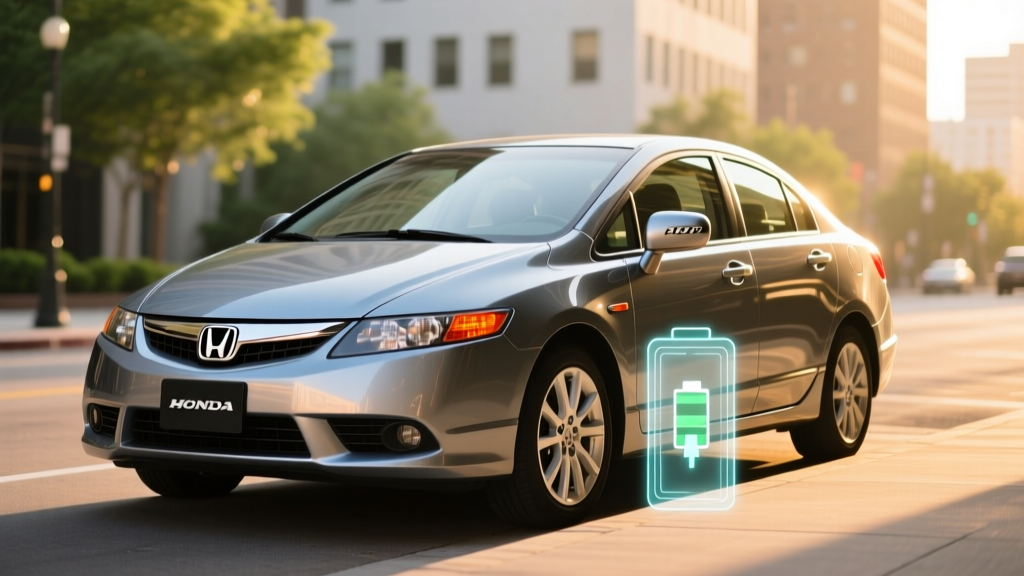
The 2009 Honda Civic Hybrid sedan occupies a specific niche in the used-car market: an early mainstream hybrid that prioritized fuel economy over performance, built on Honda's Integrated Motor Assist (IMA) parallel-hybrid system. For 2026 buyers hunting a budget commuter with low running costs, this car still gets attention — but its age, battery replacement history, and dated nickel-metal hydride (NiMH) chemistry demand careful scrutiny before you hand over cash.
This guide covers everything you need to evaluate a used 2009 Civic Hybrid: EPA and real-world MPG, the IMA powertrain, battery lifespan and replacement costs, reliability data, and how it compares to modern hybrids, PHEVs, and EVs on the market today.
2009 Honda Civic Hybrid Sedan: Key Specifications
| Specification | Value |
|---|---|
| Powertrain Type | Conventional Hybrid (HEV) — no plug-in |
| Engine | 1.3L i-VTEC 4-cylinder (98 hp) |
| Electric Motor (IMA) | 15 kW / 20 hp |
| Combined Output | 110 hp @ 6,000 rpm / 123 lb-ft torque |
| Transmission | CVT (continuously variable) |
| Hybrid Battery | NiMH, ~0.6 kWh (nominal) |
| EPA MPG (City / Hwy / Combined) | 40 / 45 / 42 MPG |
| Fuel Tank | 13.2 gallons |
| Estimated Total Range | ~554 miles |
| 0-60 mph | ~10.5 seconds |
| Original MSRP (2009) | $23,550 (base) |
| 2026 Used Price Range | $3,500 – $7,000 (private party) |
| Federal Tax Credit (New in 2009) | $2,150 (expired; phase-out hit in 2008) |
| Hybrid Battery Warranty (Original) | 10 years / 150,000 miles (CARB states); 8 yr / 80,000 mi elsewhere |
Fuel Economy: EPA Numbers vs. Real-World MPG
The EPA rated the 2009 Honda Civic Hybrid at 40 city / 45 highway / 42 combined MPG. These figures come from Honda's 1.3-liter lean-burn engine paired with the IMA electric motor, which assists during acceleration and recovers energy during braking via regenerative braking.
Owners on Fuelly and Edmunds consistently report real-world combined averages between 38–43 MPG, with some hypermilers pushing past 48 MPG on flat city routes. Highway cruising at 75+ mph tends to drop efficiency to 36–40 MPG due to the small engine working harder and the CVT holding higher revs. In cold weather (below 30°F), expect a 5–10% drop as the engine runs longer to warm the cabin and the NiMH battery delivers less assist. The Civic Hybrid's lean-burn technology excels in stop-and-go city driving, where the electric motor's torque fill and frequent regenerative braking cycles maximize efficiency.
Compared to the non-hybrid 2009 Civic (25 city / 36 hwy / 29 combined with the 1.8L and automatic), the hybrid's 42 MPG combined represents a 45% improvement — meaningful for high-mileage commuters.
The IMA Powertrain: How Honda's First-Gen Hybrid System Works
The 2009 Civic Hybrid uses Honda's Integrated Motor Assist (IMA) system — a parallel hybrid architecture fundamentally different from Toyota's Hybrid Synergy Drive. Here's the distinction:
- IMA (Honda): A thin electric motor sits between the engine and transmission. The motor cannot propel the car on electric power alone (with one minor exception: at very low speeds under light load, the engine's cylinders deactivate and the motor provides brief electric-only creeping). The engine is always mechanically connected to the wheels.
- Toyota HSD (for comparison): Uses a power-split device allowing true electric-only driving at low speeds, with the engine decoupled from the wheels.
The IMA system's simplicity means fewer failure points but less electric assist flexibility. The 15 kW (20 hp) motor primarily provides torque fill during acceleration and captures regenerative braking energy to recharge the small NiMH battery pack.
Engine and Motor Specs
- Gasoline Engine: 1.3L i-VTEC inline-4, 98 hp @ 6,000 rpm, 88 lb-ft @ 1,000 rpm (lean-burn capable)
- IMA Motor: 15 kW permanent-magnet, 20 hp, 58 lb-ft assist torque
- Combined System Output: 110 hp, 123 lb-ft
- Battery Pack: Nickel-metal hydride (NiMH), approximately 0.6 kWh nominal capacity, located behind the rear seat
Hybrid Battery Lifespan, Replacement Cost, and Warranty
This is the single biggest concern for any used 2009 Civic Hybrid buyer. The car is now 17 years old, and the original NiMH battery pack was designed for an 8–10 year service life.
Honda's original hybrid battery warranty covered 10 years / 150,000 miles in CARB states (California and states adopting CARB emissions standards) and 8 years / 80,000 miles in non-CARB states. As of 2026, virtually all 2009 Civic Hybrids are out of factory battery warranty regardless of mileage. Battery health depends heavily on climate (heat degrades NiMH faster), driving patterns, and whether the pack has already been replaced.
IMA Battery Replacement Costs (2026)
| Option | Estimated Cost | Notes |
|---|---|---|
| Dealer OEM Replacement | $2,500 – $3,500 | New Honda NiMH pack; limited availability for this age |
| Aftermarket / Refurbished Pack | $1,200 – $2,000 | Reconditioned NiMH cells from suppliers like BumbleBee Batteries or Dorman |
| DIY Cell Replacement (Grid Charging + Individual Cell Swap) | $300 – $600 | Requires technical skill; grid charger (~$200) can extend pack life |
| Used Salvage Pack | $400 – $800 | Risky — unknown remaining capacity; not recommended without testing |
A critical ownership tip: many IMA battery issues stem from cell imbalance rather than total pack failure. An aftermarket grid charger (such as those from Hack-a-Civic or BumbleBee) can rebalance cells and extend pack life by years. If the IMA warning light illuminates, a diagnostic scan can determine whether a full replacement or a grid-charge rebalance is needed.
Reliability Track Record
The 2009 Civic Hybrid scores moderately well in long-term reliability surveys, but with caveats. The gasoline 1.3L engine and CVT are generally robust. The primary failure points are:
- IMA Battery: Expected to need replacement or reconditioning at 120,000–180,000 miles (or 10–15 years).
- CVT Transmission: Earlier Civic Hybrids (2003–2005) had CVT issues; by 2009, Honda had largely resolved these, but high-mileage units can develop shudder or slipping.
- 12V Auxiliary Battery: Standard replacement item; not related to the hybrid system.
- Motor Mount: The rear engine mount is a known wear item on 8th-gen Civics (2006–2011), hybrid and gas alike.
According to NHTSA, the 2009 Civic Hybrid has relatively few recalls — primarily related to the passenger airbag inflator (Takata), which should have been addressed by now but verify with the VIN.
HEV vs. PHEV vs. EV: Where Does the Civic Hybrid Fit in 2026?
The 2009 Civic Hybrid is a conventional hybrid (HEV) — it has no plug, no electric-only driving range to speak of, and no ability to charge from an external source. The gas engine and regenerative braking are the only ways to recharge the battery. Here's how it compares to the three electrified powertrain categories available today:
| Category | Example (2026) | Electric-Only Range | Needs a Plug? | Combined Efficiency | Federal Tax Credit (New) |
|---|---|---|---|---|---|
| HEV (Conventional Hybrid) | 2009 Civic Hybrid / 2026 Toyota Prius LE | None (motor assist only) | No | 42–57 MPG | No |
| PHEV (Plug-In Hybrid) | 2026 Toyota Prius Prime | ~44 miles | Yes (Level 1/2) | 52 MPG + 127 MPGe | Up to $3,750 (§30D, if eligible) |
| BEV (Battery Electric) | 2026 Chevrolet Equinox EV | ~319 miles | Yes (Level 1/2/DC) | ~3.0 kWh/mi / ~113 MPGe | Up to $7,500 (§30D, if eligible) |
The Civic Hybrid's advantage in 2026 is purely financial: you can acquire one for $3,500–$7,000, never plug it in, and still achieve 40+ MPG. A new 2026 Prius LE starts around $29,000 and delivers 57 MPG combined — better efficiency but 4–8× the purchase price.
Tax Credits and Incentives: What Applies to a Used 2009 Civic Hybrid?
Let's be direct: the 2009 Honda Civic Hybrid does not qualify for any current federal tax credit.
When new, the Civic Hybrid was eligible for a federal hybrid tax credit under the Energy Policy Act of 2005, but Honda's credit phase-out was triggered in 2008 when the company hit the 60,000-unit cap. By 2009, the credit had been reduced to $0 for most buyers (some late-2008 purchasers received a partial $1,075 credit).
Current §30D Federal Tax Credit Rules (2026)
Under IRS §30D rules effective in 2026, the Used Clean Vehicle Credit (up to $4,000 or 30% of sale price, whichever is lower) applies only to:
- Used BEVs and PHEVs (not conventional HEVs)
- Sale price of $25,000 or less
- Buyer income caps: $75,000 single / $112,500 head of household / $150,000 joint
- Vehicle must be at least 2 model years old and sold by a licensed dealer
- Vehicle must have a battery capacity of at least 7 kWh
The 2009 Civic Hybrid fails on two counts: it's a conventional HEV (not a BEV or PHEV), and its ~0.6 kWh battery is far below the 7 kWh threshold. No federal credit applies. Check your state's DMV or energy office for any local incentives — some states offer smog-exemption benefits or HOV lane access for older hybrids, though these have largely expired.
Who Should Buy the 2009 Honda Civic Hybrid Sedan in 2026?
- Your total vehicle budget is under $7,000 and you need maximum MPG without plugging in.
- You commute in heavy city traffic where the hybrid system's regenerative braking and lean-burn engine deliver peak efficiency.
- You have no access to home or workplace charging (making a PHEV or EV impractical).
- You're comfortable budgeting $1,500–$2,500 for an IMA battery replacement or reconditioning if needed.
- You want a simple, lightweight sedan with cheap insurance and low registration fees.
- You want modern safety features (the 2009 Civic lacks standard stability control on some trims, has no automatic emergency braking, lane-keeping, or blind-spot monitoring).
- You need strong highway passing power (110 hp combined is modest; merging at speed requires planning).
- You want a warranty-backed battery — you're buying a 17-year-old car as-is.
- You drive mostly highway miles at 70+ mph, where the hybrid advantage shrinks to 36–40 MPG and a modern turbocharged gas car might match it.
- You want to reduce tailpipe emissions as much as possible — a modern PHEV or BEV is far cleaner.
Ownership Costs: 2026 Budget Estimate
Here's what annual ownership of a 2009 Civic Hybrid looks like at 15,000 miles per year and a national average gas price of ~$3.30/gallon:
| Expense | Annual Estimate |
|---|---|
| Fuel (15,000 mi ÷ 42 MPG × $3.30/gal) | ~$1,179 |
| Insurance (varies by state/driver) | $800 – $1,400 |
| Maintenance (oil, brakes, tires — hybrid regenerative braking extends pad life) | $500 – $800 |
| Registration & Taxes | $100 – $300 |
| IMA Battery Reserve (amortized over 5 years) | $300 – $500/yr |
| Total Estimated Annual Cost | $2,879 – $4,179 |
Compare this to a 2009 Civic gas model at 29 MPG combined: annual fuel cost would be ~$1,707 — about $528 more per year in fuel alone. The hybrid's fuel savings offset the IMA battery replacement reserve in roughly 3 years of driving.
Frequently Asked Questions
How many MPG does the 2009 Honda Civic Hybrid get?
The EPA rates it at 40 city / 45 highway / 42 combined MPG. Real-world owner reports cluster around 38–43 MPG combined, with city driving often exceeding the EPA estimate thanks to regenerative braking and lean-burn operation. Highway driving at sustained high speeds typically yields 36–40 MPG.
Does the 2009 Civic Hybrid need to be plugged in?
No. It is a conventional hybrid (HEV), not a plug-in hybrid (PHEV). The battery recharges exclusively through the gasoline engine and regenerative braking. There is no charging port and no electric-only driving mode of any practical distance.
Is the IMA battery replacement worth it on a 2009 Civic Hybrid?
It depends on the car's overall condition. A refurbished NiMH pack costs $1,200–$2,000 installed. If the rest of the car (engine, CVT, body) is in good shape and you plan to keep it 3+ more years, the replacement pays for itself through continued 40+ MPG fuel savings versus buying a different vehicle. If the car has other major issues, it may be time to move on.
How does the 2009 Civic Hybrid compare to a 2026 Toyota Prius?
The 2026 Prius LE delivers 57 MPG combined (36% better), 196 hp combined (78% more power), modern safety tech (Toyota Safety Sense 3.0 with AEB, lane-keeping, adaptive cruise), and a full factory warranty — but starts at ~$29,000. The 2009 Civic Hybrid costs $3,500–$7,000 and lacks modern safety features but achieves respectable 42 MPG at a fraction of the price. It's a budget play, not a technology play.
Does the 2009 Honda Civic Hybrid qualify for any federal tax credit in 2026?
No. The original hybrid tax credit phased out for Honda in 2008. Under current IRS §30D rules, the used clean vehicle credit applies only to BEVs and PHEVs with battery capacity of at least 7 kWh — the Civic Hybrid's ~0.6 kWh NiMH pack and HEV powertrain make it ineligible. No federal tax credit is available for this vehicle in 2026.
What should I check before buying a used 2009 Civic Hybrid?
Before purchasing, verify: (1) IMA battery health — ask for a state-of-charge/state-of-health scan or look for recent battery replacement receipts; (2) whether the Takata airbag recall was performed (check VIN at nhtsa.gov/recalls); (3) CVT operation — test-drive for shudder, hesitation, or slipping; (4) rear engine mount condition; (5) maintenance records showing regular oil changes and brake fluid service. Budget $1,500–$2,500 for a battery replacement if there's no documentation of a recent swap.