Quick Verdict: The 2009 Escape Hybrid in 2026
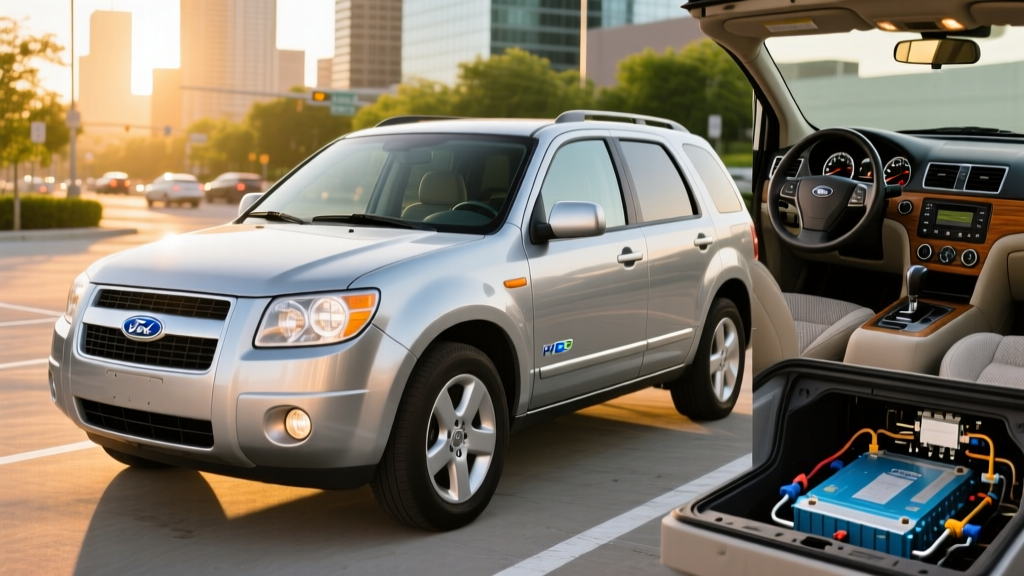
The 2009 Ford Escape Hybrid is a conventional hybrid (HEV) — not a plug-in — and it remains one of the most durable early-generation hybrid SUVs on the used market. Built on Ford's second-generation hybrid powertrain co-developed with Toyota-derived technology, the Escape Hybrid delivers a real-world combined 30-32 MPG, exceptional for a compact SUV of its era. If you're shopping the used market for a budget-friendly hybrid commuter that sips fuel without requiring any plug-in infrastructure, this vehicle still has legs — but battery age and replacement cost are the variables that will make or break your ownership experience.
| Specification | 2009 Ford Escape Hybrid (FWD) | 2009 Ford Escape Hybrid (AWD) |
|---|---|---|
| Powertrain Type | Conventional Hybrid (HEV) | Conventional Hybrid (HEV) |
| Engine | 2.5L Atkinson-cycle I4 | 2.5L Atkinson-cycle I4 |
| Combined Horsepower | 177 hp (net) | 177 hp (net) |
| EPA City MPG | 34 | 29 |
| EPA Highway MPG | 31 | 27 |
| EPA Combined MPG | 32 | 28 |
| Battery Chemistry | NiMH (Nickel-Metal Hydride) | NiMH |
| EV-Only Mode | Low-speed, <1 mile | Low-speed, <1 mile |
| Plug-In Required? | No | No |
| 0-60 mph | ~10.5 seconds | ~11.0 seconds |
| Original MSRP | ~$29,995 | ~$31,495 |
| 2026 Used Price (typical) | $4,500 – $7,500 | $5,000 – $8,000 |
HEV vs PHEV: Understanding What the Escape Hybrid Is (and Isn't)
A common source of confusion with older hybrid nameplates is whether the vehicle needs to be plugged in. The 2009 Ford Escape Hybrid is a conventional hybrid electric vehicle (HEV). It cannot be plugged in. It has no usable electric-only range beyond low-speed parking-lot crawling (under 25 mph, for less than a mile). The battery recharges exclusively through regenerative braking and the gasoline engine.
| Feature | HEV (2009 Escape Hybrid) | PHEV (e.g., 2026 RAV4 Prime) | BEV (e.g., 2026 Ioniq 5) |
|---|---|---|---|
| Plug-in Charging | No | Yes (Level 1/2) | Yes (Level 1/2/DC) |
| Electric-Only Range | ~0.5 mi at low speed | 35–45 mi | 250–320 mi |
| Gas Engine | Yes (primary) | Yes (backup) | No |
| Battery Size | ~1.3 kWh (NiMH) | ~18 kWh (Li-ion) | 58–84 kWh (Li-ion) |
| Tax Credit Eligibility | No (used HEV) | Up to $7,500 (§30D, new) | Up to $7,500 (§30D, new) |
| Best For | No home charging access | Short commute + road trips | Home charging + daily driving |
The Escape Hybrid's role is straightforward: it uses its electric motor to assist the gas engine during acceleration and capture energy during braking, reducing fuel consumption by roughly 30–40% compared to the gas-only 2009 Escape. If you're looking for meaningful electric-only driving, you need a PHEV or BEV — the Escape Hybrid is a fuel-efficiency play, not an electrification play.
Fuel Economy: EPA Ratings vs Real-World MPG
The EPA rated the 2009 Ford Escape Hybrid FWD at 34 city / 31 highway / 32 combined MPG. The AWD variant drops to 29 city / 27 highway / 28 combined. These figures come from fueleconomy.gov and remain the benchmark for comparison.
| Driving Scenario | EPA Estimate (FWD) | Real-World Expectation |
|---|---|---|
| City (stop-and-go) | 34 MPG | 32–36 MPG (hybrids excel here) |
| Highway (65–75 mph) | 31 MPG | 27–30 MPG (less regen benefit) |
| Combined | 32 MPG | 29–33 MPG |
| Cold Weather (below 32°F) | N/A | 24–28 MPG (engine runs more for heat) |
Why real-world city MPG can beat the EPA sticker: Conventional hybrids recapture the most energy in stop-and-go driving, where regenerative braking feeds the battery constantly. Many owners report 34–36 MPG in dense urban traffic. Highway driving, by contrast, relies more on the gas engine with less regen opportunity, so expect 27–30 MPG at 70+ mph.
Cold-weather caveat: In sub-freezing temperatures, the Escape Hybrid's engine runs more frequently to provide cabin heat (there's no electric resistance heater powerful enough to handle winter alone). Expect a 15–20% fuel-economy penalty in sustained cold. This is normal for all hybrids of this generation.
Powertrain Deep Dive: How the Hybrid System Works
The 2009 Escape Hybrid pairs a 2.5-liter Atkinson-cycle inline-4 engine (153 hp on its own) with a permanent-magnet electric motor integrated into the eCVT transaxle. Combined net output is 177 horsepower. The Atkinson cycle sacrifices some low-end torque for greater thermal efficiency — a hallmark of hybrid engine design still used in 2026 models from Toyota, Hyundai, and Ford.
Key powertrain characteristics:
- eCVT transmission: Not a traditional belt-and-pulley CVT. This is a planetary gearset (power-split device) that seamlessly blends engine and motor power. It's mechanically robust with no belts or clutches to wear out.
- Regenerative braking: The electric motor reverses direction under deceleration, converting kinetic energy back into battery charge. Brake pad life is typically 80,000–120,000 miles because regen handles most routine slowing.
- Auto stop-start: The engine shuts off at idle and restarts seamlessly via the electric motor. This was advanced for 2009 and remains smooth even by today's standards.
- EV mode: Under ~25 mph with light throttle, the Escape Hybrid can run on electric power alone for very short distances (roughly 0.5 miles). This is useful for creeping through parking lots but has no practical commuting range.
Battery Lifespan, Warranty & Replacement Cost
This is the single most important ownership question for a 2009 hybrid in 2026: what shape is the battery in?
Battery Facts: 2009 Ford Escape Hybrid
- Chemistry: Nickel-Metal Hydride (NiMH), manufactured by Sanyo
- Capacity: ~1.3 kWh (small by modern standards — for comparison, a 2026 PHEV carries 15–20 kWh)
- Original Warranty: 8 years / 100,000 miles (expired on all 2009 models by 2017)
- Expected Lifespan: 150,000–200,000 miles with gradual capacity loss
- Replacement Cost (2026): $2,000–$3,500 (remanufactured pack, installed)
NiMH degradation is gradual, not catastrophic. Unlike early lithium-ion packs that could show abrupt capacity cliffs, NiMH batteries lose capacity slowly over time and heat exposure. A 17-year-old Escape Hybrid battery will almost certainly have lost 20–35% of its original capacity. This doesn't strand you — the car still drives — but you'll notice reduced low-speed EV-mode availability and slightly lower MPG (typically a 2–4 MPG drop from original figures).
Replacement options in 2026:
- Remanufactured pack (most common): $2,000–$3,500 installed at an independent hybrid specialist. Companies like Green Bean Battery and Re-Involt offer refurbished NiMH packs with 3–5 year warranties.
- OEM new (Ford dealer): $3,500–$5,000. Ford still supplies replacement packs, but at a premium that often exceeds the vehicle's value.
- Individual module replacement: $500–$1,200 if only a few cells have failed. Requires a technician who can diagnose and balance individual NiMH modules. Not all shops offer this.
How to check battery health before buying: Use an OBD-II scanner with hybrid-compatible software (e.g., Torque Pro with Ford hybrid PID support, or a dedicated ScanGauge) to read battery voltage delta under load. A healthy pack shows less than 0.3V difference between highest and lowest modules. A delta exceeding 0.5V indicates failing modules. A pre-purchase inspection at a hybrid-aware shop ($100–$150) is strongly recommended.
Reliability, Safety & Long-Term Ownership
The 2009 Escape Hybrid earns above-average reliability marks for its era. The hybrid powertrain itself — particularly the eCVT and planetary gearset — has proven more durable than many conventional automatic transmissions of the same period. The NiMH battery, while subject to age-related degradation, rarely fails catastrophically.
Common issues to watch for:
- Brake actuator assembly: The electrohydraulic brake system (which integrates regen with friction braking) can develop faults around 120,000–150,000 miles. Replacement runs $1,200–$1,800. Symptoms include a firm brake pedal, ABS warning light, or reduced regen.
- Electric power steering (EPS): Some units develop torque sensor faults. Ford issued extended coverage on certain model years. Check for TSBs.
- Blend door actuator: HVAC temperature blend doors can fail, causing one side of the cabin to blow hot while the other blows cold. A $30 part but requires dash disassembly (~$400–$600 labor).
- 12V battery drain: Like all hybrids, the Escape has a conventional 12V battery that powers electronics. If the car sits for weeks, the 12V can die, preventing the hybrid system from booting. A $150 AGM replacement and a trickle charger solve this.
Safety: The 2009 Escape received a 4-star overall rating from NHTSA (out of 5) and a "Good" rating from IIHS in moderate overlap front testing. Note that it lacks modern ADAS features — no automatic emergency braking, no lane-keeping assist, no adaptive cruise. For a 2009 vehicle, this is expected, but it's a gap relative to 2026 safety expectations.
Pricing, Tax Credits & Total Cost of Ownership
Used market pricing (2026): A 2009 Ford Escape Hybrid in good condition with 120,000–160,000 miles typically sells for $4,500–$7,500 depending on trim, mileage, and battery health. Low-mileage examples under 80,000 miles command $7,000–$9,000.
Tax credit eligibility: The 2009 Escape Hybrid does not qualify for any current federal tax credit. The IRS §30D credit applies only to new plug-in vehicles (BEVs and PHEVs) meeting battery-sourcing and MSRP requirements. As a used conventional HEV, it falls outside all federal incentive programs. Some states offer modest used-EV rebates, but these typically target plug-in vehicles. Check your state's energy office for specifics.
Estimated 5-Year Cost of Ownership (Used 2009 Escape Hybrid FWD)
| Category | Estimated Cost | Notes |
|---|---|---|
| Purchase Price | $5,500 | Mid-range example, ~130k mi |
| Fuel (12,000 mi/yr @ 30 MPG) | $6,600 | $3.30/gal avg, 5 years |
| Insurance | $4,200 | ~$70/mo, older vehicle discount |
| Maintenance | $3,000 | Oil, tires, brakes (regen extends pad life) |
| Battery Replacement (if needed) | $0 – $2,800 | May or may not be needed in 5 years |
| Estimated Total | $19,300 – $22,100 | ~$3,860 – $4,420/year |
Compare this to a gas-only 2009 Escape (rated at 20 city / 28 highway / 23 combined): over 60,000 miles, the hybrid saves roughly $2,200–$2,800 in fuel alone, partially offsetting any battery replacement cost.
Who Should Buy the 2009 Escape Hybrid (and Who Shouldn't)
Choose the 2009 Escape Hybrid If:
- You need a budget AWD SUV under $8,000 with low fuel costs
- You have no access to home or workplace charging (HEV needs no plug)
- You drive primarily in city/stop-and-go traffic where hybrid efficiency shines
- You want proven hybrid reliability without the complexity of a PHEV or BEV
- You're a DIY-oriented buyer willing to check battery health and handle maintenance
Look Elsewhere If:
- You want meaningful electric-only driving range (consider a used PHEV like the Prius Prime or Clarity)
- You need modern safety features (AEB, lane-keep, blind-spot monitoring)
- You drive mostly highway miles (the hybrid advantage narrows significantly)
- You want a federal or state tax credit (only new plug-in vehicles qualify under current IRS §30D rules)
- You can't budget $2,000–$3,500 for a potential battery replacement
Frequently Asked Questions
How many MPG does the 2009 Ford Escape Hybrid get?
The EPA rates the FWD model at 34 city / 31 highway / 32 combined MPG. The AWD model is rated at 29/27/28. Real-world city driving often yields 32–36 MPG thanks to regenerative braking, while sustained highway driving at 70+ mph typically returns 27–30 MPG.
Can the 2009 Escape Hybrid drive on electric power alone?
Only at very low speeds (under ~25 mph) and for less than a mile. This is a conventional hybrid — it has no meaningful electric-only range. The electric motor assists the gas engine and captures braking energy, but it is not designed for plug-in or extended EV driving.
Does the 2009 Ford Escape Hybrid qualify for any tax credit?
No. The federal §30D clean vehicle credit applies only to new plug-in electric vehicles (BEVs and PHEVs) that meet battery-sourcing, MSRP, and buyer-income requirements. As a 17-year-old conventional hybrid, the Escape Hybrid is ineligible for all current federal and most state incentives.
How long does the hybrid battery last, and what does replacement cost?
The NiMH battery typically lasts 150,000–200,000 miles with gradual capacity loss. At 17 years old, most surviving packs have degraded 20–35%. A remanufactured replacement costs $2,000–$3,500 installed. The original 8-year/100,000-mile warranty expired on all 2009 models by 2017.
Is the 2009 Escape Hybrid reliable?
Yes, with caveats. The eCVT and hybrid powertrain are mechanically robust. The main concerns are age-related: NiMH battery degradation, brake actuator wear (120k–150k miles), and general 17-year-old vehicle wear items (suspension, seals, electronics). A pre-purchase inspection focusing on hybrid battery health is strongly recommended.
Hybrid vs PHEV vs EV — which should I choose?
Choose a conventional hybrid (HEV) like this Escape if you have no charging access and want maximum fuel efficiency with zero behavioral change. Choose a PHEV if you can charge at home and want 30–45 miles of electric commuting with gas-engine backup for road trips. Choose a full EV (BEV) if you have reliable home charging, drive under 250 miles daily, and want the lowest per-mile fuel cost and zero tailpipe emissions.