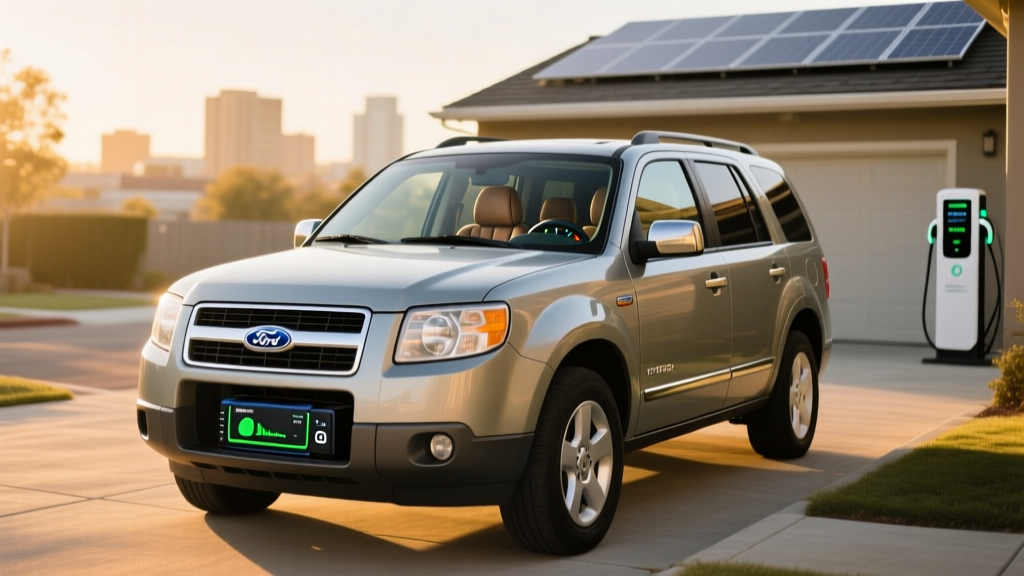
The 2009 Ford Escape Hybrid SUV occupies a specific niche in today's used-car market: it's one of the earliest mainstream hybrid crossovers, and for budget-minded drivers who want hybrid fuel economy without plug-in complexity, it remains a relevant option. With an EPA-estimated 34 MPG city and a proven nickel-metal hydride (NiMH) battery pack, this second-generation Escape Hybrid delivers real-world efficiency that still competes with newer non-hybrid crossovers. But at 17 years old, prospective buyers need clear data on battery health, replacement costs, and how this conventional hybrid (HEV) stacks up against modern PHEVs and full EVs.
HEV vs PHEV: What the 2009 Escape Hybrid Actually Is
Before evaluating specs, it's critical to understand that the 2009 Ford Escape Hybrid is a conventional hybrid (HEV), not a plug-in hybrid (PHEV). This distinction drives everything about ownership:
| Feature | 2009 Escape Hybrid (HEV) | Modern PHEV (e.g., 2026 Ford Escape PHEV) |
|---|---|---|
| Plug-in charging | No — charges via engine & regen | Yes — Level 1/2 AC charging |
| Battery size | 1.3 kWh (NiMH) | 14.4 kWh (NMC lithium-ion) |
| Electric-only driving | ~0.5–1 mile at low speed | 37 miles EPA electric-only |
| Federal tax credit (new) | Never qualified (HEV) | Up to $7,500 (§30D, subject to rules) |
| Regenerative braking | Yes | Yes |
| Gas engine required | Always available, auto start/stop | Yes, activates after EV range depleted |
The Escape Hybrid's battery recharges itself through regenerative braking and the gasoline engine. There is no charging port, no plug, and no electric-only range beyond brief low-speed assist. If you want plug-in capability, you'd need to look at newer PHEV models — this generation Escape was never offered as a plug-in.
Fuel Economy: EPA Numbers and Real-World MPG
According to fueleconomy.gov, the 2009 Ford Escape Hybrid with front-wheel drive carries the following EPA estimates:
| Drivetrain | City MPG | Highway MPG | Combined MPG |
|---|---|---|---|
| FWD | 34 | 31 | 32 |
| AWD (4WD) | 29 | 27 | 28 |
Real-World MPG: What Owners Actually See
Hybrids like the Escape tend to meet or exceed their EPA city estimates because stop-and-go driving maximizes regenerative braking and electric-motor assist. Highway driving, where the gasoline engine does most of the work, typically yields lower numbers than the city rating — the opposite of conventional gas cars.
Owner-reported data on forums and fuel-tracking sites consistently shows FWD Escape Hybrids achieving 29–35 MPG combined in mixed driving. Drivers who do heavy city commuting with frequent stops often report 35–38 MPG, while sustained highway trips at 75+ MPH may drop to 27–29 MPG. Cold weather reduces efficiency by roughly 5–10% due to increased engine warm-up time and cabin heating demands on the gasoline engine.
For context, a comparable 2009 gas-only Escape 4-cylinder FWD was EPA-rated at 20 city / 28 highway / 23 combined. The hybrid's 32 MPG combined represents a ~39% improvement in fuel economy.
Powertrain Specs: Engine, Motor, and Combined Output
The 2009 Escape Hybrid uses Ford's second-generation hybrid system, co-developed with Aisin and sharing architecture with Toyota's Hybrid Synergy Drive of that era. Here's the powertrain breakdown:
| Specification | Detail |
|---|---|
| Engine | 2.5L Atkinson-cycle inline-4 |
| Engine horsepower | 153 HP @ 6,000 RPM |
| Electric motor | Permanent-magnet AC synchronous |
| Combined system output | 177 HP |
| Transmission | Electronic CVT (eCVT) — planetary gearset |
| Battery type | Nickel-metal hydride (NiMH) |
| Battery capacity | 1.3 kWh (usable ~0.8 kWh) |
| 0–60 MPH | ~9.7 seconds (FWD) |
| Curb weight | ~3,800 lbs (FWD) |
| Towing capacity | 1,000 lbs |
The Atkinson-cycle engine sacrifices low-RPM torque for higher thermal efficiency, while the electric motor fills in the torque gap at launch. The eCVT is not a belt-and-cone CVT like those found in some Nissan products — it's a planetary gearset with no belts, chains, or clutches to wear out, which contributes to the powertrain's strong reliability record.
Battery Lifespan, Warranty, and Replacement Cost
For any used hybrid, the traction battery is the single biggest financial risk. Here's what you need to know about the 2009 Escape Hybrid's NiMH pack:
Original Battery Warranty (When New)
- Duration: 8 years / 100,000 miles (10 years / 150,000 miles in CARB states including CA, NY, MA, and others)
- Coverage: Defects and capacity loss below a defined threshold
- Status in 2026: Original warranty has expired for all 2009 models
How Long Do These Batteries Actually Last?
NiMH batteries in the Escape Hybrid have demonstrated strong longevity. Fleet data and owner reports indicate many original packs reaching 150,000–200,000+ miles before requiring replacement. Unlike early lithium-ion packs, NiMH chemistry degrades more gradually and is less susceptible to sudden capacity cliff failure.
Key factors that accelerate NiMH degradation include:
- Prolonged storage at extreme states of charge (full or empty) in hot climates
- Repeated deep cycling in very high ambient temperatures (100°F+)
- Infrequent driving — batteries that sit unused for months fare worse
Battery Replacement Cost (2026 Estimates)
| Option | Cost Range | Notes |
|---|---|---|
| Dealer OEM replacement | $3,500–$5,000 | New Ford/Motorcraft pack, includes labor |
| Independent hybrid shop | $2,000–$3,500 | Remanufactured or reconditioned pack |
| Used/salvage pack | $500–$1,200 | Risky — unknown remaining life, no warranty |
| Individual cell replacement | $800–$1,800 | Only viable if 1–2 cells failed; requires specialist |
Given that a clean 2009 Escape Hybrid trades for roughly $3,500–$7,000 in 2026 private-party sales, a dealer battery replacement can approach or exceed the vehicle's value. Most buyers opt for independent hybrid shops or reconditioned packs to keep the math sensible.
Pre-Purchase Battery Check
Before buying any used 2009 Escape Hybrid, request a hybrid battery health scan. A qualified hybrid technician can read the pack's state of health (SoH), individual cell voltages, and internal resistance values. A pack with balanced cells and SoH above 75–80% likely has years of service remaining. Avoid vehicles where the battery warning light is active or where cells show significant voltage imbalance.
Pricing and Tax Credit Eligibility
The 2009 Escape Hybrid was originally priced around $29,000–$33,000 MSRP when new. In the 2026 used market:
| Condition | Private-Party Price Range | Dealer Price Range |
|---|---|---|
| Fair (150k+ mi, cosmetic wear) | $2,500–$4,000 | $4,000–$5,500 |
| Good (100k–140k mi, maintained) | $4,000–$6,000 | $5,500–$7,500 |
| Excellent (sub-100k mi, records) | $5,500–$8,000 | $7,000–$9,500 |
Tax Credits: What Applies?
The federal §30D tax credit has never applied to conventional hybrids like the Escape Hybrid — it is reserved for plug-in vehicles (PHEVs and BEVs) meeting specific battery-capacity and sourcing requirements. The original Escape Hybrid qualified for a much smaller federal tax deduction (up to $2,200) when purchased new between 2006–2009, but that provision expired long ago.
For used-vehicle buyers in 2026, the Used Clean Vehicle Credit (§25E) offers up to $4,000 — but only for plug-in vehicles (PHEVs or BEVs) meeting age, price, and income requirements. The 2009 Escape Hybrid, as an HEV, does not qualify. Check IRS.gov §25E guidelines for the current rules if you're considering a used plug-in alternative instead.
Reliability and Common Issues Beyond the Battery
The 2009 Escape Hybrid benefits from a relatively simple and proven drivetrain. The eCVT planetary gearset is essentially bulletproof — there are no belts, clutches, or torque converters to fail. NHTSA records show no major systemic recalls targeting the hybrid system specifically.
Common non-hybrid issues to inspect:
- Brake actuator assembly: The electro-hydraulic brake system (which blends regenerative and friction braking) can develop faults around 120,000–160,000 miles. Replacement runs $1,200–$2,000.
- Electric power steering: Some units develop rack noise or assist faults. Ford extended warranty coverage on certain model years.
- A/C compressor: Electrically driven; failures are uncommon but expensive ($800–$1,400) due to the high-voltage connection.
- 12V auxiliary battery: Located in the rear cargo area; standard replacement, but if it dies, the vehicle cannot start even if the hybrid pack is full.
- Rust: Inspect rear wheel arches, rocker panels, and subframe, particularly on vehicles from salt-belt states.
Hybrid vs PHEV vs EV: Which Powertrain Fits You?
Choose the Used 2009 Escape Hybrid (HEV) If:
- Your budget is under $7,000 and you want hybrid MPG without plug-in infrastructure
- You lack access to home or workplace charging (apartment, street parking)
- You drive 20–50 miles daily in mixed city/highway conditions
- You want a known, simple powertrain with a long track record
- You're willing to budget $2,000–$3,500 for a potential battery replacement
Choose a Modern PHEV Instead If:
- You have Level 2 home charging and a daily commute under 30–40 miles
- You want electric-only driving for most trips with gas-engine backup for road trips
- You want current safety tech (AEB, lane-keeping, blind-spot monitoring)
- You may qualify for federal/state incentives on a new or certified used PHEV
Choose a Full EV (BEV) Instead If:
- You have reliable home Level 2 charging
- Your daily driving is under 200 miles and you rarely tow
- You want minimal maintenance (no oil changes, no engine, fewer moving parts)
- You can access the federal §30D credit (up to $7,500) or state rebates to offset higher upfront cost
Ownership Economics: Annual Fuel Cost
At 32 MPG combined and 12,000 miles driven annually, the 2009 Escape Hybrid FWD consumes approximately 375 gallons per year. At a national average of $3.20/gallon (2026 estimate), that's roughly $1,200/year in fuel.
For comparison:
| Vehicle | Combined MPG / MPGe | Annual Fuel Cost (12k mi) |
|---|---|---|
| 2009 Escape Hybrid (FWD) | 32 MPG | ~$1,200 |
| 2009 Escape Gas 4-cyl (FWD) | 23 MPG | ~$1,670 |
| 2026 Escape PHEV | 40 MPG / 105 MPGe | ~$600–$900 (varies by EV vs gas split) |
| 2026 EV (e.g., Tesla Model Y) | 122 MPGe | ~$500–$700 (electricity) |
The hybrid saves roughly $470/year over the gas-only equivalent. That savings compounds over time but won't offset a $3,000 battery replacement on its own — the real value proposition is buying a cheap, efficient vehicle that's already depreciated fully.
Pros and Cons at a Glance
Pros
- 34 MPG city — excellent for an SUV of its era
- eCVT planetary gearset is extremely reliable
- No plug-in infrastructure needed
- NiMH battery degrades gradually, proven 150k+ mile lifespan
- Low purchase price ($3,500–$7,000 used)
- Decent cargo room (67 cu ft with rear seats folded)
- Available AWD for snow-belt buyers
Cons
- Battery replacement ($2,000–$5,000) can exceed vehicle value
- Outdated safety tech — no AEB, no blind-spot monitoring, no backup camera standard
- Modest 177 HP — sluggish highway merging
- NiMH battery less energy-dense than modern lithium-ion
- No electric-only driving range to speak of
- Interior materials and infotainment dated by 2026 standards
- Brake actuator replacement is expensive if it fails
Frequently Asked Questions
How many MPG does the 2009 Ford Escape Hybrid get?
The FWD model is EPA-rated at 34 city / 31 highway / 32 combined MPG. The AWD version drops to 29/27/28 MPG. Real-world owners report 29–35 MPG combined, with city-heavy driving often exceeding the EPA city estimate thanks to regenerative braking.
Does the 2009 Escape Hybrid need to be plugged in?
No. This is a conventional hybrid (HEV). The battery charges through regenerative braking and the gasoline engine. There is no charging port and no plug-in capability.
How far can it drive on electric power alone?
Less than 1 mile, and only at very low speeds (under ~25 MPH). The electric motor primarily assists the gas engine during acceleration and enables engine-off coasting — it does not provide meaningful electric-only range like a PHEV or EV.
Is the 2009 Escape Hybrid reliable?
Yes, with caveats. The hybrid powertrain (eCVT, motor, engine) has a strong track record. The NiMH battery commonly lasts 150,000–200,000+ miles. Main risks at this age are the brake actuator assembly, standard wear items, and rust. A pre-purchase hybrid battery scan is essential.
What does a replacement hybrid battery cost?
Expect $2,000–$3,500 at an independent hybrid specialist for a reconditioned pack, or $3,500–$5,000 at a Ford dealer for a new OEM unit. Used/salvage packs are available for $500–$1,200 but carry unknown remaining life.
Does the 2009 Escape Hybrid qualify for any tax credit?
No. The federal §30D credit and the used-vehicle §25E credit apply only to plug-in vehicles (PHEVs and BEVs). The Escape Hybrid, as a conventional HEV, has never qualified for these credits. Some states offered small rebates for hybrids when new, but those programs have ended.
How does it compare to a modern hybrid crossover?
A 2026 Toyota RAV4 Hybrid achieves 41/38/40 MPG combined — roughly 25% more efficient — and includes modern safety features (AEB, lane-keeping, adaptive cruise). However, a used RAV4 Hybrid costs $22,000–$30,000+. The 2009 Escape Hybrid's value proposition is ultra-low entry price, not cutting-edge efficiency.
Should I buy a 2009 Escape Hybrid in 2026?
If your budget is tight (under $7,000), you lack plug-in charging access, and a pre-purchase inspection confirms healthy battery cells, the 2009 Escape Hybrid remains a practical, fuel-efficient used SUV. Budget an additional $1,500–$3,000 as a battery-replacement reserve. If you can spend $15,000+, a newer hybrid or used PHEV will deliver better safety, tech, and efficiency with warranty coverage remaining.