Quick Verdict: A Pioneer That Still Saves at the Pump
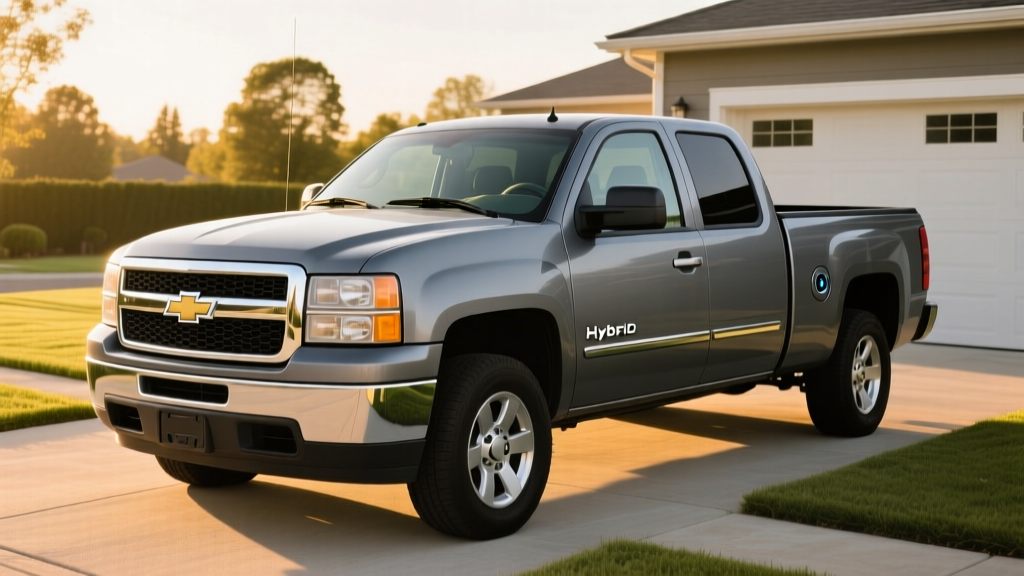
The 2009 Chevrolet Silverado Hybrid was one of the first full-size pickup trucks to pair a V8 engine with an electric motor system, delivering meaningful fuel economy gains over its gas-only siblings without sacrificing towing or payload capability. Today, it exists exclusively on the used market — and for buyers seeking a capable work truck with lower fuel costs, it remains a compelling option if you understand its strengths, limitations, and long-term reliability profile.
This was a conventional hybrid (HEV), not a plug-in hybrid (PHEV). It never needed to be plugged in. The truck recaptured energy through regenerative braking and used its electric motors to assist the 6.0L V8 during acceleration and enable engine-off driving at low speeds. The result was a real-world efficiency advantage that still holds up in stop-and-go driving nearly two decades later.
The 2009 Silverado Hybrid is a conventional hybrid (HEV). It charges its small battery pack entirely through regenerative braking and engine power. There is no plug, no electric-only range to speak of (brief low-speed electric assist only), and no eligibility for the federal §30D plug-in vehicle tax credit. A plug-in hybrid (PHEV), by contrast, has a larger battery you charge from a wall outlet and offers 20-50 miles of electric-only driving. The Silverado Hybrid predates mainstream PHEV trucks by more than a decade.
Powertrain and Hybrid System Specs
The 2009 Silverado Hybrid used GM's two-mode hybrid system — a sophisticated setup co-developed with BMW and Chrysler (then DaimlerChrysler). Unlike simpler mild-hybrid systems that only provide stop-start functionality, the two-mode system could propel the truck on electric power alone at low speeds, seamlessly blending electric and gasoline power through two distinct operating modes optimized for city and highway driving respectively.
| Specification | Value |
|---|---|
| Engine | 6.0L Vortec V8 (VVT, Active Fuel Management) |
| Engine Output | 332 hp @ 5,100 rpm / 367 lb-ft @ 4,100 rpm |
| Electric Motors | Two 60-kW motors integrated in transmission |
| Combined System Output | 379 hp |
| Transmission | Electrically Variable Transmission (EVT), two-mode |
| Hybrid Battery | ~1.8 kWh Nickel-Metal Hydride (NiMH), 300V |
| Drivetrain | Rear-wheel drive or 4WD (depending on trim) |
| Towing Capacity | Up to 6,100 lbs (properly equipped) |
| 0-60 mph | ~7.8 seconds |
The two-mode system was genuinely advanced for 2009. In Mode 1 (city driving), the truck could operate on electric power alone up to about 25 mph, with the V8 shutting off at stops and seamlessly restarting when needed. Mode 2 engaged at highway speeds, using the electric motors to supplement the V8 under load while also enabling cylinder deactivation (Active Fuel Management) to run the engine on four cylinders during light-load cruising.
Fuel Economy: EPA Ratings vs. Real-World MPG
Fuel economy was the entire reason the Silverado Hybrid existed. Compared to the standard 5.3L V8 Silverado of the same era (rated around 14 city / 20 highway), the hybrid delivered substantial gains — especially in urban driving where the two-mode system could maximize electric assist and engine-off time.
| Configuration | City MPG | Highway MPG | Combined MPG |
|---|---|---|---|
| 2WD Hybrid | 21 | 22 | 21 |
| 4WD Hybrid | 20 | 20 | 20 |
| 2WD Gas 5.3L V8 (comparison) | 15 | 20 | 17 |
Source: fueleconomy.gov — U.S. EPA official ratings.
EPA ratings tell part of the story, but hybrid trucks shine disproportionately in city driving. Many 2009 Silverado Hybrid owners have reported achieving 22-24 MPG in mixed suburban driving — slightly above the EPA combined figure — thanks to frequent stop-and-go conditions that maximize regenerative braking and electric-assist operation. On the highway at sustained 75+ mph speeds, expect the advantage to shrink: real-world highway figures often land around 19-21 MPG, closer to a conventional V8 Silverado. Towing will drop fuel economy to the mid-teens regardless of hybrid assist.
Hybrid Battery: Longevity, Warranty, and Replacement Cost
The 2009 Silverado Hybrid uses a Nickel-Metal Hydride (NiMH) battery pack rated at approximately 1.8 kWh and 300 volts. This is a small pack by modern standards — it exists to buffer regenerative energy and provide brief electric assist, not to store meaningful driving range. NiMH chemistry was the standard for hybrids of this era (the Toyota Prius used the same chemistry through 2015) and is known for predictable, gradual degradation rather than sudden failure.
GM originally warranted the hybrid battery and related components for 8 years / 100,000 miles on the 2009 Silverado Hybrid. Given the vehicle's age, most examples on the used market are well past original warranty coverage. However, NiMH hybrid batteries in GM two-mode systems have demonstrated strong longevity: many units remain functional past 150,000-200,000 miles with proper maintenance. Key factors affecting battery health include:
- Heat exposure: Prolonged high ambient temperatures accelerate NiMH degradation
- Usage patterns: Regular driving with frequent charge/discharge cycles actually preserves NiMH health better than long sit periods
- Cooling system maintenance: The hybrid battery has its own cooling fan — a clogged filter or failed fan can cause overheating and premature cell failure
If the hybrid battery does require replacement, expect costs in the range of $2,000-$4,000 for a refurbished or aftermarket pack, or $4,500-$6,500 for a new OEM unit through a dealer (parts and labor). Several aftermarket suppliers offer reconditioned NiMH packs specifically for the GM two-mode system. Independent hybrid-specialty shops can typically perform the swap in 2-3 hours.
Before purchasing a used 2009 Silverado Hybrid, have a qualified technician scan the hybrid battery state of health (SoH) using a diagnostic tool that can read individual cell voltages. Voltage imbalance between cells is the most reliable early indicator of impending battery issues.
Reliability and Common Issues
The 2009 Silverado Hybrid shares the GMT900 platform with its conventional counterparts, meaning the truck's core structure, suspension, and body are well-understood with abundant parts availability. The hybrid-specific components — the EVT transmission, electric motors, and battery pack — add complexity, but the two-mode system proved reasonably durable in fleet and owner use.
Common issues reported by owners and documented in service bulletins include:
- Hybrid battery cooling fan failure: The most frequent hybrid-specific issue. The cooling fan or its filter becomes clogged or fails, causing the battery to overheat and trigger reduced-power warnings. Repair cost: $300-$600.
- Active Fuel Management (AFM) lifter wear: The cylinder-deactivation system on the 6.0L V8 can develop lifter issues at high mileage, causing misfires. This affects both hybrid and non-hybrid GM V8s of this era. Repair cost: $1,500-$3,000 depending on severity.
- EVT transmission cooler line leaks: Transmission cooler lines can develop leaks at fittings. Catch early to avoid low-fluid damage to the EVT. Repair cost: $200-$500.
- 12V auxiliary battery drain: Like all hybrids, a failing 12V battery can cause cascading electrical gremlins. The 12V battery is separate from the 300V hybrid pack and is a standard replacement item.
- Standard GMT900 issues: Rust on rocker panels and wheel arches (especially in salt-belt states), power window regulator failures, and instrument cluster stepper motor failures are platform-wide concerns shared with gas-only models.
Overall, the 2009 Silverado Hybrid is not a fragile vehicle, but it does demand more informed maintenance than a conventional Silverado. Finding a technician familiar with the GM two-mode hybrid system is important — not every general repair shop has the diagnostic capability or training to service the high-voltage system safely.
Pricing and Tax Credit Eligibility (2026 Used Market)
The 2009 Chevrolet Silverado Hybrid originally carried an MSRP of approximately $38,000-$42,000 depending on configuration (2WD vs 4WD, crew cab vs extended cab). On the 2026 used market, examples typically list between $6,000 and $14,000 depending on mileage, condition, and location. Low-mileage, well-maintained 4WD crew cab models command the premium end of that range.
The 2009 Chevrolet Silverado Hybrid does not qualify for the federal §30D Clean Vehicle tax credit (up to $7,500). That credit applies only to plug-in electric vehicles (BEVs and PHEVs) with qualifying battery capacity and sourcing requirements. As a conventional HEV with no plug, the Silverado Hybrid is ineligible.
Additionally, the Used Clean Vehicle credit (up to $4,000 or 30% of sale price, per IRS guidelines) applies only to used plug-in EVs and PHEVs — not conventional hybrids. There is currently no federal tax incentive for purchasing a used HEV.
Some states or municipalities may offer registration discounts, HOV lane access, or other perks for hybrid vehicles. Check your state's DMV or energy office for current local programs.
Silverado Hybrid vs. Modern Alternatives: What Should You Buy?
The 2009 Silverado Hybrid was a trailblazer, but the truck market has evolved significantly. Here's how it compares to the options available to today's electrified-truck buyer:
| Factor | 2009 Silverado Hybrid (HEV) | 2025-2026 Ford F-150 PowerBoost (HEV) | 2025-2026 Silverado EV / F-150 Lightning (BEV) |
|---|---|---|---|
| Type | Conventional Hybrid | Conventional Hybrid | Battery Electric |
| Combined MPG / MPGe | 20-21 MPG | ~22-24 MPG | ~70-77 MPGe |
| Price Range | $6,000-$14,000 (used) | $55,000-$75,000 (new) | $50,000-$90,000 (new) |
| Federal Tax Credit | None | None (HEV) | Up to $7,500 (§30D, if eligible) |
| Towing | 6,100 lbs | ~11,000 lbs | 7,500-10,000 lbs |
| Fuel Cost per Mile | ~$0.17 (at $3.50/gal) | ~$0.15 (at $3.50/gal) | ~$0.04-$0.07 (home charging) |
Choose the 2009 Silverado Hybrid if: You need a low-cost, capable work truck for mixed city/highway driving; you don't have access to home or workplace charging; your budget is under $15,000; and you want V8 capability with a 20-25% fuel economy improvement over a gas-only truck of the same era.
Choose a modern hybrid truck (F-150 PowerBoost, etc.) if: You need a new-vehicle warranty, modern safety tech, significantly higher towing capacity, and you want hybrid efficiency without plug-in requirements — and your budget supports a $55,000+ purchase.
Choose a full EV truck (Silverado EV, F-150 Lightning, Rivian R1T) if: You have reliable Level 2 home charging, most of your driving is within 200-300 miles of home, you want the lowest per-mile fuel cost, and you're eligible for the §30D tax credit to offset the higher upfront price.
Who Should Buy the 2009 Silverado Hybrid?
This truck makes the most sense for a specific buyer profile:
- Budget-conscious truck buyers who need real truck capability (towing, payload, 4WD availability) but want to reduce fuel costs without paying the premium of a new hybrid or EV truck.
- Urban and suburban drivers who spend significant time in stop-and-go traffic, where the two-mode hybrid system delivers its greatest MPG advantage.
- Fleet operators managing work trucks that idle extensively — the hybrid system's engine-off capability at stops reduces fuel burn and engine wear during PTO and job-site idle time.
- Buyers without charging access — apartment dwellers or those without a garage who cannot install a Level 2 charger and are not candidates for a PHEV or BEV.
This truck is not the right choice if you do mostly highway-only driving (where the hybrid advantage shrinks), if you need maximum towing capacity (modern trucks far exceed the 6,100-lb rating), or if you want current-generation safety features like automatic emergency braking, lane-keeping assist, or adaptive cruise control — none of which were available on the 2009 Silverado.
Frequently Asked Questions
How many MPG does the 2009 Chevrolet Silverado Hybrid get?
The EPA rates the 2WD model at 21 city / 22 highway / 21 combined MPG, and the 4WD model at 20 city / 20 highway / 20 combined. In real-world mixed suburban driving, many owners report 22-24 MPG. Highway-only driving at high speeds may return 19-21 MPG. Towing drops fuel economy significantly, into the 13-16 MPG range.
Does the 2009 Silverado Hybrid need to be plugged in?
No. The 2009 Silverado Hybrid is a conventional hybrid (HEV), not a plug-in hybrid (PHEV). The battery charges entirely through regenerative braking and the gasoline engine. There is no charging port and no electric-only driving range beyond brief low-speed assist (under 25 mph for short distances).
How far can the 2009 Silverado Hybrid drive on electric power alone?
Effectively zero meaningful miles. The two-mode hybrid system can propel the truck on electric motors alone at very low speeds (under ~25 mph) for short distances — typically a few hundred yards in parking lots or heavy traffic. This is not a PHEV; there is no usable electric-only range. The electric motors exist to assist the V8 and improve efficiency, not to replace it.
Is the 2009 Silverado Hybrid reliable, and what does a battery replacement cost?
The GMT900 platform is generally robust, and the GM two-mode hybrid system has demonstrated good durability at high mileages when maintained properly. The most common hybrid-specific issue is the battery cooling fan, which is a relatively inexpensive repair ($300-$600). A full hybrid battery replacement runs $2,000-$4,000 for a refurbished pack or $4,500-$6,500 for new OEM. NiMH batteries in these trucks commonly last 150,000+ miles. Always have the battery SoH checked by a hybrid-qualified technician before purchase.
Does the 2009 Silverado Hybrid qualify for any federal tax credit?
No. The federal §30D Clean Vehicle credit applies only to plug-in electric vehicles (BEVs and PHEVs) meeting battery sourcing, MSRP cap, and buyer income requirements. As a conventional hybrid with no plug, the 2009 Silverado Hybrid is ineligible for both the new-vehicle credit and the Used Clean Vehicle credit (up to $4,000). Check your state's energy office for any local hybrid incentives, which vary by jurisdiction.
Can I still get parts and service for the hybrid system?
Yes, though it requires some effort. The GMT900 platform parts (suspension, brakes, body) are widely available. Hybrid-specific components — the EVT transmission, electric motors, and NiMH battery — are available through GM dealers, aftermarket suppliers, and hybrid-specialty shops. Not every independent mechanic is trained on high-voltage systems, so seek out a shop with hybrid certification or a GM dealer with hybrid-trained technicians.
For official EPA fuel economy data, visit fueleconomy.gov. For federal tax credit rules, consult the IRS Used Clean Vehicle Credit page and Clean Vehicle Credit page.