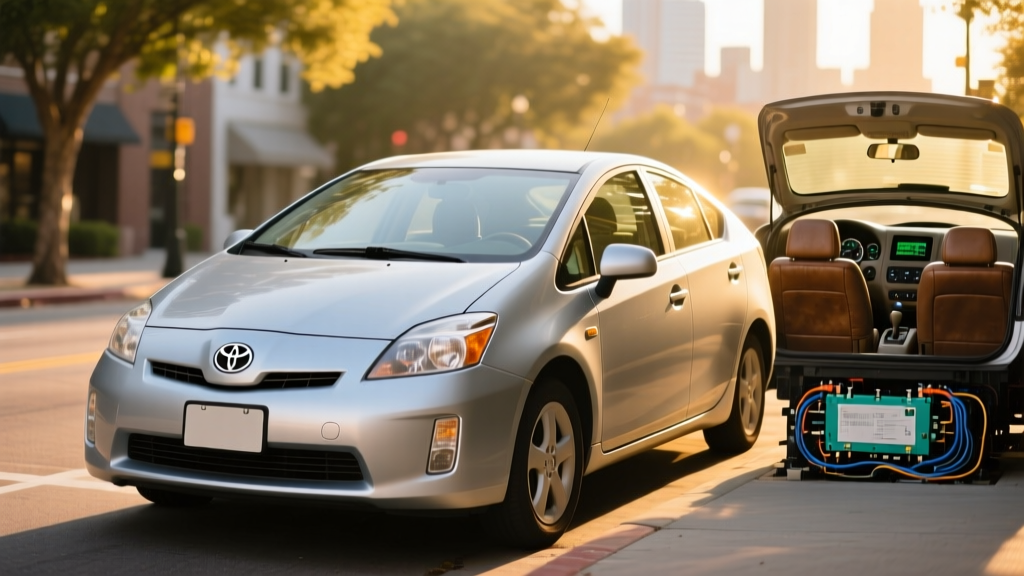
If you're researching the 2008 Toyota Prius hybrid in 2026, you're likely considering one of the most influential hybrid vehicles ever built — now available on the used market for a fraction of its original price. As a second-generation Prius (model code NHW20), the 2008 model represents the sweet spot of Toyota's early hybrid engineering: proven reliability, exceptional fuel economy, and a simplicity that modern hybrids have largely moved past.
This guide covers everything a used-car buyer needs to know: exact EPA and real-world MPG figures, the hybrid battery's remaining lifespan and replacement cost, how the 2008 Prius stacks up against 2026 hybrid and EV options, and whether this 18-year-old hybrid still makes financial sense today.
2008 Toyota Prius: HEV Basics and Powertrain Specs
Before evaluating the 2008 Prius, it's essential to clarify what it is — and what it isn't. The 2008 Toyota Prius is a conventional hybrid electric vehicle (HEV), not a plug-in hybrid (PHEV) or a battery electric vehicle (BEV). It cannot be plugged in to charge. Instead, its small nickel-metal hydride (NiMH) battery recharges through regenerative braking and the gasoline engine.
HEV vs. PHEV: What's the Difference?
| Feature | HEV (2008 Prius) | PHEV (e.g., 2026 Prius Prime) |
|---|---|---|
| Plug-in charging | No — never plugs in | Yes — Level 1 or Level 2 |
| Electric-only range | ~1 mile at low speed | ~44 miles (EPA) |
| Battery size | 1.3 kWh (NiMH) | 13.6 kWh (lithium-ion) |
| Gas engine | 1.5L 4-cylinder | 2.0L 4-cylinder |
| Combined HP | 110 hp | 220 hp |
| EPA combined MPG / MPGe | 46 MPG | 52 MPG / 127 MPGe |
2008 Prius Powertrain Breakdown
| Specification | 2008 Toyota Prius |
|---|---|
| Engine | 1.5L inline-4 (1NZ-FXE), Atkinson cycle |
| Engine output | 76 hp @ 5,000 rpm / 82 lb-ft torque |
| Electric motor | 50 kW (67 hp) permanent-magnet synchronous |
| Combined system output | 110 hp |
| Transmission | CVT (planetary gearset, e-CVT) |
| Hybrid battery | 1.3 kWh NiMH (28 modules, 7.2V nominal) |
| Drivetrain | Front-wheel drive |
| Curb weight | ~2,932 lbs |
| 0-60 mph | ~9.8 seconds |
| Original MSRP (2008) | $21,500 (base) – $23,570 (Touring) |
| 2026 used price range | $3,500 – $7,500 (private party) |
The 2008 Prius uses Toyota's Hybrid Synergy Drive (HSD) system, which seamlessly blends the gasoline engine and electric motor through a planetary gearset — no traditional transmission or clutch. This mechanical simplicity is a key reason the drivetrain has proven remarkably durable over nearly two decades of real-world use.
Fuel Economy: EPA Ratings vs. Real-World MPG
Fuel economy is the reason the Prius exists. For the 2008 model year, the EPA revised its testing methodology, producing more realistic (and lower) numbers than the pre-2008 estimates many owners remember.
| Driving Cycle | EPA Rating (2008 Prius) | Real-World Expectation |
|---|---|---|
| City | 48 MPG | 45–52 MPG |
| Highway | 45 MPG | 40–47 MPG |
| Combined | 46 MPG | 42–50 MPG |
Source: fueleconomy.gov — 2008 Toyota Prius
Why Real-World MPG Varies
The 2008 Prius is one of the few vehicles where city MPG often exceeds highway MPG. This is because the hybrid system recovers energy during stop-and-go braking and allows the engine to shut off at low speeds and at stops. On sustained highway runs above 70 mph, aerodynamic drag and the engine's continuous load reduce efficiency.
Key factors that affect your actual fuel economy:
- Tire condition: The Prius originally shipped with low-rolling-resistance (LRR) tires. Replacement with standard all-season tires can reduce MPG by 2–4 MPG.
- Hybrid battery health: A degraded NiMH battery forces the engine to run more frequently to maintain charge, reducing efficiency by 3–8 MPG depending on degradation severity.
- Climate: Cold weather below 40°F reduces MPG by 5–10% due to longer engine warm-up cycles and increased cabin heater use (the 2008 Prius uses engine waste heat, not an electric heater).
- Driving style: Aggressive acceleration defeats the hybrid system's efficiency advantage. Smooth, moderate driving maximizes regenerative braking and electric-only operation.
Real-World Fuel Cost (2026)
At a national average of $3.20/gallon (regular unleaded) and 46 MPG combined, the 2008 Prius costs approximately $0.069 per mile in fuel. For a driver covering 12,000 miles annually, that's roughly $835 per year in gasoline — about $600–$800 less than a comparable 2008 gas-only midsize sedan averaging 24 MPG combined.
Hybrid Battery: Lifespan, Degradation, and Replacement Cost
For any used hybrid buyer, the traction battery is the single largest financial risk. The 2008 Prius uses a 28-module nickel-metal hydride (NiMH) battery pack rated at 1.3 kWh total capacity. Unlike modern lithium-ion packs, NiMH chemistry degrades more gradually and predictably — but after 18 years, most original batteries are at or beyond end-of-life.
How Long Does the 2008 Prius Battery Last?
Toyota's original warranty covered the hybrid battery for 8 years / 100,000 miles (10 years / 150,000 miles in California and states adopting CARB emissions standards). That warranty expired long ago for every 2008 Prius on the road.
In practice, data from Prius owner communities and salvage yards shows:
- Original batteries in moderate climates: 12–15 years or 150,000–200,000 miles before significant degradation
- Original batteries in hot climates (AZ, TX, FL): 8–12 years due to heat accelerating NiMH cell degradation
- Mileage at failure: Failures have been reported anywhere from 100,000 to 250,000+ miles — usage patterns and climate matter more than odometer reading
Battery Replacement Options and Costs (2026)
| Option | Cost Range | Warranty | Notes |
|---|---|---|---|
| New OEM Toyota battery | $2,200 – $2,800 (installed) | 1 year / unlimited miles | Available through Toyota dealers; increasingly scarce for Gen 2 |
| Refurbished/reconditioned pack | $800 – $1,400 (installed) | 1–3 years | Replaced weak modules; quality varies by shop |
| Aftermarket new pack (e.g., Dorman) | $1,500 – $2,200 (installed) | 3 years / limited miles | New NiMH modules; good middle ground |
| Used/salvage yard pack | $300 – $600 + install | 30–90 days | Highest risk — unknown remaining life |
| DIY module replacement | $100 – $250 (parts only) | None | Replace individual bad modules; requires high-voltage safety knowledge |
Critical safety note: The Prius hybrid battery operates at approximately 200V DC. Any work on the battery pack requires proper high-voltage safety procedures, including insulated gloves and disconnecting the service plug. If you're not trained in HV systems, use a qualified hybrid repair shop.
Signs the Hybrid Battery Is Failing
- Rapid state-of-charge fluctuations on the dashboard display (bars jumping from full to near-empty)
- Engine running constantly, even at stops or low speeds
- Noticeable drop in fuel economy (5+ MPG below normal)
- Check engine light with codes P0A80 (replace hybrid battery) or individual module voltage codes (P0A7F–P0A8A range)
- Cooling fan for the battery running loudly and continuously
Reliability and Long-Term Ownership Costs
The 2008 Toyota Prius has one of the strongest long-term reliability records of any vehicle from its era. The planetary e-CVT has no belts, bands, or clutches to wear out. The Atkinson-cycle engine runs under lighter loads than a conventional engine. And the overall simplicity of the Hybrid Synergy Drive means fewer failure points.
According to data aggregated by owner surveys and repair databases, common issues on the 2008 Prius include:
- Hybrid battery degradation (expected at this age — see above)
- Combination meter (dashboard) failure: A known issue where the instrument cluster goes dark or displays incorrectly. Repair: $200–$500 for a refurbished unit.
- Water pump (electric, for inverter cooling): Can fail around 120,000–160,000 miles. Part cost ~$80–$150; labor ~$100–$200.
- Brake actuator: The regenerative braking system's actuator can develop issues at high mileage. This is a more expensive repair ($800–$1,500) but relatively uncommon.
- 12V auxiliary battery: Located in the rear cargo area, this standard lead-agid battery typically lasts 3–5 years and costs $150–$250 to replace. It powers electronics and the ECU — a dead 12V battery will prevent the car from starting even if the hybrid battery is fully charged.
Beyond these known items, the 2008 Prius is a low-maintenance vehicle. There is no transmission fluid to change (the e-CVT uses Toyota ATF WS, checked but rarely replaced), no starter motor, no alternator, and no serpentine belt. Routine maintenance is limited to oil changes (5W-30, every 5,000 miles), tire rotations, brake inspections (regenerative braking extends pad life to 80,000+ miles in many cases), and cabin air filter replacement.
2008 Prius vs. Modern Hybrids and EVs: What's Changed
The hybrid landscape has transformed dramatically since 2008. Here's how the second-generation Prius compares to what you can buy new in 2026:
| Vehicle | Type | EPA Combined | Combined HP | Starting Price (2026) |
|---|---|---|---|---|
| 2008 Toyota Prius | HEV | 46 MPG | 110 hp | $3,500–$7,500 (used) |
| 2026 Toyota Prius LE | HEV | 57 MPG | 194 hp | ~$29,445 |
| 2026 Toyota Prius Prime | PHEV | 52 MPG / 127 MPGe | 220 hp | ~$34,445 |
| 2026 Hyundai Elantra Hybrid | HEV | 54 MPG | 139 hp | ~$27,500 |
| 2026 Chevrolet Equinox EV | BEV | 315 mi range (3.2 mi/kWh) | 213 hp | ~$34,900 |
The gains are substantial: the 2026 Prius delivers 24% better fuel economy with 76% more horsepower, thanks to a lighter lithium-ion battery, a more efficient 2.0L Dynamic Force engine, and improved aerodynamics. The Prius Prime adds 44 miles of electric-only range — enough for most commutes without using any gasoline.
Tax Credit Eligibility
The 2008 Toyota Prius does not qualify for any federal tax credit in 2026. The original §30D federal hybrid credit for the Prius was phased out for Toyota in 2007 after the manufacturer exceeded the 60,000-vehicle cap. As a used vehicle, it does not qualify for the current used-EV credit (which applies only to BEVs and PHEVs under $25,000, per IRS guidelines).
If you're considering a new 2026 Prius Prime (PHEV), it may qualify for up to $3,750 in federal tax credit under current §30D rules, depending on battery sourcing requirements and your income level (capped at $150,000 AGI for single filers, $300,000 for joint filers). The conventional 2026 Prius HEV does not qualify for any federal credit. Always verify current eligibility on irs.gov before purchasing.
Who Should Buy the 2008 Prius — And Who Shouldn't
Pros
- Exceptional fuel economy (46 MPG combined) for a vehicle costing under $7,500
- Proven long-term reliability; 200,000+ mile examples are common
- Low annual maintenance costs — no transmission, starter, or alternator
- Spacious hatchback cargo area (50.2 cu ft with rear seats folded)
- Strong regenerative braking extends brake pad life significantly
- Simple to work on; extensive online repair community
Cons
- Hybrid battery replacement likely needed if original — $800–$2,800
- Very slow by modern standards (0-60 in ~9.8 seconds)
- No modern safety features (no backup camera, no AEB, no lane-keeping)
- Dated interior with hard plastics and limited tech
- NiMH battery limits electric-only operation to ~1 mile at very low speed
- No plug-in capability; cannot access HOV lane stickers in most states
Choose the 2008 Prius If:
- You need the cheapest possible transportation with the lowest fuel cost
- You're comfortable with the risk of a hybrid battery replacement
- You drive primarily in city/suburban stop-and-go traffic (where the hybrid system shines)
- You want a reliable commuter car and can accept the absence of modern safety tech
- You're mechanically inclined or have access to a hybrid-competent repair shop
Look at a Modern Hybrid or EV Instead If:
- Safety is a priority — modern vehicles offer AEB, blind-spot monitoring, and better crash structures
- You want to eliminate gasoline entirely (consider a BEV like the Equinox EV or used Tesla Model 3)
- You want electric-only commuting (the Prius Prime offers 44 miles of EV range)
- You plan to keep the car 10+ years and want a fresh battery with full warranty
- You qualify for federal tax credits on a new PHEV or BEV
Buying Checklist for a Used 2008 Prius
If you've decided the 2008 Prius fits your needs, use this checklist when evaluating a specific vehicle:
- Check hybrid battery health: Use an OBD-II scanner with hybrid-specific capabilities (e.g., Techstream or an aftermarket app like Dr. Prius) to read individual module voltages. Healthy modules should be within 0.2V of each other.
- Verify maintenance records: Regular oil changes (5W-30) are critical. Neglected oil changes accelerate engine wear and can contaminate the hybrid system.
- Inspect the inverter coolant: The inverter cooling system should have clean, pink Toyota Super Long Life Coolant. Brown or murky fluid indicates neglect.
- Test the regenerative braking: On a safe downhill, the car should slow noticeably when you lift off the accelerator. If regen feels weak, the hybrid battery may not be accepting charge properly.
- Check for warning lights: A check engine light, red triangle (master warning), or hybrid system warning on the dash should be diagnosed before purchase. These can indicate expensive battery or inverter issues.
- Evaluate the 12V battery: If the car is slow to "start" (ready to drive) or the dashboard flickers, the 12V battery may be weak — a $150–$250 fix, but a negotiation point.
- Verify title status: Salvage or rebuilt titles on a 2008 Prius often indicate a prior hybrid battery failure that was cheaply patched. Proceed with caution.
Frequently Asked Questions
How many MPG does the 2008 Toyota Prius hybrid get?
The EPA rates the 2008 Prius at 48 MPG city, 45 MPG highway, and 46 MPG combined. In real-world driving, most owners report 42–50 MPG combined depending on driving style, tire selection, climate, and hybrid battery health. City driving tends to yield higher MPG than highway driving due to regenerative braking.
Does the 2008 Prius need to be plugged in?
No. The 2008 Prius is a conventional hybrid (HEV). It has no plug and no external charging capability. The hybrid battery charges exclusively through regenerative braking and the gasoline engine. You simply fill it with regular unleaded gasoline.
How far can the 2008 Prius drive on electric power alone?
Approximately 0.5 to 1 mile at very low speeds (under 25 mph) under light load with a fully charged hybrid battery. This is not comparable to a PHEV — the 2008 Prius cannot sustain electric-only driving for any meaningful distance. The electric motor primarily assists the gasoline engine and enables engine-off coasting and stops.
What does it cost to replace the hybrid battery in a 2008 Prius?
Replacement costs range from $300–$600 for a used salvage pack (high risk) to $2,200–$2,800 for a new OEM Toyota battery installed at a dealer. The most popular option in 2026 is a refurbished or aftermarket new pack at $800–$2,200 installed. DIY module replacement is possible for $100–$250 in parts but requires high-voltage safety training.
Is the 2008 Toyota Prius reliable?
Yes. The 2008 Prius is widely regarded as one of the most reliable vehicles of its era. The e-CVT transmission has no wearable friction components, the engine runs under reduced stress, and the overall system has fewer failure points than a conventional drivetrain. With proper maintenance, 200,000–300,000 mile examples are common. The primary reliability concern at this age is hybrid battery degradation, which is a predictable and repairable issue.
Does the 2008 Prius qualify for any tax credit in 2026?
No. The original federal hybrid tax credit for the Toyota Prius was phased out in 2007 when Toyota exceeded the manufacturer cap. As a used vehicle, the 2008 Prius also does not qualify for the current federal used clean vehicle credit (which applies only to qualifying used BEVs and PHEVs under $25,000). No state incentives apply to the purchase of a used HEV in most jurisdictions.
Hybrid vs. PHEV vs. EV — which should I choose?
Choose a conventional hybrid (HEV) like the 2008 Prius if you want maximum fuel savings with zero behavior change — no charging, no range planning, just fill up with gas. Choose a PHEV like the Prius Prime if you have home charging access and want electric-only commuting with a gas backup for road trips. Choose a full EV (BEV) if you want zero tailpipe emissions, the lowest per-mile energy cost, and have reliable home or workplace charging. For budget buyers spending under $8,000, a used HEV like the 2008 Prius remains the most accessible path to high-efficiency driving.
The 2008 Toyota Prius hybrid remains a rational, data-backed choice for budget-conscious drivers who prioritize fuel economy and low operating costs above all else. It won't impress with performance or technology, but at $3,500–$7,500 with 46 MPG and Toyota reliability, it delivers one of the lowest total cost-per-mile figures of any vehicle on the road in 2026.