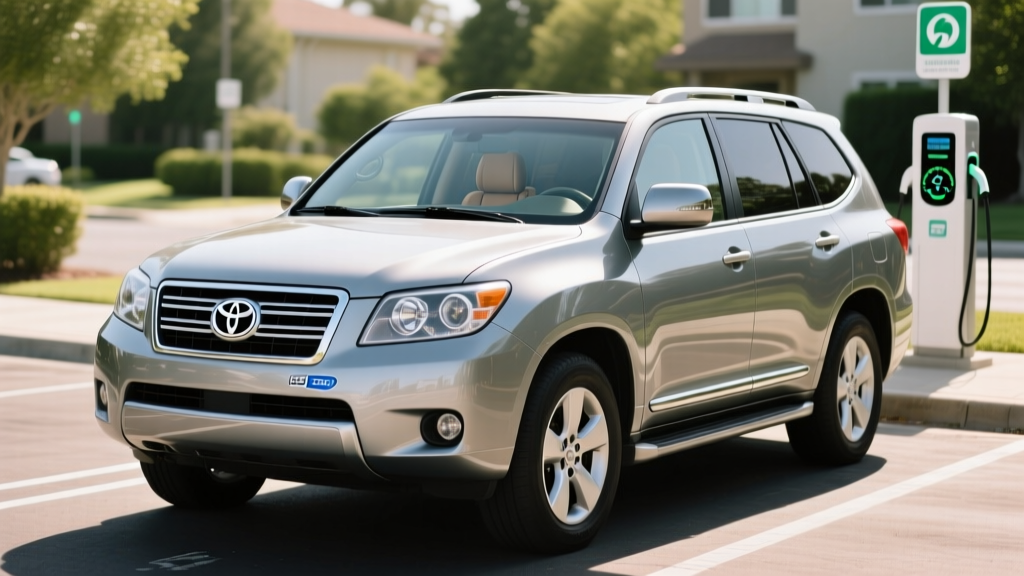
If you are browsing the used market for a midsize family hauler with electrified efficiency, the 2008 Toyota Highlander Hybrid SUV frequently appears as a budget-friendly option. Nearly two decades after it rolled off the line, this second-generation hybrid remains on the road in surprising numbers. But as a conventional hybrid (HEV)—not a plug-in—its value proposition in 2026 hinges on three things: real-world fuel economy, the condition of its aging nickel-metal hydride (NiMH) battery, and how it compares to modern hybrids, PHEVs, and full EVs.
This guide breaks down the exact specs, ownership costs, and reliability data you need before handing over cash for a 2008 Highlander Hybrid.
HEV vs PHEV vs EV: Where the 2008 Highlander Hybrid Fits
Before examining the numbers, it is critical to understand what this vehicle is—and what it is not.
Conventional Hybrid (HEV) — 2008 Highlander Hybrid
The 2008 Highlander Hybrid is a self-charging conventional hybrid. It uses a gasoline engine paired with electric motor-generators and a small NiMH battery pack. You never plug it in. The battery recharges through regenerative braking and engine power. It cannot drive on electric power alone for meaningful distances—only at very low speeds for short bursts.
Plug-In Hybrid (PHEV)
A PHEV (like the current Toyota RAV4 Prime or the 2026 Highlander Hybrid's modern equivalents) has a larger battery (typically 15–20 kWh) that you plug in to charge. It offers 30–45 miles of electric-only range before the gas engine kicks in. The 2008 Highlander Hybrid does not offer this capability.
Battery Electric Vehicle (BEV)
A full EV (Tesla Model Y, Hyundai Ioniq 5, etc.) has no gas engine at all. It runs entirely on a large battery pack (60–100+ kWh) charged from the grid. Zero tailpipe emissions, but requires access to charging infrastructure.
The 2008 Highlander Hybrid sits at the entry point of electrification: it reduces fuel consumption compared to its gas-only sibling but requires zero change to your refueling habits.
Fuel Economy: EPA Ratings and Real-World MPG
The 2008 Toyota Highlander Hybrid is powered by Toyota's Hybrid Synergy Drive system pairing a 3.3-liter V6 engine with front and rear electric motor-generators for electronic on-demand all-wheel drive (AWD-i). Here is how the EPA rates it, alongside the gas-only 2008 Highlander V6 AWD for comparison:
| Model | City MPG | Highway MPG | Combined MPG |
|---|---|---|---|
| 2008 Highlander Hybrid AWD-i | 25 | 26 | 26 |
| 2008 Highlander V6 AWD (gas only) | 17 | 22 | 19 |
Source: EPA Fuel Economy Guide
Real-World MPG Expectations in 2026
The EPA combined rating of 26 MPG was competitive for a 4,500-pound, three-row SUV in 2008. In real-world driving, owners consistently report:
- City driving: 24–27 MPG. Hybrids shine in stop-and-go traffic where regenerative braking recaptures energy and the engine shuts off at stops. Some owners report slightly exceeding the EPA city figure.
- Highway driving: 23–26 MPG. At sustained highway speeds, the gasoline engine does most of the work. The hybrid advantage narrows considerably.
- Combined real-world average: Most owners land between 23–26 MPG depending on driving style, terrain, and climate.
- Cold weather penalty: Expect a 10–15% drop in winter months (roughly 20–23 MPG combined) as the engine runs more frequently to provide cabin heat and the battery operates less efficiently at low temperatures.
With a 17.2-gallon fuel tank, real-world total range falls between 390–440 miles per tank.
Powertrain Specs and Performance
| Specification | 2008 Highlander Hybrid |
|---|---|
| Engine | 3.3L V6 (3MZ-FE) |
| Engine horsepower | 208 hp @ 5,600 rpm |
| Front electric motor | 123 kW (165 hp) |
| Rear electric motor | 50 kW (67 hp) |
| Net system horsepower | 270 hp |
| Transmission | eCVT (electronically controlled continuously variable) |
| Drivetrain | AWD-i (electronic on-demand AWD) |
| 0–60 mph | ~7.8 seconds |
| Towing capacity | 3,500 lbs |
| Curb weight | ~4,570 lbs |
| Seating | 7 passengers (3 rows) |
The combined 270 net horsepower made the 2008 Highlander Hybrid one of the quickest hybrid SUVs of its era. The rear electric motor provides torque to the rear axle only when slip is detected—there is no mechanical driveshaft connecting front and rear axles. This "AWD-i" system is effective in rain and light snow but is not designed for serious off-road use.
Hybrid Battery: Size, Lifespan, and Replacement Cost
The 2008 Highlander Hybrid uses a nickel-metal hydride (NiMH) battery pack, not the lithium-ion chemistry found in modern hybrids and EVs. This is an important distinction for used buyers.
| Battery Specification | Detail |
|---|---|
| Chemistry | NiMH (nickel-metal hydride) |
| Nominal voltage | 288V (240 cells × 1.2V) |
| Capacity | ~6.5 Ah (approximately 1.9 kWh total) |
| Location | Under second-row seat |
| Plug-in charging | No — recharges via regen braking and engine |
Original Battery Warranty
Toyota originally warranted the hybrid battery for 8 years / 100,000 miles (extended to 10 years / 150,000 miles in California Air Resources Board states). For a 2008 model, the original factory warranty expired no later than 2018. Any battery coverage on a used 2008 Highlander Hybrid today comes from an aftermarket warranty, a replacement battery's own warranty, or is entirely out-of-pocket.
How Long Does the Hybrid Battery Last?
Based on owner reports, fleet data, and repair shop surveys, the NiMH battery in the 2008 Highlander Hybrid typically lasts 150,000–200,000 miles or 12–18 years before significant degradation triggers a check-engine light or noticeable fuel-economy decline. Since we are now in 2026, most surviving examples are 18 years old and many are on their original battery—meaning replacement risk is elevated.
Signs of hybrid battery degradation include:
- Reduced fuel economy (dropping below 22 MPG combined)
- More frequent engine cycling on and off
- Hybrid system warning light or check-engine light (common codes: P0A80, P0A7F)
- Rear HVAC fan running constantly (battery cooling fan working overtime due to cell imbalance)
Battery Replacement Cost
| Option | Estimated Cost (2026) | Warranty |
|---|---|---|
| New OEM Toyota battery | $3,000–$4,000 (parts + labor) | Typically 1–3 years |
| Remanufactured battery | $1,800–$2,800 (parts + labor) | Typically 1–3 years |
| Individual cell/module replacement | $800–$1,500 (specialist shop) | Varies (often 6–12 months) |
| Used/salvage yard battery | $500–$1,000 (parts + labor) | Usually 30–90 days |
For a vehicle with a typical used-market value of $5,000–$9,000 in 2026, a full OEM battery replacement can consume 30–60% of the vehicle's value. This is the single most important cost factor when evaluating a 2008 Highlander Hybrid.
Buyer tip: Before purchasing, have a hybrid-specialist shop perform a battery health check. Many shops can read individual cell voltages and internal resistance to assess remaining life. A scan tool reading of all 40 modules showing voltages within 0.2V of each other suggests a healthy pack.
Reliability, Maintenance, and Known Issues
The 2008 Highlander Hybrid benefits from Toyota's reputation for hybrid powertrain durability. The 3MZ-FE V6 engine is generally robust, and the eCVT transmission has no traditional gears, bands, or clutches to wear out—it is one of the most reliable transmission designs in the industry.
Common Issues to Watch For
- Hybrid battery degradation: As discussed, the highest-cost risk on an 18-year-old vehicle.
- Hybrid inverter coolant pump: The electric water pump circulating coolant through the inverter can fail. Replacement runs $400–$700. Check for coolant leaks near the inverter (passenger-side engine bay).
- Brake actuator assembly: The regenerative braking system uses an electro-hydraulic brake actuator that can develop faults at higher mileage. Replacement is $1,200–$2,000. A firm, unresponsive brake pedal or brake warning light signals potential trouble.
- Power steering: Electric power steering rack can develop leaks or sensor faults. Budget $600–$1,200 for replacement if needed.
- Rust: As with any 2008-era vehicle, inspect the undercarriage, rocker panels, and wheel arches for corrosion—especially in Rust Belt or coastal states.
According to data aggregated by owner communities and repair databases, the 2008 Highlander Hybrid rates as above average in reliability for its age class, provided the hybrid battery and brake actuator remain in good condition.
Pricing, Tax Credits, and Total Ownership Cost
Used Market Pricing (2026)
| Condition / Mileage | Typical Asking Price |
|---|---|
| Excellent, under 120k miles, battery verified healthy | $7,500–$9,500 |
| Good, 120k–170k miles, original battery | $5,500–$7,500 |
| Fair, 170k+ miles or battery recently replaced | $3,500–$5,500 |
| Project / battery failure | $1,500–$3,500 |
Tax Credit Eligibility
The 2008 Toyota Highlander Hybrid does not qualify for any federal tax credit in 2026. Here is why:
- New vehicle credit (IRS §30D): This credit applies only to the purchase of new qualifying plug-in electric vehicles or fuel cell vehicles. A conventional hybrid (HEV) that cannot be plugged in does not qualify, and the 2008 model year is long discontinued.
- Used EV credit (IRS §25E): This credit of up to $4,000 (30% of sale price, capped) applies only to used plug-in electric vehicles or fuel cell vehicles purchased from a dealer for $25,000 or less. The 2008 Highlander Hybrid is a conventional hybrid—it has no plug and no qualifying battery capacity under §25E rules.
- Original hybrid credit: When new, the 2008 Highlander Hybrid qualified for a federal income tax credit of up to $2,200 under the Energy Policy Act of 2005. However, Toyota's credit phase-out threshold was reached in 2007, meaning most 2008 buyers received a reduced credit or none at all. This credit is long expired regardless.
For current federal incentive rules, always check the IRS Clean Vehicle Credits page and consult a tax professional.
Annual Fuel Cost Estimate
Assuming 15,000 miles per year, 25 MPG combined, and $3.40/gallon gasoline (2026 national average estimate):
- Annual fuel cost: ~$2,040
- Monthly fuel cost: ~$170
- Cost per mile: ~$0.136
For comparison, the gas-only 2008 Highlander V6 AWD at 19 MPG combined would cost approximately $2,684/year in fuel—meaning the hybrid saves roughly $644 per year at the pump.
2008 Highlander Hybrid vs Modern Alternatives in 2026
If you are cross-shopping the 2008 Highlander Hybrid, you are likely also considering newer used hybrids, modern PHEVs, or entry-level EVs. Here is how the options stack up:
| Vehicle | Type | Combined MPG / Range | Typical Used Price (2026) | Plug Required? |
|---|---|---|---|---|
| 2008 Toyota Highlander Hybrid | HEV | 26 MPG combined | $4,000–$9,500 | No |
| 2020 Toyota Highlander Hybrid | HEV | 35 MPG combined | $28,000–$36,000 | No |
| 2023 Toyota RAV4 Prime | PHEV | 42 mi electric + 38 MPG | $36,000–$44,000 | Yes (Level 1/2) |
| 2022 Hyundai Tucson PHEV | PHEV | 33 mi electric + 35 MPG | $26,000–$33,000 | Yes (Level 1/2) |
| 2021 Tesla Model Y LR | BEV | 326 mi EPA range | $28,000–$35,000 | Yes (Level 2/DC) |
Pros: 2008 Highlander Hybrid
- Low purchase price — one of the cheapest 7-seat hybrid SUVs available
- No plug-in infrastructure required — refuel at any gas station
- Proven, durable eCVT powertrain with 270 net hp
- AWD capability for rain and light snow
- 3,500-lb towing capacity exceeds most modern hybrid crossovers
- Parts availability remains strong through Toyota's dealer network and aftermarket
Cons: 2008 Highlander Hybrid
- Hybrid battery replacement risk is high at 18 years old ($2,000–$4,000)
- 26 MPG combined is modest by 2026 standards (modern Highlander Hybrid: 35 MPG)
- No electric-only driving range — always burning gasoline
- No federal or state tax credits available
- Outdated infotainment, no Apple CarPlay/Android Auto, basic safety tech
- NiMH battery chemistry is less efficient and more temperature-sensitive than modern lithium-ion
Decision Framework: Who Should Buy the 2008 Highlander Hybrid?
Choose the 2008 Highlander Hybrid if:
- Your budget is under $8,000 and you need three rows of seating
- You cannot install a home charger and lack access to public charging
- You drive mostly in the city where hybrid efficiency is strongest
- You are mechanically inclined or have access to a hybrid-specialist shop
- You need AWD and moderate towing capability without a truck's fuel bill
Choose a newer hybrid (2018+ Highlander Hybrid) if:
- You can spend $25,000+ and want modern safety features (automatic emergency braking, lane-keeping)
- You want 35 MPG combined and a battery with significant remaining warranty life
- You plan to keep the vehicle 5+ years and want to avoid immediate battery replacement risk
Choose a PHEV (RAV4 Prime, Tucson PHEV) if:
- You can charge at home (Level 1 or Level 2 outlet)
- Your daily commute is under 35 miles and you want electric-only driving most days
- You want to significantly reduce gasoline consumption while keeping a gas engine for road trips
Choose a full EV (Model Y, Ioniq 5) if:
- You have reliable home Level 2 charging access
- You want the lowest per-mile operating cost (~$0.04–$0.08/mile on electricity vs $0.14/mile on gas)
- You are ready to commit to charging logistics and accept current range limitations on road trips
Frequently Asked Questions
How many MPG does the 2008 Toyota Highlander Hybrid get?
The EPA rates it at 25 city / 26 highway / 26 combined. In real-world driving, most owners average 23–26 MPG combined, with city driving often matching or slightly exceeding the EPA figure and highway driving sometimes falling a bit short. Expect a 10–15% reduction in cold winter months.
Can the 2008 Highlander Hybrid drive on electric power only?
Only in very limited circumstances—at extremely low speeds (under 25 mph), with a light throttle, and with a sufficiently charged hybrid battery. This is not a meaningful electric-only range. Unlike a PHEV, it has no plug and no usable EV mode for commuting. You will burn gasoline on virtually every trip.
Is the 2008 Highlander Hybrid reliable, and what does a battery replacement cost?
The powertrain (engine + eCVT) is highly reliable. The main risk is the 18-year-old NiMH hybrid battery. If it fails, replacement costs $1,800–$4,000 depending on whether you choose remanufactured, new OEM, or individual cell repair. The brake actuator ($1,200–$2,000) and inverter coolant pump ($400–$700) are other potential expenses. Have a hybrid specialist inspect the battery before purchase.
Does the 2008 Highlander Hybrid qualify for any tax credit?
No. It is a conventional hybrid (HEV), not a plug-in vehicle. The federal §30D new vehicle credit and §25E used EV credit both require plug-in electric capability. The original hybrid tax credit available when the vehicle was new expired for Toyota in 2007 and is no longer claimable regardless. Check IRS.gov for current credit rules.
Is it worth buying a 2008 Highlander Hybrid in 2026?
It can be, if the price is right and the battery checks out. At $5,000–$7,000 with a verified healthy battery, it offers three-row seating, AWD, and 26 MPG for a fraction of what a modern equivalent costs. However, budget at least $2,000 in reserve for potential battery or brake actuator repair. If the battery has already been replaced with a quality unit and warranty, the value proposition improves significantly. If the asking price approaches $9,000+ on an original battery, you are taking on substantial risk and may be better served by a newer used hybrid.
How does the 2008 Highlander Hybrid compare to the current Highlander Hybrid?
The 2025–2026 Toyota Highlander Hybrid uses a 2.5L 4-cylinder hybrid system producing 243 net hp with an EPA rating of 35 MPG combined—a 35% improvement in fuel efficiency. It also features a lithium-ion battery, modern safety systems (Toyota Safety Sense 2.5+), Apple CarPlay/Android Auto, and a full factory warranty. The trade-off is price: a new Highlander Hybrid starts around $42,000, roughly 5–8 times the cost of a used 2008 model.
Sources: EPA Fuel Economy, IRS Clean Vehicle Credits, NHTSA