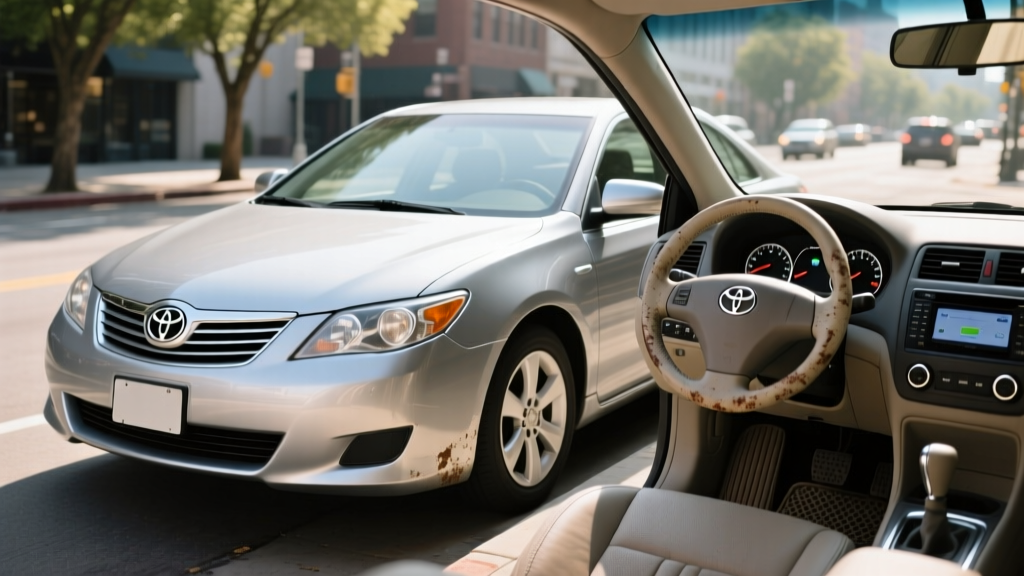
If you are shopping the used hybrid market for a dependable midsize sedan, the 2008 Toyota Camry Hybrid sedan remains one of the most frequently recommended vehicles on the list. Nearly two decades after it rolled off the assembly line, this second-generation Camry Hybrid continues to deliver impressive fuel economy, Toyota's legendary reliability, and a cost of entry that undercuts nearly every modern hybrid on the market. But with a nickel-metal hydride (NiMH) battery that is now well past its original warranty window, prospective buyers need to go in with eyes wide open about battery health, replacement costs, and what real-world MPG actually looks like in 2026.
This guide covers everything a used-car buyer needs to know: EPA versus real-world fuel economy, powertrain specs, battery longevity, ownership costs, and how the 2008 Camry Hybrid stacks up against newer hybrids, plug-in hybrids, and full battery-electric vehicles.
2008 Toyota Camry Hybrid Sedan: Key Specifications at a Glance
| Specification | 2008 Toyota Camry Hybrid |
|---|---|
| Powertrain Type | Conventional Hybrid (HEV) — no plug-in |
| Gas Engine | 2.4L inline-4 (2AZ-FXE), 147 hp @ 6,000 rpm |
| Electric Motor | Permanent-magnet synchronous, 40 hp (30 kW) |
| Combined Net Horsepower | 192 hp |
| Transmission | eCVT (electronically controlled CVT) |
| Hybrid Battery | NiMH, ~1.6 kWh (gross), sealed |
| Drivetrain | Front-wheel drive |
| EPA Fuel Economy (City/Hwy/Combined) | 33 / 34 / 34 MPG |
| Fuel Tank Capacity | 17.2 gallons |
| Total Driving Range | ~585 miles (EPA combined) |
| 0–60 mph | ~8.4 seconds (est.) |
| Cargo Volume | 10.6 cu ft (trunk) |
| Original MSRP (Base) | ~$26,480 |
| Current Used Price Range (2026) | $4,000 – $8,500 |
How Many MPG Does the 2008 Camry Hybrid Actually Get?
The EPA rates the 2008 Toyota Camry Hybrid at 33 MPG city, 34 MPG highway, and 34 MPG combined. These figures come from the U.S. Department of Energy's fueleconomy.gov database, the authoritative source for standardized fuel-economy testing.
| Driving Condition | EPA Estimate | Real-World Expectation (2026) |
|---|---|---|
| City | 33 MPG | 31–36 MPG |
| Highway | 34 MPG | 30–33 MPG |
| Combined | 34 MPG | 31–34 MPG |
Real-World MPG: What Owners Actually Report
Like most Toyota hybrids, the 2008 Camry Hybrid tends to perform close to — or slightly above — its EPA city rating in stop-and-go driving, where regenerative braking and electric-motor assist do the most work. On the highway, however, the advantage narrows. At sustained speeds above 70 mph, the gasoline engine carries the majority of the load, and the hybrid system provides less benefit.
Owner-reported data on platforms like Fuelly consistently show combined averages in the 30–35 MPG range, with some hypermilers reporting figures in the upper 30s during warm-weather city commutes. Cold weather, aggressive driving, and hilly terrain will push figures toward the low end. For a vehicle that is now 18 years old, maintaining fuel economy near the EPA estimate depends heavily on maintenance — particularly tire pressure, air filter condition, and hybrid battery health.
Conventional Hybrid (HEV) vs. Plug-In Hybrid (PHEV): Where the 2008 Camry Fits
It is critical to understand that the 2008 Toyota Camry Hybrid is a conventional hybrid electric vehicle (HEV). It is not a plug-in hybrid (PHEV) and does not have a charging port. The vehicle charges its own small NiMH battery through regenerative braking and the gasoline engine. You never plug it in — you simply fill the gas tank and drive.
| Feature | Conventional Hybrid (HEV) | Plug-In Hybrid (PHEV) | Battery Electric (BEV) |
|---|---|---|---|
| Plug-In Charging? | No | Yes (Level 1/2) | Yes (Level 1/2/DC) |
| Electric-Only Range | ~1 mile at low speed | 20–50 miles (typical) | 200–400+ miles |
| Battery Size | ~1–2 kWh | ~10–25 kWh | ~50–100+ kWh |
| Gas Engine? | Yes (primary + assist) | Yes (backup/extender) | No |
| Fueling | Gas station only | Gas + plug-in | Plug-in only |
| Federal Tax Credit (New) | None (expired 2010) | Up to $7,500 (§30D) | Up to $7,500 (§30D) |
| Example (2008 era) | 2008 Camry Hybrid | N/A (PHEVs emerged later) | N/A |
Toyota did not introduce a Camry plug-in hybrid until much later, and even then it was limited. If you need electric-only commuting range, the 2008 Camry Hybrid will not provide it. Its electric motor assists the gas engine and enables brief low-speed electric-only movement (typically under 1 mile at speeds below ~25 mph), but it cannot sustain highway speeds on battery power alone.
Hybrid Battery Health, Warranty, and Replacement Costs
The single biggest concern for any used hybrid buyer is the traction battery. The 2008 Camry Hybrid uses a nickel-metal hydride (NiMH) battery pack located behind the rear seat. Toyota originally warranted this battery for 8 years/100,000 miles (extended to 10 years/150,000 miles in California Air Resources Board states).
How Long Does the NiMH Battery Last?
Toyota's NiMH hybrid batteries have proven remarkably durable. Many 2008 Camry Hybrids are still running on their original battery packs at 150,000–200,000+ miles. However, capacity degradation is inevitable. A degraded hybrid battery doesn't strand you — the car still drives — but you will notice:
- Reduced fuel economy (2–5 MPG drop as the engine compensates)
- More frequent engine cycling on and off
- Reduced regenerative braking effectiveness
- Possible check-engine or hybrid-system warning lights
Battery Replacement Cost Breakdown
| Replacement Option | Estimated Cost (2026) | Warranty |
|---|---|---|
| New OEM Toyota Battery | $2,500 – $3,500 (parts + labor) | 3 years/unlimited miles (dealer) |
| Refurbished/Reconditioned Battery | $1,000 – $1,800 (parts + labor) | 1–3 years (varies by vendor) |
| Individual Module Replacement | $300 – $800 (parts + labor) | Limited (replaced modules only) |
The most cost-effective route for a budget-conscious buyer is a refurbished battery from a reputable hybrid specialist. Many shops now offer reconditioned NiMH packs with 1–3 year warranties for under $1,500 installed. Individual bad-module replacement is also an option if diagnostic scanning identifies only one or two failed cells within the pack.
Pre-Purchase Battery Inspection
Before buying any 2008 Camry Hybrid, have a qualified technician perform a hybrid battery health check. This involves:
- Reading the battery's State of Health (SoH) via an OBD-II scanner with hybrid-specific software (such as Toyota's Techstream or aftermarket tools like Dr. Prius)
- Checking for voltage imbalance across individual battery modules (delta voltage should be under 0.3V across all modules)
- Reviewing stored diagnostic trouble codes (DTCs) related to the hybrid system
- Verifying the battery cooling fan is operational (a clogged or failed fan accelerates battery degradation)
Powertrain Deep Dive: How the 2008 Camry Hybrid Drives
The 2008 Camry Hybrid pairs Toyota's 2.4-liter 2AZ-FXE Atkinson-cycle four-cylinder engine with a permanent-magnet electric motor through an electronically controlled continuously variable transmission (eCVT). The Atkinson cycle sacrifices some low-end torque for greater thermal efficiency — the engine produces 147 horsepower on its own, but combined with the 40-hp electric motor, Toyota rates the net system output at 192 horsepower.
That is genuinely strong for a 2008 midsize sedan. The eCVT — which uses a planetary gearset rather than a belt-and-pulley system — provides seamless acceleration without the rubber-band feeling of conventional CVTs. Off the line, the electric motor delivers instant torque, making the car feel quicker than its 8.4-second 0–60 time suggests in everyday driving.
Drive modes are automatic: the car's computer decides when to use the engine, the motor, or both. There is an "EV" button on the dashboard that forces electric-only operation, but it is limited to very low speeds (under ~25 mph) and very short distances (roughly one mile on a full battery). This is not a meaningful electric-commuting feature — it is designed for creeping through a parking garage or quiet neighborhood.
Does the 2008 Camry Hybrid Qualify for Any Tax Credit?
No. The 2008 Toyota Camry Hybrid does not qualify for any current federal tax credit. Here is why:
- Original hybrid credit expired: The federal hybrid tax credit that existed when this car was new (up to $2,600 under the Energy Policy Act of 2005) was subject to a manufacturer phase-out cap. Toyota hit that cap in 2007, meaning the credit was already reduced or eliminated for most 2008 buyers.
- Used EV credit (§25E) does not apply: The current federal used clean vehicle credit (up to $4,000 under IRC §25E) applies only to plug-in electric vehicles and fuel-cell vehicles — not conventional hybrids. The 2008 Camry Hybrid has no plug and is ineligible.
- New clean vehicle credit (§30D) does not apply: This credit is for new plug-in vehicles only, with MSRP, income, and battery-sourcing requirements. Irrelevant for a 2008 used conventional hybrid.
- State incentives: A small number of states have offered hybrid-specific rebates or HOV-lane access historically, but nearly all have expired or shifted to plug-in vehicles. Check your state's current DMV or energy office website for any residual programs.
The bottom line: factor the full purchase price into your budget. There is no federal or state incentive available to offset the cost of a used 2008 Camry Hybrid in 2026. For authoritative details on current federal credit rules, consult the IRS clean vehicle credits page.
Hybrid vs. PHEV vs. Full EV: Is the 2008 Camry Hybrid Right for You?
The used hybrid market in 2026 offers buyers an unusual decision matrix. A 2008 Camry Hybrid costs $4,000–$8,500 and delivers 33–34 MPG. A newer used PHEV like a 2017+ Toyota Prius Prime offers 25 miles of electric-only range plus hybrid operation, but starts around $15,000–$20,000. A used BEV like a 2018 Nissan Leaf can be found for $10,000–$14,000 but requires charging infrastructure and offers 150 miles of range.
- Your budget is under $8,000 and you need reliable daily transportation
- You have no access to home or workplace charging (no plug needed)
- You drive a mix of city and highway miles and want consistent fuel savings
- You want minimal maintenance complexity — no charging cables, no plug-in routines
- You plan to keep the car 2–4 years and can absorb a potential battery replacement
- You have home Level 2 charging and a short commute (under 30 miles)
- You want to eliminate or drastically reduce gasoline use
- You qualify for a federal or state plug-in tax credit on a newer vehicle
- You want modern safety features (AEB, lane-keeping, blind-spot monitoring) not available on the 2008 model
- You want a vehicle with a full battery warranty still in effect
Ownership Costs: What to Budget in 2026
One of the strongest arguments for the 2008 Camry Hybrid is its low total cost of ownership. Here is a realistic annual budget for a driver covering 12,000 miles per year at 33 MPG combined and $3.40/gallon regular unleaded:
| Annual Cost Category | Estimated Cost |
|---|---|
| Fuel (12,000 mi ÷ 33 MPG × $3.40/gal) | ~$1,236 |
| Insurance (varies widely by state/driver) | $900 – $1,500 |
| Maintenance (oil, filters, brakes, tires) | $400 – $700 |
| Registration & Taxes | $100 – $300 |
| Hybrid Battery Reserve (amortized) | $200 – $400/yr |
| Total Annual Operating Cost | ~$2,836 – $4,136 |
For comparison, a similarly aged gas-only 2008 Camry (4-cylinder, rated at 21/30/24 MPG combined) would cost approximately $1,700/year in fuel alone — nearly $500 more than the hybrid. Over a 4-year ownership period, the fuel savings alone can offset a significant portion of the purchase price, even after budgeting for a battery replacement.
Brake wear is notably low on the Camry Hybrid thanks to regenerative braking handling most deceleration. Many owners report original brake pads lasting 80,000+ miles — a significant maintenance savings over the gas-only model.
Pros and Cons of the 2008 Toyota Camry Hybrid Sedan
✅ Pros
- 33–34 MPG combined is still competitive in 2026
- 192 hp provides confident highway merging
- Toyota reliability — powertrain easily reaches 200K+ miles
- No plug-in required — works with any lifestyle
- Very low entry price ($4,000–$8,500)
- Regenerative braking extends brake pad life significantly
- Spacious midsize cabin, comfortable ride
- Large aftermarket support for battery repair/replacement
❌ Cons
- Hybrid battery warranty has expired on all examples
- Battery replacement cost ($1,000–$3,500) is a real risk
- No electric-only commuting capability
- Dated interior tech — no Bluetooth audio, no backup camera standard
- Missing modern ADAS (no automatic emergency braking, no lane-keeping)
- Trunk space reduced by battery pack (10.6 cu ft vs 15.0 in gas model)
- No federal or state tax credits available
- NiMH battery less efficient than modern lithium-ion systems
Is the 2008 Camry Hybrid Reliable? Long-Term Durability Data
The 2008 Camry Hybrid benefits from one of the most proven hybrid powertrains ever built. Toyota's Hybrid Synergy Drive system, shared in concept with the Prius, has accumulated billions of real-world miles across the Toyota fleet. The 2AZ-FXE engine is a derivative of the widely used 2AZ-FE, which has known issues with oil consumption in high-mileage examples — something to monitor closely.
Consumer Reports and NHTSA complaint data show relatively few systemic problems with the hybrid system itself. The most common issues reported include:
- Hybrid battery degradation (expected at this age — not a defect)
- Hybrid battery cooling fan clogging (located in the trunk area — keep it clean)
- Brake actuator assembly wear (a known Toyota hybrid issue; replacement runs $800–$1,500)
- Oil consumption on the 2AZ-FXE engine above 120,000 miles
- Power steering pump noise (electric power steering — occasional pump replacement needed)
Overall, the 2008 Camry Hybrid is widely regarded as one of the most reliable used hybrid vehicles available. The powertrain's simplicity — no traditional starter motor, no alternator, no conventional automatic transmission with clutches and bands — means fewer mechanical failure points compared to the gas-only Camry.
Frequently Asked Questions
How many MPG does the 2008 Toyota Camry Hybrid get?
The EPA rates it at 33 MPG city, 34 MPG highway, and 34 MPG combined. Real-world owners typically report 30–35 MPG combined depending on driving conditions, weather, and battery health. City driving with frequent stops tends to yield the best results, while sustained high-speed highway driving pushes figures toward the low 30s.
Is the 2008 Camry Hybrid a plug-in hybrid?
No. The 2008 Toyota Camry Hybrid is a conventional hybrid (HEV). It has no charging port and cannot be plugged in. The hybrid battery charges itself through regenerative braking and the gasoline engine. You fuel it exclusively at a gas station, just like a conventional car.
How far can it go on electric power alone?
Under one mile, at speeds below approximately 25 mph, under light acceleration on a fully charged hybrid battery. This is not a usable electric-commuting feature — it is designed for low-speed maneuvers like parking-lot crawling. For meaningful electric-only range, you would need a plug-in hybrid (PHEV) or a full battery-electric vehicle (BEV).
What does it cost to replace the hybrid battery?
A new OEM Toyota replacement battery costs approximately $2,500–$3,500 installed at a dealer. Refurbished aftermarket batteries run $1,000–$1,800 installed at hybrid-specialist shops. Individual module replacement (if only one or two cells are bad) can be done for $300–$800. Many 2008 Camry Hybrids are still running on their original batteries, so replacement is not guaranteed to be necessary.
Does the 2008 Camry Hybrid qualify for any tax credit in 2026?
No. The original federal hybrid tax credit was phased out for Toyota in 2007. The current federal used clean vehicle credit (§25E, up to $4,000) applies only to plug-in electric and fuel-cell vehicles, not conventional hybrids. No state incentives are currently available for this model either.
Is the 2008 Camry Hybrid a good buy in 2026?
For budget-conscious buyers who need reliable, fuel-efficient transportation without the complexity of plug-in charging, yes — it is one of the best values in the used hybrid market. At $4,000–$8,500 with 33–34 MPG, the total cost of ownership is very low. The main risk is hybrid battery replacement, which should be factored into your purchase budget. Have the battery health checked before buying, and set aside $1,000–$1,500 as a battery reserve.
How does the 2008 Camry Hybrid compare to a modern hybrid like the 2026 Camry Hybrid?
The current-generation Toyota Camry Hybrid (2026 model year) is rated at approximately 50–52 MPG combined — a massive 16–18 MPG improvement over the 2008 model, thanks to a more efficient lithium-ion battery, a lighter platform, and a newer 2.5L Dynamic Force engine. However, a new 2026 Camry Hybrid starts around $30,000. The 2008 model at $5,000–$8,000 delivers two-thirds of the fuel savings for one-fifth the cost, making it a compelling budget option if you accept the age and technology gap.