Why the 2008 Toyota Camry Hybrid Still Matters in 2026
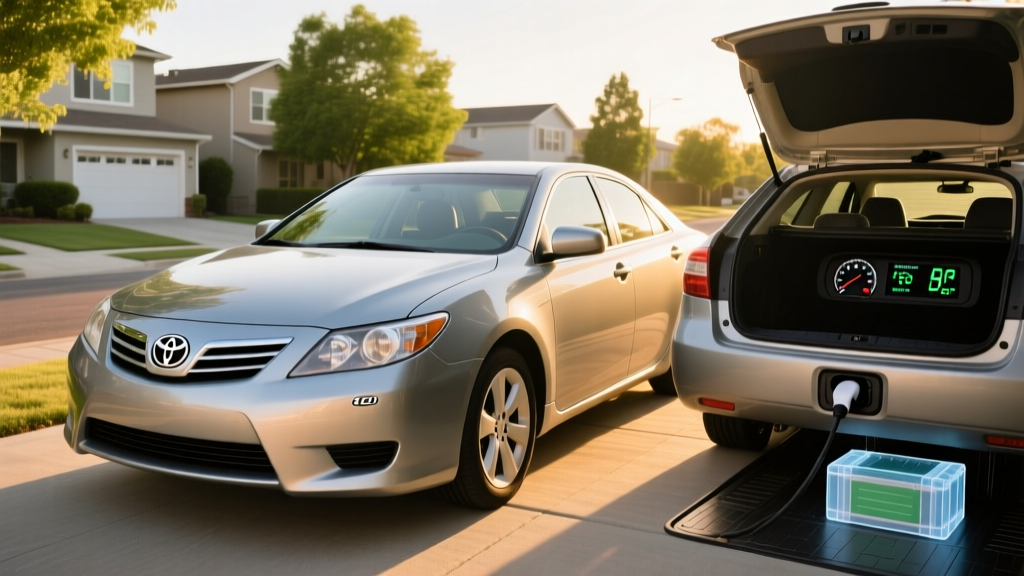
Eighteen years after it rolled off the assembly line, the 2008 Toyota Camry Hybrid remains one of the most searched used hybrids on the market — and for good reason. It was Toyota's second-generation Camry Hybrid, built on the proven Synergy Drive system that also powered the Prius, and it established a template for midsize hybrid sedans that competitors are still chasing. For budget-conscious buyers in 2026 looking to cut fuel costs without stepping into a full battery-electric vehicle (BEV), this car deserves a serious look — but only if you understand what you're getting into with a hybrid battery that's approaching two decades old.
This guide covers everything a used-car buyer needs to know: exact EPA fuel economy, real-world MPG expectations, the hybrid powertrain under the hood, battery longevity and replacement cost, and how this early hybrid stacks up against modern PHEVs and EVs.
HEV vs PHEV vs EV: Where the 2008 Camry Hybrid Fits
Before diving into specs, it's essential to understand what the 2008 Camry Hybrid is — and what it isn't.
Conventional Hybrid (HEV) — This Is What the 2008 Camry Is
The 2008 Toyota Camry Hybrid is a conventional hybrid electric vehicle (HEV). It pairs a gasoline engine with an electric motor and a small battery pack that recharges through regenerative braking and the engine. You never plug it in. There is no electric-only driving range to speak of — the electric motor assists the gas engine at low speeds and during acceleration, but the car cannot operate as a pure EV for any meaningful distance.
Plug-In Hybrid (PHEV) — Not This Car
Toyota did not offer a Camry Plug-In Hybrid until much later, and even then only in limited markets. A PHEV has a larger battery (typically 10–20 kWh), an electric-only range of 20–50 miles, and can be plugged into a Level 1 or Level 2 charger. The 2008 Camry Hybrid has none of these features. If you want plug-in capability in a Toyota sedan from this era, you're looking at the wrong model.
Battery Electric Vehicle (BEV) — A Different Category Entirely
A full EV like the Tesla Model 3 or Hyundai Ioniq 6 runs exclusively on battery power with zero gasoline use. BEVs offer 250–350+ miles of EPA range but require access to home or public charging infrastructure. The 2008 Camry Hybrid is the opposite end of the spectrum: a gas-first vehicle with electric assist, zero plug-in needs, and zero range anxiety.
Fuel Economy: EPA Ratings vs Real-World MPG
The headline number for any hybrid buyer is miles per gallon. Here's what the EPA officially rated the 2008 Toyota Camry Hybrid at, per fueleconomy.gov:
| Metric | EPA Rating |
|---|---|
| City MPG | 33 MPG |
| Highway MPG | 34 MPG |
| Combined MPG | 34 MPG |
| Annual Fuel Cost (est.) | ~$1,450 (based on 15,000 mi/yr at 2026 avg gas prices) |
| Fuel Type | Regular Unleaded (87 octane) |
Real-World MPG: What Owners Actually Report
One of the quirks of conventional hybrids is that they often exceed their EPA highway rating in city driving — the opposite of gas-only cars. The electric motor does its best work at low speeds, in stop-and-go traffic, and during frequent deceleration events where regenerative braking recovers energy. Many 2008 Camry Hybrid owners report real-world city MPG in the 35–38 MPG range when driving conservatively.
Highway driving is a different story. At sustained 70–80 mph speeds, the gasoline engine does nearly all the work, and real-world highway fuel economy typically drops to 30–33 MPG. Cold weather further reduces efficiency — expect a 5–10% MPG drop in winter months as the engine runs more frequently to maintain cabin heat and battery temperature.
Real-World MPG Bottom Line: Expect 32–36 MPG combined in mixed driving under normal conditions. If your commute is heavily urban with lots of stops, you'll skew toward the higher end. Highway-heavy commuters should expect numbers closer to the low 30s.
Powertrain Specs: Engine, Motor, and Combined Output
The 2008 Camry Hybrid uses Toyota's Hybrid Synergy Drive (HSD) system, a series-parallel full hybrid architecture. Here are the exact numbers:
| Specification | Detail |
|---|---|
| Gasoline Engine | 2.4L inline-4 (2AZ-FXE, Atkinson cycle) |
| Engine Horsepower | 147 HP @ 6,000 RPM |
| Engine Torque | 138 lb-ft @ 4,400 RPM |
| Electric Motor | Permanent magnet synchronous (3JM) |
| Electric Motor Output | 40 HP (30 kW) |
| Combined Net Horsepower | 192 HP |
| Hybrid Battery | Nickel-Metal Hydride (NiMH), ~6.5 Ah / ~1.6 kWh total pack |
| Transmission | Electronically controlled CVT (eCVT) |
| 0–60 mph | ~8.4 seconds |
| Drivetrain | Front-wheel drive |
| Curb Weight | ~3,680 lbs |
The 192 combined horsepower figure was competitive for a midsize sedan in 2008 and still provides adequate acceleration for highway merging and passing today. The eCVT is not a traditional belt-driven CVT — it uses a planetary gearset to blend engine and motor power, which is one reason Toyota hybrids from this era are so mechanically robust. There are no belts, clutches, or traditional gear shifts to wear out.
Hybrid Battery Lifespan, Warranty, and Replacement Cost
This is the single biggest concern for anyone considering a 2008 Camry Hybrid in 2026. The car is now 18 years old, and the original NiMH hybrid battery was warranted for 8 years / 100,000 miles (10 years / 150,000 miles in CARB states like California, New York, and Massachusetts). That factory warranty has long expired for every 2008 model on the road.
How Long Do These Batteries Actually Last?
Toyota's NiMH hybrid batteries from this generation have proven remarkably durable. Data from owner forums, repair shops, and fleet operators shows:
- Typical lifespan: 150,000–200,000+ miles before significant degradation or failure
- Age-related risk: NiMH batteries degrade with time even if mileage is low. A 2008 model with only 80,000 miles may still face battery failure due to calendar aging of the cells
- Failure mode: Usually individual cell imbalance rather than total pack death — one or two weak cells drag down the entire pack
Battery Replacement Options and Costs (2026 Pricing)
| Option | Cost Range | Notes |
|---|---|---|
| New OEM Toyota Pack | $3,000–$4,500 (parts + labor) | Full new NiMH pack from Toyota dealer; best longevity |
| Refurbished/Reconditioned Pack | $1,500–$2,500 | Rebalanced used cells; 1–3 year warranty typical |
| Individual Cell Replacement | $500–$1,200 | Replace only failed cells; requires diagnostic expertise |
| Aftermarket New Pack (e.g., Dorman) | $2,000–$3,000 | New cells from third-party; quality varies by supplier |
Before purchasing any 2008 Camry Hybrid, insist on a hybrid battery health check. A qualified technician can read the pack's state of health (SoH), check for cell voltage imbalance, and pull any stored hybrid system diagnostic codes. This $100–$150 inspection can save you thousands.
Pricing and Tax Credit Eligibility in 2026
The 2008 Toyota Camry Hybrid originally carried an MSRP of approximately $26,480 (base) to $30,000+ with options. In the 2026 used-car market, expect to pay:
- $4,000–$6,000 for a high-mileage example (150,000+ miles) in fair condition
- $6,000–$9,000 for a well-maintained example under 120,000 miles with a verified healthy hybrid battery
- $9,000–$11,000 for a low-mileage, excellent-condition car with recent battery service
Does the 2008 Camry Hybrid Qualify for Any Tax Credit?
No federal tax credit applies to this vehicle in 2026. The IRS §30D new clean vehicle credit applies only to new vehicles, and the used-EV credit (§25E, up to $4,000) applies exclusively to used battery-electric vehicles and plug-in hybrids — not conventional hybrids. Since the 2008 Camry Hybrid is a standard HEV with no plug-in capability, it does not qualify for any federal purchase incentive.
Some states and local utilities offer rebates for used hybrids, but these are increasingly rare and typically favor PHEVs and BEVs. Check your state energy office or utility provider for current programs, but do not count on incentive money for this purchase.
Reliability and Long-Term Ownership Costs
The 2008 Camry Hybrid benefits from Toyota's reputation for durability, and the hybrid powertrain specifically has proven to be one of the most reliable systems Toyota has ever built. The 2AZ-FXE engine is a detuned Atkinson-cycle variant of the widely used 2AZ-FE, and its lower stress levels contribute to exceptional longevity. The eCVT transmission has no wear items comparable to a traditional automatic.
Common Issues to Watch For
- Hybrid battery degradation — the most expensive potential repair, as detailed above
- 12V auxiliary battery — like all cars, the standard 12V battery needs periodic replacement ($150–$250 every 4–5 years). A dead 12V battery can prevent the hybrid system from booting
- Brake actuator assembly — some owners report failures of the regenerative braking actuator around 120,000–160,000 miles; replacement runs $1,200–$1,800
- Water pump (electric) — the hybrid-specific electric water pump can fail; replacement is $400–$600
- Dashboard cracking — a known cosmetic issue on 2007–2009 Camrys; not mechanical but affects resale
5-Year Cost of Ownership Estimate
| Category | Estimated 5-Year Cost |
|---|---|
| Purchase Price (avg.) | $7,000 |
| Fuel (15,000 mi/yr @ 34 MPG, $3.40/gal avg) | $7,500 |
| Insurance | $4,500 |
| Maintenance & Repairs | $3,500 (includes one hybrid battery service contingency) |
| Depreciation | ~$2,000 |
| Total 5-Year Cost | ~$24,500 |
For comparison, a similarly aged gas-only 2008 Camry (22/31 MPG EPA) would cost roughly $1,800–$2,500 more in fuel over the same period, partially offsetting the hybrid's higher potential repair costs.
Who Should Buy the 2008 Camry Hybrid — And Who Shouldn't
Pros
- Proven, durable hybrid powertrain with 200K+ mile potential
- 33–34 MPG combined on regular unleaded — no premium fuel required
- No plug-in charging needed; works with existing gas-station infrastructure
- Comfortable midsize sedan with roomy rear seat and 15.1 cu-ft trunk
- Low purchase price in 2026 used market
- Strong parts availability and independent mechanic familiarity
Cons
- Hybrid battery replacement risk ($1,500–$4,500) on an 18-year-old vehicle
- No electric-only driving capability; still 100% gasoline-dependent
- Outdated infotainment — no Bluetooth audio streaming, no backup camera standard
- No eligibility for federal EV or PHEV tax credits
- Higher-mileage examples may need suspension, brake actuator, or water pump work
- Safety tech is minimal by 2026 standards (no automatic emergency braking, no lane-keep assist)
Choose the 2008 Camry Hybrid If:
- You want to reduce fuel costs without changing your driving or charging habits
- You don't have access to home EV charging (apartment, street parking)
- Your budget is under $10,000 and you need a reliable daily driver
- Your commute is urban or suburban with frequent stops (where the hybrid system shines)
- You're comfortable budgeting $1,500–$3,000 for a potential hybrid battery service
Look at a PHEV or BEV Instead If:
- You have home charging access and want to eliminate or drastically reduce gasoline use
- You want modern safety features (AEB, blind-spot monitoring, lane-keeping)
- You qualify for the IRS §25E used-EV credit (up to $4,000 on qualifying used PHEVs and BEVs under $25,000)
- You want electric-only commuting — consider a used Chevrolet Volt (38-mile EV range), Toyota Prius Prime (25-mile EV range), or a budget BEV like the Nissan Leaf
Frequently Asked Questions
How many MPG does the 2008 Toyota Camry Hybrid get?
The EPA rates it at 33 city / 34 highway / 34 combined MPG. Real-world mixed driving typically yields 32–36 MPG, with city-heavy commutes occasionally reaching 37–38 MPG and highway-only trips dropping to 30–33 MPG.
Can I plug in the 2008 Camry Hybrid to charge it?
No. This is a conventional hybrid (HEV), not a plug-in hybrid (PHEV). The battery recharges exclusively through regenerative braking and the gasoline engine. There is no charge port and no electric-only driving range.
How far can the 2008 Camry Hybrid drive on electric power alone?
Effectively zero miles. The electric motor assists the gas engine at very low speeds (under ~25 mph in light-load conditions) and can propel the car for a few hundred yards in EV mode under ideal conditions, but it cannot sustain electric-only driving. This is fundamentally different from a PHEV.
Is the 2008 Camry Hybrid reliable?
Yes, with one major caveat. The engine, eCVT transmission, and overall build quality are among the most reliable Toyota has ever produced. Many examples exceed 200,000 miles with basic maintenance. The primary reliability concern is the aging NiMH hybrid battery, which may require service or replacement at a cost of $1,500–$4,500 depending on the repair approach.
What does a hybrid battery replacement cost for the 2008 Camry?
A new OEM battery from Toyota costs $3,000–$4,500 installed. Refurbished packs run $1,500–$2,500, and individual cell replacement (if only a few cells have failed) can be done for $500–$1,200 by a specialist. Always get a battery health diagnostic before purchasing.
Does the 2008 Camry Hybrid qualify for a tax credit?
No. Federal tax credits for hybrids have expired, and the current IRS §30D new-vehicle credit and §25E used-vehicle credit apply only to plug-in hybrids and battery-electric vehicles. The 2008 Camry Hybrid is a conventional HEV and is ineligible for any federal purchase incentive.
Hybrid vs PHEV vs EV — which should I choose?
A conventional hybrid (HEV) like this Camry is best if you want better fuel economy with zero lifestyle changes — no charging, no range planning. A plug-in hybrid (PHEV) is ideal if you have home charging and want 20–50 miles of electric commuting with a gas engine for longer trips. A full EV (BEV) makes sense if you want to eliminate gasoline entirely, have reliable charging access, and drive under 300 miles daily. For budget buyers without charging access, the HEV remains the lowest-friction path to better fuel economy.
Is the 2008 Camry Hybrid a good car in 2026?
For the right buyer, yes. At $4,000–$9,000 with 34 MPG and proven reliability, it's one of the most cost-effective used cars on the market — provided you budget for a potential hybrid battery service and accept the lack of modern safety and infotainment features. It's a rational, economical choice, not an exciting one.