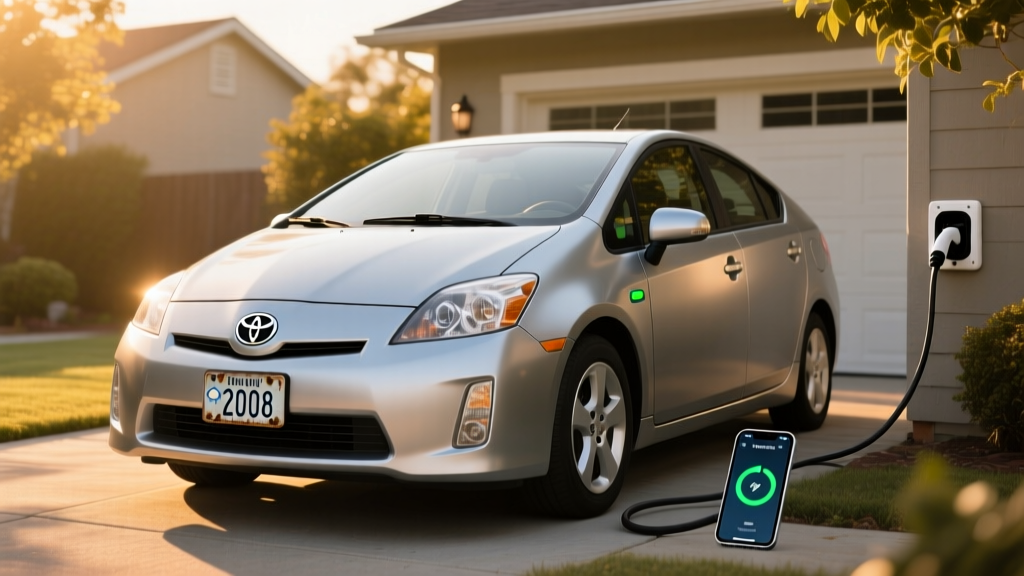
If you're researching the 2008 Prius hybrid MPG in 2026, you're likely considering one of the most iconic early hybrids on the used market. Nearly two decades after it rolled off the assembly line, the second-generation Toyota Prius (model years 2004–2009) remains a common sight on American roads — a testament to its engineering. But what kind of fuel economy can you actually expect from a 2008 Prius today, and is buying a used hybrid with a 17-year-old battery a smart move?
This guide covers the EPA numbers, real-world MPG data, battery longevity, replacement costs, and how the 2008 Prius stacks up against modern hybrids, plug-in hybrids, and full EVs available in 2026.
2008 Toyota Prius MPG: EPA Ratings vs. Real-World Results
The 2008 Toyota Prius was rated by the EPA under the older testing methodology that was revised for the 2008 model year. Here are the official numbers as listed on fueleconomy.gov:
| Metric | Value |
|---|---|
| City MPG | 48 MPG |
| Highway MPG | 45 MPG |
| Combined MPG | 46 MPG |
| Fuel Tank Capacity | 11.9 gallons |
| Estimated Total Range | ~547 miles |
2008 Prius Powertrain: How Toyota's Hybrid System Works
The 2008 Prius uses Toyota's Hybrid Synergy Drive (HSD), a series-parallel full hybrid system. It is a conventional hybrid (HEV), meaning it generates all its electricity internally — you never plug it in. Here's the breakdown:
| Component | Specification |
|---|---|
| Gasoline Engine | 1.5L 4-cylinder Atkinson cycle (76 HP, 82 lb-ft torque) |
| Electric Motor | Permanent magnet synchronous (67 HP, 295 lb-ft torque) |
| Combined Net Horsepower | 110 HP |
| Hybrid Battery | 1.3 kWh Nickel-Metal Hydride (NiMH), 201.6V nominal |
| Transmission | Planetary eCVT (continuously variable) |
| Drivetrain | Front-wheel drive |
| 0–60 MPH | ~10.0 seconds |
| Curb Weight | ~2,932 lbs |
The key to the Prius's efficiency is the power-split device — a planetary gearset that seamlessly blends engine and motor power. At low speeds (typically under 25 MPH in gentle acceleration), the car can operate on electric power alone. During braking and deceleration, the electric motor acts as a generator to recharge the battery. The gasoline engine shuts off at stops, eliminating idle fuel consumption entirely.
HEV vs. PHEV vs. EV: Understanding What the 2008 Prius Is (and Isn't)
The 2008 Prius is a conventional hybrid electric vehicle (HEV). It's important not to confuse it with modern plug-in options. Here's how the categories differ:
| Feature | HEV (2008 Prius) | PHEV (e.g., 2026 Prius Prime) | BEV (e.g., 2026 Tesla Model 3) |
|---|---|---|---|
| Plug-in Charging | No — self-charging | Yes — plug in for electric range | Yes — plug in exclusively |
| Electric-Only Range | ~1 mile at low speed | 35–44 miles | 250–350+ miles |
| Gas Engine | Yes, always available | Yes, kicks in after battery depletes | No |
| Fuel/Charging Cost | Gas only (~$0.08–0.12/mile) | Gas + electricity (~$0.04–0.08/mile) | Electricity only (~$0.03–0.05/mile) |
| Federal Tax Credit (New) | None | Up to $7,500 (§30D, if eligible) | Up to $7,500 (§30D, if eligible) |
| Home Charging Needed | No | Recommended (Level 2) | Essential (Level 2) |
The 2008 Prius requires zero lifestyle change compared to a gas car — you fill it up at any gas station and drive. That simplicity is its biggest advantage as a used purchase, but it also means you miss out on the per-mile cost savings and emissions benefits of plug-in electrification.
2008 Prius Hybrid Battery: Lifespan, Degradation, and Replacement Cost
The 2008 Prius uses a 1.3 kWh Nickel-Metal Hydride (NiMH) battery pack. NiMH chemistry is robust and less prone to catastrophic failure than early lithium-ion cells, but it does degrade gradually with age and heat exposure.
Signs of Hybrid Battery Degradation
- Reduced MPG: A drop from 44+ MPG to the mid-to-low 30s is the most common symptom
- More frequent engine cycling: The gas engine turns on more often, even at low speeds
- Rapid state-of-charge swings: The battery indicator on the dash fluctuates between full and near-empty quickly
- Check engine or hybrid system warning lights: Diagnostic codes P0A80 or similar indicate battery pack issues
Battery Replacement Options and Costs (2026 Pricing)
| Option | Estimated Cost | Warranty | Notes |
|---|---|---|---|
| New OEM Toyota Battery | $2,000–$2,500 (part) + $500–$800 labor | 3 years / unlimited miles | Most reliable, but costly for a car worth ~$4,000–$6,000 |
| Remanufactured/Reconditioned Battery | $1,000–$1,600 installed | 1–3 years typically | Replaced weak cells; quality varies by supplier |
| Used Salvage Battery | $400–$800 + $500 labor | Usually 30–90 days | High risk — unknown remaining life |
| Individual Module Replacement (DIY) | $20–$50 per module (28 modules total) | None | Requires technical skill; identify and replace only bad modules |
For most used 2008 Prius buyers, a remanufactured battery from a reputable supplier (such as Green Bean Battery or Dorman) offers the best balance of cost and reliability. Factor in $1,200–$1,800 total for a professionally installed remanufactured pack when budgeting your purchase.
Is the 2008 Prius Reliable? Long-Term Ownership Data
The second-generation Prius (2004–2009) is widely regarded as one of the most reliable vehicles Toyota has ever built. The HSD powertrain has no traditional transmission to fail (the planetary eCVT has no belts, clutches, or bands to wear), the brake pads last 80,000–100,000+ miles thanks to regenerative braking, and the engine is under-stressed due to Atkinson-cycle operation.
Key reliability considerations for a 2008 Prius in 2026:
- Hybrid battery: The primary wear item. Budget for replacement unless the seller has documented a recent swap.
- Inverter coolant pump: A known failure point on Gen 2 Prius vehicles. The electric water pump for the inverter cooling circuit can fail silently, leading to inverter overheating (~$500–$800 repair). Toyota issued a recall for this — verify it was performed.
- Combination meter (dashboard): Some 2004–2008 Prius owners report the instrument cluster failing, with the speedometer and fuel gauge going dark. Repair or replacement runs $200–$500.
- 12V auxiliary battery: Like any car, the 12V battery needs periodic replacement ($150–$250 for the AGM-type used in the Prius).
- Brake actuator: The electro-hydraulic brake actuator can fail on high-mileage examples. This is a $1,200–$1,800 repair. Test the brakes carefully — any grinding, pulsing, or warning lights are red flags.
According to data from NHTSA, the 2008 Prius received a 4-star frontal crash rating and 4-star side crash rating for front occupants. It lacks modern ADAS features — no automatic emergency braking, lane-keeping, or blind-spot monitoring — which is expected for its era.
2008 Prius Used Market Pricing and Tax Credit Eligibility
As of early 2026, a 2008 Toyota Prius in average condition (140,000–180,000 miles) sells for approximately $3,500–$5,500 from private sellers and $4,500–$7,000 from dealers. Examples with a recently replaced hybrid battery and documented maintenance command a $500–$1,000 premium.
Federal Tax Credit Status
The 2008 Prius does not qualify for any federal tax credit when purchased used in 2026:
- §30D New Clean Vehicle Credit: Only applies to new vehicles. The 2008 Prius is long discontinued.
- §25E Used Clean Vehicle Credit: Provides up to $4,000 (30% of sale price, capped) for qualifying used EVs and PHEVs purchased from a dealer. However, the 2008 Prius is a conventional HEV, not a plug-in vehicle, and does not meet the definition of a qualified clean vehicle under IRS rules.
Some states offer rebates for used hybrids, but these are rare and vary significantly by jurisdiction. Check your state's environmental or energy agency for current programs.
Who Should Buy a 2008 Prius — And Who Should Look Elsewhere?
- You want maximum MPG on a tight budget (under $6,000)
- You drive primarily in city/stop-and-go traffic where hybrids shine
- You don't have access to home or workplace charging (no plug needed)
- You want a proven, simple-to-maintain commuter car
- You're comfortable budgeting $1,000–$1,800 for a potential hybrid battery replacement
- You have home charging access and want lower per-mile fuel costs
- You want modern safety tech (AEB, lane-keeping, adaptive cruise)
- You want to qualify for the federal §30D tax credit (up to $7,500 on eligible new EVs/PHEVs) or the §25E used EV credit (up to $4,000 on qualifying used plug-in vehicles)
- You want electric-only driving for short commutes (PHEV) or zero tailpipe emissions (BEV)
- You plan to keep the car 5+ years and want a fresh battery warranty
Modern Alternatives to Consider
If the 2008 Prius doesn't fit your needs, here are alternatives at different price points:
| Vehicle | Type | EPA Combined MPG / MPGe | Approx. 2026 Price | Tax Credit |
|---|---|---|---|---|
| 2008 Toyota Prius | HEV | 46 MPG combined | $3,500–$7,000 (used) | None |
| 2026 Toyota Prius LE | HEV | 57 MPG combined | $28,550 (new) | None (HEV) |
| 2026 Toyota Prius Prime SE | PHEV | 44 mi electric + 52 MPG gas | $33,450 (new) | Up to $7,500 (§30D, if eligible) |
| 2026 Hyundai Elantra Hybrid | HEV | 54 MPG combined | $26,250 (new) | None (HEV) |
| 2024 Toyota Prius Prime (used) | PHEV | 44 mi electric + 52 MPG gas | $22,000–$27,000 | Up to $4,000 (§25E, if eligible) |
2008 Prius MPG: Frequently Asked Questions
How many MPG does the 2008 Prius get?
The EPA rated the 2008 Toyota Prius at 48 city / 45 highway / 46 combined MPG. In real-world driving in 2026, a well-maintained example with a healthy hybrid battery typically achieves 40–44 MPG combined. Degraded batteries can drop this to 35–38 MPG.
Does the 2008 Prius need to be plugged in?
No. The 2008 Prius is a conventional hybrid (HEV). It charges its own small battery through regenerative braking and the gasoline engine. You never plug it in — you only refuel at a gas station.
How long does the 2008 Prius hybrid battery last?
Original NiMH batteries in the 2008 Prius have shown lifespans of 120,000–200,000 miles or 10–18 years, depending on climate (heat accelerates degradation). In 2026, most surviving 2008 Prius vehicles either have a replacement battery or are due for one.
What does it cost to replace the hybrid battery in a 2008 Prius?
Expect to pay $1,000–$1,800 for a professionally installed remanufactured battery, or $2,500–$3,300 for a new OEM Toyota battery with labor. DIY module-level repair is possible for $200–$500 if you have the technical skill.
Does the 2008 Prius qualify for any tax credit?
No. As a conventional hybrid (HEV), the 2008 Prius does not qualify for the federal §30D new vehicle credit or the §25E used clean vehicle credit. Only plug-in vehicles (PHEVs and BEVs) are eligible. The original hybrid tax incentives for the Prius expired in 2007.
Is the 2008 Prius a good car to buy in 2026?
It can be an excellent ultra-budget commuter if you account for the likely need for a hybrid battery replacement ($1,000–$1,800) and verify the inverter coolant pump recall was performed. At $4,000–$6,000 with 40+ MPG, the total cost of ownership remains competitive with newer, more expensive used cars — especially for city-heavy driving.
How does the 2008 Prius compare to the current-generation Prius?
The 2026 Toyota Prius LE achieves 57 MPG combined — a 24% improvement over the 2008 model's 46 MPG — while producing 194 HP versus the 2008's 110 HP. The modern Prius also includes Toyota Safety Sense (AEB, lane-keeping, adaptive cruise), Apple CarPlay/Android Auto, and a significantly quieter, more refined cabin. The trade-off is price: $28,550 new versus $4,000–$6,000 used.