Quick Verdict: The 2008 Altima Hybrid in 2026
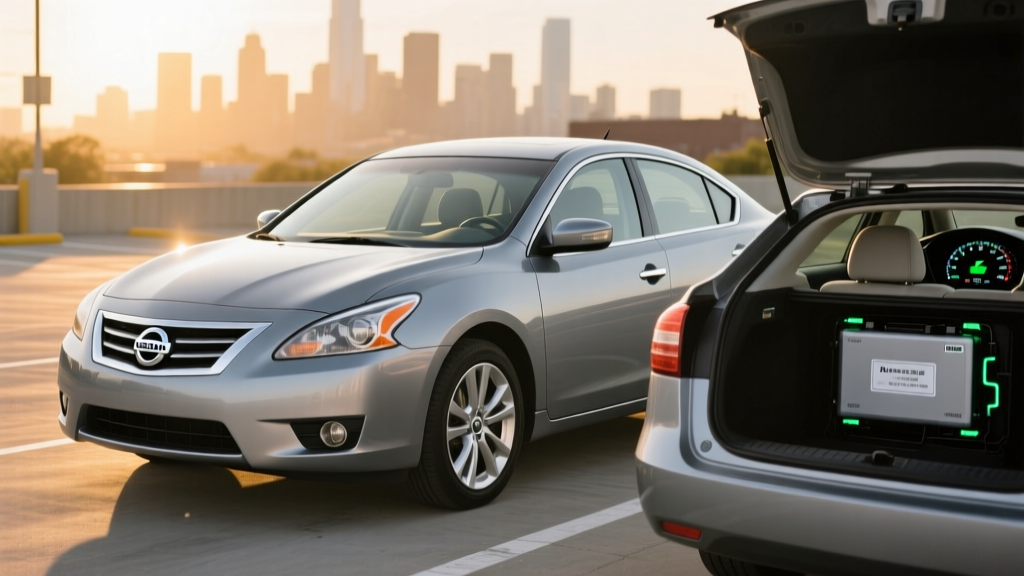
The 2008 Nissan Altima Hybrid sedan was Nissan's first foray into the hybrid market, borrowing Toyota's proven Hybrid Synergy Drive system for a midsize sedan that prioritized fuel economy over performance. With an EPA-rated 35 MPG combined, it still holds up as a budget-friendly commuter for buyers who want hybrid efficiency without plugging in. But at nearly two decades old, the big question is battery health — and whether the savings over a conventional gas Altima justify the risk of a $2,000–$4,000 battery replacement.
This guide breaks down exactly what you're getting: real-world fuel economy, the Toyota-sourced hybrid powertrain, battery longevity data, and where this car fits against modern hybrids, PHEVs, and full EVs available today.
HEV vs PHEV: What the 2008 Altima Hybrid Actually Is
Before diving into specs, it's critical to understand the distinction:
Conventional Hybrid (HEV) — This Car
The 2008 Nissan Altima Hybrid is a conventional hybrid (HEV). It has a small battery (approximately 1.6 kWh total capacity) that recharges through regenerative braking and the gasoline engine. You never plug it in. The electric motor assists the gas engine during acceleration and can propel the car at very low speeds for short distances, but there is no meaningful electric-only range.
Plug-In Hybrid (PHEV) — Not This Car
A plug-in hybrid (like the Toyota RAV4 Prime or Chrysler Pacifica Hybrid) carries a much larger battery (typically 15–20 kWh) that you charge from a wall outlet or charger, providing 25–45 miles of electric-only driving before the gas engine kicks in. The 2008 Altima Hybrid does not offer this capability.
Nissan never produced a plug-in version of this-generation Altima. If you need electric-only commuting range, you'll need to look at a modern PHEV or a full BEV instead.
Fuel Economy: EPA Ratings and Real-World MPG
The 2008 Altima Hybrid's headline number was its fuel economy advantage over the standard 4-cylinder Altima. Here's the official EPA breakdown from fueleconomy.gov:
| Metric | 2008 Altima Hybrid | 2008 Altima 2.5L (Gas) |
|---|---|---|
| City MPG | 35 | 23 |
| Highway MPG | 33 | 32 |
| Combined MPG | 34 | 26 |
| Annual Fuel Cost (est.) | ~$1,350 | ~$1,800 |
Source: EPA / fueleconomy.gov. Annual fuel cost based on 15,000 miles/year at $3.15/gallon.
Real-World MPG vs EPA Sticker
Like most conventional hybrids, the 2008 Altima Hybrid tends to exceed its EPA city rating in stop-and-go traffic — the exact scenario where regenerative braking recaptures the most energy. Owners on hybrid-focused forums report seeing 36–38 MPG in urban driving when the battery is healthy.
Highway driving tells a different story. At sustained 70+ MPH speeds, the electric motor provides minimal assistance, and real-world highway figures often drop to 30–32 MPG. Cold weather further reduces efficiency by 10–15% as the engine runs more frequently to generate cabin heat and maintain battery temperature.
Expect a realistic combined average of 31–35 MPG depending on your driving mix, climate, and battery condition. If the hybrid battery has degraded significantly, the engine will shoulder more of the load, and you may see combined figures closer to 28–30 MPG.
Powertrain Specs: Toyota Hybrid Tech in a Nissan
The most interesting aspect of the 2008 Altima Hybrid is what's under the hood: Nissan licensed Toyota's Hybrid Synergy Drive (the same system in the contemporary Camry Hybrid) rather than developing its own. Here's the full spec breakdown:
| Specification | 2008 Nissan Altima Hybrid |
|---|---|
| Engine | 2.5L inline-4 (QR25DE) |
| Engine Horsepower | 158 hp |
| Electric Motor | AC synchronous permanent magnet |
| Combined System Output | 198 hp |
| Transmission | eCVT (electronically controlled) |
| Hybrid Battery | NiMH, ~1.6 kWh total capacity |
| Drivetrain | Front-wheel drive |
| 0–60 mph (est.) | ~8.0 seconds |
| Curb Weight | ~3,480 lbs |
| EPA City / Highway / Combined | 35 / 33 / 34 MPG |
| Fuel Tank | 20.0 gallons |
| Total Range (est.) | ~680 miles |
The eCVT is not a traditional belt-and-pulley CVT — it's a planetary gearset that seamlessly blends engine and motor power. This is the same robust design Toyota has used since the original Prius, and it eliminates the fixed gear ratios and shift shock of a conventional automatic.
Hybrid Battery Lifespan, Warranty, and Replacement Cost
Battery Warranty (Original)
When new, the 2008 Altima Hybrid's NiMH battery was covered by Nissan's hybrid system warranty: 8 years / 100,000 miles (extended to 10 years / 150,000 miles in California and other CARB-emissions states). As of 2026, all original factory battery warranties have expired unless the vehicle has exceptionally low mileage and a replacement battery was installed recently with its own warranty.
How Long Does the Battery Actually Last?
The NiMH pack in the 2008 Altima Hybrid benefits from Toyota's conservative battery management — the system never fully charges or fully depletes the pack, keeping it in a longevity-friendly state-of-charge window (roughly 40–80%). This is a key reason NiMH packs in Toyota-sourced hybrid systems routinely last 150,000–200,000 miles before significant degradation.
However, at 18 years old in 2026, age is as much a factor as mileage. NiMH cells degrade over time regardless of use, particularly in hot climates. If the vehicle you're considering still has its original battery, expect reduced electric-motor assist and lower fuel economy. A "check hybrid system" warning light is a common indicator of cell failure.
Battery Replacement Cost
If the hybrid battery fails, here's what you're looking at:
- Remanufactured battery: $1,500–$2,500 installed (most common route for a car of this age)
- New OEM battery from Nissan: $3,000–$4,500 installed (limited availability)
- Individual cell/module replacement: $800–$1,500 at a hybrid specialist shop
For a vehicle with a current market value of $3,000–$5,500 (depending on mileage and condition), a full OEM battery replacement rarely makes financial sense. A remanufactured pack or module-level repair is the pragmatic choice.
Tax Credits and Incentives in 2026
The 2008 Altima Hybrid does not qualify for any federal tax credit in 2026. Here's why:
- §30D New Clean Vehicle Credit: Applies only to new vehicle purchases. The Altima Hybrid has been out of production since the 2011 model year.
- §25E Used Clean Vehicle Credit: This credit (up to $4,000 or 30% of sale price, whichever is less) applies to used EVs and fuel-cell vehicles purchased from a dealer. However, conventional hybrids (HEVs) like the Altima Hybrid are not eligible — only plug-in electric vehicles and fuel cell vehicles qualify under §25E. See IRS guidelines for the full eligibility list.
- State incentives: Most state-level hybrid incentives expired years ago or apply only to new purchases. Check your state's energy office for any remaining programs, but don't count on it.
Bottom line: you're buying this car at full cost, with no tax-credit offset. The value proposition rests entirely on fuel savings versus a comparable gas-only sedan.
Reliability and Common Issues
The 2008 Altima Hybrid benefits from two strong reliability pillars: Nissan's proven QR25DE 4-cylinder engine (used across the Altima lineup for years) and Toyota's mature hybrid system. The combination is mechanically sound, but there are known issues to watch:
Hybrid-Specific Concerns
- Hybrid battery degradation: The #1 concern. Symptoms include reduced MPG, frequent engine cycling, and dashboard warning lights.
- Inverter coolant pump: The electric water pump that cools the hybrid inverter can fail. Replacement runs $400–$700. If it fails and the inverter overheats, the inverter itself can cost $1,500–$3,000.
- Brake actuator: The electro-hydraulic brake system (which blends regenerative and friction braking) can develop issues at high mileage. Symptoms include a stiff pedal or warning lights.
Non-Hybrid Concerns (Shared With Gas Altima)
- CVT transmission (non-hybrid models): Not applicable here — the hybrid uses the Toyota eCVT, which is far more durable than Nissan's own Jatco belt-drive CVTs.
- Power steering: Electric power steering rack failures reported on this generation.
- Clear coat peeling: Cosmetic but common on Nissan paint from this era.
2008 Altima Hybrid vs Modern Alternatives
If you're cross-shopping the 2008 Altima Hybrid, you're likely weighing it against newer used hybrids, modern PHEVs, or affordable EVs. Here's how it stacks up:
Pros
- Low purchase price ($3,000–$5,500 used)
- 34 MPG combined — still competitive with many new gas sedans
- Toyota-sourced hybrid system is proven and serviceable
- No plug-in charging required — works for apartment dwellers
- Comfortable midsize cabin with decent trunk space (15.3 cu ft)
Cons
- Original battery warranty expired — replacement risk is real
- No electric-only range; not a PHEV
- No federal tax credit eligibility (new or used)
- Outdated infotainment — no Apple CarPlay, Android Auto, or USB-C
- Safety tech is minimal: no automatic emergency braking, lane-keeping, or blind-spot monitoring
- NiMH battery is less energy-dense than modern lithium-ion packs
Should You Choose This Over a Modern Hybrid, PHEV, or EV?
| Vehicle Type | Example (2026) | Combined MPG / Range | Best For |
|---|---|---|---|
| 2008 Altima Hybrid (HEV) | This car | 34 MPG combined | Tight budget, no plug access, basic commuting |
| Modern HEV | 2026 Toyota Camry Hybrid | 52 MPG combined | Maximum MPG, warranty coverage, modern safety tech |
| PHEV | 2026 Toyota RAV4 Prime | 42 mi electric + 38 MPG | Short electric commute + gas flexibility for road trips |
| Full EV (BEV) | 2026 Chevrolet Equinox EV | 319 mi EPA range | Home charging access, low operating cost, zero tailpipe emissions |
The 2008 Altima Hybrid makes sense only if your budget is strictly under $6,000 and you need a no-plugging-required commuter. If you can stretch to $15,000–$20,000, a 2018–2021 Toyota Camry Hybrid or Honda Accord Hybrid will deliver 48–52 MPG with a newer battery, modern safety features, and remaining warranty coverage.
Who Should Buy the 2008 Altima Hybrid in 2026?
This car fits a narrow but real buyer profile:
- Budget-first commuters who need reliable transportation under $5,000 and want better fuel economy than a gas-only sedan of the same vintage.
- DIY-friendly buyers comfortable with the possibility of a hybrid battery replacement — the Toyota-sourced system has strong aftermarket support and remanufactured batteries are readily available.
- Apartment dwellers without charging access who want hybrid efficiency without needing a plug.
This car is not for you if:
- You want electric-only driving or plug-in capability (look at a PHEV or BEV)
- You want modern ADAS features like automatic emergency braking or adaptive cruise control
- You're risk-averse about potential $2,000+ battery replacement costs on a car worth $4,000
- You drive mostly highway miles, where the hybrid advantage shrinks to just 1–2 MPG over the gas Altima
Frequently Asked Questions
How many MPG does the 2008 Nissan Altima Hybrid get?
The EPA rates it at 35 city / 33 highway / 34 combined MPG. In real-world driving, expect 31–35 MPG combined depending on your driving mix, climate, and battery health. City driving often yields 36+ MPG thanks to regenerative braking; highway driving at 70+ MPH typically returns 30–32 MPG.
Is the 2008 Altima Hybrid a plug-in hybrid?
No. It is a conventional hybrid (HEV) that charges its battery entirely through regenerative braking and the gasoline engine. You never plug it in. There is no meaningful electric-only driving range — the electric motor assists the gas engine but cannot propel the car at highway speeds on its own.
Is the 2008 Altima Hybrid reliable?
The powertrain is generally reliable. The Toyota-sourced hybrid system (eCVT + NiMH battery) is one of the most proven hybrid architectures ever built. The Nissan QR25DE engine is durable when maintained. The main reliability risk in 2026 is age-related hybrid battery degradation and potential inverter coolant pump failure.
What does it cost to replace the hybrid battery?
A remanufactured NiMH battery pack costs $1,500–$2,500 installed. A new OEM battery (if available) runs $3,000–$4,500. Individual module replacement at a hybrid specialist can cost $800–$1,500. Given the car's $3,000–$5,500 market value, a remanufactured pack or module repair is the most cost-effective route.
Does the 2008 Altima Hybrid qualify for any tax credit?
No. The federal §30D new vehicle credit applies only to new purchases, and the §25E used clean vehicle credit applies only to plug-in electric vehicles and fuel-cell vehicles — not conventional hybrids. No federal tax credit is available for this car in 2026. Check your state's energy office for any remaining local programs, but most have expired.
How does it compare to a Toyota Camry Hybrid of the same year?
The 2008 Camry Hybrid used the identical Toyota Hybrid Synergy Drive system and achieved similar fuel economy (33/34 city/highway). The Camry Hybrid typically has better parts availability and a larger mechanic network familiar with the system, since Toyota sold far more of them. If you're cross-shopping, a same-year Camry Hybrid may offer better long-term serviceability.
Should I buy a 2008 Altima Hybrid or save for a newer hybrid?
If your budget is firm at $5,000 or less, the Altima Hybrid is a reasonable choice — provided you get a pre-purchase inspection that includes a hybrid battery health check. If you can stretch to $12,000–$18,000, a 2016–2020 Camry Hybrid, Accord Hybrid, or Hyundai Ioniq Hybrid will deliver 50+ MPG with a lithium-ion battery, modern safety features, and years of remaining reliability.