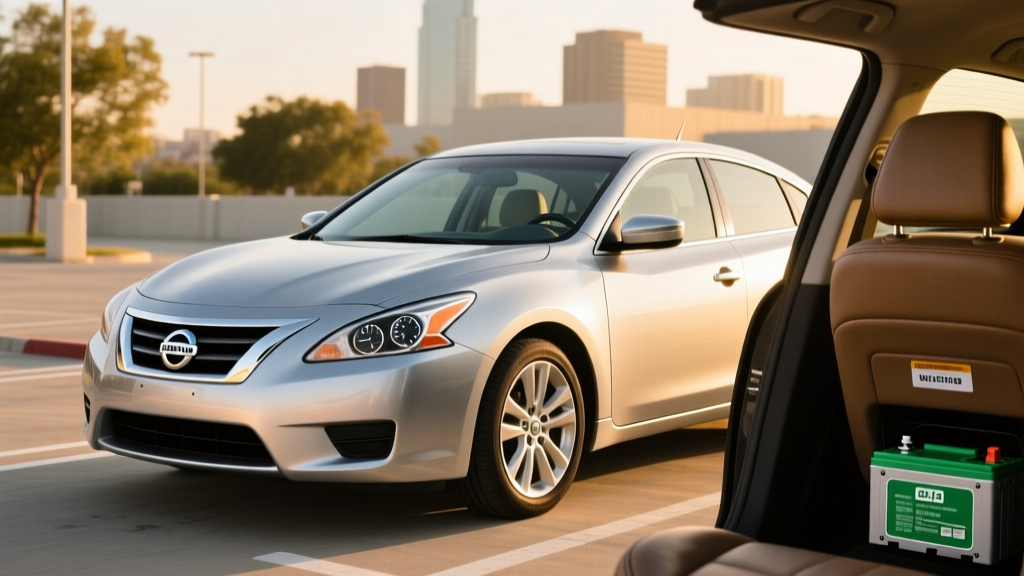
The 2008 Nissan Altima Hybrid occupies a specific niche in the used-car market: it's one of the earliest mainstream midsize sedans to pair Toyota-sourced hybrid hardware with Nissan's sheet metal. For buyers browsing the used market in 2026, this sedan promises 198 combined horsepower and an EPA-rated 35 MPG city — numbers that still hold up against many modern conventional hybrids. But with vehicles now approaching 18 years old, the real question isn't fuel economy; it's whether the hybrid battery is still viable and what ownership actually costs.
This guide breaks down every spec that matters for a used 2008 Altima Hybrid purchase, from real-world MPG to battery replacement economics, so you can decide whether this early-generation hybrid deserves a spot in your driveway or whether a newer PHEV or full EV makes more financial sense.
HEV vs PHEV: What the 2008 Altima Hybrid Actually Is
Before evaluating this car, it's critical to understand the distinction between hybrid types, because the 2008 Altima Hybrid is a conventional hybrid electric vehicle (HEV), not a plug-in hybrid (PHEV).
| Feature | Conventional Hybrid (HEV) | Plug-In Hybrid (PHEV) |
|---|---|---|
| Plug-in charging? | No — charges via engine and regenerative braking | Yes — plugs into Level 1 or Level 2 charger |
| Electric-only range | Less than 1 mile at low speeds | Typically 20–50 miles (modern PHEVs) |
| Battery size | Small (1–2 kWh) | Larger (8–25 kWh) |
| Federal tax credit (§30D) | Not eligible | Up to $7,500 (if new, subject to sourcing/income rules) |
| 2008 Altima Hybrid | ✅ This vehicle | ❌ Never offered as PHEV |
The Altima Hybrid uses Toyota's Hybrid Synergy Drive system (the same architecture found in the contemporary Camry Hybrid) adapted to Nissan's platform. You never plug it in. The 1.5 kWh nickel-metal hydride (NiMH) battery charges through regenerative braking and the gasoline engine. This matters because some used listings incorrectly describe it as needing a charger — it doesn't.
Fuel Economy: EPA Ratings and Real-World MPG
The 2008 Altima Hybrid's headline number was always fuel efficiency. Here are the official EPA figures as listed on fueleconomy.gov:
| Driving Cycle | EPA Rating | Real-World Expectation |
|---|---|---|
| City | 35 MPG | 33–38 MPG (hybrids often beat EPA in stop-and-go) |
| Highway | 33 MPG | 30–35 MPG (aerodynamic drag, A/C load) |
| Combined | 34 MPG | 31–36 MPG depending on driving mix |
Why Hybrids Often Exceed EPA City Estimates
Conventional hybrids like the Altima Hybrid thrive in city driving. Regenerative braking recaptures kinetic energy at every stop, and the electric motor handles low-speed acceleration where gasoline engines are least efficient. Owners who drive predominantly in urban traffic frequently report 36–38 MPG. Highway driving, where the gasoline 2.5L four-cylinder does most of the work, typically yields 30–33 MPG.
One important caveat: a degraded hybrid battery will reduce these numbers. If the NiMH pack has lost significant capacity, the engine runs more frequently to compensate, and real-world MPG can drop to 28–30 combined. Always verify battery health before purchase.
Powertrain Specs: Engine, Motor, and Combined Output
| Specification | 2008 Nissan Altima Hybrid |
|---|---|
| Engine | 2.5L inline-4 (QR25DE) |
| Engine output | 158 HP @ 5,200 rpm / 162 lb-ft torque |
| Electric motor | Permanent magnet synchronous (Toyota-sourced) |
| Motor output | 40 HP (30 kW) |
| Combined system output | 198 HP |
| Transmission | eCVT (electronically controlled continuously variable) |
| Drivetrain | Front-wheel drive |
| 0–60 mph | ~7.8 seconds |
| Hybrid battery | 1.5 kWh NiMH (nickel-metal hydride) |
| Fuel tank | 20.0 gallons |
| Total range (est.) | ~680 miles (at 34 MPG combined) |
The eCVT transmission is not a traditional belt-and-pulley CVT like those found in non-hybrid Nissans. Instead, it uses a planetary gearset to blend engine and motor power — a design proven over millions of miles in Toyota hybrids. This distinction matters for reliability: the eCVT in the Altima Hybrid is far more durable than the Jatco CVTs Nissan used in conventional Altimas of the same era, which had widespread failure issues.
Hybrid Battery Lifespan, Warranty, and Replacement Cost
The single biggest concern for any used hybrid buyer is battery health. Here's what you need to know about the 2008 Altima Hybrid's NiMH pack.
Original Battery Warranty
Nissan covered the 2008 Altima Hybrid's battery with an 8-year/100,000-mile warranty (10 years/150,000 miles in California Air Resources Board states including CA, CT, ME, MA, NJ, NY, OR, RI, VT, and WA). As of 2026, all original factory battery warranties have expired — even in CARB states, the 10-year/150,000-mile window closed no later than the end of the 2018 model year for 2008 vehicles.
Real-World Battery Longevity
NiMH batteries in Toyota-sourced hybrid systems have proven remarkably durable. Data from fleets and long-term owners shows these packs commonly last 150,000–200,000 miles before significant degradation. Some exceed 250,000 miles with gradual capacity loss rather than sudden failure. The key factors affecting lifespan:
- Heat exposure: Vehicles in hot climates (AZ, TX, FL) see faster degradation
- Usage pattern: Regular driving keeps cells balanced; long sit periods are harmful
- Depth of discharge: The hybrid system's software keeps the battery in a 40–80% state-of-charge window, which extends life
Battery Replacement Cost in 2026
| Option | Cost Range | Notes |
|---|---|---|
| New OEM battery (Nissan dealer) | $3,000–$4,500 | Includes parts and labor; may be difficult to source for a 2008 model |
| Remanufactured battery | $1,500–$2,500 | Third-party rebuilt packs; 1–3 year warranty typical |
| Used/salvage battery | $500–$1,200 | Pulled from wrecked vehicles; no warranty, high risk |
| Individual cell replacement | $300–$800 | Specialty shops can replace bad cells; requires diagnostic equipment |
At current used-car values, a full OEM battery replacement rarely makes financial sense. A remanufactured pack or cell-level repair is the pragmatic choice if the battery fails.
Used Market Pricing and Tax Credit Eligibility
As of early 2026, the 2008 Nissan Altima Hybrid trades between $3,500 and $7,000 on the used market, depending on mileage, condition, and battery health. Low-mileage examples (under 80,000 miles) with documented battery health command the top of that range.
Does the 2008 Altima Hybrid Qualify for Any Tax Credit?
No. The 2008 Altima Hybrid does not qualify for the federal §30D Clean Vehicle Credit. There are two reasons:
- The §30D credit for new vehicles applies only to plug-in electric vehicles (BEVs and PHEVs) with battery capacity ≥7 kWh. The Altima Hybrid is a conventional HEV with a 1.5 kWh NiMH pack and no plug-in capability.
- The used clean vehicle credit (§25E, up to $4,000 or 30% of sale price) also requires the vehicle to be a plug-in EV or fuel cell vehicle. Conventional hybrids are excluded.
Per IRS guidelines, only BEVs, PHEVs, and hydrogen fuel cell vehicles qualify. Some states may offer minimal incentives for used hybrids, but these are rare and vary by jurisdiction — check your state's energy office for current programs.
Who Should Buy the 2008 Altima Hybrid — and Who Shouldn't
Pros
- Strong city MPG (35 EPA, often 36–38 real-world)
- Toyota-sourced hybrid powertrain with proven reliability
- eCVT avoids the CVT failure issues of non-hybrid Altimas
- Low purchase price ($3,500–$7,000)
- No charging infrastructure needed
- Spacious midsize cabin with 15.3 cu ft trunk
Cons
- Original battery warranty expired; replacement is an out-of-pocket risk
- No electric-only driving capability
- No federal tax credit eligibility
- Dated interior technology (no standard Bluetooth audio, basic infotainment)
- NiMH battery chemistry less energy-dense than modern Li-ion
- Highway MPG unremarkable vs. modern hybrids
Hybrid vs PHEV vs EV: Which Fits You?
| Choose the 2008 Altima Hybrid (HEV) if… | Choose a modern PHEV if… | Choose a full EV (BEV) if… |
|---|---|---|
| You want maximum affordability (under $7K) and can't charge at home | You can install a Level 2 home charger and want 25–45 miles of electric-only commuting | You have reliable home charging, drive under 250 miles daily, and want the lowest per-mile fuel cost |
| Your budget doesn't allow for a $25K+ newer PHEV or EV | You want a federal tax credit on a new purchase (up to $7,500 with §30D eligibility) | You want zero tailpipe emissions and minimal maintenance (no oil changes, no engine) |
| You drive mostly in the city where hybrid efficiency peaks | You want the flexibility of electric commuting plus gas-engine road-trip range | You're ready to learn DC fast charging logistics for road trips |
Pre-Purchase Inspection Checklist for the 2008 Altima Hybrid
Before handing over cash for an 18-year-old hybrid, verify these items:
- Hybrid battery health: Have a shop with Toyota/Nissan hybrid scan tool capability read the battery's state of health (SoH). Look for individual cell voltage delta — cells should be within 0.2V of each other. A delta exceeding 0.5V signals impending failure.
- Hybrid system warning lights: Turn the key to ON (without starting) and confirm all warning lights illuminate, then extinguish when the car starts. A persistent "Check Hybrid System" light is a dealbreaker without a price reduction covering battery replacement.
- Regenerative braking feel: The brake pedal should transition smoothly between regenerative and friction braking. A grabby or inconsistent pedal can indicate hybrid system issues.
- Coolant system: The Altima Hybrid has a separate inverter coolant loop. Verify it's been serviced and the inverter coolant pump is operational (a failed pump can destroy the inverter — a $2,000+ repair).
- 12V auxiliary battery: Like all hybrids, the Altima has a standard 12V battery that powers electronics. A weak 12V battery can cause bizarre hybrid system errors that mimic traction battery failure.
- Service records: Prioritize examples with documented hybrid system service, inverter coolant changes, and especially any battery replacement history.
Is the 2008 Altima Hybrid Reliable? Long-Term Ownership Data
The 2008 Altima Hybrid benefits enormously from its Toyota hybrid components. The Hybrid Synergy Drive system has been validated across millions of Prius, Camry Hybrid, and Highlander Hybrid vehicles. The eCVT planetary gearset has no belts, no clutch packs, and no traditional wear items — it's essentially bulletproof with normal fluid maintenance.
Where reliability concerns arise is in Nissan-specific components: the 12V electrical system, interior build quality, and suspension components that are now 18 years old. NHTSA records show relatively few hybrid-specific complaints for this model year, with most recalls related to conventional vehicle systems (airbags, electrical) rather than the hybrid powertrain.
For context, Consumer Reports historically rated the 2008 Altima Hybrid above average for powertrain reliability but average or below for other vehicle systems. At this age, condition and maintenance history matter far more than model-year reliability scores.
Frequently Asked Questions
How many MPG does the 2008 Altima Hybrid get?
The EPA rates the 2008 Altima Hybrid at 35 MPG city, 33 MPG highway, and 34 MPG combined. In real-world city driving, many owners report 36–38 MPG. Highway driving typically yields 30–33 MPG. A degraded hybrid battery can reduce combined fuel economy to 28–30 MPG.
Does the 2008 Altima Hybrid need to be plugged in?
No. The 2008 Altima Hybrid is a conventional hybrid (HEV), not a plug-in hybrid (PHEV). The battery charges through regenerative braking and the gasoline engine. There is no charge port and no electric-only driving range beyond brief low-speed maneuvering.
How far can the 2008 Altima Hybrid go on electric only?
Effectively zero miles for practical purposes. The electric motor assists the gasoline engine and can propel the car alone at very low speeds (under 25 mph) for short distances — typically a few hundred yards in parking lots. This is not comparable to a PHEV's 20–50 mile electric-only range.
What does a replacement hybrid battery cost?
In 2026, expect to pay $1,500–$2,500 for a remanufactured NiMH battery, $3,000–$4,500 for a new OEM battery (if available), or $300–$800 for individual cell replacement at a specialty hybrid shop. Given the car's used value of $3,500–$7,000, a remanufactured pack or cell repair is usually the most economical choice.
Is the 2008 Altima Hybrid's eCVT the same as Nissan's problematic CVT?
No. This is a critical distinction. The Altima Hybrid's eCVT is a Toyota-designed planetary gearset that blends engine and motor power electronically. It has no belt, no pulleys, and no clutch — the failure-prone components in Nissan's Jatco CVTs used in non-hybrid Altimas. The eCVT is one of the most reliable transmissions ever built.
Does the 2008 Altima Hybrid qualify for any federal tax credit?
No. Under current IRS §30D and §25E rules, only plug-in electric vehicles (BEVs and PHEVs with ≥7 kWh battery) and fuel cell vehicles qualify for federal tax credits. The Altima Hybrid is a conventional HEV and is ineligible for any federal incentive. Check your state energy office for any local programs.
Should I buy a 2008 Altima Hybrid or a newer used EV?
It depends on your budget and charging access. If you can spend $15,000–$25,000 and have home Level 2 charging, a used BEV like a 2019–2021 Nissan LEAF or Chevrolet Bolt offers far lower per-mile energy costs (~$0.04/mile vs. ~$0.10/mile for the Altima Hybrid at $3.50/gallon). If your budget is under $7,000 or you lack charging access, the Altima Hybrid remains a practical, efficient choice — just budget for a potential battery replacement.