Quick Verdict: The Pioneer That Still Delivers
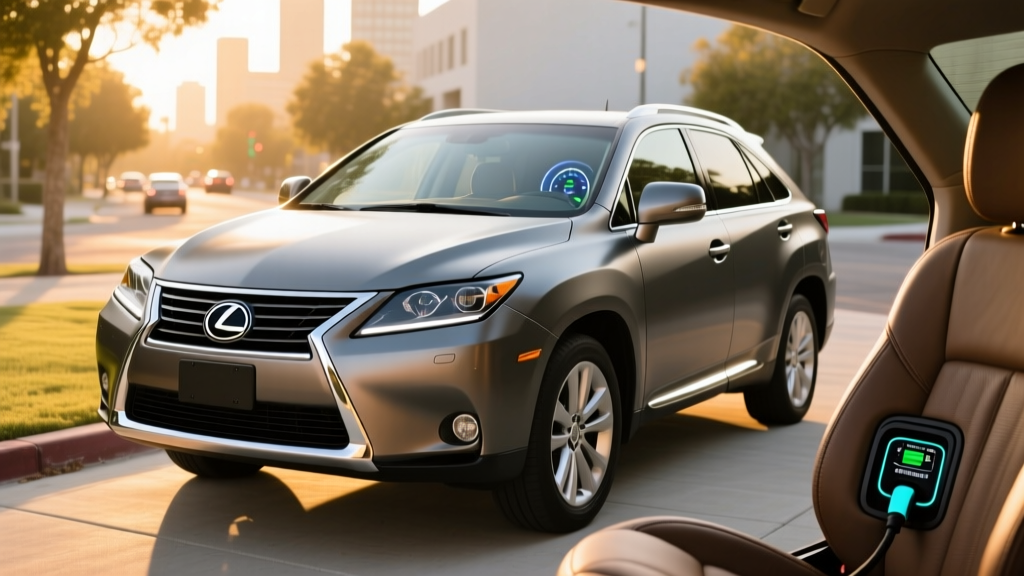
When the 2008 Lexus RX 400h arrived, it was one of the first luxury hybrid SUVs on the road — a vehicle that proved electrification could coexist with premium comfort. Nearly two decades later, used examples still populate dealer lots and private-party listings, typically priced between $6,000 and $10,000 depending on mileage and condition. For budget-conscious buyers searching for a 2008 Lexus hybrid SUV, the RX 400h remains a compelling option, provided you understand what a 17-year-old hybrid battery entails.
This is a conventional hybrid (HEV), not a plug-in. It never needs to be plugged in — the gasoline engine and regenerative braking handle all battery charging. That simplicity is part of its appeal: no home charger installation, no range anxiety, just fuel savings at every stoplight.
EPA Fuel Economy and Real-World MPG
| Metric | EPA Estimate | Real-World Expectation |
|---|---|---|
| City MPG | 31 MPG | 29–33 MPG |
| Highway MPG | 27 MPG | 25–28 MPG |
| Combined MPG | 29 MPG | 27–30 MPG |
The RX 400h's hybrid system shines in city driving, where the electric motor handles low-speed propulsion and regenerative braking recaptures energy at every stop. Many owners report exceeding the EPA city estimate in stop-and-go traffic — a characteristic unique to hybrids, since conventional gas vehicles get their worst mileage in urban conditions. Highway efficiency is less impressive because the 3.3-liter V6 carries most of the load at sustained speeds.
According to fueleconomy.gov, the 2008 RX 400h achieves 29 MPG combined with standard all-wheel drive (the e-4WD system uses a rear electric motor rather than a mechanical driveshaft). Front-wheel-drive examples are rare but marginally more efficient.
Powertrain and Performance Specifications
| Specification | 2008 Lexus RX 400h |
|---|---|
| Engine | 3.3L V6 (3MZ-FE), 211 hp |
| Front Electric Motor | 123 kW (165 hp) |
| Rear Electric Motor (AWD) | 50 kW (67 hp) |
| Net System Horsepower | 272 hp combined |
| Transmission | eCVT (electronically controlled) |
| 0–60 mph | ~7.3 seconds |
| Drivetrain | e-AWD (electric rear axle) |
| Curb Weight | ~4,500 lbs |
| Towing Capacity | 3,500 lbs (when equipped) |
The RX 400h's powertrain was genuinely innovative for its era. Toyota's Hybrid Synergy Drive pairs the V6 with two electric motors through a planetary gearset — the eCVT — that seamlessly blends power sources. The result is brisk acceleration (7.3 seconds to 60 mph was quick for a luxury SUV in 2008) and a power delivery that feels linear rather than stepped. The rear electric motor provides all-wheel-drive traction without a traditional driveshaft, reducing weight and mechanical complexity.
Hybrid Battery: Capacity, Lifespan, and Replacement Cost
The RX 400h uses a nickel-metal hydride (NiMH) traction battery pack rated at approximately 6.5 kWh total capacity (with a usable window of roughly 40–60% to preserve longevity). This is a small battery by modern standards — for comparison, a 2026 PHEV might carry 18–20 kWh — but it's sufficient for a conventional hybrid where the engine remains the primary power source.
NiMH chemistry proved remarkably durable in Toyota/Lexus applications. Many RX 400h batteries have exceeded 150,000 miles without major degradation. However, at 17+ years old, most surviving examples are on their second battery or approaching the need for one.
| Battery Replacement Option | Estimated Cost | Notes |
|---|---|---|
| New OEM (Lexus dealer) | $3,500–$5,000 | Full pack, longest expected life |
| Remanufactured pack | $1,500–$2,500 | Replaced weak cells; 1–3 yr warranty typical |
| Individual cell/module replacement | $500–$1,200 | Independent hybrid shops; requires diagnostics |
Before purchasing, request a hybrid battery health check. Many independent hybrid specialists can perform a State of Health (SoH) test that reveals cell imbalance or capacity loss. A dashboard "Check Hybrid System" warning is a deal-breaker unless the seller has documentation of recent battery service.
HEV vs PHEV vs EV: Which Fits Your Needs?
| Factor | HEV (RX 400h) | PHEV (Modern) | BEV (Full Electric) |
|---|---|---|---|
| Plug in required? | No | Yes (for max savings) | Yes |
| Electric-only range | ~1 mile at low speed | 25–50 miles typical | 200–400+ miles |
| Home charging needed | No | Recommended (Level 2) | Essential |
| Best for | No home charging access | Short commutes + road trips | Home charging + daily driving |
| Maintenance | Low (no plugs, simple) | Moderate (two systems) | Lowest (fewest moving parts) |
| Used price range (2026) | $6K–$10K | $25K–$45K | $18K–$50K+ |
The 2008 RX 400h is the right choice if you lack access to home or workplace charging and want a proven, no-plug-required hybrid. It's also ideal as a secondary vehicle or for buyers who want Lexus luxury on a tight budget. If you have a garage and a short commute, a modern PHEV like a used Toyota RAV4 Prime or a new 2026 model delivers 30–42 miles of electric-only driving before the engine engages — effectively eliminating gasoline use for daily errands.
Choose a modern PHEV if: You can install a Level 2 charger, commute under 40 miles round-trip, and want to minimize gasoline consumption.
Choose a full EV if: You have reliable home charging, drive under 300 miles daily, and want the lowest operating cost.
Federal Tax Credits and Incentives
The 2008 Lexus RX 400h originally qualified for a federal hybrid tax credit of up to $2,200 under the Energy Policy Act of 2005. However, Toyota/Lexus hit the 60,000-unit phase-out threshold in 2007, meaning the credit was already eliminated before the 2008 model year. Original purchasers received no federal incentive.
For today's used buyer, the relevant incentive is the Used Clean Vehicle Credit (IRS §25E), which provides up to $4,000 (30% of sale price) on qualifying pre-owned electrified vehicles. However, this credit applies only to vehicles with a model year at least two years older than the current calendar year — and the 2008 RX 400h qualifies on age. The vehicle must be purchased from a licensed dealer (not a private party), priced at $25,000 or less, and the buyer must meet income caps ($75,000 single / $150,000 joint). Per IRS guidelines, the credit is limited to one used vehicle purchase per three-year period.
- Vehicle must be purchased from a licensed dealer (not private party)
- Sale price must be $25,000 or less (easily met at $6K–$10K)
- Buyer income: ≤$75K single, ≤$112.5K head of household, ≤$150K joint
- One used-vehicle credit per buyer per 3 years
- Credit is 30% of sale price, up to $4,000 (a $8,000 purchase = $2,400 credit)
- Point-of-sale transfer available at participating dealers
Reliability, Safety, and Ownership Costs
The RX 400h inherited the RX 350's reputation for above-average reliability, with the hybrid system adding surprisingly few failure points. The eCVT has no traditional clutch packs or bands to wear, and the electric motors are essentially maintenance-free. Common issues reported by long-term owners include:
- Inverter coolant pump failure ($300–$600 repair) — listen for unusual whining from the engine bay
- Brake actuator wear ($800–$1,500) — the regenerative braking system uses a specialized actuator that can fail at high mileage
- Hybrid battery degradation — discussed above; budget $1,500–$5,000 depending on repair path
- Standard wear items — suspension bushings, wheel bearings, and A/C components follow typical Lexus RX patterns
The NHTSA gave the 2008 RX 400h a 5-star overall crash rating, and the IIHS rated it "Good" in frontal offset and side-impact tests — strong safety credentials for its era.
- 29 MPG combined — 30%+ better than a comparable gas RX 350
- Proven Toyota/Lexus hybrid reliability with massive parts availability
- Smooth, quiet powertrain with 272 hp for confident merging
- No plug-in required — works with existing gas infrastructure
- Low purchase price on the used market ($6K–$10K)
- Lexus interior quality and ride comfort
- Hybrid battery likely needs service or has been replaced — verify before buying
- Dated infotainment and no modern ADAS (no lane-keep, no auto emergency braking)
- Highway MPG (27) only marginally better than a gas RX 350
- No federal tax credit available at original purchase
- Small cargo area relative to modern midsize SUVs (32.6 cu ft behind rear seats)
- NiMH battery less energy-dense than modern lithium-ion alternatives
Buying Checklist for a Used 2008 Lexus RX 400h
- Hybrid battery SoH test — have an independent hybrid shop scan for cell voltage imbalance and capacity
- Check for "Check Hybrid System" codes — clear codes may hide pending battery issues
- Verify brake actuator health — test for firm pedal feel and absence of grinding or buzzing
- Review maintenance records — especially inverter coolant and transaxle fluid changes
- Inspect for rust — undercarriage and battery tray (mounted under rear seat)
- Confirm trim level — Premium, Premium Plus, and navigation-equipped models command a $500–$1,000 premium
- Test the AWD system — on a low-traction surface, the rear motor should engage smoothly
Frequently Asked Questions
How many MPG does the 2008 Lexus RX 400h hybrid SUV get?
The EPA rates the 2008 RX 400h at 31 city / 27 highway / 29 combined MPG. Real-world testing shows most owners achieve 27–30 MPG combined, with city driving often exceeding the EPA estimate thanks to regenerative braking and electric-assisted low-speed travel.
Does the 2008 RX 400h need to be plugged in?
No. The RX 400h is a conventional hybrid (HEV), not a plug-in hybrid (PHEV). The gasoline engine and regenerative braking system charge the hybrid battery automatically during driving. There is no plug, no charging cable, and no electric-only driving range beyond very low-speed creeping (roughly 1 mile at under 25 mph in ideal conditions).
How far can the 2008 RX 400h go on electric power alone?
Effectively zero miles in practical terms. The NiMH battery and electric motors assist the gasoline engine but cannot propel the vehicle at meaningful speeds without the engine running. This is fundamentally different from a PHEV, which offers 25–50 miles of true electric-only driving.
Is the 2008 Lexus hybrid SUV reliable?
Yes, with one important caveat: the hybrid battery. The powertrain, transmission (eCVT), and electric motors have proven extremely durable, with many examples exceeding 200,000 miles. The hybrid battery is the primary long-term cost — budget $1,500–$5,000 for replacement or refurbishment if the original pack hasn't been serviced.
What does a replacement hybrid battery cost for the RX 400h?
A new OEM battery from Lexus costs $3,500–$5,000 installed. Remanufactured packs run $1,500–$2,500, and individual cell module replacement at a hybrid specialist costs $500–$1,200. Many owners opt for the remanufactured route, which typically includes a 1–3 year warranty.
Does the 2008 RX 400h qualify for any tax credits in 2026?
The original new-vehicle hybrid credit is long expired. However, the IRS §25E Used Clean Vehicle Credit may provide up to $4,000 (30% of sale price) if purchased from a licensed dealer for $25,000 or less, subject to buyer income caps. Consult a tax professional for eligibility specifics.
HEV vs PHEV vs EV — which should I choose over the RX 400h?
If you lack home charging access and want a simple, affordable hybrid, the RX 400h is ideal. If you can charge at home and commute under 40 miles, a modern PHEV (like a used RAV4 Prime or 2026 Hyundai Tucson PHEV) eliminates most gasoline use. If you have reliable Level 2 charging and drive under 300 miles daily, a full EV offers the lowest operating cost and zero tailpipe emissions.