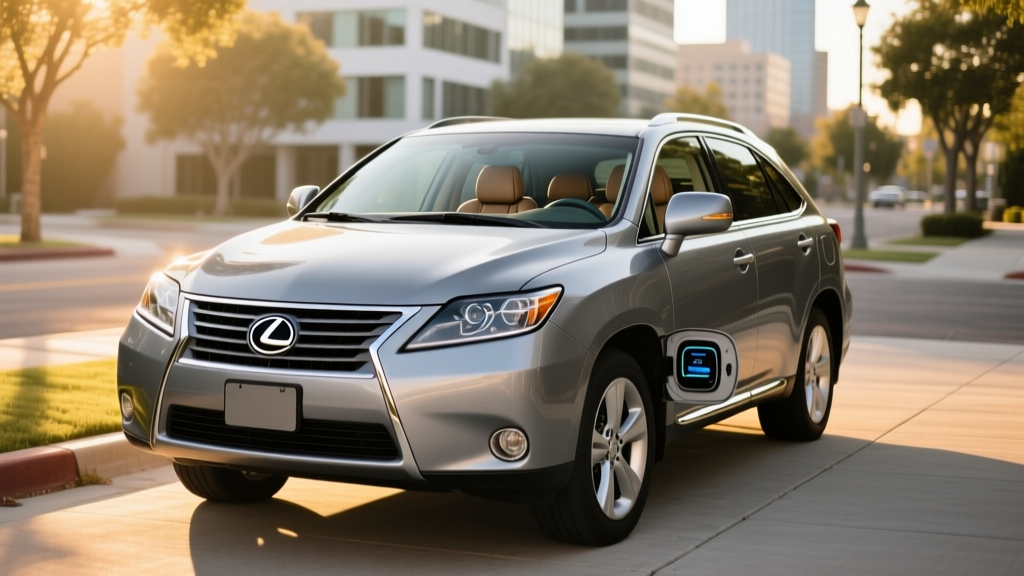
The 2008 Lexus RX 400h was one of the first luxury hybrid SUVs to reach mass-market buyers, blending Toyota's proven Hybrid Synergy Drive with Lexus refinement. Nearly two decades later, it remains a popular used-vehicle choice for drivers seeking reliable, efficient transportation without the complexity of a plug-in hybrid or full electric vehicle. This guide covers everything a prospective buyer or current owner needs to know about the 2008 Lexus RX 400h hybrid — from real-world MPG to battery replacement costs and whether it still holds up against modern alternatives.
| Spec | Value |
|---|---|
| Powertrain Type | Conventional Hybrid (HEV) — no plug required |
| Gas Engine | 3.3L V6 (211 hp) |
| Electric Motor(s) | Front + rear motors (combined system output: 272 hp) |
| Transmission | eCVT (electronically controlled continuously variable) |
| Drivetrain | AWD (e-four — electric rear axle) |
| Hybrid Battery | ~1.9 kWh NiMH (nickel-metal hydride) |
| EPA MPG (City / Hwy / Combined) | 31 / 27 / 29 |
| 0–60 mph | ~7.3 seconds |
| Cargo Volume | 38.3 cu ft (rear seats up) |
| Original MSRP (2008) | ~$45,000 |
| Typical Used Price (2026) | $5,500–$9,500 depending on mileage/condition |
EPA Fuel Economy vs. Real-World MPG
The EPA rates the 2008 Lexus RX 400h at 31 mpg city, 27 mpg highway, and 29 mpg combined. Those numbers come from fueleconomy.gov, the official source for EPA estimates.
| Driving Condition | EPA Rating | Real-World Expectation |
|---|---|---|
| City | 31 mpg | 29–33 mpg (hybrids often exceed EPA in stop-and-go) |
| Highway | 27 mpg | 25–28 mpg (aerodynamic drag limits electric assist at speed) |
| Combined | 29 mpg | 27–30 mpg |
Like most Toyota/Lexus hybrids of this era, the RX 400h tends to match or slightly exceed its EPA city rating in real-world driving. The hybrid system recaptures energy during braking and allows the gas engine to shut off at stops, which benefits urban driving disproportionately. Highway driving, by contrast, relies more heavily on the V6, since electric-only assist is limited to low speeds.
Owners reporting on fuel-tracking platforms commonly log lifetime averages between 26 and 30 mpg, with city-heavy commuters occasionally seeing 32+ mpg in warm weather. Cold climates reduce efficiency by roughly 2–4 mpg due to increased engine idling for cabin heat and reduced battery efficiency in the NiMH pack.
Hybrid (HEV) vs. Plug-In Hybrid (PHEV) vs. Full EV: Which Fits You?
The 2008 Lexus RX 400h is a conventional hybrid (HEV). It cannot be plugged in and has no meaningful electric-only driving range. Understanding the distinction is essential before comparing it to modern alternatives:
| Feature | HEV (e.g., RX 400h) | PHEV (e.g., modern RAV4 Prime) | BEV (e.g., Tesla Model Y) |
|---|---|---|---|
| Plug-in Charging | No — self-charging via regen + engine | Yes — Level 1 or Level 2 | Yes — Level 1, 2, or DC fast |
| Electric-Only Range | ~0.5–1 mile at very low speed | 25–42 miles typical | 250–350+ miles |
| Gas Engine | Yes — primary power source | Yes — backup after battery depletes | No |
| Fuel/Charging Needed | Gasoline only | Gasoline + electricity | Electricity only |
| Tailpipe Emissions | Yes | Yes (when engine runs) | None at vehicle |
| Federal Tax Credit (new) | None | Up to $7,500 (§30D, if eligible) | Up to $7,500 (§30D, if eligible) |
Choose the 2008 RX 400h (HEV) if: You want a simple, reliable daily driver with no charging infrastructure needs, you lack access to home or workplace charging, and you're shopping on a used-car budget under $10,000.
Choose a modern PHEV if: You have access to Level 2 charging at home and want 30–40 miles of electric commuting with gas flexibility for road trips.
Choose a BEV if: You have reliable home charging, want the lowest per-mile fuel cost, and are ready to commit to an all-electric lifestyle with modern range (250+ miles EPA).
Powertrain Deep Dive: How the RX 400h Hybrid System Works
The 2008 RX 400h pairs a 3.3-liter V6 engine (211 hp) with a hybrid transaxle containing two electric motor-generators. A third motor drives the rear wheels, giving the SUV its "e-four" all-wheel-drive system. Combined system output is rated at 272 horsepower — a genuinely quick figure for a luxury SUV in 2008, and still respectable today.
The NiMH (nickel-metal hydride) traction battery stores approximately 1.9 kWh of energy. This is tiny by modern standards — a contemporary PHEV carries 15–20 kWh, and a BEV carries 60–100 kWh — but the RX 400h doesn't need a large pack. The battery's job is to buffer energy for acceleration assist, recapture braking energy, and allow brief engine-off coasting and low-speed maneuvering.
The eCVT transmission is not a traditional belt-and-pulley CVT. It uses a planetary gearset to blend power from the engine and electric motors seamlessly. This design has proven extremely durable — Toyota/Lexus eCVTs from this era rarely experience mechanical failure, unlike some conventional automatic or belt-driven CVT designs from other manufacturers.
Battery Lifespan, Warranty, and Replacement Cost
Original Battery Warranty: Lexus covered the hybrid battery for 8 years / 100,000 miles (10 years / 150,000 miles in California and states adopting CARB emissions standards). For a 2008 model, factory warranty coverage expired years ago.
Real-World Battery Lifespan: The NiMH pack in the RX 400h commonly lasts 150,000–200,000+ miles before requiring replacement, based on owner reports and taxi/fleet data from similar Toyota hybrid systems. Many examples exceed 200,000 miles on the original battery.
When the hybrid battery does eventually fail, owners face a few options:
| Option | Estimated Cost | Notes |
|---|---|---|
| New OEM battery (Lexus dealer) | $3,500–$5,000 | Full new pack, best longevity, includes 1-year warranty |
| Remanufactured battery (aftermarket) | $1,800–$3,000 | Rebuilt with tested cells, 1–3 year warranty typical |
| Used/salvage battery | $500–$1,200 | From a wrecked/low-mileage donor vehicle; unknown remaining life |
| Individual cell/module replacement | $300–$800 | Requires a specialist; replaces only failed modules, not the full pack |
NiMH batteries degrade gradually rather than failing catastrophically. A degraded pack may still function but with reduced electric assist, resulting in slightly lower MPG (typically a 2–4 mpg drop). The vehicle will trigger a hybrid system warning light and store diagnostic trouble codes (e.g., P0A80) when the battery falls below acceptable performance thresholds.
According to NHTSA records, the 2008 RX 400h has no major hybrid-battery-specific recalls, which aligns with Toyota's conservative battery management strategy — the system never fully charges or fully depletes the pack, keeping it in a longevity-friendly middle range.
Reliability and Common Issues Beyond the Battery
The 2008 RX 400h is widely regarded as one of the most reliable luxury SUVs of its era. The underlying platform (shared with the Toyota Highlander Hybrid) and the Hybrid Synergy Drive powertrain have extensive longevity data supporting their durability. Key reliability considerations:
- Inverter coolant pump: A known failure point on 2006–2008 RX 400h models. Lexus issued a recall (campaign 13V-315) for the hybrid inverter coolant pump. Verify this recall was performed — a failed pump can overheat the inverter, leading to a $2,000–$4,000 repair. Check recall status at nhtsa.gov/recalls.
- Brake actuator: The electro-hydraulic brake system can develop faults after 120,000+ miles. Replacement runs $1,200–$2,000. Symptoms include a firm brake pedal, warning lights, or reduced regenerative braking.
- Power steering: Electric power steering racks on this generation can develop leaks or electronic faults. Budget $800–$1,500 if replacement is needed.
- Suspension: Standard MacPherson strut / double-wishbone setup. Bushings, struts, and sway bar links wear normally for a vehicle of this age; budget $600–$1,200 for a full refresh.
- Air conditioning compressor: Electrically driven A/C compressors can fail on high-mileage examples. Replacement: $800–$1,500.
Despite these potential repairs, the RX 400h's overall cost of ownership remains competitive with non-hybrid luxury SUVs of the same vintage, largely because the powertrain itself (engine, eCVT, hybrid system) is exceptionally robust.
Does the 2008 Lexus RX 400h Qualify for Any Tax Credit?
No. As a used conventional hybrid (HEV), the 2008 Lexus RX 400h does not qualify for any federal tax credit in 2026. Here's why:
- Federal §30D New EV Credit: Only applies to new plug-in vehicles (BEVs and PHEVs) meeting battery sourcing, MSRP, and buyer income requirements. The RX 400h is neither new nor a plug-in.
- Federal §25E Used EV Credit: Provides up to $4,000 (30% of sale price, capped at $4,000) for used plug-in electric vehicles with a battery of at least 7 kWh. The RX 400h's 1.9 kWh NiMH pack does not meet the minimum threshold, and it is not a plug-in vehicle.
- State incentives: Most state hybrid incentives expired years ago or apply only to new purchases. Some states offer emissions-testing exemptions for hybrids — check your local DMV.
The RX 400h's value proposition is purely about low running costs (fuel savings, strong reliability) rather than purchase incentives. For current §30D and §25E credit rules, consult IRS.gov clean vehicle credits.
Who Should Buy the 2008 Lexus RX 400h Today?
Pros
- Proven, durable hybrid powertrain — 200k+ miles common
- 29 mpg combined in a comfortable AWD luxury SUV
- Strong 272 hp system output; quick for its class
- No plug-in charging needed — ideal for apartment/renter living
- Low used purchase price ($5,500–$9,500)
- Lexus build quality and quiet cabin
Cons
- Aging technology — no modern ADAS (no auto emergency braking, no lane-keeping)
- NiMH battery replacement cost ($1,800–$5,000) if it fails
- Inverter coolant pump recall must be verified
- No electric-only driving range of practical use
- Fuel economy is outpaced by modern hybrids (Toyota RAV4 Hybrid: 39 mpg combined)
- Outdated infotainment — no Apple CarPlay/Android Auto without aftermarket head unit
The 2008 Lexus RX 400h hybrid makes the most sense for buyers who:
- Need a reliable, affordable AWD SUV for daily commuting and errands
- Cannot install home charging equipment (renters, apartment dwellers, street parkers)
- Want Lexus luxury and comfort at a used-economy price point
- Drive 10,000–15,000 miles per year and value fuel savings without behavioral changes
It is not the right choice for buyers who want modern safety features (automatic emergency braking, blind-spot monitoring), electric-only commuting capability, or the latest infotainment technology. Those buyers should look at a newer hybrid (2020+ RAV4 Hybrid or Highlander Hybrid), a PHEV (RAV4 Prime, Tucson PHEV), or a used BEV (Chevrolet Bolt, Tesla Model 3).
Quick Decision Framework
Buy the 2008 RX 400h if: Your budget is under $10K, you lack charging access, and you prioritize reliability and low running costs over modern tech.
Consider a newer hybrid if: You want current safety tech and 35+ mpg combined — budget $25K–$35K for a 2020+ RAV4 Hybrid or Camry Hybrid.
Consider a PHEV if: You have Level 2 home charging and a short commute (under 35 miles) — a RAV4 Prime or Prius Prime lets you drive mostly on electricity with gas backup.
Consider a BEV if: You have home charging, want the lowest per-mile cost (~$0.04/mile vs. $0.14/mile for the RX 400h at current fuel prices), and can budget $25K+ for a used EV like the Bolt or Model 3.
Frequently Asked Questions
How many MPG does the 2008 Lexus RX 400h hybrid get?
The EPA rates it at 31 mpg city, 27 mpg highway, and 29 mpg combined. Real-world owners typically report 27–30 mpg combined, with city-heavy drivers sometimes exceeding 31 mpg thanks to the hybrid system's regenerative braking and engine-off coasting.
Is the 2008 Lexus RX 400h a plug-in hybrid?
No. The 2008 RX 400h is a conventional hybrid (HEV). It charges its own battery through regenerative braking and the gas engine. You never plug it in. It has no practical electric-only range — the battery assists the gas engine but cannot power the vehicle alone for meaningful distances.
How long does the hybrid battery last, and what does replacement cost?
The NiMH hybrid battery commonly lasts 150,000–200,000+ miles. If replacement is needed, expect $1,800–$3,000 for a remanufactured pack or $3,500–$5,000 for a new OEM unit from a Lexus dealer. Used/salvage packs and individual module replacements are available for $300–$1,200.
Is the 2008 Lexus RX 400h reliable?
Yes — it is among the most reliable luxury SUVs of its generation. The hybrid powertrain (eCVT, V6, NiMH battery) is proven to last well beyond 200,000 miles with routine maintenance. The main watch-outs are the inverter coolant pump (verify the recall was performed), the brake actuator on high-mileage examples, and normal wear items (suspension, A/C).
Does the 2008 Lexus RX 400h qualify for any federal tax credit?
No. It does not qualify for the §30D new clean vehicle credit (it's used and not a plug-in) or the §25E used EV credit (its battery is under the 7 kWh minimum and it cannot be plugged in). The financial case for the RX 400h rests entirely on its low purchase price, strong fuel economy, and long-term reliability.
How does the RX 400h compare to a modern hybrid like the RAV4 Hybrid?
A 2025 Toyota RAV4 Hybrid delivers 39 mpg combined (vs. 29 for the RX 400h), offers modern ADAS (automatic emergency braking, lane-keeping, adaptive cruise), Apple CarPlay/Android Auto, and a new-vehicle warranty — but starts around $33,000. The RX 400h costs roughly $7,000 used and still provides dependable, comfortable transportation; it just can't match the efficiency, safety, or technology of a modern hybrid.