Quick Verdict: A Pioneer That Still Hauls
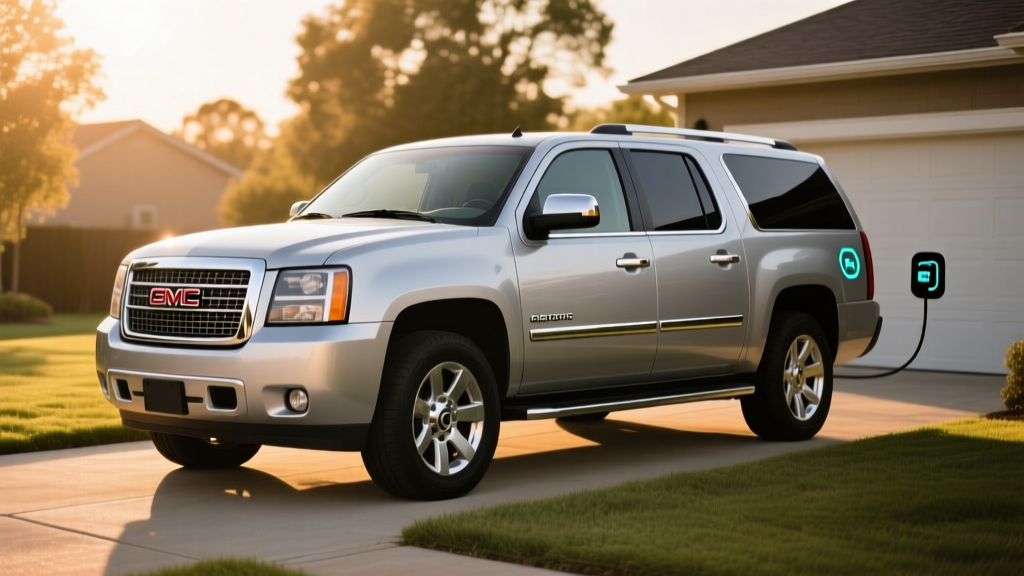
The 2008 Hybrid GMC Yukon was one of the first full-size SUVs to pair a gasoline V8 with an electric hybrid system — a bold move from General Motors during an era of $4-per-gallon fuel. Nearly two decades later, it remains a curiosity on the used market: a three-row, body-on-frame SUV that sips fuel more like a midsize sedan than a 5,800-pound truck. For 2026 used-car shoppers eyeing large-family transportation on a budget, the Yukon Hybrid offers genuine efficiency gains over its gas-only siblings, but it comes with age-related battery risks that every buyer must weigh.
This guide breaks down the exact EPA fuel economy figures, the two-mode hybrid powertrain, real-world MPG expectations, battery longevity and replacement costs, and whether this 18-year-old hybrid still makes financial sense compared to a modern PHEV or full EV.
HEV vs PHEV: What the 2008 Yukon Hybrid Actually Is
Before diving into specs, it is critical to clarify the powertrain type. The 2008 GMC Yukon Hybrid is a conventional hybrid electric vehicle (HEV), not a plug-in hybrid (PHEV). This distinction matters enormously for buyers:
| Feature | 2008 Yukon Hybrid (HEV) | Plug-In Hybrid (PHEV) | Full EV (BEV) |
|---|---|---|---|
| Plugs in to charge? | No — self-charging via regen & engine | Yes — external charging required | Yes — sole energy source |
| Electric-only driving | Very limited (low-speed, short distance) | 20–50+ miles typical | Full range (200–400+ mi) |
| Battery size | ~1.8 kWh (NiMH) | 10–30 kWh (Li-ion) | 60–120+ kWh (Li-ion/NMC/LFP) |
| Federal tax credit (§30D) | Not eligible | Up to $7,500 (if eligible) | Up to $7,500 (if eligible) |
| Primary fuel | Gasoline (electric assists) | Gasoline + electricity | Electricity only |
The Yukon Hybrid never needs to be plugged in. Its nickel-metal hydride (NiMH) battery pack charges entirely through regenerative braking and the gasoline engine. You cannot drive it on electric power alone at highway speeds — the electric motors assist the V8 and enable engine-off operation at very low speeds (under ~25 mph in stop-and-go traffic), but this is measured in blocks, not miles.
Powertrain Specs: GM's Two-Mode Hybrid System
The 2008 Yukon Hybrid uses GM's Two-Mode Hybrid system, co-developed with Chrysler and BMW. This was an engineering showcase for its time — a full hybrid system integrated into a rear-wheel-drive/4WD truck platform.
| Specification | 2008 GMC Yukon Hybrid |
|---|---|
| Engine | 6.0L Vortec V8 (VVT, Active Fuel Management) |
| Engine output | 332 HP @ 5,100 RPM / 367 lb-ft @ 4,100 RPM |
| Electric motors | Two 60-kW motors (inside transmission housing) |
| Combined system output | 379 HP (net) |
| Transmission | 2-Mode CVT (electrically variable) |
| Battery pack | ~1.8 kWh NiMH (30-module, 288V nominal) |
| Drivetrain | RWD standard; 4WD available |
| Curb weight | ~5,841 lbs (RWD) / ~6,036 lbs (4WD) |
| Towing capacity | 5,800 lbs (RWD) / 5,600 lbs (4WD) |
| Seating | 7–8 passengers (3 rows) |
| Original MSRP | $55,320 (base Hybrid RWD, 2008) |
The two-mode system operates differently depending on driving conditions. In Mode 1 (low speed, light load), one electric motor can drive the vehicle alone at low speeds, or both motors assist the V8 for smooth acceleration. In Mode 2 (highway cruising), the system locks into a more direct mechanical path for efficiency, with the electric motors providing boost during acceleration or capturing energy during deceleration. This dual-mode approach was designed to deliver efficiency gains in both city and highway driving — unusual for early hybrid systems that primarily optimized city MPG.
Fuel Economy: EPA Numbers and Real-World MPG
The headline number for the 2008 Yukon Hybrid is its EPA rating — a significant improvement over the conventional V8 Yukon of the same year.
| Configuration | City MPG | Highway MPG | Combined MPG |
|---|---|---|---|
| 2008 Yukon Hybrid (RWD) | 21 | 22 | 21 |
| 2008 Yukon Hybrid (4WD) | 20 | 20 | 20 |
| 2008 Yukon 5.3L V8 (RWD, gas-only) | 14 | 20 | 16 |
| 2008 Yukon 6.2L V8 (Denali, gas-only) | 12 | 18 | 14 |
Source: EPA Fuel Economy
The hybrid achieves a 31% improvement in combined MPG over the base 5.3L V8 and a 50% improvement over the 6.2L Denali. That is a meaningful reduction at the pump, especially for city-heavy driving where the hybrid system recaptures the most energy through regenerative braking.
Real-World MPG: What Owners Actually Report
EPA figures are laboratory estimates. Real-world data from owner-reported logs on Fuelly and Edmunds forums consistently shows the 2008 Yukon Hybrid delivering:
- City driving: 19–22 MPG (hybrid system excels in stop-and-go; some owners match or slightly exceed EPA)
- Highway driving: 18–21 MPG (aerodynamic drag and weight work against the hybrid advantage at speed)
- Combined real-world average: 19–21 MPG
- Towing or heavy cargo: 13–16 MPG (hybrid advantage diminishes under sustained high load)
The gap between EPA and real-world is narrow for this model — typically within 1–2 MPG. Unlike modern PHEVs or EVs that can suffer 20–30% range loss in cold weather, the Yukon Hybrid's gasoline engine provides cabin heat natively, so winter MPG drops are modest (roughly 1–2 MPG in sub-freezing temperatures). However, an 18-year-old vehicle with worn spark plugs, a clogged air filter, or degraded hybrid battery cells will underperform these figures. Budget for a full tune-up if purchasing.
Battery Longevity, Warranty, and Replacement Cost
Original Warranty (2008): GM warranted the hybrid battery and hybrid-specific components for 8 years / 100,000 miles. In states that adopted California emissions standards (CARB states), the warranty extended to 10 years / 150,000 miles.
Current Status (2026): All original factory hybrid warranties have expired. Any battery failure is the owner's financial responsibility.
How Long Does the NiMH Battery Last?
Nickel-metal hydride batteries are proven technology — Toyota's Prius NiMH packs from the same era frequently exceed 200,000 miles with gradual capacity loss rather than sudden failure. The Yukon Hybrid's NiMH pack follows a similar pattern:
- Expected lifespan: 150,000–200,000 miles under normal use, or 15–20 years
- Degradation pattern: Gradual capacity fade reducing electric-assist effectiveness, which lowers MPG by 2–4 MPG as the pack ages
- Failure mode: Individual cell/module failure triggering a check-engine light (DTC P0A7F or similar); the vehicle remains drivable but in reduced-power "limp" mode
Battery Replacement Costs
If you are buying a 2008 Yukon Hybrid in 2026, battery replacement cost is the single most important financial variable:
| Replacement Option | Estimated Cost (2026) | Warranty |
|---|---|---|
| New OEM GM hybrid battery | $3,500–$5,000 (if still available) | 12 months typical |
| Remanufactured battery (e.g., GreenTech, Dorman) | $2,000–$3,500 | 1–3 years |
| Used/salvage battery | $800–$1,500 | 30–90 days |
| Individual module reconditioning | $500–$1,200 (specialist shops) | Varies |
Parts availability is a growing concern. GM discontinued the Yukon Hybrid after the 2013 model year, and OEM battery packs are increasingly scarce. Third-party remanufactured packs from companies like GreenTech Automotive or Dorman remain the most practical option. Before purchasing any used 2008 Yukon Hybrid, insist on a hybrid battery health scan using a GM-compatible OBD-II tool that reads individual module voltages — a spread of more than 0.2V between modules signals impending failure.
Is the 2008 Yukon Hybrid Reliable?
Reliability for this model is a split verdict. The conventional mechanical components — the 6.0L Vortec V8, the frame, the suspension — are proven GM truck hardware with abundant aftermarket support. The hybrid-specific components carry more risk:
Common Issues Reported by Owners
- Hybrid battery degradation: The most common and costly issue, as detailed above
- Hybrid system cooling fan failure: The battery pack has a dedicated cooling fan; failure leads to overheating and reduced hybrid function (~$300–$500 repair)
- Active Fuel Management (AFM) lifter failure: The 6.0L V8 deactivates cylinders under light load; collapsed AFM lifters are a known GM V8 issue ($1,500–$3,000 if internal engine work is needed)
- Electric power steering (if equipped): Some model years had EPS module failures
- Standard truck wear: Transmission cooler lines, wheel bearings, and suspension components wear as expected for a heavy SUV
The two-mode hybrid transmission itself — the EVT unit housing the electric motors — has proven surprisingly durable. Unlike the early Ford Escape Hybrid or Toyota Highlander Hybrid transmissions, GM's 2-mode EVT does not have a widespread failure pattern. The risk concentrates on the battery pack and its cooling system.
Tax Credits and Incentives: What Applies in 2026?
The 2008 Yukon Hybrid does not qualify for the current federal §30D Clean Vehicle Credit. This credit applies only to new plug-in vehicles (PHEVs and BEVs) meeting battery sourcing, MSRP cap, and buyer income requirements per IRS guidelines. As a conventional HEV purchased used, it falls outside all current federal EV incentive programs.
Some states previously offered hybrid tax credits or HOV lane access for HEVs, but most of these programs expired years ago or shifted exclusively to plug-in vehicles. Check your state's current energy office website for any remaining used-vehicle incentives, but do not count on any credit for this purchase.
Hybrid vs PHEV vs EV: Which Full-Size SUV Fits You?
If you need a three-row, body-on-frame SUV in 2026, the landscape looks very different than it did in 2008. Here is a decision framework:
Choose the 2008 Yukon Hybrid (used HEV) if:
- Your budget is $5,000–$10,000 for a used large SUV
- You cannot charge at home (no garage, apartment living, no outlet access)
- You need towing capacity (5,600+ lbs) on a tight budget
- You drive mostly city/suburban miles where hybrid regen provides the biggest MPG gain
- You accept the risk of a $2,000–$4,000 battery replacement within your ownership period
Choose a modern PHEV SUV (e.g., Jeep Wrangler 4xe, Chrysler Pacifica Hybrid) if:
- You can install a Level 2 home charger and want 25–40 miles of electric-only commuting
- You want to qualify for the §30D tax credit (up to $7,500, subject to IRS eligibility rules)
- You want a modern warranty (8 yr/100k mi hybrid battery + full vehicle coverage)
- Your budget is $40,000–$65,000
Choose a full EV (e.g., Rivian R1S, Tesla Model X, upcoming electric Tahoe) if:
- You want zero tailpipe emissions and the lowest per-mile fuel cost (~$0.04–$0.06/mi vs $0.18–$0.22/mi for the Yukon Hybrid)
- You have reliable home and/or workplace charging
- Your budget exceeds $70,000 (or $50,000+ for used EVs like a 2022 Model X)
- You do not need to tow heavy loads frequently (EV towing range drops 40–50%)
Total Cost of Ownership: 2008 Yukon Hybrid vs Gas-Only Yukon
For a used buyer comparing the Hybrid to a same-year gas-only Yukon 5.3L V8, the math looks like this over a 5-year / 60,000-mile ownership period (assuming $3.50/gallon regular unleaded and 15,000 miles/year):
| Cost Category | Yukon Hybrid (21 MPG) | Yukon 5.3L V8 (16 MPG) |
|---|---|---|
| Fuel cost (60k mi) | $10,000 | $13,125 |
| Estimated maintenance (5 yr) | $4,000–$5,500* | $3,500–$4,500 |
| Hybrid battery replacement risk | $2,000–$3,500 (if needed) | $0 |
| Insurance (avg) | ~$7,200 | ~$6,600 |
| 5-year total (est.) | $23,200–$26,200 | $23,225–$24,225 |
*Maintenance costs for the Hybrid are higher if the hybrid battery or cooling system requires service. Without battery replacement, the Hybrid's fuel savings net roughly $2,500–$3,100 over five years. With a battery replacement, the savings evaporate entirely.
This is the central tension of buying an aging hybrid: the fuel savings are real but modest, and a single major hybrid-component repair can wipe them out. Purchase price, vehicle condition, and remaining battery health matter more than the MPG advantage alone.
Pros and Cons: 2008 GMC Yukon Hybrid
Pros
- 21 MPG combined — 31% better than gas-only Yukon, significant for a 5,800-lb SUV
- No plug-in charging needed; works with existing infrastructure
- Full towing capacity (5,600–5,800 lbs) retained vs gas models
- Three-row seating for 7–8 passengers with genuine cargo room
- Proven 6.0L V8 and truck platform with wide aftermarket support
- Low used purchase price ($5,000–$10,000 in 2026 market)
Cons
- All original hybrid warranties expired — battery replacement is out-of-pocket
- NiMH battery parts availability shrinking as model ages
- No electric-only driving range — this is an assist hybrid, not a plug-in
- No federal or state tax credit eligibility
- AFM lifter issues on the 6.0L V8 can be expensive
- Outdated infotainment, safety tech, and driver-assistance features vs modern vehicles
- Higher insurance premiums than non-hybrid equivalents
Frequently Asked Questions
How many MPG does the 2008 Hybrid GMC Yukon get?
The EPA rates the 2008 Yukon Hybrid at 21 city / 22 highway / 21 combined MPG for rear-wheel drive, and 20/20/20 for four-wheel drive. Real-world owner reports cluster between 19–21 MPG combined, with city driving often matching or slightly exceeding the EPA estimate thanks to regenerative braking. Highway-only driving at 75+ MPH typically drops to 18–19 MPG due to aerodynamic drag.
Does the 2008 Yukon Hybrid need to be plugged in?
No. The 2008 Yukon Hybrid is a conventional HEV (hybrid electric vehicle). It charges its own battery through regenerative braking and the gasoline engine. There is no plug, no charging port, and no electric-only driving range to manage. You fuel it with gasoline like any other SUV.
How far can the Yukon Hybrid drive on electric power alone?
Effectively zero miles at meaningful speeds. The electric motors can propel the Yukon at very low speeds (under ~25 mph) for short distances — think creeping through a parking lot or stop-and-go traffic. This is not a measurable electric-only range. The system is designed to assist the V8 and reduce fuel consumption, not to replace it.
Is the 2008 Yukon Hybrid reliable?
Mechanically, the truck platform and V8 engine are durable GM components with strong parts availability. The hybrid-specific risk centers on the NiMH battery pack, which is now 18 years old and likely near end-of-life if it has not been replaced. Budget $2,000–$3,500 for a remanufactured battery at purchase or shortly after. The Active Fuel Management system on the 6.0L V8 is also a known failure point. Overall reliability is moderate — good for the truck, uncertain for the hybrid system.
What does it cost to replace the hybrid battery?
A remanufactured NiMH battery pack costs $2,000–$3,500 installed at an independent hybrid specialist. A new OEM pack (if available) runs $3,500–$5,000. Used salvage packs are cheaper ($800–$1,500) but carry significant risk. Individual module reconditioning is possible for $500–$1,200 at specialist shops. Always get a pre-purchase hybrid battery health scan before buying.
Does the 2008 Yukon Hybrid qualify for any tax credit?
No. The federal §30D Clean Vehicle Credit applies only to new plug-in vehicles (PHEVs and BEVs) that meet battery sourcing, MSRP, and buyer income requirements. A used conventional hybrid does not qualify. Some states previously offered hybrid incentives, but nearly all have expired or shifted to plug-in-only programs. Consult your state energy office for any remaining programs.
Should I buy a 2008 Yukon Hybrid or a newer used PHEV?
If your budget allows $25,000+, a newer used PHEV like a 2018+ Chrysler Pacifica Hybrid (32 miles electric-only range, 84 MPGe) or a Toyota RAV4 Hybrid offers better efficiency, a remaining factory warranty, modern safety features, and lower battery-replacement risk. The 2008 Yukon Hybrid makes sense only if you need a full-size, body-on-frame, three-row SUV with towing capability for under $10,000 — a niche where it still has few competitors.
What is the difference between the Yukon Hybrid and the Tahoe Hybrid?
Mechanically, nothing. The Chevrolet Tahoe Hybrid and GMC Yukon Hybrid share the identical two-mode hybrid powertrain, battery, and EPA ratings. The differences are cosmetic (badging, grille, interior trim) and dealership experience. Choose based on condition and price, not brand.