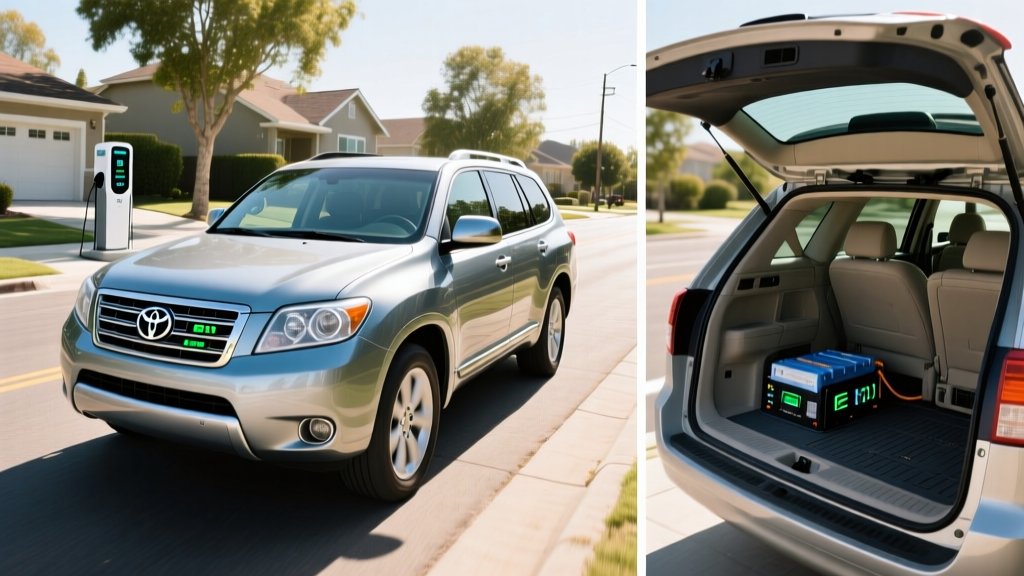
If you're researching the 2008 Highlander Hybrid mileage as a used-car buyer, you're looking at one of Toyota's earliest mainstream hybrid SUVs — a three-row, all-wheel-drive family hauler that promised V6 power with four-cylinder fuel bills. Nearly two decades later, the question isn't just what the EPA sticker said; it's what kind of fuel economy you can actually expect today, whether the hybrid battery is a ticking time bomb, and how this aging HEV stacks up against modern hybrids, PHEVs, and full EVs.
This guide covers the 2008 Toyota Highlander Hybrid's real-world MPG, powertrain specs, battery longevity, ownership costs, and whether it still earns a spot in your driveway in 2026.
2008 Highlander Hybrid MPG: EPA Numbers vs. Real-World Results
The 2008 Toyota Highlander Hybrid was rated by the EPA at 25 MPG combined, with a breakdown of 25 MPG city and 25 MPG highway. That parity between city and highway is a hallmark of Toyota's Hybrid Synergy Drive system, which leans heavily on electric-motor assist at low speeds where conventional engines are least efficient.
| Driving Cycle | EPA MPG | Real-World Expectation (2026) |
|---|---|---|
| City | 25 MPG | 24–27 MPG (hybrids often beat EPA in stop-and-go) |
| Highway | 25 MPG | 22–25 MPG (aerodynamic drag and aging battery reduce efficiency) |
| Combined | 25 MPG | 23–26 MPG depending on battery health and driving style |
For context, the conventional gas-only 2008 Highlander V6 AWD was rated at 19 MPG combined. The hybrid's ~30% fuel-economy advantage was significant for its era and remains respectable for a 4,500-pound, three-row SUV.
Powertrain Breakdown: Engine, Motors, and Combined Output
The 2008 Highlander Hybrid pairs a 3.3-liter V6 gasoline engine (code-named 3MZ-FE) with Toyota's Hybrid Synergy Drive system. This is a full hybrid (sometimes called a "strong hybrid"), meaning it can propel the vehicle on electric power alone at low speeds — but it cannot be plugged in to charge.
| Specification | Value |
|---|---|
| Engine | 3.3L V6 (3MZ-FE) |
| Engine Output | 208 HP @ 5,600 RPM |
| Front Electric Motor | 120 kW (161 HP) |
| Rear Electric Motor (AWD-i) | 50 kW (67 HP) |
| Net Combined System Power | 270 HP |
| Transmission | eCVT (planetary gearset, no fixed gears) |
| Drivetrain | AWD-i (electric rear axle, no mechanical driveshaft) |
| Hybrid Battery | Nickel-Metal Hydride (NiMH), ~6.5 kWh total / ~1.5 kWh usable |
| Curb Weight | ~4,500 lbs |
| 0–60 MPH | ~7.5 seconds |
The AWD-i system is worth noting: unlike conventional AWD with a mechanical driveshaft to the rear wheels, the Highlander Hybrid uses a dedicated rear electric motor that engages when slip is detected or during hard acceleration. This keeps weight down and eliminates a major source of drivetrain loss, but it also means rear-wheel torque is limited and not suited for serious off-roading.
HEV vs. PHEV vs. EV: Where Does the 2008 Highlander Hybrid Fit?
Understanding the distinction between hybrid types is essential when shopping used:
| Feature | Conventional Hybrid (HEV) e.g., 2008 Highlander Hybrid | Plug-In Hybrid (PHEV) e.g., 2026 RAV4 Prime | Battery Electric (BEV) e.g., 2026 Ioniq 5 |
|---|---|---|---|
| Plug in to charge? | No — regenerative braking only | Yes — Level 1 or Level 2 | Yes — Level 1, 2, or DC fast |
| Electric-only range | < 1 mile at low speed | 30–45 miles typical | 250–350+ miles (full battery) |
| Gas engine? | Yes — always available | Yes — kicks in after EV range | No |
| Battery size (usable) | ~1–2 kWh | ~15–20 kWh | ~60–100 kWh |
| Federal tax credit (§30D)? | No | Up to $7,500 (if eligible) | Up to $7,500 (if eligible) |
| Best for | No home charging, simple ownership | Short commutes + road trips | Home charging + daily driving |
The 2008 Highlander Hybrid is a conventional hybrid (HEV). It never plugs in. Its small NiMH battery charges exclusively through regenerative braking and engine-driven generation. This means zero charging infrastructure requirements — just fill up with gas and drive. The trade-off is that you get hybrid efficiency gains (roughly 25 MPG instead of 19 MPG) but no electric-only commuting capability.
Hybrid Battery Longevity: Warranty, Replacement Cost, and What to Watch
This is the number-one concern for anyone buying a 15+ year-old hybrid. The 2008 Highlander Hybrid uses a nickel-metal hydride (NiMH) battery pack — not the lithium-ion chemistry found in modern EVs and PHEVs. NiMH is less energy-dense but has proven remarkably durable in Toyota's early hybrid applications.
Real-world data from owner communities and repair shops paints a nuanced picture:
- Typical lifespan: 120,000–200,000 miles before significant degradation or failure. Some packs have exceeded 250,000 miles.
- Degradation symptoms: Reduced MPG (2–4 MPG drop), more frequent engine cycling, "Check Hybrid System" warning light, reduced regenerative braking feel.
- Replacement cost (2026): A new OEM Toyota battery pack runs approximately $3,500–$5,000 installed at a dealer. Refurbished/reconditioned packs from independent hybrid specialists cost $1,500–$2,800 installed. Individual cell module replacement (only swapping the weak cells) can cost as little as $500–$1,200 at a specialist shop.
Before purchasing, request a hybrid battery health check — most Toyota dealers and hybrid specialists can read the battery's internal resistance and state-of-health data via OBD-II. A pack showing more than 30% capacity loss or high internal-resistance variance between modules is a negotiation point or a walk-away.
Used Pricing, Running Costs, and Tax Credit Reality
As of early 2026, a 2008 Toyota Highlander Hybrid in average condition (130,000–180,000 miles) trades between $5,500 and $9,000 depending on trim (Base or Limited), condition, and region. Low-mileage, well-documented examples can push toward $11,000.
| Cost Category | Estimate | Notes |
|---|---|---|
| Purchase Price | $7,000 (avg.) | Private party, mid-condition |
| Fuel (gasoline) | $8,800 | 25 MPG avg., $3.90/gal. national avg. |
| Insurance | $5,500 | ~$1,100/yr. for older SUV, varies by state |
| Maintenance & Repairs | $4,500 | Includes one major repair reserve (brakes, suspension, hybrid system) |
| Hybrid Battery Reserve | $2,000 | Budget for refurb/reconditioning if not recently done |
| Total 5-Year Estimate | ~$27,800 | ~$0.37/mile all-in |
Does the 2008 Highlander Hybrid Qualify for Any Tax Credit?
No. The federal §30D Clean Vehicle Credit applies only to new and qualifying used plug-in electric vehicles (BEVs and PHEVs). Conventional hybrids like the 2008 Highlander Hybrid do not plug in and have never qualified for §30D. The IRS used EV credit (up to $4,000 under §25E) also requires a plug-in vehicle with at least 7 kWh of battery capacity — far beyond this hybrid's ~6.5 kWh total NiMH pack. Per IRS guidelines on the Used Clean Vehicle Credit, only plug-in EVs and PHEVs are eligible.
Some states offer inspection-emissions exemptions for hybrids, which can save $20–$50 annually, but there are no meaningful purchase incentives remaining for a 2008 model.
Reliability Track Record: What Breaks and What Doesn't
The 2008 Highlander Hybrid benefits from Toyota's reputation for over-engineered powertrains, but age introduces wear items that have nothing to do with the hybrid system:
- 3MZ-FE V6 is a proven, timing-belt-driven engine good for 250,000+ miles with proper maintenance
- eCVT planetary gearset has no clutch packs or bands to wear — far more durable than conventional automatics
- NiMH battery chemistry is stable and predictable; degradation is gradual, not sudden
- AWD-i system eliminates rear driveshaft, transfer case, and associated fluid changes
- Strong parts availability and independent hybrid-specialist repair network nationwide
- Hybrid battery age — every 2008 example is beyond original warranty; budget for replacement or refurbishment
- Hybrid inverter coolant pump can fail ($400–$800 repair) — listen for unusual whining from the engine bay
- Brake actuator assembly (regenerative braking interface) has known failure modes; replacement is $1,200–$2,000
- Power steering is electric (no fluid to check) but the rack can develop play past 150,000 miles
- Interior materials and infotainment feel dated; no Apple CarPlay/Android Auto without aftermarket head unit
According to data tracked by NHTSA for the 2008 Highlander Hybrid, there have been relatively few safety recalls specific to the hybrid system. The primary recalls addressed conventional items (seat belts, airbag inflators shared with non-hybrid models). The hybrid-specific components — inverter, battery, eCVT — have a strong reliability record in Toyota's first-generation hybrid SUVs.
Who Should Buy the 2008 Highlander Hybrid (and Who Shouldn't)?
- You need three rows and AWD on a sub-$10,000 budget
- You can't install a home charger (apartment, street parking) and want hybrid efficiency without plugging in
- You prioritize low running costs and Toyota reliability over modern tech and safety features
- Your annual mileage is moderate (10,000–15,000 mi/yr), keeping the fuel savings meaningful
- You're comfortable budgeting $1,500–$3,000 for a hybrid battery refurbishment within the next few years
- You have home charging access and a short commute — a PHEV like the RAV4 Prime delivers 42 miles of electric-only driving and 94 MPGe
- You want current safety tech (automatic emergency braking, lane-keeping assist, blind-spot monitoring) — the 2008 Highlander predates these features
- You want to claim the §30D federal tax credit (up to $7,500 for new EVs/PHEVs, up to $4,000 for used plug-in vehicles meeting IRS eligibility requirements)
- You drive more than 20,000 miles per year — the fuel savings of a modern PHEV or BEV compound quickly at high mileage
2008 Highlander Hybrid Mileage FAQ
How many MPG does the 2008 Highlander Hybrid get?
The EPA rated the 2008 Toyota Highlander Hybrid at 25 MPG city, 25 MPG highway, and 25 MPG combined. Real-world owners typically report 22–26 MPG combined depending on driving conditions, terrain, and hybrid battery health. City driving often yields slightly higher numbers thanks to regenerative braking, while sustained highway speeds above 70 MPH pull the average down.
Does the 2008 Highlander Hybrid need to be plugged in?
No. This is a conventional hybrid (HEV), not a plug-in hybrid (PHEV). The battery charges through regenerative braking and the gasoline engine. You never plug it in — just refuel with regular unleaded gasoline (87 octane).
How far can it drive on electric power alone?
Less than one mile, and only at speeds below approximately 25 MPH. The hybrid system uses the electric motor to assist acceleration and enable low-speed electric-only creeping (such as in parking lots or heavy traffic), but the ~1.5 kWh usable battery capacity is far too small for meaningful electric-only driving. This is fundamentally different from a PHEV, which offers 30–45 miles of electric range.
What does it cost to replace the hybrid battery?
In 2026, a new OEM Toyota NiMH battery pack costs approximately $3,500–$5,000 installed at a dealership. Refurbished or reconditioned packs from independent hybrid specialists typically run $1,500–$2,800 installed. Some shops offer individual cell-module replacement for $500–$1,200, which is cost-effective when only a few modules have degraded.
Is the 2008 Highlander Hybrid reliable?
The powertrain — 3.3L V6, eCVT, and hybrid system — is among the most reliable Toyota has ever built. The main risk is age-related hybrid battery degradation, which is expected on a vehicle this old and is a known, budgetable expense. Other age-related items (brake actuator, inverter coolant pump, suspension bushings) should be inspected before purchase. The vehicle predates modern ADAS features like automatic emergency braking, which is a consideration for safety-focused buyers.
Does the 2008 Highlander Hybrid qualify for any tax credits?
No. Federal tax credits under §30D (new clean vehicles) and §25E (used clean vehicles) apply only to plug-in electric vehicles — BEVs and PHEVs with sufficient battery capacity. The 2008 Highlander Hybrid is a conventional HEV with no plug-in capability and does not qualify for any federal purchase incentive. Check your state's DMV for any hybrid-specific registration or inspection benefits.
How does its fuel economy compare to a modern hybrid SUV?
The 2026 Toyota Highlander Hybrid achieves an EPA-rated 35–36 MPG combined — roughly a 40% improvement over the 2008 model, thanks to a more efficient 2.5L four-cylinder hybrid system, lithium-ion battery, and improved aerodynamics. The 2026 RAV4 Hybrid delivers 39–41 MPG combined in a smaller package. If fuel economy is your top priority and budget allows, a newer hybrid will save significantly more at the pump.
Is the 2008 Highlander Hybrid a good buy in 2026?
It can be — if you find a well-maintained example with documented hybrid battery health at a fair price ($6,000–$9,000). Its combination of three-row seating, AWD, and 25 MPG remains hard to beat at this price point. However, buyers should factor in the near-certainty of a hybrid battery service ($1,500–$5,000) within the next few years, the absence of modern active safety features, and the availability of much more efficient modern hybrids if your budget can stretch to $25,000+. For reference on current hybrid and EV efficiency ratings, fueleconomy.gov provides EPA data for every model year.