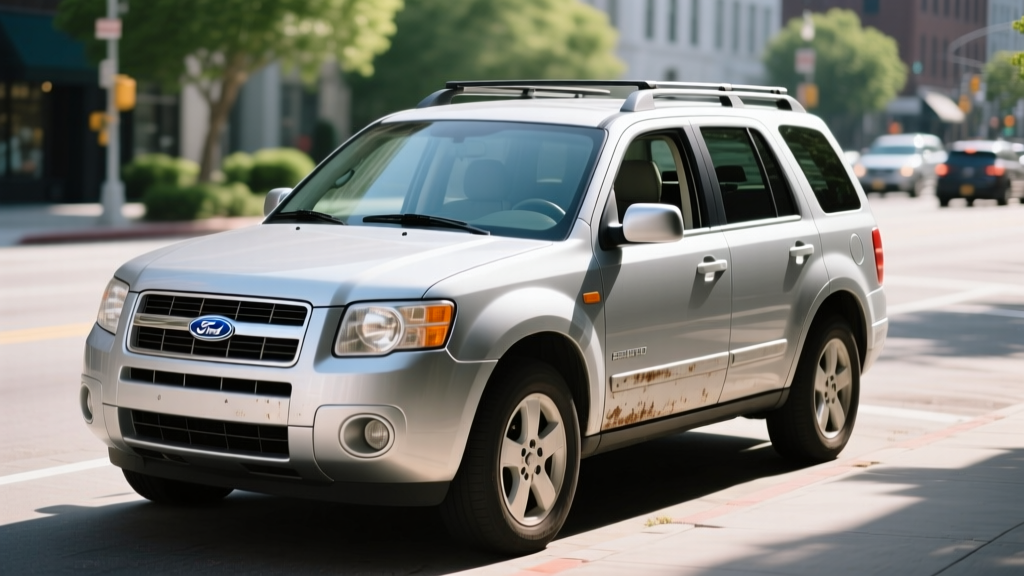
The 2008 Ford Escape Hybrid was one of the first mainstream hybrid SUVs to reach American driveways, combining a 2.3-liter Atkinson-cycle four-cylinder with an electric motor in a package that delivered genuinely impressive fuel economy for its era. Nearly two decades later, it remains a fixture on the used market — and a frequent search for budget-minded buyers asking whether an aging hybrid is a smart purchase or a money pit waiting to happen.
This guide breaks down everything you need to know about the 2008 Escape Hybrid in 2026: real-world MPG, powertrain specs, battery longevity, replacement costs, and how it stacks up against modern hybrids and EVs.
2008 Ford Escape Hybrid: Core Specifications
| Specification | 2008 Ford Escape Hybrid (FWD) |
|---|---|
| Engine | 2.3L Atkinson-cycle I4 |
| Electric Motor | Permanent-magnet AC synchronous (integrated into eCVT) |
| Combined Horsepower | 155 hp (net system) |
| Transmission | Electronically controlled CVT (eCVT) |
| Battery Type | NiMH (Nickel-Metal Hydride) |
| Battery Voltage | 330V nominal |
| Drivetrain | FWD standard; AWD available |
| EPA MPG (City / Hwy / Combined) | 34 / 30 / 32 (FWD) |
| 0–60 mph | ~10.5 seconds |
| Curb Weight | ~3,780 lbs |
| Cargo Volume | 27.3 cu ft (rear seats up) / 65.1 cu ft (folded) |
| Original MSRP (2008) | ~$27,000–$32,000 |
| Typical Used Price (2026) | $3,500–$7,500 depending on mileage and condition |
How Many MPG Does the 2008 Escape Hybrid Get?
The EPA rated the front-wheel-drive 2008 Escape Hybrid at 34 mpg city, 30 mpg highway, and 32 mpg combined. The AWD variant drops slightly to 29/27/28 mpg. These numbers were exceptional for a compact SUV in 2008 — the non-hybrid Escape with the same 2.3L engine managed only about 20/24/22 mpg.
| Variant | City | Highway | Combined |
|---|---|---|---|
| FWD Hybrid | 34 mpg | 30 mpg | 32 mpg |
| AWD Hybrid | 29 mpg | 27 mpg | 28 mpg |
| FWD Gas (2.3L I4) | 20 mpg | 24 mpg | 22 mpg |
HEV vs PHEV vs EV: Where the 2008 Escape Fits
The 2008 Escape Hybrid is a conventional hybrid (HEV). It does not plug in. The battery charges exclusively through regenerative braking and the gasoline engine. There is no electric-only driving range to speak of — the small NiMH pack provides brief electric assist at low speeds and enables engine stop-start at idle, but the vehicle cannot travel meaningful distances on electricity alone.
| Feature | HEV (e.g., 2008 Escape Hybrid) | PHEV (e.g., 2026 Escape PHEV) | BEV (e.g., Mustang Mach-E) |
|---|---|---|---|
| Plugs In? | No | Yes | Yes |
| Electric-Only Range | ~0.5 mi at very low speed | ~37 mi (EPA) | 230–320 mi (EPA) |
| Total Range | ~400+ mi | ~520 mi combined | 230–320 mi |
| Battery Chemistry | NiMH | NMC lithium-ion | NMC or LFP |
| Battery Size | ~1.3 kWh | ~14.4 kWh | 70–91 kWh |
| Charging Required? | Never — gas only | Optional (better if you plug in) | Required |
| Federal Tax Credit (New) | None | Up to $7,500 (§30D) | Up to $7,500 (§30D) |
If you're searching for a "2008 Escape Hybrid" and wondering whether it has a plug — it doesn't. Ford didn't introduce a plug-in Escape until the 2021 model year. The 2008 model operates purely as a self-charging hybrid: fill it with gas, drive it, and the system handles the rest.
Powertrain Deep Dive: How the Hybrid System Works
The 2008 Escape Hybrid pairs a 2.3-liter Atkinson-cycle four-cylinder engine (producing roughly 133 hp on its own) with a permanent-magnet electric motor integrated into Ford's eCVT transaxle. Combined net system output is 155 hp. The Atkinson cycle sacrifices some low-end torque for greater thermal efficiency — a hallmark of hybrid powertrains from Toyota, Ford, and Honda alike.
The eCVT is not a traditional belt-and-pulley CVT. It uses a planetary gearset to seamlessly blend engine and motor power, eliminating fixed gear ratios entirely. This design — licensed from Toyota's Hybrid Synergy Drive architecture — is remarkably durable because it has no friction clutches, bands, or torque converters to wear out.
Under light acceleration, the Escape can launch on electric power alone up to roughly 25 mph for short distances. Under harder throttle, the engine and motor work in tandem. During deceleration and braking, the motor reverses role to become a generator, sending recovered energy back to the NiMH battery pack. This regenerative braking is why the city MPG rating exceeds the highway number — the opposite of a conventional gas car.
Battery Lifespan, Warranty, and Replacement Cost
The NiMH battery in the 2008 Escape Hybrid is remarkably robust. Unlike early lithium-ion packs, NiMH chemistry degrades slowly and predictably. Many examples have surpassed 200,000 miles on the original pack with minimal capacity loss. That said, at 17–18 years old, any surviving original pack is living on borrowed time — not because of mileage wear, but because of calendar aging of the cells and internal connectors.
Signs of Battery Degradation
- Noticeable drop in fuel economy (falling below 28 mpg combined on consistent routes)
- Engine running more frequently, including at stops where it previously shut off
- Reduced regenerative braking feel
- Dashboard warning: "Check Hybrid System" or battery-related diagnostic codes
Battery Replacement Cost
If the NiMH pack fails, here's what you're looking at in 2026:
- OEM new battery (Ford dealer): $2,500–$3,500 including labor — often exceeding the vehicle's value
- Aftermarket refurbished/remanufactured pack: $1,200–$2,000 installed
- Used salvage pack: $400–$800 for the part, plus $300–$500 labor — risky given age
- DIY replacement: Possible for mechanically inclined owners; the pack is accessible behind the rear cargo area. Parts cost $600–$1,500 depending on source.
Given that a clean 2008 Escape Hybrid trades for $3,500–$7,500, a full OEM battery replacement rarely makes financial sense. The refurbished or salvage route is the pragmatic choice — or simply budget for the replacement when shopping and negotiate the purchase price accordingly.
Is the 2008 Escape Hybrid Reliable?
The hybrid powertrain itself — the eCVT, motor, and power electronics — has proven to be one of the most durable components Ford has ever produced. The planetary eCVT design eliminates the wear-prone elements of conventional automatics. Many taxi fleets and high-mileage commuters ran these past 250,000 miles with only the battery as a major service item.
However, the 2008 Escape platform (hybrid or not) has known weak points unrelated to the hybrid system:
- Power transfer unit (PTU) on AWD models: The PTU is bathed in gear oil that Ford labeled "lifetime" but which degrades over time. Neglected PTUs fail catastrophically. If buying AWD, confirm PTU fluid has been changed.
- Electric power steering: The 2008 Escape uses an electrically assisted rack that can develop faults — expensive to replace.
- Brake actuator module: The hybrid-specific brake-by-wire system can throw codes and require replacement ($800–$1,200).
- General age-related items: Suspension bushings, motor mounts, and cooling system hoses are all 17+ years old on original parts.
According to NHTSA records, the 2008 Escape Hybrid has relatively few recalls and complaints compared to its non-hybrid sibling, with most issues centered on standard wear items rather than hybrid-specific failures.
Tax Credits and Incentives in 2026
The 2008 Ford Escape Hybrid originally qualified for a federal hybrid tax credit of up to $3,000 under the Energy Policy Act of 2005 — but that credit phased out for Ford hybrids in 2009 and is long gone. Today, as a used vehicle, the 2008 Escape Hybrid does not qualify for any federal tax credit.
- §30D New Clean Vehicle Credit: Not applicable — applies only to new qualifying PHEVs and BEVs with MSRP, income, and battery-sourcing requirements per IRS guidelines.
- §25E Used Clean Vehicle Credit: Not applicable — requires a qualifying used BEV or PHEV (not a conventional HEV) priced at $25,000 or less, purchased from a dealer.
- State incentives: Some states offer registration discounts, HOV lane access, or emissions-test exemptions for older hybrids. Check your state's DMV or energy office for specifics.
Bottom line: you're buying this vehicle with after-tax dollars. No federal incentive applies to conventional hybrids, new or used.
2008 Escape Hybrid vs. Modern Alternatives
| Spec | 2008 Ford Escape Hybrid | 2026 Ford Escape Hybrid | 2026 Toyota RAV4 Hybrid |
|---|---|---|---|
| Combined MPG (EPA) | 32 mpg | 39 mpg | 41 mpg |
| Horsepower | 155 hp | 192 hp | |
| Battery | NiMH (~1.3 kWh) | Li-ion (~1.1 kWh) | Li-ion (~1.6 kWh) |
| Safety Tech | Basic ABS/stability control | AEB, lane-keep, adaptive cruise | Toyota Safety Sense 3.0 |
| Infotainment | Single-CD, no Bluetooth (base) | 13.2" touchscreen, wireless CarPlay | 10.5" touchscreen, wireless CarPlay |
| Starting Price | $3,500–$7,500 (used) | ~$34,000 (new MSRP) | ~$33,000 (new MSRP) |
| Battery Warranty | Expired | 8 yr / 100,000 mi | 10 yr / 150,000 mi |
The fuel-economy gap between 2008 and 2026 hybrids is real but narrower than you might expect — 32 mpg vs. 39–41 mpg. The bigger differences are in safety technology, crash-test performance, infotainment, and the peace of mind that comes with a full warranty. If your budget allows a modern hybrid, the safety and reliability advantages are substantial.
Who Should Buy the 2008 Escape Hybrid — and Who Shouldn't
Choose the 2008 Escape Hybrid if:
- You need a compact SUV under $7,500 with strong city fuel economy
- You drive primarily in urban stop-and-go traffic where the hybrid system shines
- You're mechanically inclined and comfortable budgeting for an eventual battery replacement
- You want to avoid the complexity, range planning, or charging requirements of a PHEV or BEV
- You live in a region without reliable public charging infrastructure
Look elsewhere if:
- Safety is a top priority — the 2008 Escape lacks modern ADAS (no automatic emergency braking, lane departure warning, or blind-spot monitoring)
- You drive mostly highway miles — the hybrid advantage shrinks, and a modern efficient gas car closes the gap
- You want electric-only commuting — you'd need a PHEV or BEV
- You can't absorb a $1,500–$3,000 battery replacement within the first year of ownership
- You're in a CARB state with strict emissions inspections that may flag an aging hybrid system
Buying Checklist: What to Inspect
If you're evaluating a specific 2008 Escape Hybrid, here's your pre-purchase priority list:
- Pull hybrid battery diagnostic codes — a scan tool that reads hybrid-specific PIDs can reveal cell imbalance or voltage spread before the dashboard throws a warning.
- Test the engine stop-start — at a warm idle, the engine should shut off. If it doesn't, the battery may be too degraded to support the system.
- Check regenerative braking feel — deceleration should have a distinct, consistent drag. If it feels like a normal gas car, the hybrid system may not be contributing.
- Inspect the AWD PTU fluid (if equipped) — dark, burnt-smelling fluid indicates neglect.
- Verify service history — especially coolant changes on the hybrid-specific inverter cooling loop.
- Check for rust — particularly on rear subframe mounts and rocker panels, depending on the vehicle's geographic history.
Frequently Asked Questions
How many MPG does the 2008 Ford Escape Hybrid get in real-world driving?
The EPA rates it at 34 city / 30 highway / 32 combined (FWD). Real-world city driving often yields 33–36 mpg thanks to regenerative braking. Highway driving at 70+ mph typically returns 27–29 mpg. Cold weather reduces combined economy to roughly 28–30 mpg.
Does the 2008 Escape Hybrid need to be plugged in?
No. It is a conventional hybrid (HEV), not a plug-in hybrid (PHEV). The battery charges through regenerative braking and the gasoline engine. You simply fill it with gas and drive.
How long does the 2008 Escape Hybrid battery last?
Many original NiMH packs have lasted 150,000–200,000+ miles. However, at 17–18 years old, calendar aging becomes the primary concern. If buying today, budget for a potential replacement within 1–3 years unless you can verify recent pack health through diagnostics.
What does it cost to replace the hybrid battery?
An OEM dealer replacement runs $2,500–$3,500. Aftermarket refurbished packs cost $1,200–$2,000 installed. Used salvage packs are $400–$800 plus labor. Given the vehicle's current value, refurbished or DIY replacement is the most economically rational path.
Is the 2008 Escape Hybrid eligible for any tax credit in 2026?
No. The original $3,000 federal hybrid credit phased out in 2009. The current §30D credit applies only to new qualifying PHEVs and BEVs. The §25E used EV credit also excludes conventional hybrids. No federal tax incentive is available for this vehicle.
Should I buy a 2008 Escape Hybrid or a newer hybrid?
If your budget is strictly under $8,000, the 2008 Escape Hybrid offers genuine fuel savings and a durable powertrain. If you can stretch to $25,000–$35,000, a 2020+ Escape Hybrid or RAV4 Hybrid delivers 25–30% better MPG, modern safety technology, active warranties, and significantly lower risk of a near-term battery replacement.
How does the 2008 Escape Hybrid compare to a full EV?
They serve different needs. The Escape Hybrid requires no charging infrastructure and offers unlimited range via gas stations — ideal for rural areas or apartment dwellers without charging access. A modern BEV like the Chevy Equus EV or Tesla Model Y offers dramatically lower per-mile fuel costs, zero tailpipe emissions, and minimal maintenance, but requires reliable home or public charging. For a commuter with Level 2 home charging, a BEV's total cost of ownership is typically lower over five years.