Quick Verdict: A Pioneer That Paved the Way
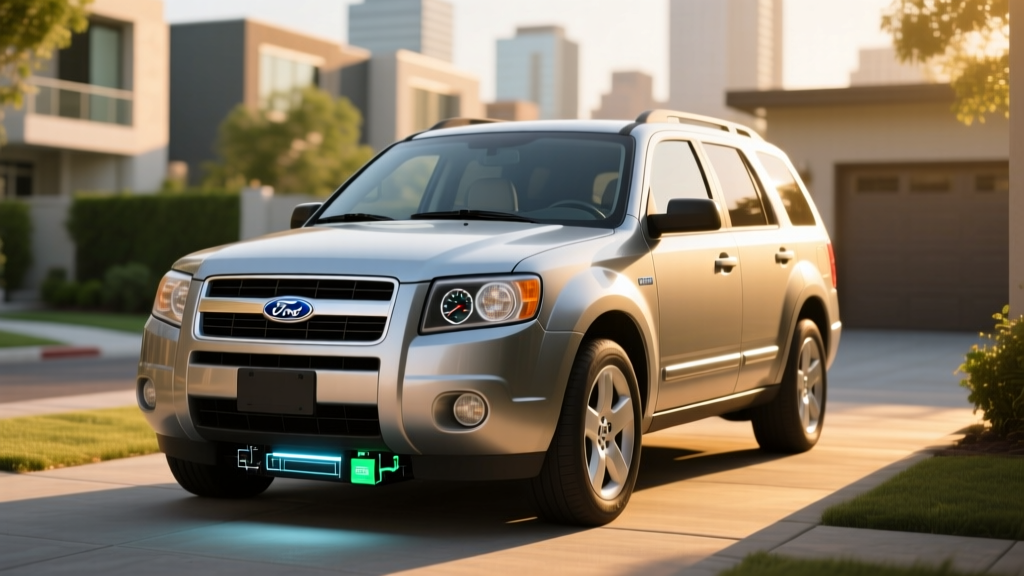
The 2008 Ford Escape Hybrid was one of the first mainstream hybrid SUVs sold in the United States, combining a 2.3-liter Atkinson-cycle four-cylinder engine with an electric motor for a combined 155 horsepower. For buyers researching this model on the used market today, it remains a data point in hybrid longevity: many examples have crossed 200,000 miles with original batteries. But with modern hybrids offering 40+ MPG and full EVs exceeding 300 miles of range, the 08 Escape Hybrid is best understood as a budget commuter rather than a technology benchmark.
| Spec | Value |
|---|---|
| Powertrain Type | Conventional Hybrid (HEV) — no plug |
| Engine | 2.3L Atkinson-cycle I4 |
| Electric Motor | Permanent-magnet AC synchronous |
| Combined Horsepower | 155 HP |
| Transmission | eCVT (planetary gearset) |
| Drivetrain | FWD standard; AWD available |
| Battery | ~1.8 kWh NiMH (nickel-metal hydride) |
| EPA Fuel Economy (FWD) | 34 city / 30 highway / 32 combined MPG |
| EPA Fuel Economy (AWD) | 29 city / 27 highway / 28 combined MPG |
| 0-60 MPH | ~10.5 seconds (est.) |
| Original MSRP | ~$26,995 (base Hybrid FWD) |
| Used Price Range (2026) | $3,500 – $7,500 |
EPA MPG vs. Real-World Fuel Economy
The EPA rated the 2008 Escape Hybrid FWD at 34 MPG city, 30 MPG highway, and 32 MPG combined according to fueleconomy.gov. The AWD variant drops to 29/27/28 MPG.
| Drivetrain | City MPG | Highway MPG | Combined MPG |
|---|---|---|---|
| FWD | 34 | 30 | 32 |
| AWD | 29 | 27 | 28 |
Real-world expectation: Like most conventional hybrids, the Escape Hybrid tends to meet or slightly exceed its EPA city rating in stop-and-go traffic, where regenerative braking recovers the most energy. Owners on forums and fueleconomy.gov user reports average between 28 and 33 MPG combined in mixed driving. Highway-heavy commutes at 75+ MPH may dip to 26–28 MPG in the FWD model due to aerodynamic drag and the Atkinson-cycle engine's lower peak output.
For context, the 2026 Toyota RAV4 Hybrid achieves 39 MPG combined — a 22% improvement over this 18-year-old design. The gap illustrates how far hybrid powertrain efficiency has advanced.
HEV vs. PHEV vs. EV: Where the 08 Escape Fits
This is a conventional hybrid (HEV). It does not plug in. The small 1.8 kWh NiMH battery charges solely through regenerative braking and the gasoline engine. There is no electric-only driving range to speak of — the motor assists the engine at low speeds and during acceleration, but the vehicle cannot operate in pure EV mode for more than a brief crawl.
| Feature | HEV (like 08 Escape) | PHEV | BEV (Full EV) |
|---|---|---|---|
| Plugs in? | No | Yes | Yes |
| Electric-only range | None (motor assist only) | 20–50 miles typical | 200–400+ miles |
| Battery size | ~1–2 kWh | ~10–25 kWh | ~60–100+ kWh |
| Gasoline engine? | Yes (primary) | Yes (backup) | No |
| Federal tax credit (new) | None | Up to $7,500 (§30D) | Up to $7,500 (§30D) |
| Home charging needed? | No | Recommended (Level 2) | Essential |
Who should consider the 08 Escape Hybrid today? Budget-conscious commuters who want better fuel economy than a gas-only SUV without any change to their fueling habits. If you can charge at home and want electric-only commuting, a modern PHEV like the Toyota RAV4 Prime (42 miles EV range) or a full EV like the Hyundai Ioniq 5 (300+ miles range) delivers vastly lower operating costs. The 08 Escape Hybrid makes sense only at its current used-market price of roughly $3,500–$7,500.
Powertrain Deep Dive: 155 HP Through an eCVT
The 2008 Escape Hybrid pairs a 2.3-liter Atkinson-cycle inline-four (producing roughly 133 HP on its own) with a permanent-magnet electric motor integrated into the transaxle. Combined system output is 155 HP. The Atkinson cycle sacrifices low-RPM torque for higher thermal efficiency — exactly the trade-off a hybrid can make, because the electric motor fills in the torque gap during acceleration.
The eCVT is not a belt-and-cone CVT like those in some Nissan models. It uses a planetary gearset that seamlessly blends engine and motor power. This design, shared conceptually with Toyota's Hybrid Synergy Drive of the same era, is mechanically simple and has proven highly durable.
Performance is modest: expect 0–60 MPH in roughly 10.5 seconds. This was adequate for merging in 2008 and remains so today, though it feels leisurely compared to modern turbocharged hybrids or any EV.
Battery Longevity, Warranty & Replacement Cost
The original hybrid battery is a nickel-metal hydride (NiMH) pack rated at approximately 1.8 kWh. Ford warranted the hybrid-specific components, including the battery, for 8 years or 100,000 miles (10 years/150,000 miles in California and states adopting CARB emissions standards).
Battery Warranty & Lifespan Summary
- Original warranty: 8 yr / 100,000 mi (10 yr / 150,000 mi in CARB states)
- Chemistry: NiMH (nickel-metal hydride)
- Expected lifespan: 150,000–200,000+ miles with normal use
- Replacement cost (2026): $2,000–$4,000 (remanufactured pack, installed)
- Cell-level repair: Some hybrid specialists can replace individual modules for $500–$1,200
Is the 08 Escape Hybrid reliable? The powertrain has a strong track record. The eCVT planetary gearset has no belts or clutches to wear, and the NiMH battery, while less energy-dense than modern lithium-ion packs, degrades gradually rather than failing catastrophically. Taxi fleets in cities like New York and San Francisco logged 200,000+ miles on first-generation Escape Hybrids with minimal hybrid-system issues.
That said, any 18-year-old NiMH battery has lost capacity. A degraded pack won't strand you — the car still runs on its gasoline engine — but fuel economy may drop by 2–5 MPG as the motor assist weakens. If you're buying one today, budget for a remanufactured battery replacement unless the seller can provide documentation of a recent swap.
Pricing, Tax Credits & Ownership Economics
The 2008 Escape Hybrid originally carried an MSRP of approximately $26,995 for the FWD base model. On the 2026 used market, expect to pay between $3,500 and $7,500 depending on mileage, condition, and battery health.
Tax credit eligibility: The federal hybrid tax credit for the Escape Hybrid expired after 2010 (Ford reached its manufacturer cap under the original Energy Policy Act provisions). Today, no federal tax credit applies to the purchase of this vehicle — new or used. The IRS §30D clean vehicle credit applies only to new qualifying PHEVs and BEVs that meet battery-sourcing, MSRP, and buyer income requirements. The used clean vehicle credit (up to $4,000) requires the vehicle to be a qualifying PHEV or BEV — conventional hybrids like the 08 Escape do not qualify.
Operating cost comparison: At 32 MPG combined and $3.50/gallon gasoline (2026 national average), the 08 Escape Hybrid costs roughly $0.11 per mile in fuel. A comparable gas-only 2008 Escape (rated around 20 MPG combined) costs about $0.175 per mile — a difference of ~$650 per year at 10,000 miles driven. That savings is real but modest compared to a modern PHEV running on electricity for daily commuting.
Who Should Buy This Hybrid — And Who Shouldn't
Reasons to Consider the 08 Escape Hybrid
- Low used-market entry price ($3,500–$7,500)
- No charging infrastructure needed — fuel like any gas car
- Proven powertrain durability; eCVT is nearly bulletproof
- 32 MPG combined still beats most non-hybrid SUVs of the era
- Simple to maintain; no plug, no charging apps, no range anxiety
Reasons to Look Elsewhere
- 32 MPG trails modern hybrids (RAV4 Hybrid: 39 MPG; Honda CR-V Hybrid: 40 MPG)
- No electric-only driving; no plug-in capability
- No federal or state tax credit eligibility
- Performance is slow by 2026 standards (~10.5 sec 0–60)
- NiMH battery nearing end of service life on most surviving examples
- Safety tech is minimal: no automatic emergency braking, no lane-keep assist
Choose the 08 Escape Hybrid if: You need a cheap, fuel-efficient compact SUV for city commuting, have no access to home or workplace charging, and are comfortable budgeting for a potential battery replacement.
Choose a modern PHEV or BEV instead if: You can install a Level 2 charger at home, want to commute on electricity, value current safety technology, and can spend $30,000+ on a newer vehicle that qualifies for the §30D federal tax credit.
Frequently Asked Questions
How many MPG does the 2008 Ford Escape Hybrid get?
The EPA rates the FWD model at 34 city / 30 highway / 32 combined MPG. The AWD version drops to 29/27/28 MPG. Real-world averages fall between 28 and 33 MPG combined depending on driving style and battery condition.
Does the 2008 Escape Hybrid need to be plugged in?
No. This is a conventional hybrid (HEV). The battery recharges through regenerative braking and the gasoline engine. There is no plug, no charging port, and no electric-only driving range.
How far can the 08 Escape Hybrid go on electric only?
It cannot. The electric motor assists the gasoline engine at low speeds and during acceleration but cannot propel the vehicle alone for any meaningful distance. If electric-only commuting is your goal, you need a PHEV or a full EV.
Is the 2008 Ford Escape Hybrid reliable?
Yes, with caveats. The eCVT transmission and planetary gearset are mechanically robust. The NiMH battery typically lasts 150,000–200,000 miles before significant degradation. At 18 years old, most surviving examples will need a battery replacement or refurbishment, costing $2,000–$4,000 for a remanufactured pack.
What does it cost to replace the hybrid battery?
A remanufactured NiMH battery pack installed at an independent hybrid specialist typically runs $2,000–$4,000 in 2026. Some shops offer individual module replacement for $500–$1,200 if only a few cells have failed. OEM new packs from Ford are largely discontinued for this model year.
Does the 2008 Escape Hybrid qualify for any tax credit?
No. The original federal hybrid credit for this model expired over a decade ago. Current IRS rules under §30D provide credits only for new qualifying PHEVs and BEVs. The used clean vehicle credit (up to $4,000) also excludes conventional hybrids. Check irs.gov for current eligibility rules.
Should I buy a 2008 Escape Hybrid or a newer full EV?
If your budget is under $8,000 and you lack home charging, the 08 Escape Hybrid is a reasonable short-term commuter. If you can spend $25,000+ and charge at home, a used EV like a 2019–2021 Chevrolet Bolt (259 miles EPA range) or a new PHEV delivers dramatically lower per-mile costs, modern safety features, and available tax credits.