The 2008 Ford Escape Hybrid was one of the first hybrid SUVs to reach American driveways, arriving at a time when Toyota's RAV4 Hybrid didn't yet exist and most buyers equated "hybrid" exclusively with the Prius. Nearly two decades later, used examples still pop up on dealer lots and private-party listings for $3,000–$6,000. For budget-minded shoppers or anyone researching the lineage of Ford's electrified vehicles, the question is straightforward: does a 2008 Escape Hybrid still make sense as reliable, efficient daily transportation?
This guide breaks down every number that matters — EPA fuel economy, real-world MPG behavior, the nickel-metal hydride (NiMH) battery's lifespan and replacement cost, powertrain specs, and how this pioneering HEV stacks up against modern hybrids and plug-in hybrids in 2026.
2008 Ford Escape Hybrid: Key Specs at a Glance
| Specification | 2008 Ford Escape Hybrid (FWD) | 2008 Escape Hybrid (AWD) |
|---|---|---|
| Powertrain Type | Conventional Hybrid (HEV) | Conventional Hybrid (HEV) |
| Gas Engine | 2.3L Atkinson-cycle I4 | 2.3L Atkinson-cycle I4 |
| Engine HP | 133 hp @ 6,000 rpm | 133 hp @ 6,000 rpm |
| Electric Motor | 70 kW permanent-magnet AC | 70 kW permanent-magnet AC |
| Combined System HP | 155 hp | 155 hp |
| Transmission | Electronic CVT (eCVT) | Electronic CVT (eCVT) |
| EPA City MPG | 34 | 29 |
| EPA Highway MPG | 30 | 27 |
| EPA Combined MPG | 32 | 28 |
| Fuel Tank | 16.5 gal | 16.5 gal |
| Approx. Total Range | ~528 mi | ~462 mi |
| 0-60 mph | ~10.5 sec (est.) | ~11.0 sec (est.) |
| Towing Capacity | 1,000 lb | 1,000 lb |
| Cargo Volume | 69.3 cu ft (rear seats folded) | 69.3 cu ft |
Source: EPA fueleconomy.gov — 2008 Ford Escape Hybrid FWD
How Many MPG Does the 2008 Escape Hybrid Actually Get?
The EPA rated the front-wheel-drive 2008 Escape Hybrid at 34 city / 30 highway / 32 combined MPG. The AWD variant drops to 29 city / 27 highway / 28 combined. Those numbers were genuinely impressive for a compact SUV in 2008, when the average new car achieved roughly 20 MPG combined.
Real-World MPG: What Owners Report
Conventional hybrids like the Escape HEV don't need a plug — they recapture energy through regenerative braking and use the electric motor to assist the gas engine and enable brief electric-only driving at low speeds. This architecture tends to exceed EPA city estimates in real-world stop-and-go driving, because city traffic maximizes regen opportunities.
| Driving Scenario | Expected MPG (FWD) | Notes |
|---|---|---|
| City / Stop-and-Go | 32–36 MPG | Regen-heavy; may exceed EPA |
| Highway (65-70 mph) | 27–30 MPG | Less regen benefit; aero drag dominates |
| Mixed Commute | 29–33 MPG | Close to EPA combined |
| Cold Weather (below 30°F) | 25–29 MPG | Engine runs more for cabin heat; battery less efficient |
On fueleconomy.gov, owners of the FWD model have reported lifetime averages clustering around 29–31 MPG combined — slightly below the EPA sticker, largely because many owners do more highway driving than the EPA test cycle assumes. If your commute is primarily urban, hitting 34+ MPG is realistic.
HEV vs PHEV vs EV: Where Does the 2008 Escape Hybrid Fit?
The 2008 Escape Hybrid is a conventional hybrid (HEV), not a plug-in hybrid. Ford did not offer an Escape plug-in variant in 2008 — the Escape PHEV concept existed in limited fleet testing, but no consumer PHEV Escape was sold. Here's how the three electrified categories compare:
| Feature | HEV (2008 Escape Hybrid) | PHEV (e.g., 2026 Ford Escape PHEV) | BEV (e.g., 2026 Tesla Model Y) |
|---|---|---|---|
| Plugs In? | No — gas only | Yes — Level 1 or Level 2 | Yes — Level 2 or DC fast |
| Electric-Only Range | ~0.5 mi at low speed | ~37 mi (current Escape PHEV) | 260–330+ mi |
| Total Range | ~528 mi | ~520 mi (electric + gas) | 260–330 mi |
| Battery Size | ~1.8 kWh (NiMH) | ~14.4 kWh (NMC lithium-ion) | 60–82 kWh (NMC/LFP) |
| Combined MPG / MPGe | 32 MPG | ~40 MPG / 105 MPGe | ~120 MPGe |
| Home Charging Needed? | No | Recommended | Essential |
| §30D Tax Credit (New) | N/A (used) | Up to $7,500 if eligible | Up to $7,500 if eligible |
Bottom line: The HEV Escape is for drivers who want better fuel economy without any change in refueling habits. You fill up at any gas station and never think about charging. A modern PHEV like the current-gen Escape PHEV offers 37 miles of electric-only commuting (enough for most daily trips) but requires home or workplace charging access. A full BEV eliminates gas entirely but demands reliable charging infrastructure.
Powertrain Deep Dive: 2.3L Atkinson-Cycle + Electric Motor
The 2008 Escape Hybrid pairs a 2.3-liter four-cylinder engine running the Atkinson cycle — which sacrifices low-end torque for higher thermal efficiency — with a 70 kW (94 hp) permanent-magnet AC electric motor. Combined system output is 155 horsepower, routed through an electronically controlled continuously variable transmission (eCVT).
This eCVT is not a belt-and-cone CVT like those in some conventional cars. It's a planetary gearset (Ford licensed Toyota's Hybrid Synergy Drive architecture for this generation) that seamlessly blends gas and electric power. There are no fixed gear ratios to shift through, and no belts to wear out — a key reason this powertrain has aged well.
The system can operate in several modes:
- EV mode: Electric-only at speeds below ~25 mph for very short distances (roughly half a mile), using energy from the NiMH battery
- Assist mode: Electric motor supplements the gas engine during acceleration, reducing fuel consumption
- Regen mode: Deceleration and braking recapture kinetic energy to recharge the battery
- Engine-only: Steady-state highway cruising where the gas engine is most efficient
Acceleration is leisurely by modern standards — expect roughly 10.5 seconds to 60 mph for the FWD model. Merging onto fast-moving highways requires planning. This is a vehicle optimized for efficiency, not performance.
Battery Life, Warranty, and Replacement Cost
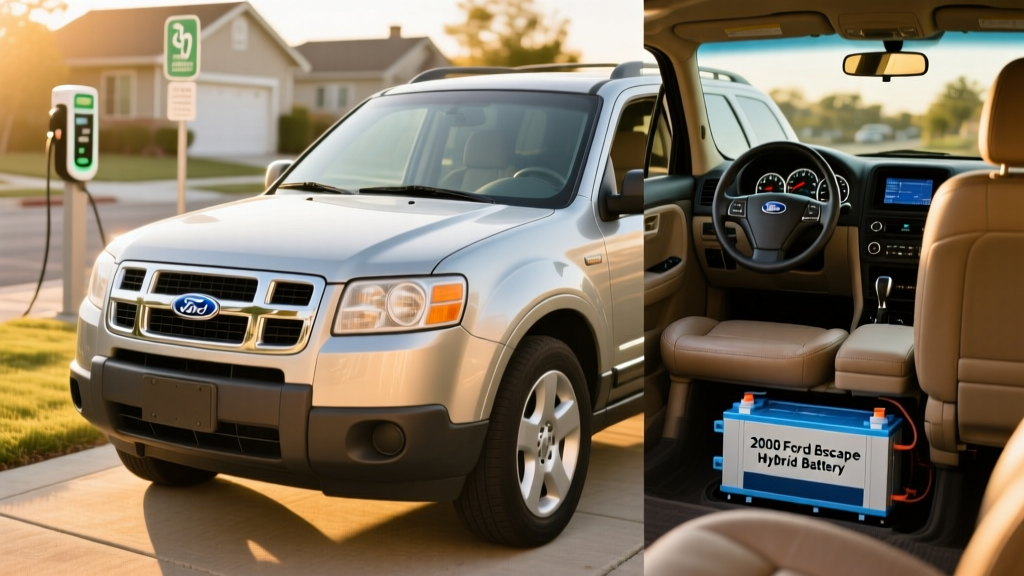
The 2008 Escape Hybrid uses a nickel-metal hydride (NiMH) battery pack with approximately 1.8 kWh of capacity, located beneath the rear cargo floor. This is a mature, proven chemistry — NiMH packs in Toyota and Ford hybrids of this era have demonstrated remarkable longevity.
Original Battery Warranty
Ford warranted the 2008 Escape Hybrid battery for 8 years / 100,000 miles (extended to 10 years / 150,000 miles in California Air Resources Board states). That factory coverage has expired for all 2008 models.
How Long Do These Batteries Actually Last?
Real-world data from fleet operators, taxi services, and long-term owners shows NiMH hybrid batteries from this era commonly lasting 150,000 to 200,000+ miles before significant degradation. The key factors affecting lifespan:
- Heat exposure: Vehicles in hot climates (Arizona, Texas) tend to see earlier battery degradation than those in temperate regions
- Usage pattern: Regular driving keeps the battery cycling and conditioned; long periods of sitting idle are more harmful
- State of charge management: Ford's battery management system keeps the NiMH pack in a narrow 40–60% SoC window, which dramatically extends cycle life — the usable buffer is small by design
Battery Replacement Cost in 2026
If the hybrid battery fails in a 2008 Escape Hybrid, here's what to expect:
| Option | Cost Range | Notes |
|---|---|---|
| New OEM battery (Ford) | $2,500–$3,500 | May be difficult to source for a 2008 model |
| Remanufactured battery | $1,200–$2,000 | Most common choice; reputable suppliers offer 1–3 year warranties |
| Used/salvage battery | $400–$800 | Unknown remaining life; gamble for budget buyers |
| Individual cell replacement | $300–$600 | Requires a specialist hybrid shop; replaces only failed cells |
For a vehicle worth $3,000–$6,000, a full OEM battery replacement rarely makes financial sense. A remanufactured pack or targeted cell replacement is the pragmatic path. Independent hybrid specialists in most metro areas can perform this service.
Reliability and Common Issues
The 2008 Escape Hybrid's powertrain — particularly the eCVT and hybrid system — is one of the most reliable Ford has ever built. The planetary gearset has no wear-prone belts or clutches, and the electric motor has essentially no consumable parts. The NHTSA vehicle page shows relatively few powertrain-related complaints for this model year.
Common issues to watch for in a used 2008 Escape Hybrid:
- Hybrid battery degradation: At 15–18 years old, any original battery is near or past end-of-life. Ask for a hybrid system diagnostic or budget $1,200–$2,000 for a remanufactured replacement
- 12V auxiliary battery: Like any car, the standard 12V battery needs periodic replacement ($150–$250). If the 12V dies, the hybrid system won't boot — even if the traction battery is fully charged
- Brake actuator: The electrohydraulic brake system is unique to the hybrid. Replacement runs $800–$1,500 if it fails. Listen for unusual grinding or delayed brake response during a test drive
- Electric power steering: Some owners report EPS motor failures, typically $600–$1,000 to repair
- Rust: Check rocker panels, wheel arches, and the subframe, particularly on examples from the Rust Belt
Overall, the hybrid-specific components have aged better than the conventional mechanical parts. Most high-mileage examples that need work require standard wear items — suspension, brakes, tires — rather than hybrid system repairs.
Pricing and Tax Credit Eligibility
The 2008 Escape Hybrid originally started at approximately $26,240 MSRP for the FWD base model. In 2026's used market, expect to pay:
| Condition | Price Range (2026) |
|---|---|
| High-mileage (180k+ mi), fair condition | $2,500–$3,500 |
| Average (120k–160k mi), good condition | $4,000–$5,500 |
| Low-mileage (under 100k mi), excellent | $5,500–$7,000 |
Does the 2008 Escape Hybrid Qualify for Any Tax Credit?
No. The federal §30D tax credit for new hybrid vehicles expired for this model years ago. The current IRS §30D clean vehicle credit applies only to new plug-in electric vehicles (PHEVs and BEVs) meeting battery sourcing, MSRP caps, and buyer income limits. Conventional hybrids like the 2008 Escape HEV have never qualified for §30D.
The federal used EV credit (§25E) — up to $4,000 or 30% of the sale price — applies only to used plug-in vehicles (BEVs and PHEVs), not conventional hybrids. So the 2008 Escape Hybrid does not qualify for §25E either.
Some states and local utilities offer incentives for hybrid purchases or hybrid battery replacements, but these vary widely. Check your state energy office or utility provider for current programs.
Who Should Buy a 2008 Escape Hybrid — and Who Shouldn't
Choose the 2008 Escape Hybrid If:
- You need a compact SUV on a tight budget ($3K–$5K)
- Your commute is primarily city/suburban driving where hybrid efficiency shines
- You want better MPG without any charging infrastructure or habit changes
- You value the elevated seating position and cargo space of a small SUV over a Prius-style liftback
- You're mechanically inclined or have access to an independent hybrid shop for maintenance
Look Elsewhere If:
- You drive mostly highway miles — the MPG advantage narrows significantly at 70+ mph
- You want modern safety tech (blind-spot monitoring, auto emergency braking, lane-keep) — the 2008 Escape has none of these
- You need a third row or more than 69 cu ft of cargo space
- You're uncomfortable budgeting $1,200–$2,000 for a potential hybrid battery replacement
- You want plug-in electric commuting — consider a used 2017–2019 Toyota Prius Prime or a current Escape PHEV instead
How the 2008 Escape Hybrid Compares to Modern Alternatives
For context, here's how the 2008 Escape Hybrid's numbers compare to current hybrid and plug-in hybrid SUVs:
| Vehicle | Type | EPA Combined | Combined HP | Starting Price |
|---|---|---|---|---|
| 2008 Ford Escape Hybrid (FWD) | HEV | 32 MPG | 155 hp | $26,240 (orig.) |
| 2026 Ford Escape Hybrid (FWD) | HEV | 39 MPG | 192 hp | ~$34,000 |
| 2026 Ford Escape PHEV | PHEV | 40 MPG / 105 MPGe | 210 hp | ~$39,000 |
| 2026 Toyota RAV4 Hybrid (AWD) | HEV | 39 MPG | 219 hp | ~$33,000 |
| 2026 Honda CR-V Hybrid (FWD) | HEV | 40 MPG | 204 hp | ~$35,000 |
Modern hybrids deliver roughly 20–25% better fuel economy, significantly more power, and current safety technology — but at 6–8x the used price of a 2008 Escape Hybrid. The value proposition of the 2008 model rests entirely on its low entry cost.
Frequently Asked Questions
Is the 2008 Ford Escape Hybrid a plug-in hybrid?
No. The 2008 Escape Hybrid is a conventional hybrid (HEV). It has no charging port and cannot be plugged in. The battery recharges exclusively through regenerative braking and the gas engine. You refuel it at a standard gas station, exactly like a conventional vehicle.
How far can the 2008 Escape Hybrid drive on electric power alone?
Only about half a mile, and only at speeds below roughly 25 mph. The 1.8 kWh NiMH battery is far too small for meaningful electric-only driving. Its role is to assist the gas engine during acceleration and capture braking energy — not to serve as an electric vehicle.
What's the most common problem with a used 2008 Escape Hybrid?
Hybrid battery degradation is the primary concern at this vehicle's age. Any original NiMH pack is 15–18 years old and likely near end-of-life. Budget $1,200–$2,000 for a remanufactured replacement or confirm that a previous owner has already replaced it. Secondary concerns include the electrohydraulic brake actuator and standard age-related wear (suspension bushings, rubber hoses, seals).
Is the 2008 Escape Hybrid good for highway driving?
It's adequate but not where it excels. The EPA highway rating is 30 MPG (FWD), and real-world highway driving often yields 27–29 MPG. Hybrids gain their biggest advantage in city driving where regenerative braking recaptures energy. At sustained 70+ mph, the gas engine does nearly all the work, and the efficiency gap versus a conventional 4-cylinder SUV narrows. If 90% of your driving is highway, the fuel savings over a non-hybrid Escape are modest.
Can I tow with the 2008 Escape Hybrid?
Yes, but the rated capacity is only 1,000 pounds — enough for a small utility trailer or a couple of dirt bikes, but not a boat or camper. The hybrid system's cooling capacity and the eCVT's design are not suited for heavy towing. If you need 1,500+ lb towing, look at the conventional V6 Escape or a modern hybrid SUV.
Does the 2008 Escape Hybrid qualify for the federal EV tax credit?
No. The §30D new clean vehicle credit and the §25E used clean vehicle credit both apply exclusively to plug-in vehicles (BEVs and PHEVs). Conventional hybrids like the 2008 Escape HEV do not qualify for any federal purchase incentive. The original hybrid tax credit that existed in 2006–2009 (up to $2,600 for the Escape Hybrid) expired for Ford vehicles after March 2009 and is no longer available.
What's the difference between the 2008 Escape Hybrid and the 2008 Mercury Mariner Hybrid?
Mechanically, they are identical — same 2.3L Atkinson-cycle engine, same 70 kW electric motor, same 155 hp combined output, same EPA ratings. The Mercury Mariner Hybrid was the upscale-badge twin with slightly different interior trim, a standard AWD system in most configurations, and a higher base price. Parts interchangeability is nearly 100% for the hybrid powertrain.
Final Verdict: A Budget Hybrid That Still Delivers
The 2008 Ford Escape Hybrid is a relic of an earlier electrification era — but a remarkably durable one. Its 32 MPG combined EPA rating still beats most non-hybrid compact SUVs sold today, the eCVT powertrain has proven bulletproof, and the NiMH battery, while aging, can be replaced for less than a single month's payment on a new vehicle.
For buyers with $3,000–$5,000 to spend, a city-heavy commute, and willingness to budget for a potential battery swap, the 2008 Escape Hybrid remains a rational, efficient choice. Just go in with eyes open about its age, its modest power, its complete lack of modern driver-assist technology, and the reality that any original hybrid battery is living on borrowed time.