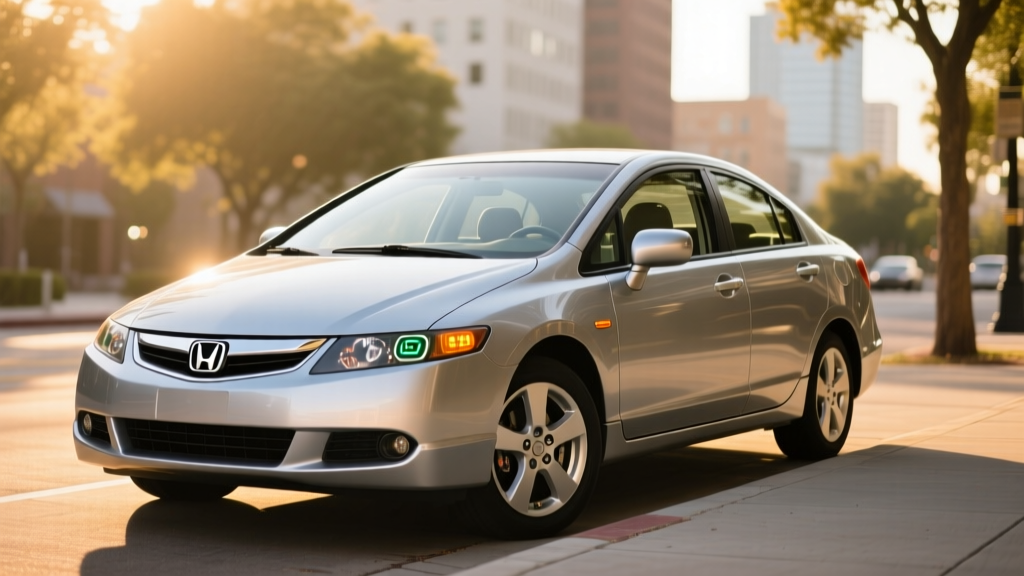
The 2008 Honda Civic Hybrid was one of the most fuel-efficient mainstream sedans of its era, leveraging Honda's Integrated Motor Assist (IMA) system to deliver impressive city mileage without ever needing a plug. Nearly two decades later, it remains a popular search among budget-conscious used-car shoppers exploring hybrid ownership for the first time. This guide breaks down the real-world fuel economy, the IMA battery's longevity and replacement economics, and how this early hybrid stacks up against modern HEVs, PHEVs, and full EVs available today.
2008 Civic Hybrid Powertrain and Hybrid System Explained
The 2008 Civic Hybrid pairs a 1.3-liter inline-four gasoline engine (producing 93 hp on its own) with a 20-horsepower electric motor sandwiched between the engine and the continuously variable transmission (CVT). Combined system output is 110 horsepower and 123 lb-ft of torque. Unlike Honda's later two-motor hybrid systems, the IMA setup uses a single thin electric motor that assists during acceleration and captures energy during braking — it cannot drive the car on electricity alone.
This is a conventional hybrid (HEV), meaning it never plugs in. The small nickel-metal hydride (NiMH) battery pack — roughly 0.35 kWh of usable capacity — recharges exclusively through regenerative braking and engine-generated power. If you're comparing this to a plug-in hybrid (PHEV) like the modern Honda Clarity Plug-In or a full battery electric vehicle (BEV), the distinction matters: no charging cable, no electric-only range, but also no range anxiety about finding a plug.
- HEV (this car): No plug. Small battery (~0.35 kWh). Motor assists engine. EPA 42 MPG combined. Zero electric-only miles.
- PHEV (e.g., 2026 Toyota RAV4 Prime): Plugs in. Larger battery (~18 kWh). 42 miles electric-only, then operates as hybrid. ~38 MPG combined after battery depletes.
- BEV (e.g., 2026 Hyundai Ioniq 6): Plugs in. Large battery (~77 kWh). 300+ miles all-electric. Zero gasoline.
EPA Fuel Economy and Real-World MPG
According to EPA data on fueleconomy.gov, the 2008 Honda Civic Hybrid is rated at:
| Metric | EPA Rating | Real-World Expectation |
|---|---|---|
| City | 40 MPG | 38–44 MPG |
| Highway | 45 MPG | 38–43 MPG |
| Combined | 42 MPG | 38–44 MPG |
A few real-world factors shift these numbers. Hybrids typically exceed their EPA city rating in stop-and-go traffic because regenerative braking recovers more energy and the engine shuts off at stops. Conversely, sustained highway driving at 75+ mph reduces the hybrid advantage — expect high-60s to low-70s in actual highway driving if you cruise at interstate speeds. Cold weather also reduces fuel economy by roughly 10–15% as the engine runs longer to heat the cabin and the NiMH battery operates less efficiently. Owners who drive conservatively in moderate climates regularly report 44–48 MPG combined; aggressive highway drivers may see 35–38 MPG.
IMA Battery Longevity, Replacement Cost, and Warranty
The single biggest concern for any used 2008 Civic Hybrid buyer is the IMA battery. Honda's original NiMH pack was warranted for 8 years or 80,000 miles (10 years/150,000 miles in California Air Resources Board states). That original warranty has long expired on every surviving example.
The IMA battery in most 2006–2011 Civic Hybrids tends to degrade noticeably between 100,000 and 150,000 miles. Symptoms include reduced assist, lower MPG, and the IMA warning light. Replacement costs range from $2,000–$3,500 for a new OEM-equivalent pack (installed) or $800–$1,500 for a refurbished/reconditioned unit. Some owners opt for grid-charger reconditioning ($150–$300 for equipment) as a stopgap.
When evaluating a used 2008 Civic Hybrid, ask specifically whether the IMA battery has been replaced and whether documentation exists. A car with a fresh aftermarket replacement battery may be a better buy than one still running the original 18-year-old pack. The IMA system also has a 12-volt auxiliary battery (separate from the hybrid pack) that requires standard replacement every 4–5 years.
Spec Sheet: 2008 Honda Civic Hybrid at a Glance
| Powertrain | 1.3L I4 + IMA electric motor, CVT |
| Combined Horsepower | 110 hp / 123 lb-ft torque |
| Battery Chemistry | Nickel-Metal Hydride (NiMH), ~0.35 kWh usable |
| EPA Fuel Economy | 40 city / 45 highway / 42 combined MPG |
| Electric-Only Range | None (conventional HEV — no plug) |
| Fuel Tank | 13.2 gallons (~550 miles total range) |
| 0–60 mph | ~11.5 seconds |
| Original MSRP | $22,600 (single trim) |
| 2026 Used Price Range | $3,000–$7,500 (condition/mileage dependent) |
| Original Hybrid Warranty | 8 yr / 80,000 mi (10/100k in CARB states) — expired |
Tax Credits and Incentives: What Applies in 2026?
The 2008 Civic Hybrid originally qualified for a federal hybrid tax credit under the Energy Policy Act of 2005 — but that credit was phased out after Honda hit the 60,000-vehicle manufacturer cap back in 2007. Buyers purchasing this car new in 2008 did not receive a federal credit.
For 2026 used-car buyers, the relevant incentive is the §25E Used Clean Vehicle Credit, which offers up to $4,000 (or 30% of the sale price, whichever is less) on qualifying used EVs and fuel-cell vehicles. However, per IRS guidelines, conventional hybrids like the Civic Hybrid do not qualify for §25E — that credit applies only to battery electric and plug-in hybrid vehicles with at least 7 kWh of battery capacity. The Civic Hybrid's 0.35 kWh NiMH pack falls far below that threshold.
Bottom line: expect no federal tax credit for purchasing a used 2008 Civic Hybrid. Some states offer inspection-emissions exemptions for hybrids, which can save $20–$50 annually depending on your jurisdiction — check your state's DMV or environmental agency for specifics.
Reliability, Ownership Costs, and Known Issues
The eighth-generation Civic platform (2006–2011) is broadly regarded as reliable, and the hybrid variant shares most of its mechanical components with the conventional Civic. The engine timing chain, CVT transmission, and suspension are proven designs. NHTSA records show a relatively low complaint volume for the 2008 Civic Hybrid compared to some competitors of the era.
Known issues specific to the hybrid variant include:
- IMA battery degradation — the most common and costly failure point, as discussed above.
- CVT shudder — some owners report a slight shudder at low speeds; Honda issued software updates and, in some cases, extended warranty coverage for the CVT. Verify that any recall/service bulletin work was completed.
- 12V battery drain — the IMA system can occasionally drain the 12V auxiliary battery if the car sits unused for extended periods.
- A/C compressor cycling — the engine auto-stop feature can cause the A/C to warm at long stoplights in hot weather; this is normal behavior, not a defect.
Annual maintenance costs are modest — expect $400–$700 per year for oil changes, brake pads (which last longer thanks to regenerative braking), tires, and fluid top-offs. Insurance is inexpensive, typically $800–$1,200 annually depending on your profile and state.
2008 Civic Hybrid vs Modern Hybrids, PHEVs, and EVs
- Ultra-low entry price ($3K–$7.5K used)
- Proven 40+ MPG real-world fuel economy
- No plug required — works with any lifestyle
- Cheap insurance and maintenance
- Simple system — fewer failure points than PHEV/BEV
- Original IMA battery likely near end-of-life
- No federal or state purchase incentives
- Modest 110 hp — slow by modern standards
- No electric-only driving capability
- Outdated infotainment and safety tech
- Modern hybrids (e.g., 2026 Prius) deliver 57 MPG
If you're cross-shopping, a 2026 Toyota Prius starts around $29,000 and delivers an EPA-estimated 57 MPG combined — a 35% improvement over the Civic Hybrid with modern safety features, a full warranty, and available AWD. A PHEV like the 2026 Toyota RAV4 Prime offers 42 miles of electric-only range plus 38 MPG hybrid operation, though at $44,000+ MSRP. A used 2018–2020 Toyota Prius (3rd or 4th gen) in the $14,000–$19,000 range often represents a better middle ground: 52–56 MPG, a more robust hybrid system, and remaining battery warranty.
Who Should Buy the 2008 Civic Hybrid?
This car makes sense for a narrow but real set of buyers:
- Budget-first commuters who need reliable sub-$8K transportation with strong fuel economy and can absorb a potential $2K–$3.5K battery replacement if needed.
- Apartment dwellers without charging access who want hybrid efficiency without needing a plug — though any conventional HEV fills this role.
- Student or second-car buyers who drive moderate annual miles and want to minimize fuel costs without a large upfront investment.
If you have home charging access, drive more than 15,000 miles per year, or can stretch to $15K+, a newer used hybrid (2016+ Prius, 2018+ Honda Insight) or a new 2026 Prius will deliver meaningfully better fuel economy, safety, and reliability with a warranty still in effect.
Frequently Asked Questions
How many MPG does the 2008 Civic Hybrid get in real driving?
The EPA rates it at 40 city / 45 highway / 42 combined MPG. Real-world results vary from about 35 MPG (aggressive highway driving in cold weather) to 48 MPG (conservative city driving in mild climates). Most owners average 38–44 MPG combined.
Does the 2008 Civic Hybrid need to be plugged in?
No. It is a conventional hybrid (HEV), not a plug-in hybrid. The battery charges exclusively through regenerative braking and the gasoline engine. You fuel it like any normal car.
How much does it cost to replace the IMA battery?
A new OEM-equivalent IMA battery pack costs approximately $2,000–$3,500 installed. Refurbished or reconditioned packs run $800–$1,500. Some owners use aftermarket grid chargers ($150–$300) to recondition individual cells as a temporary fix.
Does the 2008 Civic Hybrid qualify for any tax credit in 2026?
No. It does not qualify for the §25E Used Clean Vehicle Credit because that credit applies only to battery electric and plug-in hybrid vehicles with at least 7 kWh of battery capacity. The Civic Hybrid's 0.35 kWh NiMH pack does not meet the threshold. The original new-vehicle hybrid credit expired for Honda in 2007.
Is the 2008 Civic Hybrid reliable?
The underlying Civic platform is reliable, and the IMA system is simpler than modern two-motor hybrids. The main risk is the aging NiMH battery — at 18 years old, most original packs are degraded or have already been replaced. Verify battery health and replacement history before purchasing.
How does it compare to a modern hybrid like the 2026 Prius?
The 2026 Prius delivers 57 MPG combined (35% more), 196 hp (78% more), modern safety systems (automatic emergency braking, lane-keeping), and a full factory warranty — starting at roughly $29,000. The Civic Hybrid wins purely on acquisition cost.