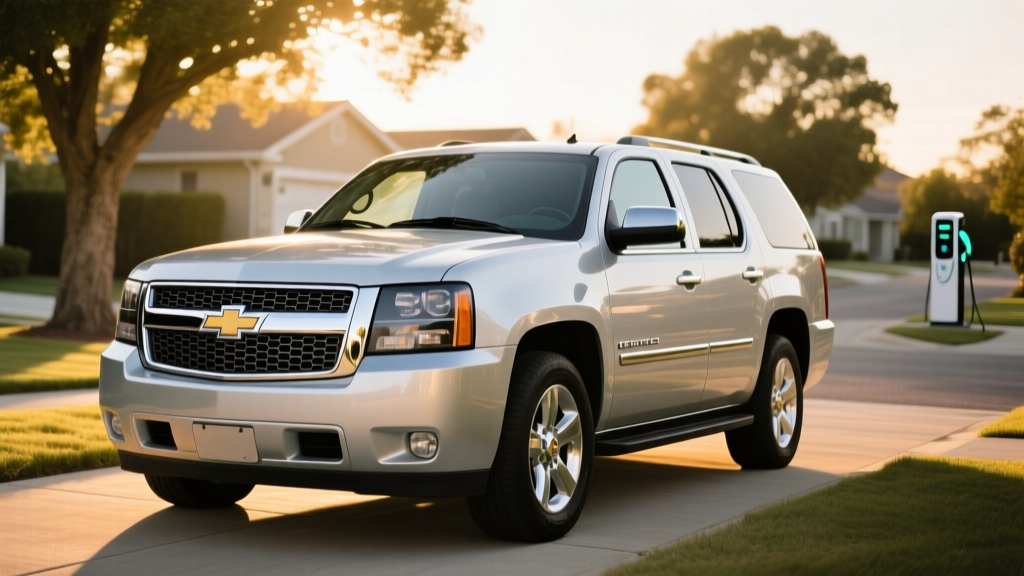
The 2008 Chevrolet Tahoe Hybrid: An Early Full-Size SUV Electrification Experiment
Long before plug-in hybrids dominated family-SUV showrooms, General Motors bet on a different kind of electrification: the two-mode hybrid system bolted into its biggest trucks. The 2008 Chevrolet Tahoe Hybrid was the first full-size SUV to offer a gas-electric powertrain, pairing a 6.0-liter V8 with twin electric motors inside a specialized transmission. Nearly two decades later, used examples still surface on dealer lots and private-party listings, typically priced between $4,000 and $9,000 depending on mileage and condition.
For buyers researching the 2008 Chevrolet Tahoe Hybrid as a budget-friendly large SUV, the key questions are practical: What fuel economy does it actually deliver? Is the hybrid battery a ticking time bomb? And how does a 2008-era conventional hybrid compare to the PHEVs and BEVs available today? This guide breaks down every number that matters.
Conventional Hybrid (HEV) vs. Plug-In Hybrid (PHEV): What the Tahoe Actually Is
The 2008 Tahoe Hybrid is a conventional hybrid electric vehicle (HEV), not a plug-in hybrid. This distinction is critical for used-car shoppers who may be cross-shopping newer electrified SUVs.
| Feature | 2008 Tahoe Hybrid (HEV) | Modern PHEV (e.g., 2026 Jeep Wrangler 4xe) |
|---|---|---|
| Plugs in to charge? | No — regenerative braking and engine charge the battery | Yes — Level 1 or Level 2 AC charging |
| Electric-only driving | Very low speeds only (under ~25 mph, short distances) | 20–50 miles at highway-capable speeds |
| Battery size | ~1.8 kWh (NiMH, net usable much less) | 15–25 kWh (lithium-ion) |
| Federal tax credit (new) | Expired after 2010; none for used purchase | Up to $7,500 via §30D if eligible (new/used rules differ) |
| Primary fuel | Gasoline always | Electricity first, gasoline for longer trips |
The Tahoe's hybrid system never needs to be plugged in. It recovers energy through regenerative braking and uses the gasoline engine to keep the nickel-metal hydride (NiMH) battery pack charged. You drive it exactly like a conventional gas SUV — the hybrid system operates transparently in the background.
Fuel Economy: EPA MPG and Real-World Expectations
The headline reason the 2008 Tahoe Hybrid existed was to cut fuel consumption in a segment notorious for single-digit efficiency. Here is how the numbers stack up, sourced from fueleconomy.gov:
| Metric | 2008 Tahoe Hybrid (2WD) | 2008 Tahoe Hybrid (4WD) | 2008 Tahoe Gas 5.3L V8 (2WD) |
|---|---|---|---|
| City MPG | 21 | 20 | 14 |
| Highway MPG | 22 | 20 | 20 |
| Combined MPG | 21 | 20 | 16 |
| Annual fuel cost (est.) | ~$2,850 | ~$3,000 | ~$3,750 |
Real-world MPG vs. EPA: The two-mode hybrid system shines in stop-and-go city driving, where the electric motors handle low-speed propulsion and regenerative braking recovers energy that a conventional SUV would waste as heat. Many owners reported exceeding the EPA city estimate by 1–3 MPG in heavy traffic. Highway driving is a different story: at sustained 70–80 mph speeds, the Tahoe's boxy aerodynamics and 5,800-pound curb weight work against it. Expect highway MPG to fall to 18–20 in real-world use, slightly below the EPA sticker.
The combined improvement over the gas-only 5.3L V8 Tahoe was substantial for 2008: roughly 30% better city fuel economy. By 2026 standards, however, 21 MPG combined is modest — a modern Toyota Grand Highlander Hybrid achieves 36 MPG combined in a three-row package, though with less towing capacity.
Two-Mode Hybrid Powertrain: How It Works and What It Makes
The 2008 Tahoe Hybrid uses GM's Two-Mode Hybrid system, co-developed with BMW and Chrysler (then DaimlerChrysler). It is far more sophisticated than the simple belt-alternator mild-hybrid systems appearing on some vehicles of that era.
| Specification | Detail |
|---|---|
| Engine | 6.0L V8 (Vortec), Atkinson-cycle capable, cylinder deactivation (AFM) |
| Engine horsepower | 332 hp @ 5,200 rpm |
| Electric motors | Twin 60-kW motors integrated into the transmission |
| Combined system output | 379 hp |
| Transmission | Electrically Variable Transmission (EVT) — 2 modes + 4 fixed gears |
| Battery pack | NiMH, ~1.8 kWh gross capacity, 300V nominal |
| 0–60 mph | ~7.8 seconds |
| Towing capacity | 5,800 lbs (2WD) / 5,600 lbs (4WD) |
| Curb weight | ~5,840 lbs |
| Drivetrain | Rear-wheel drive (2WD) or 4WD with low range |
The "two modes" refer to how the transmission manages power delivery. In Mode 1 (low speed, city driving), the system operates primarily as a series-parallel hybrid — the electric motors handle launch and low-speed cruising, the engine shuts off at stops, and regenerative braking recovers energy. In Mode 2 (highway and towing), the transmission locks into fixed mechanical gear ratios for efficient high-speed cruising and heavy-load situations. This dual-mode architecture was specifically designed for truck-duty applications, allowing the Tahoe Hybrid to retain full towing capability while still cutting city fuel consumption.
The Active Fuel Management (AFM) cylinder deactivation system further improves efficiency by shutting down four of the eight cylinders during light-load cruising — a feature that works in conjunction with the hybrid system but has its own reliability history (more on that below).
Battery Longevity, Reliability, and Replacement Cost
The hybrid battery is the single biggest concern for anyone considering a 2008 Tahoe Hybrid in 2026. These vehicles are now 17–18 years old, and the original NiMH battery packs were not designed for multi-decade service life.
Original Battery Warranty (When New)
GM warranted the hybrid-specific components — including the battery pack, electric motors, and EVT transmission — for 8 years / 100,000 miles. The standard powertrain warranty was 5 years / 100,000 miles. All factory warranties on 2008 models expired no later than 2016.
What actually happens to these batteries? NiMH chemistry degrades more gracefully than early lithium-ion packs — you typically see gradual capacity loss rather than sudden failure. However, after 15+ years, most original packs will have lost significant capacity. The impact on a conventional hybrid is different from a PHEV or EV: because the battery is small (~1.8 kWh) and used primarily for low-speed assist and regenerative buffering, degradation manifests as reduced fuel economy (perhaps 1–3 MPG below original) and more frequent engine cycling rather than a dramatic range loss.
Battery replacement cost: A refurbished or reconditioned NiMH hybrid battery pack for the 2008 Tahoe Hybrid typically runs $2,000 to $3,500 installed at an independent hybrid specialist. A new OEM pack from GM (if still available through a dealer) historically cost $5,000–$7,000, though availability for a 2008 model is increasingly limited. Some owners opt for individual cell replacement within the pack, which can cost $800–$1,500 but requires a technician experienced with NiMH module balancing.
Other reliability considerations: The 6.0L V8 is generally robust, but the Active Fuel Management (AFM) system has a well-documented history of lifter failure in GM's V8 engines of this era. The EVT transmission, while complex, proved surprisingly durable in fleet and taxi use. The electric motors themselves rarely fail. When evaluating a used example, a pre-purchase inspection by a technician familiar with GM's two-mode hybrid system is strongly recommended — standard OBD-II scanners may not fully interrogate the hybrid control module.
Tax Credits, Incentives, and Total Ownership Cost in 2026
The 2008 Tahoe Hybrid originally qualified for a federal tax credit of up to $2,200 under the Energy Policy Act of 2005. However, GM hit the 60,000-unit manufacturer cap for hybrid credits, and the credit phased out completely for GM vehicles by mid-2010. This credit has not been available for over 15 years.
For used buyers in 2026: The current federal used clean vehicle credit (§25E) provides up to $4,000 or 30% of the sale price — but only for vehicles with a battery capacity of at least 7 kWh, which effectively limits eligibility to PHEVs and BEVs. The 2008 Tahoe Hybrid's ~1.8 kWh NiMH pack does not qualify. No federal tax credit is available for this vehicle.
Some states offer their own incentives for hybrid purchases or hybrid battery replacements — check your state's energy office or department of environmental quality for current programs. These vary widely by jurisdiction and change frequently.
Ownership cost reality check: At a used purchase price of $5,000–$8,000, the Tahoe Hybrid's main economic advantage is fuel savings versus a gas-only Tahoe. If you drive 15,000 miles per year and gas costs $3.20/gallon:
| Annual Fuel Cost | 2008 Tahoe Hybrid (21 MPG) | 2008 Tahoe Gas 5.3L (16 MPG) |
|---|---|---|
| Gallons consumed | ~714 | ~938 |
| Annual cost | ~$2,285 | ~$3,002 |
| Annual savings (hybrid) | ~$717/year | |
That ~$717 annual fuel savings means the hybrid premium over a comparable gas Tahoe (typically $500–$1,500 on the used market) pays for itself within 1–2 years. However, factor in the potential $2,000–$3,500 battery replacement if the original pack is degraded, and the economics narrow considerably. The hybrid makes financial sense primarily for buyers who plan to keep the vehicle 3+ years and do significant city driving.
Who Should Buy the 2008 Tahoe Hybrid — And Who Should Look Elsewhere
Pros
- 30% city MPG improvement over gas-only Tahoe
- Retains full-size SUV towing (5,800 lbs) and seating for 7–8
- No plug-in charging required — drives like a normal SUV
- Low used purchase price ($4,000–$9,000)
- Regenerative braking reduces brake pad wear
Cons
- Highway MPG barely better than gas Tahoe
- Hybrid battery likely needs replacement at this age ($2,000–$3,500)
- AFM lifter failure risk on the 6.0L V8
- No federal tax credit available
- Outdated safety tech (no automatic emergency braking, no lane-keeping)
- 21 MPG combined is poor by 2026 hybrid standards
Choose the 2008 Tahoe Hybrid if:
You need a cheap, large SUV with genuine towing capability, you do a lot of city/suburban driving where the hybrid system shines, and you're comfortable budgeting for a potential hybrid battery replacement. It's a pragmatic choice for budget-conscious families who need three rows and a hitch but can't justify $50,000+ for a new hybrid SUV.
Look at a modern PHEV or HEV instead if:
You want current safety technology (automatic emergency braking, blind-spot monitoring, lane-keeping), better overall fuel economy (30+ MPG combined), a factory warranty, or the ability to drive on electricity alone for short commutes. Vehicles like the Toyota Grand Highlander Hybrid (36 MPG combined, ~$42,000 new) or a used Toyota Highlander Hybrid (30+ MPG, widely available for $20,000–$30,000) offer dramatically better efficiency and modern safety in a slightly smaller package.
Consider a full EV if:
You have home charging access, your daily driving is under 250 miles, and you want to eliminate fuel costs entirely. The per-mile energy cost of an EV is roughly one-third to one-quarter that of a 21-MPG hybrid on national average electricity rates. However, no current EV matches the Tahoe's combination of 5,800-lb towing and sub-$10,000 pricing.
Frequently Asked Questions
How many MPG does the 2008 Chevrolet Tahoe Hybrid get?
The EPA rates the 2WD model at 21 city / 22 highway / 21 combined MPG, and the 4WD model at 20 city / 20 highway / 20 combined. In real-world driving, city MPG often exceeds the EPA estimate by 1–3 MPG thanks to aggressive regenerative braking, while highway MPG typically falls 1–2 MPG below the sticker at sustained 70+ mph speeds.
Is the 2008 Tahoe Hybrid a plug-in?
No. The 2008 Tahoe Hybrid is a conventional hybrid (HEV). It cannot be plugged in and has no meaningful electric-only range. The battery recharges through regenerative braking and the gasoline engine. If you want plug-in capability with electric-only driving, you need a PHEV — a category that didn't exist in the Tahoe lineup until the 2026 model year announcements.
How far can it drive on electric power alone?
Essentially zero miles at normal driving speeds. The electric motors can propel the Tahoe at very low speeds (under ~25 mph) for brief distances — think creeping through a parking lot or inching forward in traffic. The engine starts automatically once more power is needed. This is fundamentally different from a PHEV, which offers 20–50 miles of full-speed electric driving.
Is the hybrid system reliable, and what does a battery replacement cost?
The two-mode hybrid system proved mechanically durable, with the EVT transmission and electric motors rarely failing. The main concern in 2026 is battery age: the original NiMH pack is 17+ years old and likely degraded. A reconditioned replacement battery costs $2,000–$3,500 installed. The 6.0L V8's AFM cylinder-deactivation system is a separate reliability concern (lifter failures are documented). A pre-purchase inspection by a hybrid-experienced technician is essential.
Does the 2008 Tahoe Hybrid qualify for any tax credit?
No. The original federal hybrid tax credit (up to $2,200) phased out for GM vehicles in 2010. The current federal used clean vehicle credit (§25E) requires a minimum 7 kWh battery, which the Tahoe Hybrid's ~1.8 kWh pack does not meet. Check with a tax professional and your state energy office for any local incentives that may apply.
Can it still tow like a regular Tahoe?
Yes. The hybrid system was specifically engineered for truck duty. The 2WD hybrid tows up to 5,800 pounds and the 4WD tows 5,600 pounds — only slightly less than the gas-only models of the same year. The two-mode transmission's fixed-gear Mode 2 provides direct mechanical power transfer for heavy loads.
Is the 2008 Tahoe Hybrid worth buying in 2026?
It depends on your priorities. If you need a large, cheap SUV with real towing capability and you do mostly city driving, the hybrid's fuel savings over a gas Tahoe are meaningful. But at 21 MPG combined, it's far less efficient than any modern hybrid, and you're taking on battery-age risk with no warranty safety net. For most buyers, a newer used hybrid SUV — even at a higher purchase price — offers better total cost of ownership, modern safety features, and remaining factory warranty coverage.