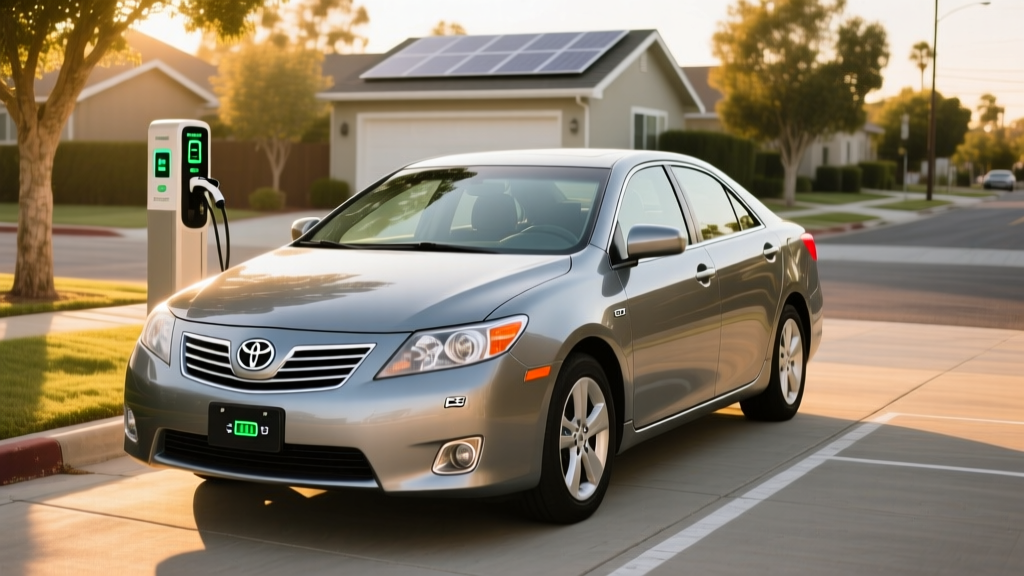
Quick Verdict: The 2008 Camry Hybrid in 2026
The 2008 Toyota Camry Hybrid is a conventional hybrid electric vehicle (HEV) — not a plug-in — that pairs a 2.4-liter four-cylinder engine with an electric motor for an EPA-rated 33 city / 34 highway / 34 combined MPG. Nearly two decades after its debut, it remains one of the most affordable entry points into hybrid ownership on the used market, with examples typically selling for $4,000–$7,500 depending on mileage and condition. For budget-conscious commuters who want proven hybrid efficiency without plug-in infrastructure, it still holds up — but battery age and replacement cost are the critical variables every prospective buyer must evaluate.
Fuel Economy: EPA Ratings vs. Real-World MPG
| Metric | Value |
|---|---|
| City MPG | 33 MPG |
| Highway MPG | 34 MPG |
| Combined MPG | 34 MPG |
| Fuel Tank Capacity | 17.2 gallons |
| Total Range | ~585 miles |
| Annual Fuel Cost (EPA est.) | ~$1,650 (at 15,000 mi/yr) |
Source: EPA fueleconomy.gov
Real-World MPG: What Owners Actually Report
The 2008 Camry Hybrid's EPA ratings are unusually balanced between city and highway — a hallmark of Toyota's Hybrid Synergy Drive system, which leverages the electric motor heavily at low speeds. In real-world ownership, many drivers report 30–36 MPG combined, with city driving often matching or slightly exceeding the EPA estimate thanks to frequent regenerative braking opportunities. Highway-heavy driving at 75+ MPH tends to drop economy to 29–31 MPG, as the aerodynamic drag and sustained engine load reduce the hybrid system's advantage.
Compared to the 2008 gas-only Camry 4-cylinder (EPA 21/31/24 combined), the hybrid delivers roughly 42% better combined fuel economy. At $3.50/gallon and 15,000 miles per year, that translates to approximately $735 in annual fuel savings — or $3,675 over five years.
Powertrain and Hybrid System Specifications
| Component | Specification |
|---|---|
| Gasoline Engine | 2.4L inline-4 (2AZ-FXE), Atkinson cycle, 147 HP @ 6,000 RPM |
| Electric Motor | Permanent magnet synchronous, 40 HP (30 kW) |
| Combined Net Output | 192 HP |
| Transmission | eCVT (electronically controlled continuously variable) |
| Drivetrain | Front-wheel drive |
| Hybrid Battery | Nickel-metal hydride (NiMH), ~1.4 kWh (nominal), 244.8V |
| 0–60 MPH | ~8.4 seconds |
The Hybrid Synergy Drive system in the 2008 Camry uses a power-split device that seamlessly blends engine and motor output. Unlike a traditional automatic transmission, the eCVT has no fixed gear ratios — it uses planetary gearsets to manage power flow between the engine, motor-generator, and wheels. The result is smooth, shift-free acceleration and the ability to drive short distances (typically under 1 mile) on electric power alone at low speeds, though Toyota did not publish an electric-only range figure because this is an HEV, not a PHEV.
- Choose this HEV (2008 Camry Hybrid) if: You want better fuel economy with zero behavior change — no plugging in, no range planning, just fill up with gas and drive. Ideal for apartment dwellers without charging access.
- Choose a PHEV if: You have home charging and a short commute (under 30 miles). You get electric-only daily driving with gas-engine backup for road trips. Examples: Toyota RAV4 Prime, Chrysler Pacifica Hybrid.
- Choose a full BEV if: You have reliable home or workplace charging, want zero tailpipe emissions, and are ready to plan around charging on long trips. Examples: Tesla Model 3, Hyundai Ioniq 5.
Hybrid Battery: Lifespan, Warranty, and Replacement Cost
When new, Toyota warranted the 2008 Camry Hybrid's NiMH battery for 8 years / 100,000 miles (10 years / 150,000 miles in California and states adopting CARB emissions standards). As of 2026, all original factory warranties have expired.
Expected battery lifespan: Toyota's NiMH hybrid batteries have demonstrated remarkable longevity, with many Camry Hybrids reaching 150,000–200,000+ miles on the original pack. However, a 2008 model is now 18 years old, and battery degradation is a realistic concern regardless of mileage.
Battery Replacement Cost in 2026
If the hybrid battery fails or degrades significantly, owners have three main options:
- New OEM Toyota battery: $2,500–$3,500 for the battery pack, plus $500–$800 in labor at a dealership.
- Remanufactured/reconditioned battery: $1,200–$2,000 installed from third-party suppliers like Green Bean Battery or Dorman. These typically carry a 1–3 year warranty.
- Individual cell/module replacement: Some specialist shops replace only the failed modules within the pack for $600–$1,200, though this is a temporary fix if other cells are also aging.
For a used 2008 Camry Hybrid worth $4,000–$7,500, a full OEM battery replacement can consume 40–70% of the vehicle's value. This is the single biggest financial risk in buying an older hybrid. Before purchasing, request a hybrid battery health check from a Toyota dealer or qualified hybrid technician — they can read the battery's state of health (SoH) and individual cell voltage delta through the OBD-II port.
Reliability and Common Issues
The 2008 Camry Hybrid inherits Toyota's strong reliability reputation, and the hybrid powertrain itself has proven exceptionally durable. The eCVT transmission, which lacks the clutch packs and bands found in conventional automatics, is notably robust. However, 18-year-old vehicles present age-related concerns beyond the hybrid battery:
- Inverter coolant pump: Some owners report failure of the inverter cooling system water pump. Toyota issued a recall for certain model years. Verify recall status via NHTSA's recall lookup.
- Brake actuator: The regenerative braking system uses an electro-hydraulic brake actuator that can fail at high mileage. Replacement costs $1,200–$1,800.
- 12V auxiliary battery: Like any car, the standard 12V battery needs periodic replacement ($150–$250). In the Camry Hybrid, it's located in the trunk.
- General aging: Suspension bushings, struts, engine mounts, and rubber hoses are wear items that may need attention on a vehicle of this age.
Overall, the 2008 Camry Hybrid earns above-average reliability marks for its era. The hybrid-specific components (inverter, eCVT, motor-generators) have proven more durable than many conventional drivetrain parts.
Pricing and Tax Credit Eligibility
| Condition / Mileage | Typical Price Range |
|---|---|
| Excellent (<100k mi, battery verified) | $6,000–$7,500 |
| Good (100k–150k mi) | $4,500–$6,000 |
| Fair (150k+ mi, potential battery concern) | $3,000–$4,500 |
Federal Tax Credit Status
The 2008 Camry Hybrid does not qualify for the federal §30D new clean vehicle credit, as it was sold new well before current incentive structures and Toyota's hybrid credit allocation was exhausted in 2007. For used purchases, the §25E Used Clean Vehicle Credit offers up to $4,000 (30% of sale price, capped at $4,000) — but only for vehicles with a sale price of $25,000 or less purchased from a licensed dealer, and the vehicle must be at least two model years old. However, the §25E credit applies to qualified plug-in electric vehicles and fuel cell vehicles. Since the 2008 Camry Hybrid is a conventional HEV (not a plug-in), it does not qualify for the §25E used EV credit. See IRS §25E guidelines for details.
Some states offer their own incentives for hybrid purchases or emissions-reducing vehicles, but these vary widely and change frequently. Check your state's environmental or energy agency for current programs.
Who Should Buy the 2008 Camry Hybrid in 2026?
- Proven 34 MPG combined — 42% better than gas Camry
- Extremely durable hybrid powertrain (eCVT, NiMH)
- No plug-in required — works for apartment/rental living
- Low used-market entry price ($4k–$7.5k)
- Spacious midsize sedan with 15.1 cu-ft trunk
- Strong Toyota parts and service network
- 18-year-old hybrid battery is a $2k–$4k risk
- No federal tax credit eligibility (HEV, not PHEV/BEV)
- Dated safety tech — no automatic emergency braking, lane-keep assist
- NiMH battery is less energy-dense than modern lithium-ion
- Modest 192 HP — adequate but not quick
- Original warranty fully expired
Best for: Budget-minded commuters driving 10,000–20,000 miles per year who lack home charging access and want reliable, efficient transportation without the complexity or cost of a plug-in vehicle. The fuel savings alone — roughly $700–$800 per year versus a comparable gas Camry — can offset the purchase price within a few years, provided the hybrid battery holds up.
Consider alternatives if: You have home charging and could benefit from a PHEV's electric-only commuting (e.g., a used Toyota Prius Prime or Chevrolet Volt), or if you want modern ADAS safety features like automatic emergency braking and adaptive cruise control, which are absent on the 2008 model.
Frequently Asked Questions
How many MPG does the 2008 Camry Hybrid get?
The EPA rates the 2008 Camry Hybrid at 33 city / 34 highway / 34 combined MPG. Real-world owners typically report 30–36 MPG combined, with city driving often achieving the best results due to regenerative braking and frequent electric-motor assist at low speeds.
Does the 2008 Camry Hybrid need to be plugged in?
No. The 2008 Camry Hybrid is a conventional hybrid (HEV). Its 1.4 kWh NiMH battery charges through regenerative braking and the gasoline engine. You simply fill it with regular unleaded gasoline — no plug, no charging station, no behavior change required.
How long does the 2008 Camry Hybrid battery last?
Toyota's NiMH hybrid batteries in this era commonly last 150,000–200,000+ miles. However, age is also a factor: an 18-year-old battery may show degradation regardless of mileage. A pre-purchase hybrid battery health scan is strongly recommended.
What does it cost to replace the hybrid battery?
A new OEM battery from Toyota costs $2,500–$3,500 plus labor. Remanufactured batteries run $1,200–$2,000 installed. Individual module repairs can be done for $600–$1,200 but may not be a long-term fix on an aged pack.
Does the 2008 Camry Hybrid qualify for any tax credit?
No. As a conventional hybrid (HEV) — not a plug-in — it does not qualify for the federal §30D new vehicle credit or the §25E used clean vehicle credit. State-level incentives for hybrids vary; consult your state's energy agency.
Is the 2008 Camry Hybrid reliable?
Yes, with caveats. The hybrid powertrain (eCVT, motor-generators, inverter) has proven exceptionally durable. The main risk is the aging NiMH battery. Non-hybrid components (suspension, brakes, electronics) carry normal wear expectations for an 18-year-old vehicle. The IIHS rated the 2008 Camry as a "Good" in frontal offset crash testing — see IIHS ratings for full details.
How does the 2008 Camry Hybrid compare to a modern hybrid?
The 2026 Toyota Camry Hybrid achieves an EPA 51 city / 53 highway / 52 combined MPG — roughly 53% more efficient — thanks to a more advanced lithium-ion battery, a more efficient 2.5L Dynamic Force engine, and improved aerodynamics. However, a 2026 Camry Hybrid starts at approximately $30,000, making the 2008 model an attractive budget alternative if the battery is healthy.