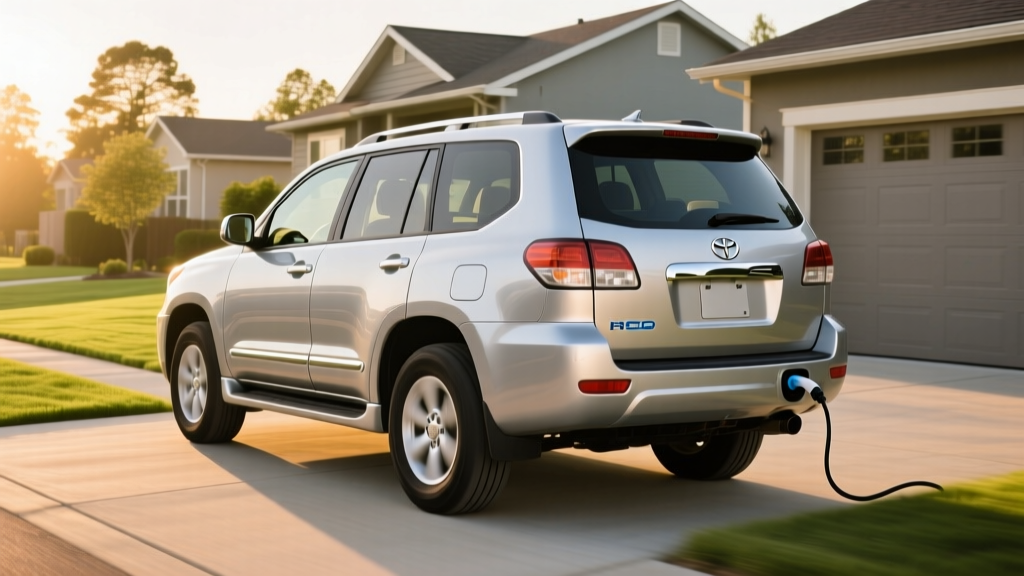
If you're researching the 2007 Toyota Highlander Hybrid MPG in 2026, you're likely evaluating this early-generation hybrid SUV as a budget-friendly used vehicle. Nearly two decades after its debut, the 2007 Highlander Hybrid remains one of the most recognizable nameplates from Toyota's pioneering hybrid era. But how do its EPA fuel economy numbers hold up today, what should you expect from a hybrid battery that could be 18+ years old, and how does it compare to the modern hybrid, PHEV, and EV alternatives now on the market?
This guide covers every number that matters — EPA MPG, real-world fuel economy, powertrain specs, battery replacement costs, reliability data, and a clear framework for deciding whether this legacy hybrid is the right choice for your next vehicle.
2007 Toyota Highlander Hybrid MPG: The Official EPA Numbers
The 2007 Toyota Highlander Hybrid was rated by the EPA under the revised testing methodology that took effect for the 2008 model year (and was retroactively applied). Here are the official figures from fueleconomy.gov:
| Metric | Value |
|---|---|
| City MPG | 31 MPG |
| Highway MPG | 27 MPG |
| Combined MPG | 26 MPG |
| Fuel Type | Regular Unleaded (87 octane) |
| Fuel Tank Capacity | 17.2 gallons |
| EPA Estimated Total Range | ~447 miles |
For context, the conventional gas-only 2007 Toyota Highlander with the 3.3L V6 was rated at approximately 20 MPG combined (18 city / 24 highway). The hybrid's 26 MPG combined represented a roughly 30% improvement — substantial for a three-row, all-wheel-drive SUV in 2007.
Real-World MPG: What Owners Actually Report
Hybrid vehicles, especially Toyota's Synergy Drive system, tend to perform better than their EPA city ratings in stop-and-go traffic because regenerative braking recaptures energy that gas cars waste as heat. However, the 2007 Highlander Hybrid has some real-world considerations in 2026:
City driving: 27–32 MPG (hybrids shine here; regenerative braking maximizes efficiency)
Highway driving: 24–27 MPG (aerodynamic drag and sustained engine load reduce hybrid advantage)
Combined mixed driving: 25–28 MPG
Cold weather penalty: Expect a 10–15% reduction (battery efficiency drops, engine runs more for cabin heat)
Note: Vehicles with degraded hybrid batteries may see 2–4 MPG below these ranges until the battery is replaced or reconditioned.
Owner-reported data on forums and fuel-tracking sites consistently shows the 2007 Highlander Hybrid averaging 25–27 MPG combined in mixed driving, which aligns closely with the EPA estimate. The city MPG advantage over the gas model is the most pronounced — owners who do mostly urban driving report the biggest fuel savings.
Powertrain & Hybrid System Specs
The 2007 Highlander Hybrid uses Toyota's Hybrid Synergy Drive (HSD), a series-parallel full hybrid system. This is a conventional hybrid (HEV) — it does not plug in. The system charges its own battery through regenerative braking and the gasoline engine.
| Specification | Detail |
|---|---|
| Gasoline Engine | 3.3L V6 (3MZ-FE), 208 HP @ 5,600 RPM |
| Electric Motor | Front: 123 kW (165 HP); Rear: 50 kW (67 HP) |
| Combined Net Horsepower | 270 HP |
| Drivetrain | Electronic AWD (e-Four) — electric motor powers rear axle |
| Transmission | Electronically controlled CVT (eCVT) |
| Hybrid Battery | Nickel-Metal Hydride (NiMH), ~6.5 kWh (gross) |
| 0–60 MPH | ~7.8 seconds |
| Towing Capacity | 3,500 lbs (when properly equipped) |
| Curb Weight | ~4,345 lbs |
The e-Four AWD system is notable: instead of a mechanical driveshaft to the rear wheels, a dedicated rear electric motor provides on-demand rear traction. This eliminates drivetrain parasitic loss and contributes to the hybrid's efficiency advantage over the gas AWD Highlander.
HEV vs PHEV vs EV: Understanding What You're Buying
The 2007 Highlander Hybrid is a conventional hybrid (HEV). If you're cross-shopping in 2026, it's essential to understand the distinctions:
| Feature | HEV (e.g., 2007 Highlander Hybrid) | PHEV (e.g., 2026 RAV4 Prime) | BEV (e.g., 2026 Hyundai Ioniq 5) |
|---|---|---|---|
| Plugs In? | No | Yes | Yes |
| Electric-Only Range | ~1 mile at low speed | 35–42 miles | 250–320+ miles |
| Total Range | ~447 miles | ~550+ miles (EV + gas) | 250–320+ miles |
| Battery Size | ~6.5 kWh (NiMH) | ~18.1 kWh (Li-ion) | 63–84 kWh (Li-ion) |
| Fueling | Gas station only | Gas station + Level 1/2 plug | Plug only (Level 1/2/DC) |
| Federal Tax Credit | No | Up to $7,500 (§30D, if eligible) | Up to $7,500 (§30D, if eligible) |
| Maintenance | Standard + hybrid system | Standard + hybrid + plug system | Minimal (no engine) |
The 2007 Highlander Hybrid requires zero behavioral change from a gas car — you fuel it the same way and never think about charging. The tradeoff is that its fuel economy improvement, while meaningful, is modest compared to what a modern PHEV or BEV delivers.
Hybrid Battery Lifespan, Warranty & Replacement Cost
Hybrid Battery Warranty: 8 years / 100,000 miles (10 years / 150,000 miles in CARB states including CA, NY, MA, and others)
Warranty Capacity Threshold: Toyota warranted the battery against failure and significant capacity loss
Current Status (2026): All original factory warranties have expired — replacement is an owner expense
This is the single most important ownership question for anyone buying a 2007 Highlander Hybrid in 2026. The NiMH battery pack is now 18–19 years old. While Toyota's hybrid batteries have a strong track record for longevity, NiMH chemistry degrades with age and heat cycling regardless of mileage.
Expected battery lifespan: Most 2007-era Highlander Hybrid batteries last 150,000–200,000 miles or 12–18 years before significant degradation. Many are now at or beyond that threshold.
Signs of hybrid battery degradation:
- Reduced fuel economy (2–5 MPG drop from baseline)
- More frequent engine cycling (engine starts/stops more often to charge the battery)
- Reduced EV-mode capability at low speeds
- Check hybrid system warning light or diagnostic trouble codes (P0A80 and related)
Battery replacement costs in 2026:
| Option | Cost Range | Notes |
|---|---|---|
| New OEM Toyota Battery | $3,000–$4,500 (installed) | Available through Toyota dealers; best longevity |
| Remanufactured/Refurbished Battery | $1,500–$2,800 (installed) | Replaced weak cells; 1–3 year warranty typical |
| Used/Salvage Battery | $500–$1,200 (plus install) | Highest risk; unknown remaining life |
| Cell-Level Reconditioning | $800–$1,500 | Specialist shops replace individual bad modules |
At current used vehicle values ($4,000–$8,000 for a well-maintained 2007 Highlander Hybrid), an OEM battery replacement can represent 40–80% of the vehicle's value. This is the critical economic calculation for any buyer.
Reliability & Long-Term Ownership Costs
The 2007 Toyota Highlander Hybrid benefits from Toyota's strong reliability reputation and the proven durability of the HSD powertrain. The 3MZ-FE V6 engine is known to reach 250,000+ miles with regular maintenance. The eCVT transmission has no traditional gears or clutch packs to wear out — it uses planetary gearsets that are exceptionally durable.
Common issues to watch for:
- Hybrid battery degradation (as detailed above — the #1 cost risk)
- Hybrid inverter coolant pump — known failure point; ~$400–$700 replacement
- Brake actuator assembly — the electro-hydraulic brake system can develop faults; $1,200–$2,000 repair
- Standard wear items — suspension components, water pump, ignition coils at high mileage
According to NHTSA records, the 2007 Highlander Hybrid has relatively few recalls and complaints for its age, which supports its reliability reputation. However, any 18-year-old vehicle will require ongoing maintenance budget.
Tax Credits & Purchase Economics in 2026
The 2007 Toyota Highlander Hybrid does not qualify for any federal tax credit under current IRS §30D rules. The federal hybrid tax credit that existed when this vehicle was new (up to $2,200) expired long ago, and current credits apply only to new plug-in electric vehicles (PHEVs and BEVs).
- Federal §30D New EV Credit: Not applicable — this is a used HEV, not a new PHEV or BEV
- Used EV Credit (§25E): Not applicable — conventional hybrids do not qualify; only PHEVs and BEVs with ≥4 kWh battery capacity are eligible
- State incentives: No state currently offers incentives for purchasing a used conventional hybrid
- Fuel savings vs. gas model: At 26 MPG combined vs. 20 MPG combined (gas Highlander), saving ~6 MPG translates to roughly $400–$600/year in fuel savings at 12,000 miles/year and $3.50/gallon
The economics of buying a 2007 Highlander Hybrid in 2026 come down to purchase price, condition, and the battery replacement question — not incentives.
Who Should Buy the 2007 Highlander Hybrid (And Who Shouldn't)
- You need a low-cost three-row SUV with AWD and better-than-average fuel economy
- You do mostly city/suburban driving where the hybrid system delivers maximum MPG benefit
- You have no access to home or workplace charging (ruling out PHEVs and EVs)
- You've verified the hybrid battery health (via diagnostic scan) before purchase
- You're comfortable budgeting $1,500–$4,000 for a potential battery replacement
- You want electric-only driving for short commutes (a 2026 RAV4 Prime offers 42 miles EV-only)
- You want to qualify for federal or state EV tax credits (up to $7,500 for eligible new PHEVs/BEVs)
- You want modern safety features (automatic emergency braking, lane-keeping, blind-spot monitoring — the 2007 has none of these)
- You want lower long-term maintenance costs with a newer vehicle under warranty
- You want the latest infotainment, connectivity, and driver-assistance technology
- 270 HP combined — surprisingly quick for a 2007 hybrid SUV
- 31 MPG city is excellent for a three-row AWD vehicle
- Proven Toyota reliability; eCVT is nearly bulletproof
- Electric AWD (e-Four) with no mechanical driveshaft losses
- No plug-in infrastructure needed — fuel like a normal car
- Low purchase price on the used market ($4,000–$8,000)
- Hybrid battery likely at or past end of life — $1,500–$4,500 replacement risk
- No modern ADAS features (no AEB, lane-keep, or blind-spot monitoring)
- Dated interior and infotainment by 2026 standards
- No federal or state tax credit eligibility
- Highway MPG (27) is less impressive than city (31)
- Fuel savings vs. gas model may not offset battery replacement cost
Frequently Asked Questions
How many MPG does the 2007 Toyota Highlander Hybrid get?
The EPA rates the 2007 Toyota Highlander Hybrid at 31 MPG city, 27 MPG highway, and 26 MPG combined. Real-world owners typically report 25–28 MPG combined, with city driving often matching or slightly exceeding the EPA estimate thanks to regenerative braking.
Does the 2007 Highlander Hybrid need to be plugged in?
No. The 2007 Highlander Hybrid is a conventional hybrid (HEV). It charges its own battery through regenerative braking and the gasoline engine. You never plug it in — you fuel it at a gas station like any other car.
How much does it cost to replace the hybrid battery?
In 2026, a new OEM Toyota hybrid battery for the 2007 Highlander Hybrid costs approximately $3,000–$4,500 installed. Remanufactured batteries run $1,500–$2,800, and cell-level reconditioning costs $800–$1,500 at specialist shops.
Is the 2007 Highlander Hybrid reliable?
Yes, with caveats. The powertrain (3MZ-FE V6, eCVT, hybrid system) is proven durable to 200,000+ miles. The main reliability concern in 2026 is hybrid battery age — most original batteries are at or beyond their expected lifespan. Budget for a replacement or verify battery health before purchase.
Does the 2007 Toyota Highlander Hybrid qualify for any tax credit?
No. The 2007 Highlander Hybrid does not qualify for the federal §30D new EV credit, the §25E used EV credit, or any current state EV incentives. These programs are limited to plug-in vehicles (PHEVs and BEVs). The original federal hybrid credit for this model expired in 2007.
How does the 2007 Highlander Hybrid compare to a modern hybrid SUV?
A 2026 Toyota Highlander Hybrid achieves 35 MPG combined — a 35% improvement over the 2007 model. Modern hybrids also feature lithium-ion batteries (lighter, more durable), full ADAS suites, and current safety standards. If budget allows, a newer hybrid delivers meaningfully better efficiency and safety, though at a significantly higher purchase price.
What's the difference between the 2007 Highlander Hybrid and a PHEV?
The 2007 Highlander Hybrid is an HEV — it cannot plug in and has essentially no electric-only range. A modern PHEV like the 2026 Toyota RAV4 Prime has an 18.1 kWh battery, 42 miles of electric-only driving, and can plug into a Level 2 charger. PHEVs offer much greater fuel savings for drivers with short commutes and charging access, but cost significantly more upfront.