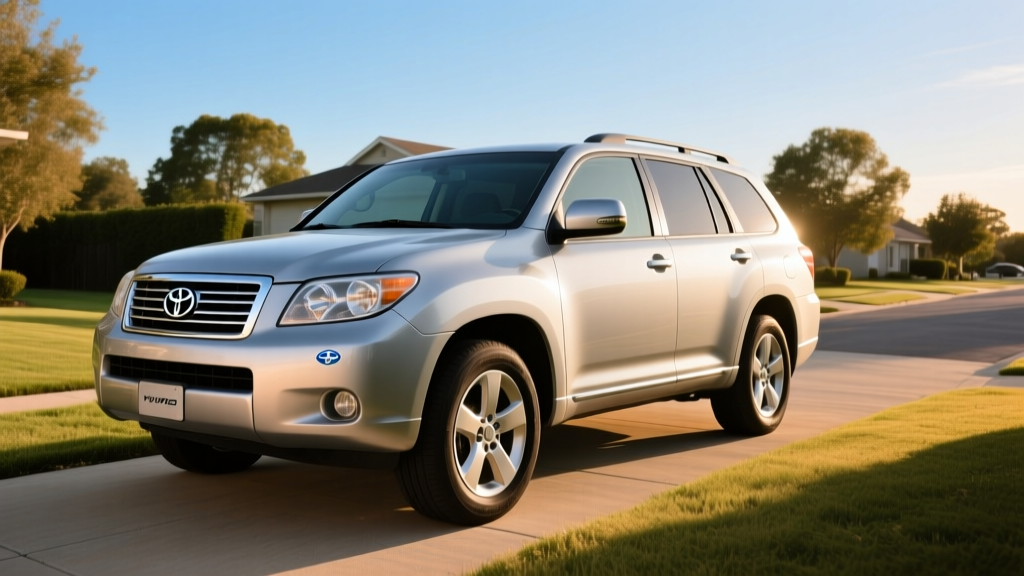
The 2007 Toyota Highlander Hybrid was one of the first mainstream midsize SUVs to pair a V6 engine with an electric motor system, offering a compelling blend of power and fuel efficiency nearly two decades before electrification became the industry norm. If you're researching this model on the used market in 2026, you likely want hard numbers on fuel economy, hybrid battery longevity, and whether it still makes financial sense. This guide covers every spec that matters.
2007 Toyota Highlander Hybrid: Quick Specs at a Glance
| Specification | 2007 Highlander Hybrid |
|---|---|
| Powertrain Type | Conventional Hybrid (HEV) — no plug |
| Engine | 3.3L V6 + electric motor (Toyota Hybrid Synergy Drive) |
| Combined Horsepower | 272 HP (net system output) |
| Transmission | eCVT (electronically controlled continuously variable) |
| EPA Fuel Economy | 27 city / 28 highway / 26 combined MPG* |
| Drivetrain | AWD (eAWD — electric rear motor, no mechanical driveshaft) |
| Seating | 7 passengers (Limited) / 5 (Base) |
| Cargo Volume | ~79.3 cu ft (rear seats folded) |
| Towing Capacity | 3,500 lbs (with tow prep package) |
| Original MSRP (2007) | $33,070–$39,780 |
| Typical 2026 Used Price | $4,500–$8,500 depending on mileage/condition |
*EPA ratings for the 2007 model year as listed on fueleconomy.gov. Real-world figures vary — see section below.
Fuel Economy: EPA Ratings vs Real-World MPG
The 2007 Toyota Highlander Hybrid carries EPA ratings of 27 MPG city, 28 MPG highway, and 26 MPG combined. The slightly unusual pattern — where highway MPG equals or slightly exceeds city — is worth explaining.
Unlike many Toyota hybrids (the Prius, for example, gets far better city mileage than highway), the Highlander Hybrid's heavy 4,500-pound curb weight and less aggressive regenerative braking tuning mean its city advantage is muted. The Atkinson-cycle V6 still shuts off at stops and assists with low-speed electric-only driving, but the mass of the vehicle limits the gains.
| Driving Scenario | EPA Estimate | Real-World Expectation |
|---|---|---|
| City (stop-and-go) | 27 MPG | 25–28 MPG |
| Highway (65–75 mph) | 28 MPG | 24–27 MPG |
| Combined (mixed driving) | 26 MPG | 23–26 MPG |
| Cold weather (below 32°F) | — | 21–24 MPG |
In practice, owners reporting on fuel-tracking platforms typically see 23–25 MPG combined in mixed driving. Highway-heavy commutes at 75+ mph can drop that to 22 MPG. City driving with frequent stops — where the hybrid system recaptures the most energy through regenerative braking — can push toward 27 MPG, close to the EPA sticker.
For context, the gas-only 2007 Highlander V6 AWD was rated at 18 city / 24 highway / 20 combined. The hybrid's ~6 MPG combined advantage translates to roughly 50–70 fewer gallons per year at 12,000 miles of driving — a meaningful savings even at moderate fuel prices.
Hybrid Powertrain: How It Works
The 2007 Highlander Hybrid uses Toyota's Hybrid Synergy Drive system — the same architecture that powered the contemporary Camry Hybrid and Prius, but scaled up for a 4,500-lb SUV. Here's what's under the hood:
- 3.3L 3MZ-FE V6 engine running an Atkinson cycle for improved thermal efficiency, producing approximately 208 HP on its own
- Front electric motor (MG2) contributing up to ~120 kW peak, integrated into the transaxle
- Rear electric motor (MGR) powering the rear axle for AWD traction — no mechanical driveshaft connects front to rear
- NiMH (Nickel-Metal Hydride) traction battery mounted under the second-row seat, approximately 1.9 kWh capacity
- System net output: 272 HP — the combined maximum available from engine and motors simultaneously
This is a conventional hybrid (HEV), not a plug-in. The battery charges exclusively through regenerative braking and the gasoline engine. You never plug it in. The electric-only mode operates only at very low speeds (typically under 25 mph) and for short distances — it's designed to assist with creeping in traffic and reducing idle fuel consumption, not to serve as an EV.
HEV vs PHEV: Where the 2007 Highlander Fits
| Feature | HEV (This Highlander) | PHEV (e.g., 2026 RAV4 Prime) |
|---|---|---|
| Plug-in charging? | No — self-charging | Yes — plug in for EV range |
| Battery size | ~1.9 kWh NiMH | ~18 kWh lithium-ion |
| Electric-only range | Under 1 mile at low speed | 35–42 miles at highway speed |
| Total range | ~450 miles (19.2 gal tank) | ~600+ miles combined |
| Federal tax credit | Not eligible | Up to $7,500 (§30D, if eligible) |
If you're comparing this to a modern plug-in hybrid like the Toyota RAV4 Prime or Hyundai Tucson PHEV, understand that the 2007 Highlander Hybrid occupies a completely different category. It's a fuel-efficiency assist system, not an electric-first vehicle.
Hybrid Battery: Lifespan, Warranty & Replacement Cost
This is the single most important question for anyone buying a nearly 20-year-old hybrid. Here's what you need to know:
Original Hybrid Battery Warranty
Toyota originally warranted the hybrid battery in the 2007 Highlander Hybrid for 8 years / 100,000 miles (10 years / 150,000 miles in CARB states including California, New York, Massachusetts, and others that adopted California emissions standards). That factory coverage has expired on every surviving example as of 2026.
Real-World Battery Longevity
The NiMH battery in this generation Highlander Hybrid has proven remarkably durable. Toyota's hybrid battery management system is conservative — it never fully charges or fully depletes the pack, keeping it in a narrow state-of-charge window that dramatically extends cycle life. Owner forums and repair databases show many 2007 Highlander Hybrids reaching 150,000–200,000+ miles on the original battery.
That said, at 18–19 years old, any original battery is living on borrowed time. NiMH chemistry degrades with age even more than with use. Expect reduced fuel economy and more frequent engine engagement as cells weaken.
Battery Replacement Cost (2026 Estimates)
| Option | Estimated Cost | Notes |
|---|---|---|
| New OEM Toyota battery | $3,500–$5,000 (parts + labor) | Available through Toyota dealers; best reliability |
| Remanufactured battery | $2,000–$3,000 | Third-party rebuilt packs; quality varies by vendor |
| Used/salvage battery | $800–$1,500 | From a wrecked Highlander; gamble on remaining life |
| Individual cell module replacement | $500–$1,200 | Only viable if 1–2 modules are weak; requires specialist |
Before purchasing, have the hybrid battery load-tested by a Toyota dealer or hybrid specialist. A scan tool can read individual module voltages — a healthy pack shows all modules within 0.2V of each other. Wide voltage spread indicates imminent failure.
Reliability & Ownership Costs
The 2007 Highlander Hybrid shares its platform and powertrain DNA with the Lexus RX 400h, and its reliability record reflects Toyota's engineering rigor of this era. Key reliability points:
- Engine (3MZ-FE): Well-proven V6 with timing belt (not chain) — requires replacement every 90,000 miles. Budget $800–$1,200 for this service if records are unknown.
- eCVT transaxle: Toyota's planetary-gear hybrid transmission has no belts, clutches, or torque converter to wear out. Failures are rare below 200,000 miles.
- Inverter/cooling system: The hybrid inverter coolant pump is a known wear item. Listen for unusual whining from the engine bay and verify the inverter coolant reservoir is circulating.
- eAWD rear motor: Simple and reliable; no driveshaft or transfer case to service.
- Brakes: Regenerative braking significantly reduces pad wear. Original brake pads lasting 80,000+ miles are common.
According to NHTSA records, the 2007 Highlander Hybrid has few major recalls — check the VIN on nhtsa.gov/recalls before buying.
Tax Credits & Incentives in 2026
The 2007 Toyota Highlander Hybrid does not qualify for the federal §30D tax credit. Under current IRS rules, the §30D credit applies only to new clean vehicles purchased new, and it has specific MSRP caps, buyer income limits, and battery critical-mineral sourcing requirements. This credit was never available for conventional HEVs regardless — it applies to plug-in electric vehicles (BEVs and PHEVs) with minimum battery capacity thresholds.
When the 2007 Highlander Hybrid was new, it did qualify for a now-expired Alternative Motor Vehicle Credit (IRS Form 8910), which offered up to $2,200 depending on purchase date and Toyota's cumulative hybrid sales volume. That credit has been fully expired for years.
Some states and local utilities offer rebates for purchasing used hybrids or for general fuel-efficient vehicle ownership, but these vary enormously by jurisdiction. Check your state energy office or utility provider for current programs.
Who Should Buy the 2007 Highlander Hybrid?
This Hybrid Makes Sense If:
- You need a 7-passenger AWD SUV on a tight budget (under $10,000)
- You want better fuel economy than a gas V6 SUV without plugging in
- You do mixed city/highway driving and value the smooth, quiet hybrid start-stop
- You're comfortable with potential hybrid battery replacement ($2,000–$5,000) within your ownership window
- You value Toyota's proven reliability and widely available parts
Consider a Newer PHEV or BEV Instead If:
- You want meaningful electric-only driving range (30+ miles on battery alone)
- You want to qualify for a federal tax credit (up to $7,500 for eligible new PHEVs/BEVs)
- You prioritize modern safety features (blind-spot monitoring, automatic emergency braking, lane-keep assist — none of which were available on the 2007 Highlander)
- You want the lowest possible cost-per-mile on electricity
Pros
- 272 HP provides confident acceleration and highway passing
- AWD via electric rear motor — no mechanical complexity
- Proven hybrid system with strong longevity record
- Low purchase price on the used market ($4,500–$8,500)
- Significant fuel savings vs gas-only V6 Highlander (~6 MPG better)
- eCVT is one of the most reliable transmissions Toyota has ever built
Cons
- Hybrid battery replacement likely needed at this age ($2,000–$5,000)
- No modern driver-assistance or active safety features
- Dated interior with hard plastics and small infotainment screen
- NiMH battery is heavier and less energy-dense than modern lithium-ion
- No federal tax credit or incentive eligibility
- Timing belt service is mandatory and costly if overdue
Frequently Asked Questions
How many MPG does the 2007 Toyota Highlander Hybrid get?
The EPA rates it at 27 city / 28 highway / 26 combined MPG. Real-world combined driving typically returns 23–25 MPG, with city-heavy routes reaching 26–27 MPG and highway cruising at 75+ mph dropping to 22–24 MPG. Cold weather can reduce economy by 10–15%.
Is the 2007 Highlander Hybrid a plug-in?
No. It is a conventional hybrid (HEV). The battery charges through regenerative braking and the gasoline engine. You never plug it in. It can creep short distances on electric power alone at very low speeds, but this is not meaningful EV range.
How much does a replacement hybrid battery cost?
Expect $3,500–$5,000 for a new OEM Toyota pack installed at a dealer, $2,000–$3,000 for a quality remanufactured unit, or $800–$1,500 for a used salvage pack. Individual cell module replacement is possible for $500–$1,200 if only a few cells have degraded.
Is the 2007 Highlander Hybrid reliable?
Yes, with proper maintenance. The 3.3L V6, eCVT transaxle, and hybrid system are proven durable. The main risk at this age is hybrid battery degradation and overdue timing belt service. With records showing regular maintenance, these SUVs commonly reach 200,000+ miles.
Does it qualify for any federal tax credit in 2026?
No. The federal §30D credit applies only to new plug-in electric vehicles (BEVs and PHEVs). The 2007 Highlander Hybrid originally qualified for the now-expired Alternative Motor Vehicle Credit (up to $2,200), which ended over a decade ago. No current federal incentive applies.
Should I buy this or a newer hybrid?
If your budget is strictly under $10,000 and you need AWD and 7 seats, the 2007 Highlander Hybrid is one of the best options available. If you can spend $25,000–$40,000, a newer Toyota Highlander Hybrid (35 MPG combined), RAV4 Hybrid, or a PHEV like the RAV4 Prime (42 miles electric-only + 38 MPG hybrid) will deliver dramatically better efficiency, safety, and technology.
What's the difference between this and the Lexus RX 400h?
The 2005–2008 Lexus RX 400h shares the same 3.3L hybrid powertrain and eAWD system but in a 5-passenger crossover with a more premium interior, slightly lighter weight, and marginally better fuel economy (28 city / 27 highway EPA). The RX 400h typically commands a higher used price for similar age and mileage.
The Bottom Line
The 2007 Toyota Highlander Hybrid remains a pragmatic used-SUV choice in 2026 for buyers who need AWD, passenger space, and better-than-average fuel economy on a tight budget. Its 272 HP hybrid V6 is genuinely quick for its class, and Toyota's hybrid system has proven itself over hundreds of thousands of real-world miles. The critical caveat is the hybrid battery: budget for replacement or confirm its health before signing. If you can stretch your budget into a newer hybrid or PHEV, the efficiency and safety gains are substantial — but for under $10,000, this Highlander punches above its weight.