The 2007 Toyota Highlander Hybrid in 2026: Does the MPG Still Hold Up?
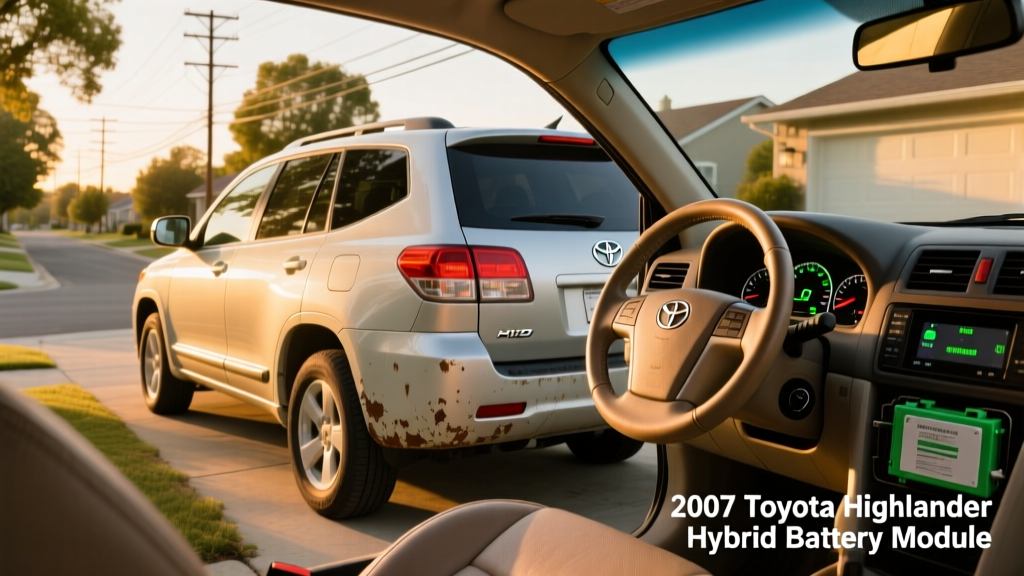
Nearly two decades after it rolled off the assembly line, the 2007 Toyota Highlander Hybrid remains one of the most recognizable early hybrid SUVs on American roads. With Toyota's Hybrid Synergy Drive system pairing a 3.3-liter V6 with electric motors, this three-row family hauler promised V6 power with near-four-cylinder fuel consumption. But what does 2007 Toyota Highlander Hybrid fuel economy actually look like in 2026, when the vehicle is approaching 20 years old and battery degradation is a real factor?
This guide covers the original EPA ratings, what you should expect from a well-maintained example today, hybrid battery health and replacement economics, and whether this legacy HEV still makes sense compared to modern hybrids, plug-in hybrids, and full EVs.
| Specification | 2007 Toyota Highlander Hybrid |
|---|---|
| Powertrain | 3.3L V6 + 2 electric motors (Hybrid Synergy Drive) |
| Combined Horsepower | 272 hp (net system output) |
| Transmission | eCVT (electronically controlled CVT) |
| Drivetrain | AWD (eAWD — rear motor drives rear wheels) |
| EPA City MPG | 31 MPG |
| EPA Highway MPG | 27 MPG |
| EPA Combined MPG | 29 MPG |
| Hybrid Battery | ~1.9 kWh NiMH (nickel-metal hydride), sealed |
| Curb Weight | ~4,500 lbs |
| Seating | Up to 7 passengers |
| Original MSRP (2007) | $33,735–$39,550 |
| 2026 Used Market Range | $3,500–$8,000 (private party) |
EPA Fuel Economy vs. Real-World MPG: What Owners Actually Report
The EPA rated the 2007 Highlander Hybrid at 31 city / 27 highway / 29 combined MPG. For context, the non-hybrid 2007 Highlander V6 AWD was rated at 18 city / 24 highway / 20 combined — meaning the hybrid delivered roughly a 45% improvement in combined fuel economy.
According to real-world data aggregated by FuelEconomy.gov, owners of the 2007 Highlander Hybrid report an average of approximately 25.7 MPG combined based on user-submitted fuel logs. This is a meaningful gap from the EPA sticker, and several factors explain it:
- Battery aging: The original NiMH pack loses capacity over time. A 15-to-20-year-old battery that hasn't been replaced will rely more heavily on the gas engine, reducing electric-assist frequency and regenerative braking effectiveness.
- Highway-heavy driving: Hybrids shine in stop-and-go city traffic where regen braking and electric-only low-speed operation maximize efficiency. Highway cruising at 70+ MPH largely bypasses the hybrid advantage.
- Cold-weather penalty: NiMH batteries lose efficiency in cold temperatures, and the engine must run more frequently to provide cabin heat and maintain battery temperature.
- Tire and maintenance variables: Under-inflated tires, old spark plugs, and dirty air filters compound efficiency losses on any vehicle, but especially on a hybrid where the margin of advantage is narrower.
| Driving Scenario | Expected MPG | Notes |
|---|---|---|
| EPA City (sticker) | 31 MPG | Original rating, new battery |
| EPA Highway (sticker) | 27 MPG | |
| EPA Combined (sticker) | 29 MPG | Original rating, new battery |
| Real-world city (healthy battery) | 27–30 MPG | Best-case scenario with fresh battery |
| Real-world highway (healthy battery) | 24–27 MPG | Hybrid advantage diminishes at speed |
| Real-world combined (aged battery) | 23–26 MPG | Typical for original, un-replaced battery |
| Cold-weather combined (below 32°F) | 20–23 MPG | Engine runs more for heat and battery warmup |
Key takeaway: If you're shopping for a 2007 Highlander Hybrid today, budget your fuel expectations around 24–27 MPG combined in moderate climates with a healthy battery. If the original battery is still in place, expect the lower end of that range or below.
Understanding the Hybrid Synergy Drive: HEV, Not PHEV
The 2007 Highlander Hybrid is a conventional hybrid electric vehicle (HEV) — it does not plug in, has no electric-only driving mode of meaningful distance, and generates all its electricity from the gasoline engine and regenerative braking. This is a critical distinction from plug-in hybrids (PHEVs) like the modern Toyota RAV4 Prime or Chrysler Pacifica Hybrid.
| Feature | HEV (2007 Highlander Hybrid) | PHEV (e.g., 2026 RAV4 Prime) |
|---|---|---|
| Plugs in to charge? | No | Yes (Level 1/Level 2) |
| Electric-only range | ~1 mile at low speed | 42 miles (EPA) |
| Battery size | ~1.9 kWh NiMH | 18.1 kWh lithium-ion |
| Regenerative braking | Yes | Yes |
| Gas engine | 3.3L V6 | 2.5L I4 |
| Federal tax credit | None (expired long ago) | Potentially up to $7,500 (§30D, subject to eligibility) |
| Home charging needed | No | Yes, for EV-range benefit |
The Highlander Hybrid's small NiMH battery exists solely to buffer energy from regenerative braking and provide torque assist to the V6 during acceleration. At very low speeds (parking lots, stop-and-go creep), the vehicle can move short distances on electric power alone — typically under 1 mile and below ~25 MPH — but this is incidental, not a designed EV mode.
Powertrain Deep Dive: 272 HP with Hybrid Efficiency
The 2007 Highlander Hybrid uses Toyota's second-generation Hybrid Synergy Drive system, which was remarkably sophisticated for its era:
- Gasoline engine: 3.3-liter 3MZ-FE V6 producing 208 hp and 212 lb-ft of torque. This is an Atkinson-cycle variant, optimized for efficiency over peak power.
- Front electric motor (MG2): 123 kW (165 hp) permanent-magnet motor integrated into the transaxle, providing primary electric drive and regenerative braking.
- Rear electric motor (MGR): 50 kW (67 hp) motor driving the rear axle, enabling electronic AWD without a mechanical driveshaft.
- Generator motor (MG1): Starts the engine, generates electricity, and controls the planetary gearset ratio.
- Net system output: 272 hp combined (not a simple sum — the motors and engine peak at different RPMs).
The eCVT transmission uses a planetary gearset rather than belts or cones, which is why Toyota hybrid transaxles are among the most durable in the industry — there are no traditional CVT belts to fail. The eAWD system engages the rear motor automatically when front-wheel slip is detected or during hard acceleration, providing confident traction without the weight and friction losses of a mechanical AWD system.
Hybrid Battery Health, Warranty, and Replacement Costs in 2026
For any 2007 Highlander Hybrid buyer, the hybrid battery is the single most important — and potentially expensive — component to evaluate.
Original Battery Warranty
Toyota originally warranted the hybrid battery for 8 years / 100,000 miles (10 years / 150,000 miles in CARB states including California, New York, Massachusetts, and others adopting California emissions standards). For a 2007 model, this warranty expired no later than 2017, meaning no factory coverage remains for any 2007 Highlander Hybrid in 2026.
Battery degradation reality: NiMH batteries in Toyota hybrids of this era typically lose 15–30% of their original capacity by years 12–15. Symptoms of a degraded pack include:
- Noticeably reduced fuel economy (dropping below 22–23 MPG combined)
- The engine running more frequently and at higher RPMs
- Rapid state-of-charge swings on the dashboard energy monitor
- The battery cooling fan running loudly and frequently
- Possible check-engine or hybrid system warning lights
Replacement options and costs (2026 estimates):
| Option | Cost Range | Notes |
|---|---|---|
| New OEM Toyota battery | $2,500–$3,800 (parts + labor) | Full new pack from Toyota dealer; best longevity |
| Refurbished/reconditioned pack | $1,200–$2,200 | Replaced individual cells; quality varies by vendor |
| Used/salvage pack | $600–$1,200 | From a wrecked or parted-out Highlander; gamble on remaining life |
| Aftermarket new pack | $1,800–$2,800 | Third-party manufacturers; check warranty terms |
Given that a well-maintained 2007 Highlander Hybrid trades for $3,500–$8,000 in 2026, a full OEM battery replacement can represent 30–80% of the vehicle's value. This is the central economic calculation for any prospective buyer: is the remaining useful life of the vehicle worth the investment? For a mechanically sound example with low miles and good maintenance records, many owners find the math works — especially compared to monthly payments on a new vehicle.
According to NHTSA records, the 2007 Highlander Hybrid has no major safety recalls specific to the hybrid battery system, which speaks to the robustness of Toyota's NiMH pack design.
Does the 2007 Highlander Hybrid Qualify for Any Tax Credit?
No. The 2007 Toyota Highlander Hybrid originally qualified for a federal hybrid tax credit under the Energy Policy Act of 2005 — but that credit was subject to a manufacturer phase-out cap. Once Toyota sold 60,000 qualifying hybrids, the credit began phasing down and was fully eliminated for Toyota vehicles purchased after September 30, 2007.
Even if the credit had remained available, it applied only to the original purchaser of a new qualifying vehicle. There is no federal tax credit available for purchasing a used conventional hybrid (HEV) in 2026.
For reference, the current IRS §30D Clean Vehicle Credit of up to $7,500 applies only to new qualifying battery electric vehicles (BEVs) and plug-in hybrids (PHEVs) that meet battery sourcing, critical mineral, MSRP cap, and buyer income requirements. Conventional hybrids like the 2007 Highlander Hybrid have never been eligible under §30D.
A used EV credit of up to $4,000 (§25E) exists for pre-owned BEVs and PHEVs under $25,000 purchased from a dealer — but again, this excludes conventional HEVs entirely.
2007 Highlander Hybrid vs. Modern Alternatives: What Should You Buy in 2026?
If you're considering a 2007 Highlander Hybrid, you're likely weighing it against other options in the $5,000–$15,000 range or wondering whether to stretch the budget for something newer. Here's how the decision framework breaks down:
2007 Highlander Hybrid — Pros
- Low purchase price ($3,500–$8,000 used)
- Proven, durable powertrain (eCVT, V6)
- AWD capability without traditional drivetrain losses
- Three-row seating (7 passengers)
- No charging infrastructure needed
- 24–27 MPG real-world is still respectable for an AWD 7-seater
2007 Highlander Hybrid — Cons
- Hybrid battery likely near end-of-life if not replaced
- No remaining factory warranty on any component
- Outdated infotainment, no modern safety tech (no AEB, lane-keep, etc.)
- NiMH battery less efficient than modern lithium-ion systems
- Higher maintenance costs as vehicle ages (suspension, brakes, electronics)
- No tax credits or incentives available
Choose the 2007 Highlander Hybrid if:
- You need a cheap AWD family hauler and can budget $2,000–$3,000 for a potential battery replacement
- You drive primarily in city/suburban traffic where hybrid efficiency shines
- You have no access to home or workplace charging (ruling out PHEVs and EVs)
- You plan to keep the vehicle 3–5 years and accept rising maintenance costs
Consider a modern hybrid (2022+ Toyota Highlander Hybrid) if:
- Your budget allows $30,000–$45,000 for a used or new example
- You want 35–36 MPG combined EPA with modern safety features (Toyota Safety Sense 2.5+)
- You want remaining factory warranty coverage
Consider a PHEV (e.g., 2026 RAV4 Prime, Hyundai Tucson PHEV) if:
- You have reliable Level 2 home charging
- Your daily commute is under 40 miles (covering most trips on electric power)
- You want to qualify for potential federal tax credits
- You want electric-only driving for zero tailpipe emissions on short trips
Consider a full EV (e.g., 2026 Hyundai Ioniq 5, Tesla Model Y) if:
- You have home Level 2 charging and your daily driving is under 250 miles
- You want the lowest per-mile fuel cost (electricity vs. gasoline)
- You want minimal drivetrain maintenance (no oil changes, no transmission fluid)
- You qualify for federal/state EV incentives
Frequently Asked Questions
How many MPG does the 2007 Toyota Highlander Hybrid get?
The EPA rated it at 31 city / 27 highway / 29 combined MPG when new. In 2026 real-world driving with an aging NiMH battery, expect approximately 23–27 MPG combined depending on battery health, driving style, and climate. City driving yields the best results; sustained highway speeds above 70 MPH reduce the hybrid advantage significantly.
Is the 2007 Highlander Hybrid a plug-in hybrid?
No. It is a conventional hybrid (HEV) that charges its small battery exclusively through regenerative braking and the gasoline engine. You never plug it in. It cannot drive meaningful distances on electric power alone.
How much does it cost to replace the hybrid battery?
A new OEM battery from Toyota costs approximately $2,500–$3,800 installed. Refurbished packs range from $1,200–$2,200, and used/salvage packs from $600–$1,200. Given the vehicle's 2026 market value of $3,500–$8,000, battery replacement is a significant percentage of the car's worth — factor this into your purchase decision.
Is the 2007 Highlander Hybrid reliable?
The 3MZ-FE V6 engine and Toyota's eCVT transaxle are among the most durable powertrain components ever produced. The primary reliability concern is the hybrid battery, which is now well beyond its designed service life if never replaced. Other age-related concerns include suspension bushings, brake actuator assemblies (unique to Toyota hybrids), and aging electronics. With a fresh battery and regular maintenance, these vehicles routinely exceed 200,000 miles.
Does the 2007 Highlander Hybrid qualify for any tax credit in 2026?
No. The original federal hybrid tax credit for Toyota vehicles phased out in 2007, and credits applied only to original new-vehicle purchasers. Current federal incentives (§30D and §25E) apply exclusively to battery electric vehicles and plug-in hybrids — conventional HEVs are not eligible.
What should I check before buying a used 2007 Highlander Hybrid?
Prioritize a hybrid battery health check (a Toyota dealer or hybrid specialist can pull state-of-charge data and internal resistance values). Also inspect the brake actuator assembly (expensive to replace at ~$1,500–$2,500), verify the inverter coolant pump is functioning (a known failure point), check for rust in the rear subframe, and confirm the vehicle has current maintenance records. A pre-purchase inspection by a hybrid-experienced mechanic is strongly recommended.
How does the 2007 Highlander Hybrid compare to the gas-only 2007 Highlander?
The gas-only 2007 Highlander V6 AWD was EPA-rated at 18 city / 24 highway / 20 combined MPG. The hybrid's 29 MPG combined represents a 45% improvement. The hybrid also produces more combined system horsepower (272 hp vs. 230 hp for the gas V6) while delivering substantially better fuel economy — a rare win-win. The trade-off is the eventual battery replacement cost and slightly higher complexity.
Final Assessment: A Proven Hybrid at a Crossroads
The 2007 Toyota Highlander Hybrid remains a capable, efficient AWD family SUV nearly 20 years after its debut. Its 272-hp hybrid powertrain was ahead of its time, and the EPA's 29 MPG combined rating still competes with many modern non-hybrid crossovers. In real-world 2026 driving, 24–27 MPG combined is achievable with a healthy battery — a meaningful fuel savings for a seven-passenger AWD vehicle.
However, the economics of buying one today hinge almost entirely on battery condition. If the hybrid battery has been recently replaced with a quality unit, a well-maintained 2007 Highlander Hybrid is arguably one of the best value-per-mile used vehicles you can buy. If the original battery is still in place, you're effectively purchasing a vehicle with a $2,000–$3,500 deferred maintenance item that will surface within months or a year.
For buyers with home charging access and a higher budget, a modern PHEV or BEV delivers dramatically lower operating costs, current safety technology, and available tax incentives. But for those who need a cheap, capable, no-plug-required AWD hauler — and who go in with eyes open about battery costs — the 2007 Highlander Hybrid's fuel economy proposition still holds up.