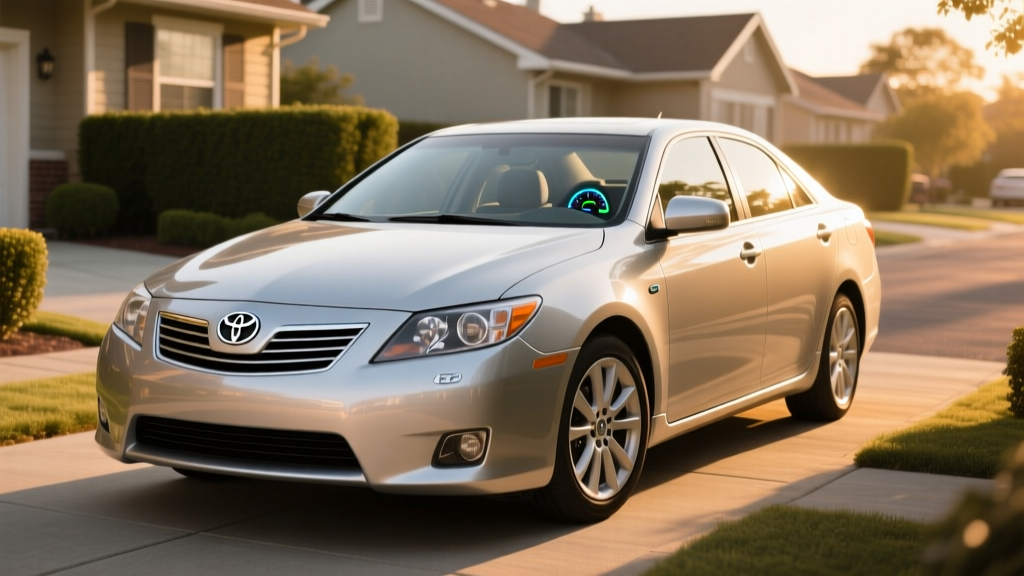
The 2007 Toyota Camry Hybrid was one of the first mainstream midsize sedans to pair a gasoline engine with an electric motor for efficiency rather than pure performance. Nearly two decades later, used examples still circulate on the secondary market, and buyers want to know: does the 07 Toyota Camry Hybrid MPG hold up in real-world driving, and is the hybrid battery still a safe bet? This guide breaks down the EPA numbers, real-world fuel economy, battery longevity, and whether this early hybrid still makes sense in 2026 compared to a modern hybrid, PHEV, or full EV.
2007 Toyota Camry Hybrid MPG: EPA Ratings and Real-World Results
The EPA rated the 2007 Toyota Camry Hybrid at 33 MPG city / 34 MPG highway / 34 MPG combined. For context, the 2007 gas-only Camry 4-cylinder was rated at 24 MPG combined — so the hybrid delivered roughly a 42% efficiency improvement in city-heavy driving.
| Metric | 2007 Camry Hybrid | 2007 Camry 4-Cyl (Gas) |
|---|---|---|
| City MPG | 33 | 21 |
| Highway MPG | 34 | 30 |
| Combined MPG | 34 | 24 |
| Fuel Tank (gal) | 17.2 | 18.5 |
| Approx. Total Range | ~585 mi | ~444 mi |
Source: fueleconomy.gov
Owner-reported data on Fuelly and Edmunds shows the 2007 Camry Hybrid averaging 30–36 MPG combined in everyday driving. Drivers who do mostly city commuting with frequent stops (where regenerative braking recovers energy) often see 35–38 MPG. Highway-only trips at 70+ MPH tend to drop to 28–31 MPG. Cold weather, aggressive acceleration, and an aging hybrid battery can push figures toward the low end of that range. Expect roughly 31–33 MPG as a realistic year-round average for a well-maintained example.
Powertrain Specs: How the 2007 Camry Hybrid Works
The 2007 Camry Hybrid uses Toyota's Hybrid Synergy Drive (HSD), a series-parallel system that seamlessly blends the gas engine and electric motor. It is a conventional hybrid (HEV) — not a plug-in. You never plug it in; the battery charges through regenerative braking and the gasoline engine.
| Spec | Value |
|---|---|
| Engine | 2.4L 4-cylinder (2AZ-FXE, Atkinson cycle) |
| Engine HP | 147 hp @ 6,000 rpm |
| Electric Motor HP | 40 hp (permanent magnet AC) |
| Net Combined HP | 192 hp |
| Transmission | eCVT (planetary gearset, no fixed gears) |
| Hybrid Battery | Nickel-Metal Hydride (NiMH), ~1.6 kWh gross |
| Drivetrain | Front-wheel drive |
| 0–60 MPH | ~7.3 seconds |
The Atkinson-cycle engine sacrifices low-RPM torque for higher thermal efficiency, while the electric motor fills in the torque gap at low speeds. This is why the Camry Hybrid feels responsive off the line despite the 4-cylinder engine — the electric motor provides instant torque from 0 RPM.
HEV vs. PHEV vs. EV: Which Powertrain Fits Your Driving?
The 2007 Camry Hybrid is a conventional HEV. If you're cross-shopping used vehicles, here's how the three electrified powertrain types compare:
| Factor | HEV (e.g., 2007 Camry Hybrid) | PHEV (e.g., newer Prius Prime) | BEV (e.g., Tesla Model 3) |
|---|---|---|---|
| Plug in to charge? | No | Yes (optional) | Yes (required) |
| Electric-only range | ~1 mile at low speed | 25–44 miles (modern) | 250–360 miles |
| Home charging needed? | No | Recommended | Essential |
| Fuel cost (per mile) | ~$0.10–0.13 | ~$0.04 (electric) / $0.10 (gas) | ~$0.03–0.05 |
| Maintenance complexity | Moderate (engine + hybrid system) | Higher (dual systems) | Lowest (no engine) |
| Upfront cost (used market) | $4,000–$8,000 | $18,000–$32,000 | $15,000–$35,000 |
Choose a modern PHEV if: You have home charging, a short commute (under 30 miles), and want electric-only daily driving with gas backup for road trips.
Choose a full EV if: You have reliable home Level 2 charging, want the lowest per-mile fuel cost, and your daily driving is under 250 miles.
Hybrid Battery Lifespan, Warranty, and Replacement Cost
The biggest concern for any used hybrid buyer is the traction battery. The 2007 Camry Hybrid uses a nickel-metal hydride (NiMH) pack — proven chemistry that degrades more gradually than early lithium-ion cells, but still loses capacity over time and heat cycles.
Toyota originally covered the hybrid battery for 8 years / 100,000 miles (10 years / 150,000 miles in California and states that adopted CARB emissions standards). For a 2007 model, this factory warranty expired years ago. Any battery coverage now depends on whether a previous owner purchased an extended warranty or had a replacement installed with its own warranty.
| Battery Scenario | Estimated Cost | Expected Lifespan |
|---|---|---|
| Original NiMH battery (still in car) | $0 (but test before buying) | 150,000–200,000+ mi typical |
| Refurbished/reconditioned battery | $1,000–$1,800 (installed) | 3–5 years / 60,000–80,000 mi |
| New OEM Toyota battery | $2,500–$4,000 (installed) | 10+ years / 150,000+ mi |
| Aftermarket new battery | $1,500–$2,500 (installed) | 5–8 years / 100,000+ mi |
Many 2007 Camry Hybrids are still running on their original batteries at 180,000+ miles. NiMH chemistry is tolerant of the shallow charge-discharge cycles that Toyota's hybrid system uses (the system keeps the battery between roughly 40% and 80% state of charge to prolong life). However, heat is the enemy: vehicles from hot climates (Arizona, Texas, Florida) tend to see earlier battery degradation than those from cooler regions.
Before buying, insist on a hybrid battery health check. A Toyota dealer or hybrid specialist can read the battery's internal resistance and block voltage deltas using a scan tool. Large voltage differences between modules signal impending failure. An independent hybrid shop typically charges $100–$150 for this diagnostic.
Tax Credits and Incentives: Does the 2007 Camry Hybrid Qualify?
The short answer: no federal tax credit applies to the 2007 Toyota Camry Hybrid in 2026. Here's why:
- Original §30D credit (expired for this model): When new, the 2007 Camry Hybrid qualified for a $2,600 federal tax credit under the original Energy Policy Act. However, Toyota hit the 250,000-unit credit phase-out cap in 2007, and the credit was reduced to $1,300 then eliminated entirely for subsequent buyers.
- Used EV credit (§25E): The Inflation Reduction Act created a used-EV credit of up to $4,000, but it applies only to plug-in electric vehicles (BEVs and PHEVs) with a minimum 4 kWh battery. The Camry Hybrid is a conventional HEV and does not qualify.
- State incentives: Some states offer registration discounts, HOV lane access, or emissions-test exemptions for hybrids. Check your state's DMV and energy office for current programs.
Source: IRS Clean Vehicle Credits
Reliability and Long-Term Ownership Costs
The 2007 Camry Hybrid benefits from Toyota's reputation for durability and the inherent simplicity of the eCVT transmission. Unlike conventional automatics, Toyota's planetary-gear eCVT has no clutch packs, bands, or torque converter to wear out. Failures are rare and usually tied to neglected coolant changes on the transaxle.
Key reliability data points:
- NHTSA recalls: The 2007 Camry Hybrid had relatively few recalls. Check the VIN at nhtsa.gov/recalls for any open campaigns.
- Common non-hybrid issues: Dashboard cracking (widespread on 2007–2009 Camrys), excessive oil consumption on the 2AZ-FE engine family (less common on the Atkinson-cycle FXE variant), and worn power steering fluid.
- Brake longevity: Regenerative braking handles most deceleration, so friction brake pads often last 80,000–100,000 miles — significantly longer than on gas-only cars.
- Insurance: Typically 5–10% lower than comparable gas Camrys due to lower accident severity data and the demographic of hybrid buyers.
| Annual Cost Category | Estimated Cost |
|---|---|
| Fuel (12,000 mi/yr, $3.40/gal) | ~$1,235 |
| Insurance (national avg.) | ~$1,100–$1,400 |
| Maintenance (oil, brakes, tires) | ~$400–$600 |
| Hybrid battery reserve | ~$200/yr (amortized) |
| Total annual operating | ~$2,935–$3,435 |
Pros and Cons of the 2007 Camry Hybrid in 2026
- Proven, simple hybrid system with 200,000+ mi potential
- No plug-in required — works for apartment dwellers
- 30–36 MPG real-world combined saves ~$500–$700/yr vs. gas Camry
- eCVT is nearly bulletproof with basic maintenance
- Low purchase price ($4,000–$8,000 used)
- Regenerative braking extends brake pad life significantly
- Hybrid battery is 17+ years old — replacement likely if original
- No electric-only driving beyond parking-lot speeds
- No federal or state EV tax credits available
- Dated safety tech (no auto emergency braking, lane keep, or blind-spot monitoring)
- Dashboard cracking is a known cosmetic defect
- Highway MPG barely exceeds the gas 4-cylinder
How the 2007 Camry Hybrid Compares to Modern Hybrids
If you're weighing a used 2007 Camry Hybrid against a newer option, here's how the efficiency gap has evolved:
| Model | EPA Combined MPG | Hybrid Type | Used Price Range (2026) |
|---|---|---|---|
| 2007 Toyota Camry Hybrid | 34 | HEV | $4,000–$8,000 |
| 2020 Toyota Camry Hybrid | 52 | HEV | $18,000–$25,000 |
| 2025 Toyota Prius | 57 | HEV | $28,000–$33,000 |
| 2025 Toyota Prius Prime | 52 MPG / 44 mi electric | PHEV | $33,000–$39,000 |
| 2025 Toyota Camry Hybrid | 51 | HEV | $29,000–$36,000 (new) |
The efficiency gain is substantial: a 2020+ Camry Hybrid delivers over 50% better combined MPG than the 2007 model, largely thanks to Toyota's fourth-generation hybrid system, a lighter lithium-ion battery, and improved aerodynamics. However, the used price gap is also enormous — $15,000+ separates a 2007 from a 2020. For a budget buyer who drives under 10,000 miles per year, the fuel savings of a newer hybrid may not justify the price premium.
Frequently Asked Questions
How many MPG does the 2007 Toyota Camry Hybrid actually get?
The EPA rates it at 33 city / 34 highway / 34 combined. In real-world driving, owners report 30–36 MPG combined, with city-heavy commutes pushing toward 36–38 MPG and sustained highway driving dropping to 28–31 MPG. A well-maintained example averages about 31–33 MPG year-round.
Does the 2007 Camry Hybrid need to be plugged in?
No. It is a conventional hybrid (HEV). The battery charges entirely through regenerative braking and the gasoline engine. There is no plug, no charging cable, and no electric-only range beyond very low-speed maneuvering.
How long does the hybrid battery last, and what does replacement cost?
Toyota's NiMH batteries in this generation commonly last 150,000–200,000+ miles with the factory charge-management strategy. If replacement is needed, expect $1,000–$1,800 for a refurbished unit or $2,500–$4,000 for a new OEM battery, installed. Always get a battery health diagnostic before purchasing a used example.
Does the 2007 Camry Hybrid qualify for any tax credit?
No. The original federal hybrid tax credit expired for Toyota in 2007 after the manufacturer hit the 250,000-vehicle cap. The current used clean-vehicle credit (§25E) applies only to plug-in vehicles (BEVs and PHEVs), not conventional hybrids. No federal incentive is available for this vehicle in 2026.
Is the 2007 Camry Hybrid reliable?
Yes, with caveats. The powertrain (engine + eCVT + hybrid system) is among the most durable Toyota has built. The main risk is the aging NiMH battery, which may need replacement if it's still the original unit. Other common issues include dashboard cracking and typical 17-year-old car wear items (suspension bushings, seals, hoses). A pre-purchase inspection by a hybrid-aware mechanic is strongly recommended.
Should I buy the 2007 Camry Hybrid or a newer hybrid?
If your budget is under $8,000 and you need reliable transportation with no plug-in requirement, the 2007 Camry Hybrid is a rational choice — budget $2,000–$3,000 for potential battery replacement and deferred maintenance. If you can stretch to $18,000+, a 2020 Camry Hybrid gives you 52 MPG, modern safety features (Toyota Safety Sense), and likely years of trouble-free driving with remaining factory warranty.