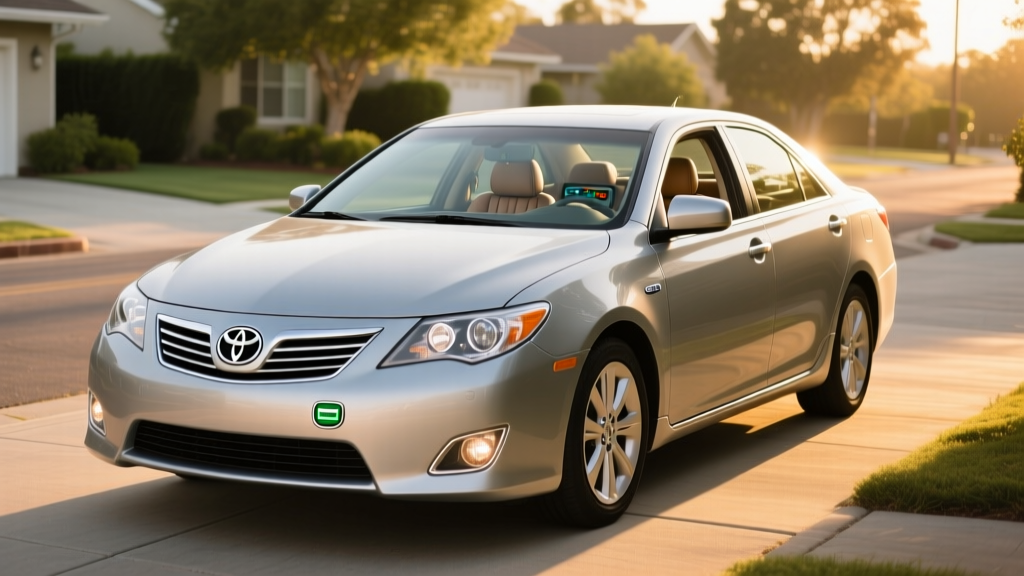
The 2007 Toyota Camry Hybrid was one of the first mainstream midsize sedans to pair a four-cylinder engine with an electric motor, arriving at a time when "hybrid" still meant a niche eco-statement. Nearly two decades later, used examples of this second-generation Camry Hybrid (XV40 chassis) still circulate on the used market at bargain prices. But with a 19-year-old high-voltage battery in the equation, buyers need hard data — not nostalgia — before signing the title.
This guide covers the 2007 Camry Hybrid's EPA fuel economy, real-world MPG performance, hybrid battery lifespan and replacement cost, powertrain specs, and whether it still makes financial sense versus a newer hybrid, plug-in hybrid, or full EV in 2026.
2007 Camry Hybrid Powertrain and Specs at a Glance
| Specification | Value |
|---|---|
| Powertrain type | Conventional Hybrid (HEV) — no plug-in capability |
| Gas engine | 2.4L inline-4 (2AZ-FXE), 147 hp @ 6,000 rpm |
| Electric motor | Permanent-magnet synchronous, 40 hp (30 kW) |
| Combined net horsepower | 192 hp |
| Transmission | eCVT (planetary gearset, not a belt-driven CVT) |
| Hybrid battery | Nickel-Metal Hydride (NiMH), ~1.6 kWh total / ~0.9 kWh usable |
| EPA city MPG | 33 MPG |
| EPA highway MPG | 34 MPG |
| EPA combined MPG | 34 MPG |
| 0–60 mph | ~7.6 seconds |
| Drivetrain | Front-wheel drive |
The 2007 Camry Hybrid uses Toyota's Hybrid Synergy Drive (THS-II), the same proven architecture found in the contemporaneous Prius but scaled for a larger sedan. The eCVT is a power-split device using two motor-generators and a planetary gearset — there are no belts, cones, or traditional gear shifts. This is fundamentally different from the belt-driven CVTs in some Nissan and Subaru models and is a key reason Toyota hybrids have earned their reliability reputation.
How Many MPG Does the 2007 Camry Hybrid Actually Get?
| Driving Scenario | EPA Sticker | Real-World Expectation |
|---|---|---|
| City | 33 MPG | 30–36 MPG |
| Highway (70 mph cruise) | 34 MPG | 29–33 MPG |
| Combined | 34 MPG | 28–34 MPG |
The EPA rated the 2007 Camry Hybrid at 33 city / 34 highway / 34 combined MPG (per fueleconomy.gov). Note that the 2008 EPA methodology revision adjusted testing procedures, so some databases show slightly different figures depending on whether original or revised calculations are used.
Real-world nuance: Like most Toyota hybrids, the Camry Hybrid tends to match or slightly exceed its EPA city rating in stop-and-go traffic, where regenerative braking recaptures energy and the engine shuts off at stops. Highway efficiency is where this hybrid loses ground — at sustained 70+ mph speeds, the electric motor contributes less and the 2.4L engine carries the load, often dropping to 29–31 MPG. Cold weather (below 40°F) can reduce combined MPG by 10–15% as the engine runs more frequently to maintain cabin heat and battery temperature.
With a 17.2-gallon fuel tank, expect a real-world range of roughly 480–570 miles per fill-up depending on driving mix. That remains competitive with many 2026 compact hybrids.
Conventional Hybrid (HEV) vs Plug-In Hybrid (PHEV): Where the 2007 Camry Fits
The 2007 Camry Hybrid is a conventional hybrid electric vehicle (HEV). It cannot be plugged in. Its small NiMH battery (~0.9 kWh usable) recharges exclusively through regenerative braking and the gas engine. Electric-only operation is limited to brief low-speed bursts (under ~25 mph, for roughly one mile or less) — this is not a vehicle with meaningful electric-only range.
HEV vs PHEV vs BEV — Which Fits You?
| Factor | HEV (like 2007 Camry Hybrid) | PHEV (e.g., 2026 RAV4 Prime) | BEV (e.g., 2026 Tesla Model 3) |
|---|---|---|---|
| Plug-in required? | No | Yes (Level 1 or 2) | Yes (Level 2 or DC fast) |
| Electric-only range | ~1 mile at low speed | 25–42 miles typical | 250–360 miles (full range) |
| Gas engine | Yes, primary power | Yes, backup/extended range | None |
| Federal tax credit (§30D) | Not eligible | Up to $7,500 (if sourcing/income rules met) | Up to $7,500 (if sourcing/income rules met) |
| Best for | No home charging access, budget buyers, high-mile commuters | Home chargers who want electric commuting + gas road trips | Home chargers ready to go fully electric |
The 2007 Camry Hybrid's advantage in 2026 is simplicity: no charging infrastructure needed, no plug-in tax-credit paperwork, and a proven powertrain with abundant used-market supply. Its disadvantage is that it cannot operate as an electric vehicle for any meaningful distance, meaning every mile still burns gasoline.
Hybrid Battery Lifespan, Reliability, and Replacement Cost
Battery Warranty and Longevity
Original warranty: Toyota covered the 2007 Camry Hybrid's high-voltage battery for 8 years / 100,000 miles (10 years / 150,000 miles in California Air Resources Board states). That factory coverage has expired on every 2007 model.
Real-world battery life: Toyota's NiMH hybrid batteries from this era frequently last 150,000–200,000+ miles before significant degradation. However, at 19 years old, age-related degradation is now the primary risk factor regardless of mileage. Heat exposure, prolonged storage at low state of charge, and deep cycling all accelerate NiMH cell deterioration.
Battery replacement costs (2026 estimates):
- Remanufactured NiMH pack (e.g., Green Bean Battery, Dorman): $1,200–$2,000 including core exchange and installation
- New OEM Toyota NiMH pack: $2,500–$3,800 installed at a dealership
- Individual module replacement (independent hybrid specialist): $400–$900 if only a few cells are weak
The 2007 Camry Hybrid uses 34 NiMH modules. Independent hybrid shops can test and replace only the degraded modules, a cost-effective option if the pack is mostly healthy. A full remanufactured pack is the most common choice for high-mileage examples and typically comes with a 1–3 year warranty.
Reliability beyond the battery: The 2AZ-FXE engine and eCVT transaxle are among Toyota's most durable components. Common non-hybrid issues on the XV40 Camry platform include worn strut mounts, power steering pump leaks (this generation uses electric power steering, so this is less common), and aging rubber suspension bushings. None are hybrid-specific. The NHTSA complaint database shows relatively few powertrain-related complaints for this model year.
Does the 2007 Camry Hybrid Qualify for Any Tax Credit?
No. The 2007 Toyota Camry Hybrid does not qualify for the current federal §30D Clean Vehicle Credit. That credit applies only to new plug-in electric vehicles (BEVs and PHEVs) meeting battery-sourcing, MSRP, and buyer income requirements (see IRS.gov §30D guidelines).
When new, the 2007 Camry Hybrid did qualify for a federal tax deduction (not a credit) of up to $2,600 under the Energy Policy Act of 2005 — but that incentive expired long ago and applied only to the original purchaser. There is no current federal incentive for purchasing a used conventional hybrid.
Some states offer minimal incentives for used hybrid purchases or registration fee reductions, but these vary widely. Check your state's DMV or energy office for current programs.
2007 Camry Hybrid Ownership Economics in 2026
At current used-market prices, a 2007 Camry Hybrid typically sells for $3,500–$6,500 depending on mileage, condition, and battery health. Here's how ownership costs stack up:
| Expense | Annual Estimate |
|---|---|
| Fuel (34 MPG combined, $3.40/gal avg) | ~$1,500 |
| Insurance (varies by state/driver) | $800–$1,400 |
| Maintenance (oil, tires, brakes — regen extends pad life) | $500–$900 |
| Battery reserve (amortized over ownership) | $300–$500 |
| Total estimated annual cost | $3,100–$4,300 |
For comparison, a 2026 Toyota Camry Hybrid LE (EPA 51 combined MPG) costs roughly $30,000 new and would use about $1,000/year in fuel — saving ~$500/year in gas but adding $3,500+/year in depreciation and higher insurance. The 2007 model wins on total cost if you accept the age-related maintenance risk and potential battery replacement.
Pros and Cons of the 2007 Camry Hybrid in 2026
Pros
- Proven, durable Hybrid Synergy Drive powertrain with massive service history
- Strong city MPG (33 EPA, often 34–36 real-world in traffic)
- No plug-in required — works anywhere gas is available
- Low purchase price ($3,500–$6,500 used)
- eCVT has no belt or friction material to wear — mechanically robust
- Regenerative braking extends brake pad life significantly
Cons
- High-voltage battery is 19 years old — replacement likely needed if not already done
- Highway MPG drops to 29–31 at sustained 70+ mph
- No electric-only driving range (unlike modern PHEVs)
- No federal tax credit or incentive eligibility
- Dated safety tech — no standard AEB, lane-keep, or blind-spot monitoring
- NiMH battery is heavier and less energy-dense than modern lithium-ion packs
Who Should Buy the 2007 Camry Hybrid — and Who Shouldn't
Decision Framework
Choose the 2007 Camry Hybrid if:
- You need a cheap, reliable commuter that doesn't require home charging infrastructure
- Your commute is mostly city/suburban stop-and-go (where hybrid efficiency shines)
- You're comfortable budgeting $1,500–$2,500 for a potential battery replacement
- You want to minimize upfront cost and are willing to accept older safety technology
Look elsewhere if:
- You primarily drive highway miles (a modern diesel or efficient gas sedan may match its highway MPG)
- You want electric-only commuting — consider a used PHEV like a 2017+ Prius Prime or a 2019+ RAV4 Prime
- You need current safety features (AEB, lane-centering) — look at a 2018+ Camry Hybrid with Toyota Safety Sense
- You qualify for the §30D tax credit — a new PHEV or BEV may cost only marginally more after incentives and offer far lower running costs
Frequently Asked Questions
How many MPG does the 2007 Toyota Camry Hybrid get?
The EPA rated it at 33 city / 34 highway / 34 combined MPG. In real-world driving, owners typically see 30–36 MPG in city traffic and 29–33 MPG on the highway, for a combined average of roughly 28–34 MPG depending on conditions and driving style.
How far can the 2007 Camry Hybrid go on electric only?
Essentially zero meaningful distance. As a conventional HEV, it can creep at very low speeds (under ~25 mph) on electric power for roughly one mile or less before the gas engine restarts. It has no plug and no substantial electric-only range — this is fundamentally different from a plug-in hybrid (PHEV).
Is the 2007 Camry Hybrid reliable, and what does a battery replacement cost?
The powertrain (2AZ-FXE engine + eCVT) is among Toyota's most reliable. The main risk is the 19-year-old NiMH hybrid battery. A remanufactured replacement pack costs $1,200–$2,000; a new OEM pack runs $2,500–$3,800 installed. Many examples have already had battery replacements — always ask for documentation.
Does the 2007 Camry Hybrid qualify for any tax credit?
No. The federal §30D Clean Vehicle Credit applies only to qualifying new plug-in vehicles (BEVs and PHEVs). Conventional hybrids like the 2007 Camry Hybrid are not eligible for any current federal tax credit. The original $2,600 federal deduction available to first owners expired over a decade ago.
Should I buy a 2007 Camry Hybrid or a newer used hybrid?
If your budget is under $7,000 and you accept the battery-replacement risk, the 2007 model offers strong value. If you can spend $12,000–$18,000, a 2015–2018 Camry Hybrid (XV50) delivers 40+ combined MPG, Toyota Safety Sense, and a younger battery. For electric commuting capability, a used Prius Prime PHEV adds 25 miles of electric range.
How do I check the hybrid battery health before buying?
Ask a Toyota dealer or hybrid specialist to perform a battery health check using Toyota's Techstream diagnostic tool, which reports individual module voltages and internal resistance. Alternatively, an OBD-II reader with hybrid-specific apps (like Dr. Prius or Hybrid Assistant) can display battery state of health (SoH) data. Look for module voltage variance under 0.3V — wider spreads indicate weak cells nearing failure.