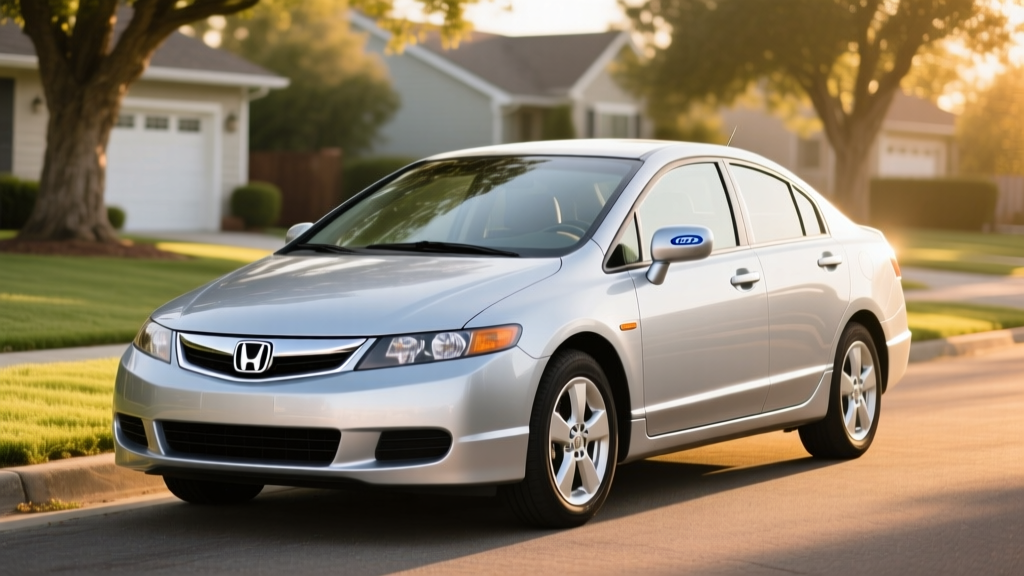
The 2007 Honda Civic Hybrid was one of the first mainstream sedans to prove that hybrid technology could deliver meaningful fuel savings without sacrificing everyday drivability. Nearly two decades later, it remains a fixture on the used-car market — often priced between $3,000 and $6,000 — and buyers still search for the real story behind its fuel economy. Below, we break down the 2007 Honda Civic Hybrid sedan's MPG ratings, real-world efficiency, Integrated Motor Assist (IMA) battery longevity, and whether this early hybrid still makes financial sense in 2026.
EPA Fuel Economy Ratings: What the Sticker Says
The 2007 Honda Civic Hybrid sedan carries the following official EPA fuel economy ratings, as published on fueleconomy.gov:
| Metric | Value |
|---|---|
| City MPG | 49 MPG |
| Highway MPG | 51 MPG |
| Combined MPG | 50 MPG |
| Annual Fuel Cost (est.) | ~$900 (15,000 mi/yr at $3.00/gal) |
| Fuel Type | Regular Unleaded (87 octane) |
These numbers were class-leading in 2007, rivaling the Toyota Prius. The Civic Hybrid achieved them through Honda's IMA system, which pairs a 1.3-liter i-DSI four-cylinder engine with a thin electric motor sandwiched between the engine and the continuously variable transmission (CVT).
Real-World MPG vs. EPA Estimates
One of the most important things to understand about the 2007 Civic Hybrid is that its real-world fuel economy often falls short of EPA stickers — a known issue that led to a class-action lawsuit against Honda in the late 2000s. Many owners reported achieving 35–42 MPG in mixed driving rather than the advertised 50 MPG combined.
EPA Combined: 50 MPG | Real-World Owner Reports: 35–44 MPG mixed driving
Factors that reduce efficiency: aggressive acceleration, sustained highway speeds above 70 mph, hot weather (A/C compressor load), and aged IMA battery reducing electric assist. City driving with gentle braking tends to return the best results — often 42–47 MPG — because regenerative braking recaptures energy and the IMA system assists most at low speeds.
By 2026, most surviving 2007 Civic Hybrids have accumulated 150,000+ miles, and age-related factors further impact efficiency:
- Degraded IMA battery: Reduced capacity means less electric assist, forcing the gas engine to work harder
- CVT fluid aging: Old transmission fluid increases parasitic drag; Honda recommends replacement every 30,000 miles
- Spark plug wear: The i-DSI engine uses 8 spark plugs (two per cylinder); many owners neglect the rear four, reducing combustion efficiency
- Tire rolling resistance: Replacement tires rarely match the low-rolling-resistance OEM rubber
Powertrain Specifications: The IMA System Explained
The 2007 Civic Hybrid uses Honda's Integrated Motor Assist (IMA) — a mild hybrid architecture fundamentally different from the full-parallel hybrid system in the Toyota Prius. Here is the complete powertrain breakdown:
| Component | Specification |
|---|---|
| Gas Engine | 1.3L i-DSI inline-4 (8-valve, SOHC) |
| Engine Power | 93 hp @ 6,000 rpm |
| Engine Torque | 89 lb-ft @ 4,600 rpm |
| Electric Motor | 15 kW (20 hp) permanent-magnet, integrated in flywheel |
| Combined System Output | 110 hp @ 6,000 rpm / 123 lb-ft @ 1,000–2,500 rpm |
| Transmission | Continuously Variable Transmission (CVT) |
| IMA Battery | Nickel-Metal Hydride (NiMH), ~0.35 kWh (nominal) |
| Drivetrain | Front-Wheel Drive |
| 0–60 mph | ~11.5 seconds |
The IMA system cannot propel the car on electric power alone. Unlike a full hybrid (such as the Prius) or a plug-in hybrid (PHEV), the electric motor only assists the gas engine during acceleration and captures energy during braking. The vehicle always requires the gasoline engine to be running for propulsion. This is a key distinction: the 2007 Civic Hybrid is a conventional hybrid (HEV), not a PHEV — it has no plug, no electric-only driving mode, and no external charging capability.
| Feature | 2007 Civic Hybrid (HEV) | Modern PHEV (e.g., 2026 Toyota Prius Prime) |
|---|---|---|
| Plug-in Charging | No — never plugs in | Yes — Level 1/Level 2 AC charging |
| Electric-Only Range | 0 miles (motor only assists engine) | ~40–45 miles on battery alone |
| Battery Size | ~0.35 kWh NiMH | ~13.6 kWh lithium-ion |
| Regenerative Braking | Yes | Yes |
| Federal Tax Credit (new) | None (expired) | Up to $3,750 (§30D, subject to sourcing rules) |
| Fuel Required | Always uses gasoline | Gasoline + electricity |
IMA Battery Life, Degradation, and Replacement Cost
The IMA battery is the single biggest ownership concern for any 2007 Civic Hybrid buyer in 2026. This NiMH pack is now 18–19 years old, and even well-maintained examples show significant capacity loss.
Honda warranted the IMA battery for 8 years / 80,000 miles in most states, and 10 years / 150,000 miles in California Air Resources Board (CARB) states (CA, CT, MA, ME, NY, NJ, OR, RI, VT, WA). This warranty has long since expired for all 2007 models.
Signs of IMA battery degradation include:
- IMA warning light on the dashboard
- Noticeable drop in fuel economy (often 5–10 MPG below historical average)
- Reduced electric assist during acceleration (car feels sluggish)
- State of Charge (SoC) gauge fluctuating wildly or stuck at low bars
- Recalibration events (SoC drops to zero, then recharges — the car's BMS attempting to recalibrate)
Replacement options and costs in 2026:
| Option | Cost Range | Notes |
|---|---|---|
| New OEM IMA Battery (Honda) | $2,000–$3,500 (if still available) | Increasingly discontinued for 2007 models; check dealer parts departments |
| Remanufactured IMA Battery | $1,000–$1,800 | Most common option; suppliers include BumbleBee Batteries and Dorman; typically 1–3 year warranty |
| Used IMA Battery (junkyard) | $300–$600 | Highest risk — unknown remaining capacity; may last 6 months or 3 years |
| IMA Bypass / Grid Charger | $150–$400 (grid charger) | Grid charging can extend battery life and recalibrate cells; not a fix for dead cells |
A remanufactured battery installation typically costs $1,400–$2,200 total (parts plus 1–2 hours of labor). Given that a 2007 Civic Hybrid in good condition is worth $3,500–$6,000 in 2026, a battery replacement represents a significant percentage of the vehicle's value — a critical factor in the buy/don't-buy decision.
Is the 2007 Civic Hybrid Reliable in 2026?
Beyond the IMA battery, the 2007 Civic Hybrid's mechanical reliability is generally strong, with several caveats specific to this generation:
Known strengths:
- The 1.3L i-DSI engine is under-stressed and routinely exceeds 200,000 miles with basic maintenance
- Front suspension, brakes, and steering components are conventional Civic parts — cheap and widely available
- The CVT, when serviced with fresh Honda HMMF (Honda Multi-Matic Fluid) every 30,000 miles, is durable
Known weak points:
- CVT failure risk: If fluid was neglected, the CVT can develop shudder or fail entirely ($2,500–$4,000 replacement)
- Motor mount wear: The engine/transmission motor mounts degrade with age and mileage, causing vibration
- A/C compressor: The electric-assist A/C compressor is unique to the hybrid and more expensive to replace than the conventional Civic's unit
- 12V battery drain: If the car sits for extended periods, the 12V auxiliary battery can die, which also prevents the IMA system from starting
- Rust: In salt-belt states, subframe and rocker panel corrosion is the most common reason these cars are scrapped
Safety ratings for the 2007 Civic sedan (including the Hybrid trim) were strong for its era. The NHTSA awarded it 5 stars for frontal crash protection for both driver and passenger. The IIHS gave it a "Good" rating in the moderate overlap front test.
Tax Credits and Incentives: What Applies in 2026?
When new, the 2007 Honda Civic Hybrid qualified for a federal Alternative Motor Vehicle Credit of up to $2,100. That credit has long since expired and is irrelevant for used-car buyers today.
Current tax credit landscape for this vehicle in 2026:
- Federal Used EV Credit (§25E): Does NOT apply — the 2007 Civic Hybrid is a conventional HEV, not a plug-in electric vehicle. The §25E credit (up to $4,000) applies only to used BEVs and PHEVs with a sale price under $25,000.
- Federal New Clean Vehicle Credit (§30D): Not applicable to used purchases.
- State/Local Incentives: A small number of states offer emissions-based rebates or HOV lane access for hybrids, but most programs have shifted to prioritize zero-emission vehicles (BEVs). Check your state's energy or environmental agency for current programs.
- Insurance Discounts: Some insurers (e.g., GEICO, Liberty Mutual) have historically offered small hybrid-vehicle discounts (5–10%), though these are less common in 2026 as hybrid adoption has normalized.
Bottom line: there is no federal tax credit available for purchasing a 2007 Honda Civic Hybrid in 2026. The purchase decision rests entirely on the vehicle's fuel savings and low entry price.
2007 Civic Hybrid vs. Alternatives: Which Should You Choose?
For buyers considering a fuel-efficient vehicle in the $3,000–$8,000 range in 2026, here is how the Civic Hybrid stacks up against its most common alternatives:
- Your budget is under $5,000 and you want maximum MPG per dollar
- You drive primarily in city traffic where regenerative braking maximizes efficiency
- You want a conventional sedan trunk (10.4 cu ft) rather than a hatchback
- You're comfortable budgeting $1,000–$2,000 for a potential IMA battery replacement
- You don't have access to home charging and a PHEV/BEV isn't practical
- You want a proven full-hybrid system with electric-only low-speed driving
- You need hatchback cargo space (the Prius offers ~14 cu ft)
- You prioritize real-world MPG consistency — Prius owners typically see 42–48 MPG with less variance
- You have Level 1 or Level 2 home charging and a commute under 25 miles
- You want electric-only driving for daily errands with gas backup for road trips
- Your budget allows $12,000–$18,000
- You have reliable home charging
- Your daily driving is under 100 miles
- You want zero tailpipe emissions and minimal maintenance
- Your budget allows $8,000–$15,000 (and potentially the §25E used-EV credit of up to $4,000)
- Low purchase price ($3,000–$6,000 in 2026)
- Strong city fuel economy when IMA battery is healthy
- Comfortable ride, good visibility, intuitive controls
- Widely available parts (shared with 8th-gen Civic platform)
- No plug-in charging required — operates like a normal gas car
- Real-world MPG often 10–15 MPG below EPA sticker
- IMA battery replacement cost can exceed 30% of vehicle value
- Sluggish acceleration (11.5 sec 0–60) — merging onto highways requires planning
- CVT reliability depends heavily on prior maintenance history
- No modern safety tech (no AEB, no lane-keep, no backup camera standard)
- No federal tax credit or incentive available in 2026
Maintenance Checklist for 2007 Civic Hybrid Buyers
If you're evaluating a 2007 Civic Hybrid in 2026, request maintenance records and verify the following before purchase:
- IMA battery health: Ask for a recent IMA State of Charge readout (a Honda dealer or an OBD-II scanner with Honda-specific software can pull this). Look for SoC above 60% and no recent recalibration events.
- CVT fluid change history: Confirm at least 2–3 fluid changes using Honda HMMF fluid. Brown or burnt-smelling fluid is a red flag.
- Spark plug replacement: All 8 plugs should have been replaced at 110,000 miles. Many shops only change the 4 easily accessible front plugs.
- Timing chain: The 1.3L uses a timing chain (not a belt), so no scheduled replacement is needed — but listen for rattling on cold start, which indicates chain stretch.
- Brake system: Regenerative braking reduces wear on the friction brakes, but the rear drum brakes (if equipped) can corrode from underuse. Inspect for seized wheel cylinders.
- Rust inspection: Check rear subframe mounts, rocker panels, and front fender arches — especially in Rust Belt states.
Frequently Asked Questions
How many MPG does the 2007 Honda Civic Hybrid actually get?
The EPA rates it at 49 city / 51 highway / 50 combined MPG. However, real-world owner reports average 35–44 MPG in mixed driving. City driving with gentle inputs tends to return the best results (42–47 MPG), while sustained highway driving above 70 mph and aggressive acceleration reduce economy to 32–38 MPG. A degraded IMA battery will push fuel economy toward the lower end of this range.
Does the 2007 Civic Hybrid need to be plugged in?
No. The 2007 Civic Hybrid is a conventional hybrid (HEV), not a plug-in hybrid (PHEV). It charges its small NiMH battery exclusively through regenerative braking and engine-driven generation. There is no plug, no charging port, and no electric-only driving mode. You fuel it exactly like a standard gasoline car.
How much does it cost to replace the IMA battery?
In 2026, a remanufactured IMA battery (the most common option) costs $1,000–$1,800 for the part, with installation labor adding $200–$400. Total cost typically lands at $1,400–$2,200. New OEM batteries from Honda are increasingly unavailable for this model year. Used batteries from salvage yards cost $300–$600 but carry significant risk of early failure.
Is the 2007 Civic Hybrid reliable enough for daily driving?
Yes, with conditions. The 1.3L engine and manual-like CVT are durable when maintained, and the car shares most wear parts with the high-volume 8th-generation Civic. The main reliability risk is the aging IMA battery and potential CVT issues from neglected fluid changes. Budget $1,500–$2,500 in the first year for deferred maintenance (IMA battery, CVT fluid, spark plugs, brake inspection) and the car can serve reliably as a daily commuter.
Does the 2007 Honda Civic Hybrid qualify for any tax credit?
No. The original federal hybrid tax credit (up to $2,100) expired years ago and applied only to original purchasers. In 2026, neither the §30D New Clean Vehicle Credit nor the §25E Used EV Credit applies to conventional hybrids — both programs require plug-in capability (BEV or PHEV). Some states may offer minor incentives; check your state energy office for current programs.
How does the 2007 Civic Hybrid compare to a 2026 hybrid?
Modern hybrids like the 2026 Toyota Prius (57 MPG combined EPA) or 2026 Honda Civic Hybrid (49 MPG combined EPA) use more advanced lithium-ion batteries, more powerful electric motors, and sophisticated thermal management. They deliver EPA-rated MPG figures that are far closer to real-world results, come with 8-year/100,000-mile hybrid battery warranties, and include modern safety features like automatic emergency braking and lane-keeping assist. The trade-off is price: a 2026 hybrid starts around $28,000–$32,000, versus $3,000–$6,000 for a 2007 model.
Can the 2007 Civic Hybrid run on electric power alone?
No. Honda's IMA system in this generation is a mild hybrid — the 15 kW electric motor assists the gasoline engine but cannot independently drive the wheels. The gas engine must be running for the car to move. This is fundamentally different from full hybrids (like the Prius) that can creep on electric power at low speeds, and from PHEVs that offer 25–50 miles of electric-only range.