The Original Hybrid SUV: Why the 2007 Escape Hybrid Still Matters
Long before the RAV4 Prime and Tucson PHEV dominated sales charts, the Ford Escape Hybrid was pioneering electrified SUV ownership. Launched for the 2005 model year and refreshed through 2007, it was the world's first hybrid SUV — pairing a 2.3-liter Atkinson-cycle four-cylinder with an electric motor and a nickel-metal hydride (NiMH) battery pack. Nearly two decades later, used examples still circulate on the secondary market, and buyers searching for a 2007 Ford Escape Hybrid SUV want to know one thing above all: is it still a reliable, economical daily driver, or a maintenance liability?
This guide breaks down the exact specs, real-world fuel economy, battery longevity data, and ownership costs you need to evaluate a 2007 Escape Hybrid in 2026 — with honest numbers, not nostalgia.
HEV vs PHEV vs EV: Where the Escape Hybrid Fits
The 2007 Ford Escape Hybrid is a conventional hybrid electric vehicle (HEV), not a plug-in hybrid (PHEV). This distinction is critical for used buyers who may confuse the two:
| Feature | HEV (2007 Escape Hybrid) | PHEV (e.g., RAV4 Prime) | BEV (e.g., Mustang Mach-E) |
|---|---|---|---|
| Plug-in charging required? | No — self-charging via regen & engine | Yes — plug in for electric-only miles | Yes — sole propulsion source |
| Electric-only range | ~0.5 mi at very low speed | 35–42 mi typical | 230–320 mi EPA |
| Battery size | 1.3 kWh (NiMH) | 14.9–18.1 kWh (Li-ion) | 70–91 kWh (Li-ion) |
| Gas engine | Yes — primary propulsion | Yes — backup & highway | None |
| Fuel/energy source | Gasoline only | Gasoline + grid electricity | Grid electricity only |
The Escape Hybrid never needs to be plugged in. Its battery recharges through regenerative braking and the gasoline engine. If you need electric-only commuting range, you'll want a modern PHEV or BEV instead. But if your goal is simply better fuel economy without changing your refueling habits, a well-maintained HEV like this one can still deliver.
Fuel Economy: EPA Ratings and Real-World MPG
The 2007 Ford Escape Hybrid was rated by the EPA at:
| Drivetrain | City MPG | Highway MPG | Combined MPG |
|---|---|---|---|
| FWD (Front-Wheel Drive) | 34 | 30 | 32 |
| AWD (All-Wheel Drive, eCVT) | 29 | 27 | 28 |
Source: EPA Fuel Economy Guide
Hybrid fuel economy behaves opposite to gas cars: city MPG is typically higher than highway because regenerative braking recaptures energy in stop-and-go traffic, and the engine shuts off at idle. FWD Escape Hybrid owners on Fuelly and Edmunds forums report 28–33 MPG combined in mixed driving, with city-heavy commuters occasionally seeing 35+ MPG. Highway-only driving at 75 MPH drops economy to 26–28 MPG. The AWD variant sacrifices roughly 3–4 MPG across the board due to the added weight and mechanical drag of the rear electric drive unit.
For context, the non-hybrid 2007 Escape with the 2.3L I-4 and 4-speed automatic was rated at 20 city / 24 highway / 22 combined. The hybrid delivers a ~45% improvement in combined fuel economy — a gap that remains meaningful even by 2026 standards.
Powertrain Specs: What's Under the Hood
| Specification | 2007 Ford Escape Hybrid |
|---|---|
| Engine | 2.3L Atkinson-cycle I-4 |
| Engine output | 133 HP @ 6,000 RPM / 124 lb-ft @ 4,250 RPM |
| Electric motor | Permanent-magnet AC synchronous (integrated into transaxle) |
| Motor output | 94 HP / 147 lb-ft |
| Combined system output | 155 HP (net) |
| Transmission | Electronically controlled CVT (eCVT — planetary gearset, not belt-driven) |
| Battery type | Nickel-Metal Hydride (NiMH) |
| Battery capacity | 1.3 kWh (gross) / ~0.9 kWh usable |
| Battery location | Under the cargo floor (rear) |
| 0–60 MPH | ~10.8 seconds (FWD) |
| Curb weight | ~3,780 lbs (FWD) / ~3,930 lbs (AWD) |
| Towing capacity | 1,000 lbs (not rated for heavy towing) |
The eCVT in the Escape Hybrid is a Toyota-licensed planetary gearset design — the same fundamental architecture used in the Prius of that era. Ford and Toyota cross-licensed hybrid patents in the early 2000s, which is why this powertrain shares DNA with Toyota's Hybrid Synergy Drive. The result is a smooth, gearless driving experience with no belt-driven CVT drone or rubber-band feel. Acceleration is adequate for city merging but leisurely by modern standards; the 155 combined HP is moving nearly 3,800 pounds.
Battery Longevity, Warranty, and Replacement Costs
The single biggest concern for any used hybrid buyer is the traction battery. Here's what the data shows for the 2007 Escape Hybrid:
Ford covered the hybrid battery for 8 years / 100,000 miles (10 years / 150,000 miles in California and states that adopted CARB emissions standards). All original factory warranties expired by 2017 at the latest.
Battery degradation reality: NiMH batteries degrade more gracefully than early lithium-ion packs. Rather than sudden capacity cliff failure, they lose capacity gradually — typically 20–30% over 150,000 miles. Many Escape Hybrids have been documented running past 200,000 miles on the original battery, though with reduced electric-assist contribution and slightly lower MPG.
Replacement cost in 2026:
- OEM new battery (Ford dealer): $3,000–$4,200 installed — though new OEM stock is increasingly scarce for this model year
- Remanufactured battery: $1,500–$2,500 installed from hybrid specialists like GreenTech Automotive or local hybrid repair shops
- Used/salvage battery: $500–$1,000 (risky — unknown remaining life, no warranty)
- Individual module replacement: Some hybrid specialists can replace only the failed modules within the pack for $800–$1,500, extending pack life at lower cost
Failure warning signs: Watch for a dashboard "Check Hybrid System" warning, a noticeable drop in fuel economy (below 25 MPG combined), the engine running constantly without shutting off at stops, or reduced regenerative braking feel. A pre-purchase hybrid battery health scan (via OBD-II with a tool like ScanGauge or a dealer diagnostic) can reveal State of Health (SoH) percentage before you buy.
2026 Ownership Economics: Is It Worth It?
Let's run the numbers for a 2007 Escape Hybrid at today's used prices and fuel costs:
| Cost Factor | 2007 Escape Hybrid (HEV) | 2007 Escape Gas (2.3L I-4) | 2026 EV (e.g., Equinox EV) |
|---|---|---|---|
| Used purchase price (2026) | $3,500–$6,500 | $2,800–$5,000 | $28,000–$35,000 (new) |
| Annual fuel (12,000 mi/yr) | ~$1,240 (32 MPG, $3.30/gal) | ~$1,800 (22 MPG, $3.30/gal) | ~$540 ($0.15/kWh, 3 mi/kWh) |
| Annual insurance (est.) | $900–$1,200 | $850–$1,100 | $1,300–$1,800 |
| Annual maintenance (est.) | $600–$1,000 | $500–$800 | $300–$500 |
| Battery replacement risk | $1,500–$4,200 one-time | None | Covered 8yr/100k mi (new) |
The hybrid saves roughly $560/year in fuel over the gas-only Escape at current prices. Over five years of ownership, that's $2,800 in fuel savings — enough to offset the typical price premium of a hybrid over its gas counterpart on the used market, but not enough to absorb a battery replacement if one is needed. The math works best if the battery has already been replaced or tests healthy at purchase.
Tax Credits and Incentives: What Applies in 2026?
Here's the straightforward answer: the 2007 Ford Escape Hybrid does not qualify for any federal EV or PHEV tax credit.
- The federal §30D Clean Vehicle Credit applies only to new plug-in vehicles (BEVs and PHEVs) meeting current battery-sourcing and critical-minerals requirements. The Escape Hybrid is a conventional HEV and was never eligible even when new.
- The federal Used EV Credit (§25E, up to $4,000) applies only to used BEVs and PHEVs priced under $25,000 — not conventional hybrids.
- Some states offered hybrid rebates when the Escape Hybrid was new (e.g., California's Clean Air Rebate of $1,500–$2,000 in the mid-2000s), but all of those programs have long since closed.
For current incentive rules on plug-in vehicles, consult the IRS Clean Vehicle Credits page. If you want tax-credit eligibility, you'll need to look at a newer PHEV or BEV.
Reliability, Safety, and Known Issues
Overall reliability: The 2007 Escape Hybrid earns above-average reliability marks for its era. The eCVT planetary gearset is virtually bulletproof — there are no clutch packs, belts, or bands to wear out. The gasoline 2.3L Duratec engine is a well-proven Ford design with a timing chain (not a belt), reducing maintenance. The most commonly reported issues on NHTSA and owner forums include:
- Hybrid battery cooling fan: The fan that cools the rear-mounted NiMH pack can fail or clog with dust/debris, leading to battery overheating and reduced life. Inspect and clean the vent near the rear cargo area.
- Brake actuator: The electrohydraulic brake system (which blends regenerative and friction braking) has a more complex actuator than a standard car. Replacement runs $800–$1,500 if it fails — a known cost on high-mileage examples.
- 12V auxiliary battery: Like all hybrids, the Escape has a standard 12V battery that powers electronics. If it dies, the car won't start even if the hybrid battery is full. Replace every 4–5 years.
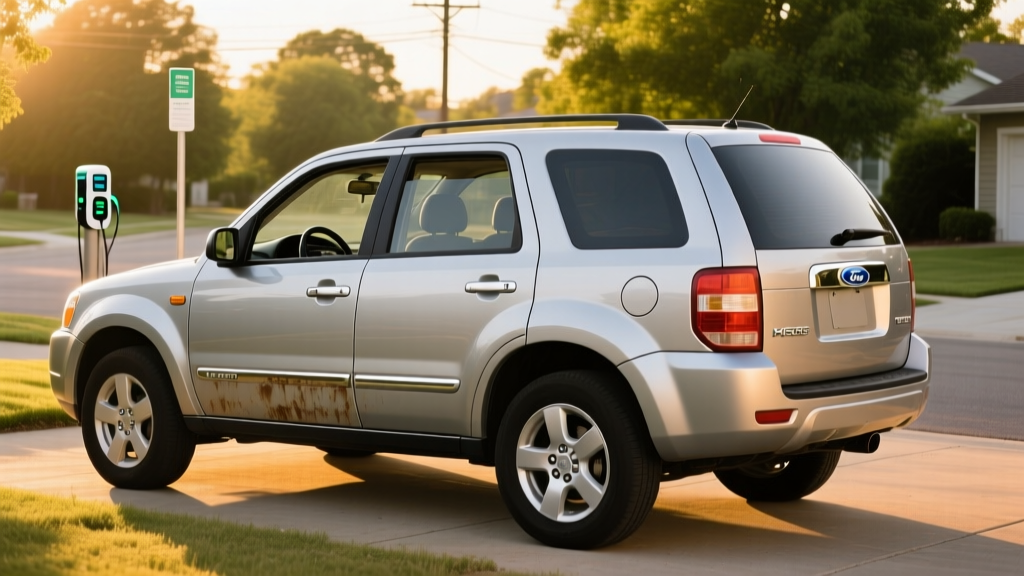
- Rust: The 2007 Escape is prone to rear subframe and rocker panel corrosion, especially in salt-belt states. Inspect underneath before buying.
Safety: The 2007 Escape received a 4-star driver / 5-star passenger frontal rating and 5 stars for side impact (with side airbags) from NHTSA. Standard equipment included front airbags; side curtain airbags were optional. By 2026 standards, it lacks modern ADAS features — no automatic emergency braking, lane-keeping assist, or blind-spot monitoring.
Who Should Buy the 2007 Escape Hybrid — And Who Shouldn't
✓ Pros
- 32 MPG combined (FWD) — still competitive with modern non-hybrid crossovers
- No plug-in charging needed — works with existing gas infrastructure
- eCVT is extremely durable (no belt/chain to fail)
- Low purchase price on used market ($3,500–$6,500)
- Practical cargo space and SUV ride height
- Proven Toyota-licensed hybrid system architecture
✗ Cons
- NiMH battery nearing end-of-life if original (18+ years old)
- No federal or state tax credit eligibility
- No electric-only driving range (not a PHEV)
- Slow acceleration (0–60 in ~10.8 seconds)
- Outdated safety tech — no AEB, lane assist, or backup camera
- AWD version drops to 28 MPG combined
- Parts availability declining for hybrid-specific components
Decision Framework: Is This the Right Hybrid for You?
Choose the 2007 Escape Hybrid if: You need a cheap, fuel-efficient used SUV for city-heavy commuting, you can't charge at home (ruling out PHEVs/BEVs), and you can verify the hybrid battery is healthy or recently replaced. It's a strong budget option for a second car or a teen driver's daily.
Look at a modern PHEV instead if: You have home charging access and want 30–40 miles of electric-only range for your commute, plus the ability to take road trips on gas. A used RAV4 Prime, Escape PHEV (2020+), or Tucson PHEV will cost more ($18,000–$30,000 used) but delivers dramatically lower fuel costs and modern safety features.
Go full EV if: You have reliable home Level 2 charging, your daily drive is under 200 miles round-trip, and you want minimal maintenance and the lowest per-mile energy cost. A used Bolt EV or new Equinox EV offers 250+ miles of range with zero gas.
Frequently Asked Questions
How many MPG does the 2007 Ford Escape Hybrid get?
The EPA rates the FWD model at 34 city / 30 highway / 32 combined MPG. The AWD version drops to 29 city / 27 highway / 28 combined. In real-world driving, city-heavy commuters often match or slightly exceed the EPA city figure thanks to regenerative braking, while highway-only driving at higher speeds yields 26–28 MPG.
Can the 2007 Escape Hybrid drive on electric power only?
Only at very low speeds (under ~25 MPH) for less than half a mile, such as creeping through a parking lot. It is a conventional hybrid (HEV), not a plug-in hybrid. The battery is too small (1.3 kWh) for meaningful electric-only range, and it cannot be plugged in to charge. If you need electric-only commuting, you need a PHEV or BEV.
Is the 2007 Ford Escape Hybrid reliable?
Yes, with caveats. The eCVT transmission and 2.3L engine are durable, and the Toyota-licensed hybrid system is proven. The main risk is the aging NiMH battery — at 18+ years old, an original battery is near end-of-life. Budget $1,500–$2,500 for a remanufactured replacement if the battery hasn't been swapped. Also inspect the hybrid cooling fan, brake actuator, and undercarriage for rust.
How much does it cost to replace the hybrid battery?
A remanufactured NiMH battery pack costs $1,500–$2,500 installed at a hybrid specialist. A new OEM battery from Ford (if available) runs $3,000–$4,200. Some shops can replace individual failed modules for $800–$1,500. Always get a battery health scan before purchasing a used example.
Does the 2007 Escape Hybrid qualify for any tax credit?
No. The federal §30D credit and the used-EV §25E credit both apply only to plug-in vehicles (BEVs and PHEVs). The Escape Hybrid is a conventional HEV and was never eligible for the federal hybrid tax credit that existed in the mid-2000s (that credit expired after Ford reached its 20,000-unit cap in 2006). No current state incentives cover conventional hybrids either.
How does the 2007 Escape Hybrid compare to the Toyota Highlander Hybrid of the same era?
The 2007 Highlander Hybrid offered more power (270 combined HP), AWD, and a third row, but at 26 MPG combined and a heavier curb weight. The Escape Hybrid is smaller, more fuel-efficient in city driving, and typically cheaper to maintain. If you need three rows or towing, the Highlander Hybrid was the better pick; for a compact commuter SUV, the Escape Hybrid wins on economy.
What should I check before buying a used 2007 Escape Hybrid?
Prioritize: (1) hybrid battery State of Health via OBD-II scan, (2) hybrid cooling fan operation and vent cleanliness, (3) brake actuator function (listen for unusual pump cycling), (4) undercarriage rust on subframe and rockers, (5) maintenance records showing regular engine oil changes and transmission fluid service, and (6) 12V battery age. A pre-purchase inspection at a hybrid-experienced shop is strongly recommended.