If you've been searching for 2007 Ford Escape Hybrid AWD rear photos and ownership details, you're likely evaluating one of the earliest mainstream hybrid SUVs on the used market. Nearly two decades after it rolled off the assembly line, the first-generation Escape Hybrid remains a notable piece of electrified-vehicle history — and, for budget-conscious buyers, a potentially practical daily driver. This guide covers the EPA fuel economy figures, the AWD powertrain layout, real-world MPG expectations, hybrid battery longevity, and whether this aging hybrid still makes sense in 2026 versus a modern PHEV or full EV.
2007 Ford Escape Hybrid AWD: Design and Rear Styling
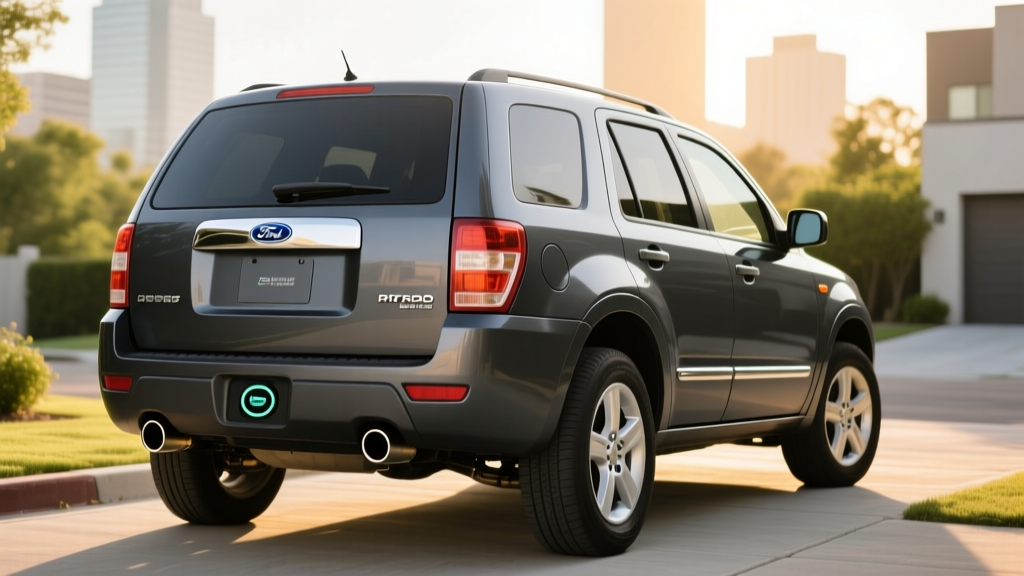
The 2007 Escape Hybrid shared its sheet metal with the conventional gas-powered Escape, meaning the rear profile is identical to its ICE sibling. From the rear, you'll find a liftgate with a flip-up glass hatch, vertically stacked taillights, a rear wiper, and a modest roof spoiler. The Hybrid's only exterior differentiators were small "Hybrid" badges on the front doors and a unique "Special Purpose" badge on the rear liftgate. If you're hunting for 2007 Ford Escape Hybrid AWD rear photos, know that visually distinguishing the AWD Hybrid from a standard AWD Escape requires looking for those badges or checking the VIN (the 8th digit will be "H" for the Hybrid's Atkinson-cycle 2.3L engine).
The AWD model sat at the same ride height as the FWD version, with 16-inch alloy wheels standard. Cargo space behind the rear seats measured approximately 29.3 cubic feet, though the NiMH battery pack beneath the cargo floor did slightly reduce the under-floor storage area compared to the gas model.
Powertrain: How the AWD Hybrid System Works
The 2007 Escape Hybrid AWD paired a 2.3-liter Atkinson-cycle inline-4 engine with an electric motor integrated into a continuously variable transmission (CVT). Here are the key powertrain figures:
| Specification | Value |
|---|---|
| Engine | 2.3L Atkinson-cycle I-4 |
| Engine Horsepower | 133 hp @ 6,000 rpm |
| Electric Motor | Permanent-magnet AC synchronous |
| Combined System Output | 155 hp |
| Transmission | eCVT (planetary gearset) |
| Drivetrain | AWD (rear axle electric motor assist) |
| Hybrid Battery | ~1.8 kWh NiMH (330V nominal) |
| 0-60 mph (estimated) | ~10.5 seconds |
The AWD system in the Escape Hybrid is worth understanding. Unlike mechanical AWD systems that use a driveshaft from the engine to the rear wheels, the Escape Hybrid AWD used a separate, smaller electric motor to drive the rear axle. This motor engaged automatically when the front wheels lost traction or during hard acceleration. Because the rear motor was electrically driven, there was no mechanical connection between the front and rear axles — a design that reduced parasitic drivetrain losses compared to traditional AWD, contributing to the Hybrid's efficiency advantage.
Fuel Economy: EPA MPG and Real-World Expectations
Fuel economy was the Escape Hybrid's headline feature in 2007, and it remains the primary reason buyers seek out this model today. Here are the official EPA figures, as published on fueleconomy.gov:
| Driving Cycle | MPG |
|---|---|
| City | 34 MPG |
| Highway | 30 MPG |
| Combined | 32 MPG |
For context, the 2007 Escape with a conventional 3.0L V6 and AWD was rated at just 19 city / 23 highway / 20 combined MPG. The Hybrid delivered roughly 60% better city fuel economy.
Real-World MPG: What to Expect in 2026
Hybrids typically exceed their EPA city estimates in stop-and-go traffic because regenerative braking recovers energy that a gas car wastes as heat. However, a 2007 model in 2026 will have a battery with significant age-related degradation. Expect the following:
- City (battery in good condition): 30-35 MPG — close to or slightly above EPA
- City (degraded battery): 26-30 MPG — the engine runs more often to compensate
- Highway: 27-31 MPG — hybrids gain less advantage at steady speeds
- Cold weather (below 32°F): Expect a 10-20% drop, bringing city MPG down to 24-28 as the engine runs longer to heat the cabin and warm the battery
If you're test-driving a used example, pay attention to how frequently the engine shuts off at stops and low speeds. If the engine rarely shuts off, the hybrid battery may be significantly degraded.
HEV vs PHEV vs EV: Where the Escape Hybrid Fits
The 2007 Escape Hybrid is a conventional hybrid (HEV). It cannot be plugged in. It has no electric-only driving range in any meaningful sense — the small 1.8 kWh NiMH battery provides brief electric-only assist at very low speeds (typically under 25 mph for short distances), but this is measured in fractions of a mile, not usable EV range.
HEV vs PHEV vs BEV — Quick Comparison
| Feature | HEV (Escape Hybrid) | PHEV (e.g., 2026 RAV4 Prime) | BEV (e.g., 2026 Ioniq 5) |
|---|---|---|---|
| Plug-in charging | No | Yes | Yes |
| Electric-only range | ~0.5 mi (negligible) | 35-42 mi | 250-310 mi |
| Battery size | ~1.8 kWh NiMH | ~18 kWh NMC | ~77 kWh NMC/LFP |
| Gas engine | Yes (primary) | Yes (backup) | No |
| Federal tax credit (§30D) | No | Up to $7,500* | Up to $7,500* |
| Home charging needed | No | Recommended (Level 2) | Required |
* §30D credit eligibility depends on MSRP caps, buyer income limits, and battery sourcing requirements per current IRS rules. Consult a tax professional.
The Escape Hybrid occupies a specific niche: it's for drivers who want better fuel economy than a gas SUV but cannot or do not want to plug in. If you have access to home charging and a short commute, a modern PHEV like the Toyota RAV4 Prime or a full BEV will dramatically outperform the Escape Hybrid in both efficiency and operating cost.
Hybrid Battery Longevity, Warranty, and Replacement Cost
Battery lifespan is the single biggest concern for any used hybrid buyer — especially one approaching 20 years old.
Original Battery Warranty
Ford originally warranted the Escape Hybrid's NiMH battery for 8 years / 100,000 miles (extended to 10 years / 150,000 miles in California Air Resources Board states). As of 2026, all original factory battery warranties have expired on 2007 models regardless of mileage.
Battery Degradation and Failure
NiMH batteries degrade more gracefully than early lithium-ion cells, but after 17-19 years, most original packs will have lost significant capacity. Common symptoms of a degraded Escape Hybrid battery include:
- Engine running almost continuously (reduced electric assist)
- Noticeable drop in fuel economy (below 26 MPG combined)
- Dashboard warnings: "Check Hybrid System" or a wrench icon
- Rapid state-of-charge fluctuation on the energy-flow display
Battery Replacement Options and Cost
| Option | Estimated Cost | Notes |
|---|---|---|
| OEM new battery (Ford dealer) | $2,500 - $3,500 | Likely discontinued or very limited availability |
| Aftermarket remanufactured | $1,200 - $2,000 | Most common option; 1-3 year warranty typical |
| Used/salvage battery | $400 - $800 | Highest risk — unknown remaining life |
| Individual cell replacement | $300 - $600 (parts) | Requires hybrid-savvy technician; not all shops offer this |
When budgeting for a 2007 Escape Hybrid, assume you will need to spend $1,200-$2,000 on a remanufactured battery at some point during ownership if the original pack hasn't already been replaced. Factor this into your purchase decision — a $4,000 Escape with a dead battery is really a $5,500 car.
Reliability and Common Issues
The 2007 Escape Hybrid earned a reputation for solid mechanical reliability, with the eCVT transmission proving particularly durable (it has no belts, clutches, or traditional wear items — just a planetary gearset). NHTSA records show relatively few powertrain complaints compared to the conventional V6 model. However, age-related issues to watch for include:
- Hybrid battery degradation (as detailed above — the #1 concern)
- Brake actuator assembly: The electro-hydraulic brake system can develop leaks or fail; replacement runs $800-$1,400
- Electric power steering: The EPS motor and sensor can fail on high-mileage examples
- Rust: Rear subframe and rocker panels are prone to corrosion in salt-belt states
- A/C compressor: The electric A/C compressor is expensive to replace ($600-$1,000)
At nearly 20 years old, rubber components, suspension bushings, and seals will likely need attention regardless of the hybrid system's condition.
Pricing, Tax Credits, and Total Cost
Used Market Pricing (2026)
As of early 2026, the 2007 Ford Escape Hybrid AWD trades in the used market for approximately:
- High-mileage / needs battery: $2,500 - $4,000
- Average condition, functioning hybrid system: $4,000 - $6,000
- Low-mileage, well-maintained, recent battery: $6,000 - $8,000
Tax Credit Eligibility
The 2007 Ford Escape Hybrid does not qualify for the federal §30D New Clean Vehicle Credit (it's a used vehicle, and it's a conventional HEV, not a PHEV or BEV). It also does not qualify for the §25E Used Clean Vehicle Credit, which applies only to used BEVs and PHEVs — not conventional hybrids. No state-level incentives currently target used HEVs either.
Total Cost of Ownership Estimate
For a buyer paying $5,000 for a 2007 Escape Hybrid AWD in decent condition, the annual operating cost is modest. At 12,000 miles/year and $3.50/gallon fuel:
- Annual fuel cost (32 MPG combined): ~$1,313
- Annual fuel cost (conventional V6 AWD at 20 MPG): ~$2,100
- Annual fuel savings vs. V6: ~$787
Over five years, the fuel savings could total ~$3,900 — but a battery replacement during that period could consume much of the advantage. The Escape Hybrid makes financial sense primarily if you find one with a recently replaced battery or are willing to budget for that eventuality.
Who Should Buy This Hybrid (and Who Shouldn't)
Choose the 2007 Escape Hybrid AWD if:
- Your budget is under $6,000 and you need AWD
- You cannot charge at home (no garage, apartment living, no outlet access)
- Your commute is primarily city/suburban stop-and-go driving where hybrids shine
- You want lower fuel costs without changing your refueling habits
- You're comfortable budgeting $1,200-$2,000 for a potential battery replacement
Skip it and consider a PHEV or BEV if:
- You have home Level 2 charging access and a commute under 40 miles (a PHEV would let you drive mostly on electricity)
- You want modern safety features (ESC, side curtain airbags, backup camera — the 2007 Escape predates many of these as standard)
- You drive more than 15,000 miles/year (the fuel savings of a modern PHEV/BEV compound significantly at high mileage)
- You want a vehicle with remaining factory warranty coverage
- You qualify for the §30D or §25E tax credits on a newer electrified vehicle
Frequently Asked Questions
How many MPG does the 2007 Ford Escape Hybrid AWD get?
The EPA rates it at 34 city / 30 highway / 32 combined MPG. In real-world 2026 driving with an aging battery, expect 26-32 MPG combined depending on battery health, driving style, and climate.
Does the 2007 Escape Hybrid need to be plugged in?
No. It is a conventional hybrid (HEV), not a plug-in hybrid (PHEV). The battery charges solely through regenerative braking and the gasoline engine. There is no charging port.
Is the 2007 Ford Escape Hybrid reliable?
The powertrain (engine + eCVT) is generally durable. The primary reliability concern is the NiMH hybrid battery, which is now 17-19 years old and likely near end-of-life if it hasn't been replaced. Budget for a $1,200-$2,000 remanufactured battery replacement.
What does it cost to replace the hybrid battery?
A remanufactured aftermarket battery costs approximately $1,200-$2,000 installed. OEM Ford replacements may be unavailable due to the vehicle's age. Used/salvage batteries cost $400-$800 but carry significant risk.
Does the 2007 Escape Hybrid qualify for any tax credits?
No. It does not qualify for the federal §30D new-vehicle credit or the §25E used-vehicle credit, both of which require plug-in capability (PHEV or BEV). It also originally qualified for a much smaller hybrid tax credit that expired long ago.
How does the AWD system work on the Escape Hybrid?
The AWD system uses a separate electric motor on the rear axle rather than a mechanical driveshaft from the engine. It engages automatically when front-wheel slip is detected or during hard acceleration. This design reduces drivetrain losses compared to conventional AWD.
Should I buy a 2007 Escape Hybrid or a newer PHEV?
If your budget allows $30,000+, a modern PHEV like the Toyota RAV4 Prime (42 miles electric-only, potential §30D credit) will dramatically outperform the Escape Hybrid in efficiency, safety, and technology. The Escape Hybrid is primarily a budget option for buyers under $6,000 who cannot plug in.
The 2007 Ford Escape Hybrid AWD was a pioneering vehicle that proved hybrid technology could work in an SUV format with all-wheel drive. In 2026, it remains a viable budget option for the right buyer — but go in with eyes open about battery age, the absence of modern safety tech, and the fact that the electrified-vehicle landscape has moved far beyond what this early hybrid could offer. Whether you're researching rear photos to verify a listing or evaluating the powertrain for a daily-driver purchase, the data here should help you make an informed decision.