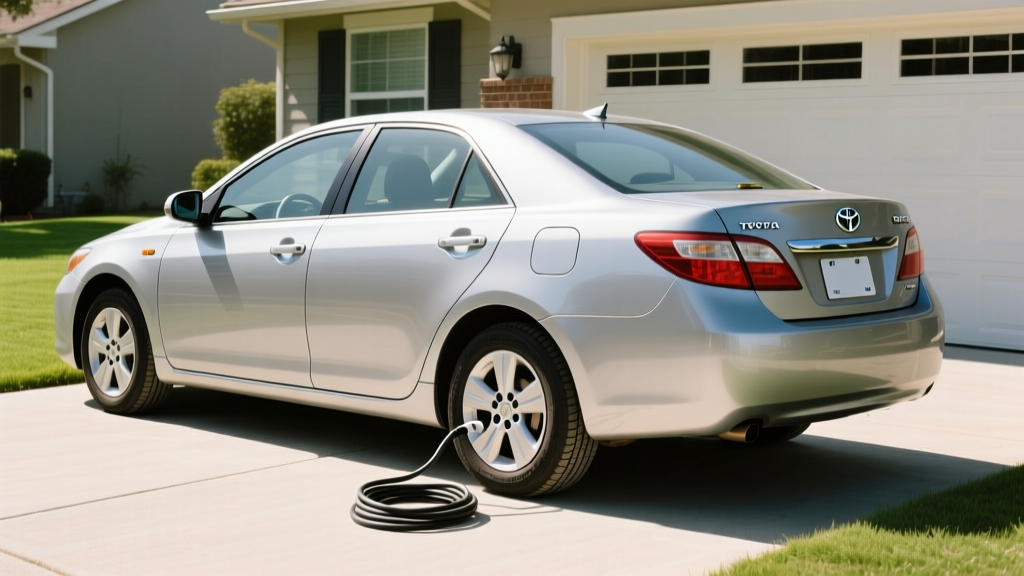
If you're researching the 2007 Camry Hybrid MPG, you're likely evaluating one of Toyota's earliest mainstream hybrids as a used-car purchase — or comparing it against modern hybrid and plug-in hybrid alternatives. The 2007 Toyota Camry Hybrid was only the second model year for the Camry Hybrid nameplate, and it helped establish the template that every midsize hybrid sedan follows today: a gasoline engine paired with an electric motor and a nickel-metal hydride (NiMH) battery pack that recharges through regenerative braking — no plug required.
This guide covers the 2007 Camry Hybrid's official EPA fuel economy, real-world MPG expectations, battery longevity, replacement costs, and how it stacks up against today's hybrid, PHEV, and full EV options. If you're shopping for a budget-friendly hybrid commuter, this is the data you need.
2007 Camry Hybrid EPA MPG: City, Highway, and Combined
The 2007 Toyota Camry Hybrid carries the following official EPA fuel economy ratings:
| Metric | Value |
|---|---|
| City MPG | 33 MPG |
| Highway MPG | 34 MPG |
| Combined MPG | 34 MPG |
| Fuel Type | Regular Unleaded (87 octane) |
| Fuel Tank Capacity | 17.2 gallons |
| Estimated Total Range | ~585 miles |
Source: EPA Fuel Economy Guide — 2007 Toyota Camry Hybrid
These numbers were competitive for 2007 and remain respectable today. For context, the 2007 gasoline-only Camry 4-cylinder was rated at 21 city / 31 highway / 24 combined MPG — meaning the hybrid delivered roughly a 42% improvement in combined fuel economy over its conventional sibling.
Real-World MPG vs. EPA Sticker: What Owners Actually Report
Hybrid vehicles — particularly Toyota's Synergy Drive system — tend to perform close to or even above their EPA ratings in mixed city driving, because stop-and-go traffic maximizes regenerative braking and electric-motor assist. Here's what real-world data suggests:
- City-heavy commuting: 32–36 MPG (regen braking thrives here)
- Highway cruising (70+ mph): 29–33 MPG (aerodynamic drag reduces hybrid advantage)
- Mixed driving: 30–34 MPG
- Cold weather (below 30°F): 27–31 MPG (engine runs more often for cabin heat; battery efficiency drops)
Note: Vehicles with 150,000+ miles and aging hybrid batteries may see a 2–5 MPG decline due to reduced battery capacity and more frequent engine engagement.
On platforms like Fuelly, owners of the 2007 Camry Hybrid report lifetime averages clustering between 31 and 35 MPG, with some hypermilers touching 37 MPG in warm-weather city driving. The key takeaway: the EPA's 34 MPG combined estimate is achievable and occasionally beatable, but highway-dominant drivers should expect numbers closer to 30–32 MPG.
Powertrain: How the 2007 Camry Hybrid Drives
The 2007 Camry Hybrid uses Toyota's Hybrid Synergy Drive (HSD), a series-parallel full hybrid system. Here's the hardware:
| Component | Specification |
|---|---|
| Gasoline Engine | 2.4L 4-cylinder (2AZ-FXE), Atkinson cycle |
| Engine Power | 147 HP @ 6,000 RPM |
| Engine Torque | 138 lb-ft @ 4,400 RPM |
| Electric Motor | Permanent magnet synchronous |
| Electric Motor Power | 40 HP (30 kW) |
| Net System Horsepower | 192 HP (combined) |
| Transmission | ECVT (electronically controlled continuously variable) |
| 0–60 mph | ~7.3 seconds |
| Drivetrain | Front-wheel drive |
The Atkinson-cycle engine sacrifices low-end torque for higher thermal efficiency, while the electric motor fills in the torque gap off the line. The ECVT isn't a traditional belt-and-cone CVT — it's a planetary gearset that seamlessly blends engine and motor power. The result is smooth, linear acceleration with no gear-hunting.
Importantly, this is a conventional hybrid (HEV), not a plug-in hybrid (PHEV). The battery recharges exclusively through regenerative braking and engine-driven generation. You never plug it in.
HEV vs. PHEV vs. EV: Which Powertrain Fits Your Needs?
If you're considering a 2007 Camry Hybrid, you're looking at a conventional HEV. But it's worth understanding how this compares to PHEVs and full battery-electric vehicles (BEVs), especially if you're weighing it against a newer used car.
HEV (like 2007 Camry Hybrid)
- No plug-in required
- Small battery (~1.0–1.5 kWh usable)
- Electric-only driving: very limited (low speed, short distance)
- MPG: 30–50+ depending on model
- No range anxiety
- No federal tax credit (used)
PHEV (e.g., RAV4 Prime, Prius Prime)
- Plugs in for electric-only range (25–45 mi typical)
- Larger battery (8–18 kWh)
- Gas engine kicks in after battery depletes
- Total range: 400–600+ miles
- Level 1/2 charging; rarely DC fast charge
- May qualify for used-EV credit (§25E, up to $4,000)
BEV (e.g., Tesla Model 3, Ioniq 6)
- 100% electric, no gas engine
- Large battery (50–100+ kWh)
- EPA range: 250–400+ miles
- DC fast charging capable
- Lowest per-mile fuel cost
- May qualify for §30D new ($7,500) or §25E used ($4,000) credit
- Choose an HEV (like the 2007 Camry Hybrid) if: You want maximum simplicity, no charging infrastructure, low purchase price (under $6,000 used), and proven reliability with minimal maintenance changes from a gas car.
- Choose a PHEV if: You have home charging access, a commute under 40 miles, and want electric-only daily driving with gas-engine flexibility for road trips.
- Choose a BEV if: You have reliable home or workplace charging, want the lowest operating cost, and your daily driving is under ~250 miles (or you're willing to plan DC fast-charge stops on road trips).
Hybrid Battery Lifespan, Warranty, and Replacement Cost
The 2007 Camry Hybrid's high-voltage battery is a nickel-metal hydride (NiMH) pack rated at approximately 244.8 volts and 6.5 Ah — roughly 1.6 kWh of total capacity (with about 0.9–1.0 kWh usable, given the system's state-of-charge buffer that prevents full charge or full depletion to protect longevity).
- Original factory warranty: 8 years / 100,000 miles (hybrid battery and components); 10 years / 150,000 miles in CARB states (CA, NY, MA, and others adopting California emissions standards)
- Expected battery lifespan: 150,000–200,000+ miles with normal use; many examples exceed 250,000 miles
- Replacement cost (2025/2026 pricing): $2,000–$4,000 for a new OEM battery from Toyota; $1,000–$2,000 for a refurbished/reconditioned pack; $500–$1,200 for individual module replacement by a hybrid specialist
- Signs of degradation: Lower MPG (2–5 MPG drop), more frequent engine engagement, reduced electric-only creep distance, dashboard warning light
NiMH batteries degrade more gracefully than early lithium-ion packs. Rather than sudden capacity cliff-drop, you'll notice a gradual increase in engine running time and a slight MPG decline. Many 2007 Camry Hybrids on the road today have had one battery replacement (or are still on the original pack at lower capacity).
If you're buying a used 2007 Camry Hybrid, request a hybrid battery health check from a Toyota dealer or qualified hybrid shop. They can read the battery's internal resistance, module voltage delta, and state-of-charge behavior to assess remaining life.
2007 Camry Hybrid vs. Modern Hybrids: Is It Still Worth Buying?
The used 2007 Camry Hybrid typically trades between $4,000 and $7,500 depending on mileage, condition, and battery health (check Kelley Blue Book or local listings for current pricing). Here's how it compares to newer hybrid benchmarks:
| Model | Year | Combined MPG (EPA) | System HP | Used Price Range (2026) |
|---|---|---|---|---|
| Toyota Camry Hybrid | 2007 | 34 MPG | 192 HP | $4,000–$7,500 |
| Toyota Camry Hybrid | 2025 | 52 MPG | 225 HP | $28,000–$35,000 (new) |
| Honda Accord Hybrid | 2024 | 48 MPG | 204 HP | $26,000–$32,000 |
| Hyundai Sonata Hybrid | 2025 | 47 MPG | 192 HP | $27,000–$33,000 (new) |
| Toyota Prius | 2025 | 57 MPG | 196 HP | $28,000–$34,000 (new) |
The 2025 Camry Hybrid's 52 MPG combined rating represents an 18-MPG improvement over the 2007 model — driven by a more efficient Dynamic Force engine, lighter lithium-ion battery, and improved aerodynamics. However, at roughly five to seven times the purchase price, the used 2007 model remains compelling for budget-conscious buyers who need basic, reliable, efficient transportation.
Tax Credits and Incentives: What Applies to the 2007 Camry Hybrid?
Here's the straightforward answer: the 2007 Camry Hybrid does not qualify for any current federal tax credit.
Under current IRS rules (see IRS §30D and §25E guidelines):
- The §30D New Clean Vehicle Credit (up to $7,500) applies only to new BEVs and PHEVs meeting battery-sourcing, MSRP, and buyer-income requirements. Conventional HEVs have never qualified.
- The §25E Used Clean Vehicle Credit (up to $4,000) applies only to used BEVs and PHEVs with a battery capacity of at least 7 kWh. The 2007 Camry Hybrid's ~1.6 kWh NiMH pack falls far below this threshold, and HEVs are excluded regardless.
- When new, the 2007 Camry Hybrid qualified for a now-expired Alternative Motor Vehicle Credit (up to $2,600), but that credit phased out for Toyota in 2007 after the manufacturer hit 60,000 units sold.
No state-level incentives currently apply to a 2007 conventional hybrid either. The financial case for this car rests entirely on its low purchase price, strong fuel economy, and Toyota reliability — not on tax benefits.
Pros and Cons: 2007 Camry Hybrid as a Used Buy
Pros
- Proven, simple hybrid system with massive parts availability
- 34 MPG combined (often exceeded in city driving)
- Low purchase price ($4K–$7.5K)
- Comfortable, spacious midsize sedan interior
- No plug-in infrastructure needed
- Strong safety ratings for its era (IIHS Top Safety Pick)
- Regular unleaded fuel — no premium required
Cons
- NiMH battery will need replacement eventually ($1K–$4K)
- 18 MPG gap vs. 2025 Camry Hybrid (52 MPG combined)
- No federal or state tax credits
- Dated infotainment (no Apple CarPlay/Android Auto, no backup camera on base trims)
- ECVT can drone under hard acceleration
- Higher-mileage examples may need suspension and brake work alongside hybrid service
Frequently Asked Questions
How many MPG does the 2007 Camry Hybrid get?
The EPA rates it at 33 city / 34 highway / 34 combined MPG. Real-world owners typically report 30–35 MPG depending on driving mix, climate, and battery condition. City-heavy commutes tend to yield higher numbers thanks to regenerative braking.
Is the 2007 Camry Hybrid a plug-in?
No. It is a conventional hybrid (HEV). The battery charges through regenerative braking and the gasoline engine. You never plug it in. Toyota did not introduce a Camry PHEV until later markets, and a plug-in Camry was never sold in the US as of the 2007 model year.
How much does it cost to replace the hybrid battery?
A new OEM battery from Toyota costs $2,000–$4,000 including labor. Refurbished packs run $1,000–$2,000, and individual module replacement by a hybrid specialist can be as low as $500–$1,200. Most 2007 Camry Hybrid batteries last 150,000–250,000 miles.
Is the 2007 Camry Hybrid reliable?
Yes. The 2AZ-FXE engine and Toyota's Hybrid Synergy Drive are among the most proven powertrains ever built. Common non-hybrid issues at high mileage include water pump failure, power steering leaks, and worn suspension components — all typical for any 15+ year-old vehicle. The hybrid system itself is remarkably durable.
Should I buy a 2007 Camry Hybrid or a newer hybrid?
If your budget is under $8,000 and you need efficient daily transportation with no charging hassle, the 2007 Camry Hybrid is a strong choice. If you can spend $25,000+, a newer Camry Hybrid (52 MPG), Prius (57 MPG), or a PHEV like the Prius Prime (44 miles electric-only) offers substantially better efficiency, modern safety tech, and available tax credits. Your decision hinges on budget and how much fuel savings matters over a 3–5 year ownership horizon.
Does the 2007 Camry Hybrid qualify for any tax credit in 2026?
No. Federal clean-vehicle credits (§30D for new, §25E for used) apply only to plug-in vehicles (BEVs and PHEVs) meeting specific battery-capacity, sourcing, MSRP, and income thresholds. Conventional hybrids like the 2007 Camry Hybrid have never been eligible for these programs.