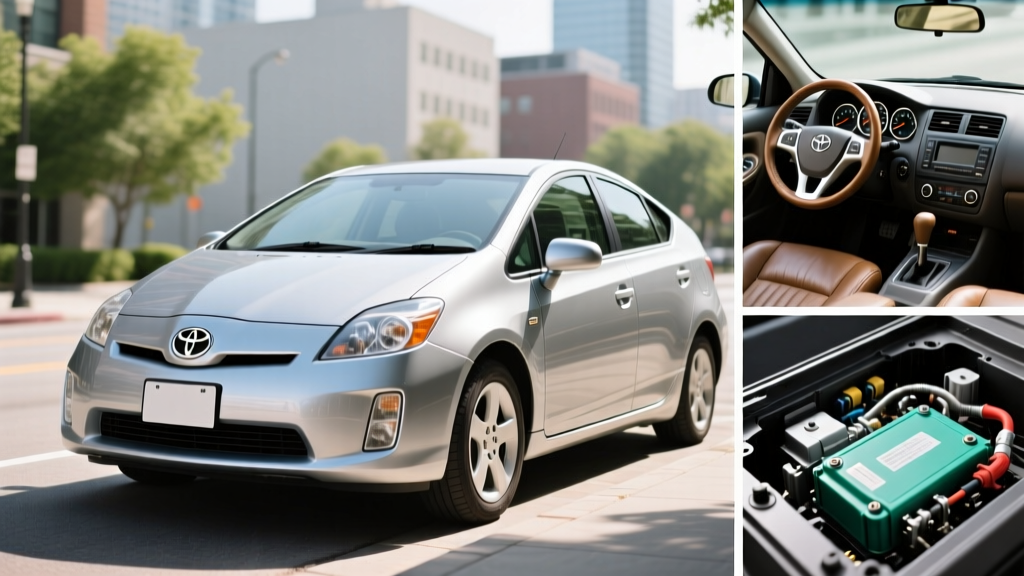
The 2006 Toyota Prius: America's Original Hybrid Benchmark
Long before the current wave of plug-in hybrids and battery-electric vehicles, the second-generation Toyota Prius (model code XW20, produced 2004–2009) defined what a mass-market hybrid could be. The 2006 Toyota Prius hybrid remains one of the most searched used vehicles among budget-conscious commuters, and for good reason: it delivers exceptional fuel economy, proven powertrain durability, and a total cost of ownership that still undercuts most new gas cars nearly two decades later.
But buying a 20-year-old hybrid in 2026 comes with real questions. What's the actual MPG after hundreds of thousands of miles? How much does a replacement hybrid battery cost? And how does this conventional hybrid (HEV) compare to today's plug-in hybrids and full EVs? This guide answers every question with hard data.
HEV vs PHEV vs EV: Where the 2006 Prius Fits
The 2006 Prius is a conventional hybrid electric vehicle (HEV). It cannot be plugged in. It has no electric-only driving range to speak of. The gasoline engine and electric motor work together seamlessly, and the small nickel-metal hydride (NiMH) battery recharges through regenerative braking and the engine itself.
| Feature | HEV (2006 Prius) | PHEV (e.g., 2026 Prius Prime) | BEV (e.g., Tesla Model 3) |
|---|---|---|---|
| Plug-in Charging | No | Yes | Yes |
| Electric-Only Range | ~0.5 mi at low speed | ~44 mi (2026 Prime) | 250–360 mi typical |
| Gasoline Engine | Yes (primary) | Yes (backup + highway) | No |
| Fuel Required | Gasoline | Gasoline + electricity | Electricity only |
| Home Charging Needed | No | Recommended | Essential |
| Federal Tax Credit (§30D) | No | Up to $3,750* | Up to $7,500* |
*Tax credit eligibility depends on income caps, MSRP limits, and battery sourcing rules per IRS §30D guidelines. The 2006 Prius as a used HEV does not qualify for any federal purchase credit.
If you lack home charging access or apartment-level plug-in infrastructure, the conventional HEV architecture of the 2006 Prius is a genuine advantage — you simply fuel it like any other car and let the hybrid system handle efficiency.
Fuel Economy: EPA Ratings and Real-World MPG
According to fueleconomy.gov, the 2006 Toyota Prius carries the following EPA ratings:
| Driving Cycle | EPA MPG |
|---|---|
| City | 60 MPG |
| Highway | 51 MPG |
| Combined | 55 MPG |
Note on EPA methodology: The 2006 Prius was rated under the pre-2008 EPA test cycle, which tended to produce higher numbers than the revised methodology used today. Under current EPA testing standards, this same powertrain would likely rate closer to 46 MPG combined. Toyota itself later re-rated the equivalent powertrain at approximately 46 MPG combined when the testing methodology changed.
Real-World MPG Expectations in 2026
For a 2006 Prius with 150,000+ miles and a healthy hybrid battery, expect the following real-world figures:
- City driving (stop-and-go): 45–52 MPG — hybrids excel here because regenerative braking recaptures energy that gas-only cars waste as heat
- Highway cruising (65–75 mph): 40–47 MPG — the Atkinson-cycle 1.5L engine operates efficiently but lacks the gearing advantage of modern hybrids at sustained speed
- Cold weather (below 35°F): 35–42 MPG — the engine runs more often to provide cabin heat and warm the catalytic converter, reducing hybrid system engagement
- Combined mixed driving: 42–48 MPG with a healthy battery
Powertrain Specs: Engine, Motor, and System Output
| Specification | 2006 Toyota Prius |
|---|---|
| Gasoline Engine | 1.5L 4-cylinder Atkinson-cycle (1NZ-FXE) |
| Engine Horsepower | 76 HP @ 5,000 rpm |
| Electric Motor | Permanent-magnet synchronous (500V system) |
| Electric Motor Output | 67 HP (50 kW) |
| Combined Net Horsepower | 110 HP |
| Combined Net Torque | 82 lb-ft (engine) + 295 lb-ft (motor) |
| Transmission | Planetary eCVT (no traditional gears or belts) |
| Hybrid Battery | 1.3 kWh NiMH (nickel-metal hydride), 201.6V nominal |
| 0–60 mph | ~10.0 seconds |
| Curb Weight | 2,932 lbs |
| Fuel Tank | 11.9 gallons |
| Total Driving Range | ~535–650 miles (at 45–55 MPG) |
The 2006 Prius uses Toyota's Hybrid Synergy Drive (HSD), which connects the gasoline engine and electric motor through a planetary gearset. This eCVT design has no clutch packs, belts, or traditional transmission components — it's one reason the Prius powertrain is extraordinarily durable. The engine can shut off completely at stops, during low-speed maneuvering, and during coasting, which is how the car achieves its city MPG advantage.
The 1.3 kWh NiMH battery pack is tiny by modern standards (a 2026 Prius Prime PHEV carries an 11.3 kWh lithium-ion pack), but it doesn't need to store much energy. It acts as a buffer, capturing regenerative braking energy and releasing it during acceleration assist. The system never fully charges or fully depletes the battery — it operates in a narrow state-of-charge window (roughly 40–80%) to maximize longevity.
Hybrid Battery Life, Replacement Cost, and Warranty
This is the number-one concern for anyone buying a 2006 Prius in 2026. Here's what the data shows:
Original Warranty
Toyota originally warranted the hybrid battery for 8 years / 100,000 miles (10 years / 150,000 miles in California Air Resources Board states). That warranty expired long ago for every 2006 Prius on the road.
Real-World Battery Longevity
NiMH hybrid batteries in the second-generation Prius have proven remarkably durable. Fleet data and owner surveys consistently show:
- Typical original battery lifespan: 150,000–200,000+ miles before significant capacity loss
- Failure mode: Gradual capacity degradation rather than sudden failure — you'll notice declining MPG (typically 3–8 MPG drop) before the car throws a hybrid system warning
- Age factor: Calendar age matters as much as mileage. A 20-year-old NiMH pack will have lost capacity even at low miles
Replacement Costs in 2026
| Option | Cost Range | Notes |
|---|---|---|
| New OEM Toyota battery | $2,200–$2,800 (parts only) | Available through Toyota dealers; increasingly scarce for this generation |
| Refurbished/reconditioned battery | $800–$1,500 (installed) | Rebuilt with tested NiMH modules; common choice for this vehicle age |
| Used salvage battery | $400–$800 | From wrecking yards; unknown remaining life — a gamble |
| Individual module replacement | $300–$600 (DIY-capable shops) | Replace only the failed modules; requires voltage-matching expertise |
12V Auxiliary Battery
Don't confuse the high-voltage hybrid battery with the standard 12V auxiliary battery (located in the rear cargo area). The 12V battery powers the computers and accessories. It typically lasts 3–5 years and costs $150–$250 to replace. If a 2006 Prius won't start or shows strange electrical errors, the 12V battery is often the culprit — not the hybrid pack.
Reliability, Safety, and Long-Term Ownership
The second-generation Prius earned a reputation as one of the most reliable vehicles Toyota has ever built. The planetary eCVT has essentially no wear components. The engine is lightly stressed (it rarely operates above 4,000 rpm thanks to electric motor assist). Taxi fleets running 2004–2009 Prius vehicles routinely reached 300,000+ miles with basic maintenance and one or two battery replacements.
Common Issues to Watch
- Hybrid battery degradation: As discussed above — the primary long-term cost
- Brake actuator assembly: The electro-hydraulic brake system can fail around 120,000–180,000 miles; replacement runs $1,200–$1,800. Check for recalls — Toyota issued extended warranty coverage on some model years
- Combination meter (dashboard): Some 2004–2009 Prius units experience display failure; refurbished units available for $200–$400
- Water pump (engine): Standard maintenance item; replace preventively if over 100,000 miles and no record of replacement
- Head gasket: Rare below 200,000 miles but documented on high-mileage examples, especially those that ran with low coolant
Safety Ratings
The 2006 Prius received a 5-star driver / 4-star passenger frontal crash rating from NHTSA and a Good rating in the IIHS moderate overlap front test. It lacks modern ADAS features (no automatic emergency braking, no lane-keeping assist), which is expected for its era. For a full safety report, check NHTSA.gov using the VIN.
Pricing in 2026 and Tax Credit Eligibility
As of early 2026, used 2006 Toyota Prius pricing breaks down as follows:
- Fair condition (150K+ mi, needs battery): $2,500–$3,500
- Good condition (120K–170K mi, healthy battery): $3,500–$5,000
- Excellent condition (under 100K mi, documented maintenance): $5,000–$6,500
Tax Credit Reality
The 2006 Toyota Prius does not qualify for the federal §30D new clean vehicle tax credit (it's not new). It also does not qualify for the used clean vehicle credit because that credit applies only to used EVs and PHEVs — not conventional HEVs — and requires a sale price under $25,000 from a licensed dealer with specific battery sourcing.
Some states offer registration incentives or HOV lane access for hybrids, but most of these programs have ended for non-plug-in vehicles. Check your state's DMV or energy office for any remaining perks.
Who Should Buy a 2006 Prius Hybrid?
Pros
- Exceptional city MPG (45–52 real-world)
- Proven 200K+ mile powertrain durability
- No plug-in charging required
- Low annual fuel cost (~$900–$1,100/yr at 12K miles)
- Affordable entry price ($3K–$5K)
- Spacious hatchback cargo area (50 cu ft seats folded)
- Minimal maintenance (no timing belt — chain-driven)
Cons
- 20-year-old technology — no modern safety features
- Slow acceleration (10-sec 0–60)
- Hybrid battery replacement is an eventual $1K–$2.5K cost
- No EV mode or electric-only driving
- No federal tax credit eligibility
- High-mileage examples may need brake actuator service
- Outdated infotainment (no Bluetooth audio, no backup camera on base trims)
Decision Framework: Is the 2006 Prius Right for You?
Choose the 2006 Prius if: You need a sub-$5,000 commuter that sips fuel in city traffic, you have no home charging option, you value mechanical simplicity, and you're prepared for a potential battery replacement.
Choose a modern PHEV (like a 2024–2026 Prius Prime) if: You have home charging, want 40+ miles of electric-only commuting, need modern safety tech, and qualify for a partial federal or state credit.
Choose a full EV if: You have reliable home or workplace charging, your daily driving is under 250 miles, you want zero gasoline costs, and your budget allows $25,000+ (used) or $35,000+ (new).
Skip the 2006 Prius if: You primarily drive highway miles (the MPG advantage shrinks), you need modern crash-avoidance technology, or you want a warranty-backed vehicle.
2006 Prius vs Modern Alternatives: Cost Comparison
To put the 2006 Prius ownership economics in context, here's a 5-year cost snapshot compared to a typical gas compact and a modern PHEV:
| 5-Year Cost Factor | 2006 Prius (HEV) | 2020 Honda Civic (Gas) | 2026 Prius Prime (PHEV) |
|---|---|---|---|
| Purchase Price | $4,000 | $18,000 | $33,000 (after credit) |
| Fuel / Energy (5 yrs, 60K mi) | $4,800 | $7,200 | $2,400 |
| Maintenance (5 yrs) | $2,500 | $2,800 | $1,800 |
| Battery Replacement Reserve | $1,200 | $0 | $0 (warranty) |
| Insurance (5 yrs est.) | $4,500 | $5,500 | $6,200 |
| Total 5-Year Cost | $17,000 | $33,500 | $43,400 |
The 2006 Prius wins on pure economics if you can accept the age and lack of modern features. The modern PHEV wins on technology, safety, and warranty protection — at more than double the total cost.
Frequently Asked Questions
How many MPG does the 2006 Toyota Prius actually get?
The EPA rated it at 60 city / 51 highway / 55 combined under the old test cycle. In real-world 2026 driving with a healthy battery, expect 42–48 MPG combined. City-heavy drivers will see the high end; highway-dominant and cold-climate drivers will see the low end.
Does the 2006 Prius need to be plugged in?
No. The 2006 Prius is a conventional hybrid (HEV). It charges its own battery through regenerative braking and the gasoline engine. There is no plug, no charging cable, and no electric-only range to manage.
How much does it cost to replace the hybrid battery?
A refurbished/reconditioned NiMH battery pack costs $800–$1,500 installed. A new OEM pack (if still available) runs $2,200–$2,800 for parts alone. Many owners opt for individual module replacement at $300–$600 when only a few cells fail.
Is the 2006 Prius reliable at high mileage?
Yes, with proper maintenance. The planetary eCVT transmission has no wear parts and routinely exceeds 250,000 miles. The main long-term expenses are the hybrid battery and the brake actuator assembly. Fleet data confirms 300,000+ mile examples are common.
Does the 2006 Prius qualify for any tax credit?
No. The federal §30D credit applies only to new qualifying plug-in vehicles. The used clean vehicle credit applies only to used EVs and PHEVs, not conventional hybrids. No federal tax incentive is available for purchasing a used 2006 Prius.
How does the 2006 Prius compare to the current-generation Prius?
The 2024–2026 Prius (fifth generation) produces 194 HP (AWD: 196 HP), achieves 57 MPG combined EPA, and features modern safety tech including Toyota Safety Sense 3.0. The current Prius Prime PHEV adds 44 miles of electric-only range. However, a new Prius starts around $28,000 — roughly 6–7× the cost of a well-maintained 2006 example.
What maintenance does the 2006 Prius need?
Standard items: oil changes every 5,000 miles (0W-20 synthetic), coolant flush every 100,000 miles (both engine and inverter coolant loops), transaxle fluid drain-and-fill every 60,000 miles, cabin air filter annually, and brake inspection (regenerative braking means the friction brakes last 80,000–120,000 miles under normal use).