Quick Verdict: A Pioneer That Still Delivers
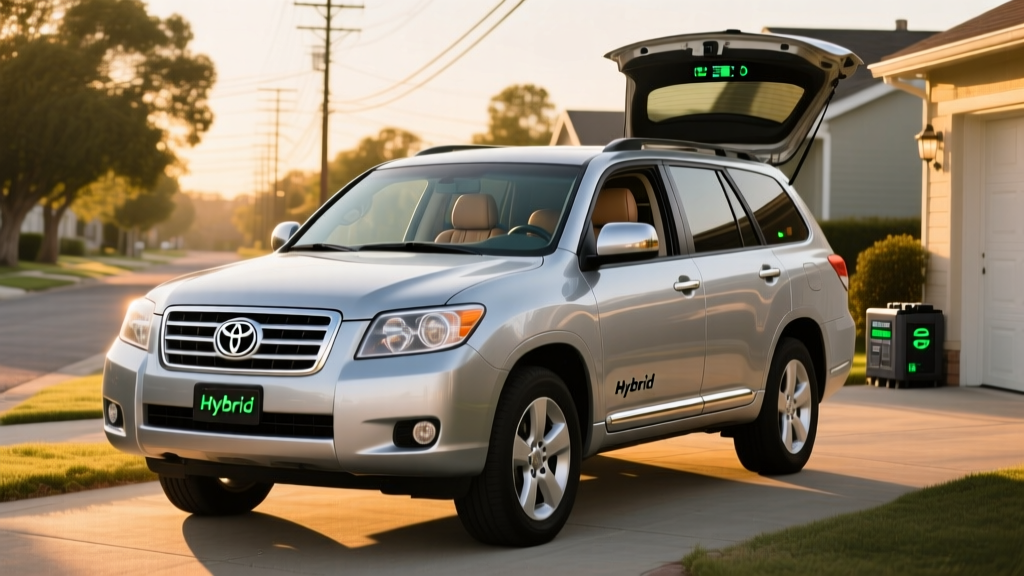
The 2006 Toyota Highlander Hybrid V6 was one of the first mainstream hybrid SUVs to hit the U.S. market, pairing a 3.3-liter V6 with Toyota's Hybrid Synergy Drive system to produce 208 combined horsepower and an EPA-estimated 33 MPG combined. Nearly two decades later, it remains a compelling used purchase for buyers who want hybrid efficiency without plug-in complexity — provided the hybrid battery is in good health.
As a conventional hybrid (HEV), the 2006 Highlander Hybrid requires no plug, no charging routine, and no range anxiety. It captures energy through regenerative braking and engine optimization, delivering city mileage that often exceeds its highway numbers — a hallmark of Toyota's series-parallel hybrid architecture.
HEV vs PHEV: Understanding What the 2006 Highlander Hybrid Is (and Isn't)
Conventional Hybrid (HEV): The 2006 Highlander Hybrid is a self-charging HEV. It uses a small nickel-metal hydride (NiMH) battery — approximately 6.5 kWh total capacity — that charges exclusively through regenerative braking and the gasoline engine. You never plug it in. The electric motor assists the V6 during acceleration and enables brief electric-only driving at low speeds (typically under 25 mph for short distances).
Plug-in Hybrid (PHEV): Toyota did not offer a Highlander Plug-in Hybrid in 2006. The current-generation Highlander Hybrid (2026) remains an HEV as well — Toyota has not produced a PHEV variant for the U.S. market. If you need electric-only range with a plug, you'd be looking at the Toyota RAV4 Prime (42 miles EV range) or a competitor like the Hyundai Tucson PHEV (33 miles EV range).
This distinction matters because some used-car listings incorrectly describe conventional hybrids as "plug-in" or suggest they need external charging. The 2006 Highlander Hybrid operates entirely on gasoline — the hybrid system simply makes that gasoline go further.
Fuel Economy: EPA Estimates vs Real-World MPG
| Metric | EPA Estimate | Real-World Expectation |
|---|---|---|
| City MPG | 33 MPG | 30–35 MPG (hybrids excel in stop-and-go) |
| Highway MPG | 28 MPG | 26–30 MPG (aerodynamic drag limits hybrid advantage) |
| Combined MPG | 33 MPG | 28–33 MPG (depends heavily on driving mix) |
| Fuel Tank Capacity | 17.2 gallons | ~480–570 miles total range |
The EPA rated the 2006 Highlander Hybrid at 33 city / 28 highway / 33 combined, according to fueleconomy.gov. The higher city figure is characteristic of Toyota's Hybrid Synergy Drive: the electric motor handles low-speed propulsion and stoplight launches, while the V6 kicks in primarily at higher speeds or under heavy load.
In real-world driving, owners report a wide spread. City-heavy commutes with frequent stops can yield 34–35 MPG, as regenerative braking continuously recaptures energy. Highway-dominant driving at 70–80 mph drops efficiency to 25–28 MPG, where the V6 operates more like a conventional engine. Cold weather further reduces fuel economy by 10–15%, as the engine runs longer to heat the cabin and bring the catalytic converter to operating temperature.
Powertrain: 208 HP from V6 + Electric Motor
| Specification | 2006 Toyota Highlander Hybrid V6 |
|---|---|
| Engine | 3.3L V6 (3MZ-FE), 208 HP combined system output |
| Engine HP (standalone) | 208 HP @ 5,600 RPM (net system) |
| Electric Motor | Permanent-magnet synchronous, integrated in transaxle |
| Transmission | eCVT (electronically controlled continuously variable) |
| Drivetrain | AWD (electronic on-demand rear motor, 4WD-i) |
| 0–60 mph | ~7.8 seconds (estimated) |
| Hybrid Battery | NiMH, ~6.5 kWh total capacity |
| Towing Capacity | 3,500 lbs (when properly equipped) |
| Curb Weight | ~4,500 lbs |
The 2006 Highlander Hybrid uses Toyota's first-generation "4WD-i" all-wheel-drive system. Unlike mechanical AWD with a driveshaft, a separate rear-mounted electric motor powers the rear wheels when slip is detected or during hard acceleration. This eliminates the weight and friction loss of a traditional drivetrain, contributing to the model's efficiency advantage over the non-hybrid V6 Highlander, which was rated at roughly 20 MPG combined.
The eCVT transmission is not a belt-and-cone CVT like those found in some competitors. It uses a planetary gearset to seamlessly blend engine and motor power — a design Toyota has refined across millions of vehicles with exceptional reliability.
Hybrid Battery Health, Warranty, and Replacement Cost
Original Battery Warranty: Toyota covered the 2006 Highlander Hybrid's NiMH battery for 8 years / 100,000 miles (10 years / 150,000 miles in California Air Resources Board states). This warranty has expired for all examples by now.
Battery Lifespan: NiMH batteries in Toyota hybrids of this era typically last 150,000–200,000 miles before significant degradation. Many examples exceed this with proper maintenance. The battery doesn't fail catastrophically — it gradually loses capacity, reducing MPG by 2–5 MPG and diminishing electric-assist smoothness.
Replacement Cost (2026): A refurbished/remanufactured NiMH battery pack costs $1,500–$2,500 installed. A new OEM battery from Toyota runs $3,000–$4,500 installed. Independent hybrid specialists in most metro areas can perform the swap in 2–3 hours.
When evaluating a used 2006 Highlander Hybrid, battery condition is the single most important factor. Request a hybrid battery health check — many Toyota dealers and hybrid specialists can read the battery's state of health (SoH) through the OBD-II port. Key indicators of a healthy pack:
- No hybrid system warning lights on the dash
- Smooth, seamless transitions between EV and engine mode
- Consistent regenerative braking feel (not weak or inconsistent)
- MPG readings within 2–3 MPG of EPA estimates
- No stored diagnostic trouble codes (DTCs) related to the hybrid battery
Some owners opt for individual module replacement rather than a full pack — the NiMH battery contains 30–40 individual modules, and replacing just the weak ones can cost $500–$1,000. However, this is a temporary fix if the overall pack is aging unevenly.
Pricing: What You'll Pay in 2026
The 2006 Highlander Hybrid originally carried an MSRP of approximately $33,030 for the base model and $37,000+ for the Limited trim. In the 2026 used market, expect the following:
- 150,000–200,000 miles, fair condition: $3,500–$5,000
- 100,000–150,000 miles, good condition: $5,500–$7,500
- Under 100,000 miles, excellent condition: $8,000–$11,000
- With new/refurbished hybrid battery: Add $1,500–$3,000 to the above ranges
Tax Credit Eligibility
Because the 2006 Highlander Hybrid is a conventional HEV (not a PHEV or BEV), it does not qualify for the federal §30D new clean vehicle credit or the §25E used clean vehicle credit. These credits are reserved for plug-in vehicles — battery electric vehicles (BEVs) and plug-in hybrids (PHEVs) with at least 7 kWh of battery capacity and external charging capability.
Some states offer separate incentives for hybrid purchases, but most have sunset or narrowed to PHEVs and BEVs. Check your state's energy office for current programs. The IRS outlines federal credit eligibility at irs.gov.
Pros and Cons: The Honest Assessment
Pros
- 33 MPG combined in a 7-passenger AWD SUV — still competitive in 2026
- Legendary Toyota hybrid reliability; eCVT is virtually bulletproof
- No plug-in requirement — fuel and go, no charging infrastructure needed
- 3,500-lb towing capacity covers small trailers and boats
- Strong parts availability and independent shop knowledge
- Low entry price compared to modern hybrids or PHEVs
Cons
- Hybrid battery replacement likely needed at this age ($1,500–$4,500)
- No electric-only driving beyond very low-speed, short-distance creep
- Dated interior technology (no Apple CarPlay, basic infotainment)
- Older safety features — no automatic emergency braking, lane-keep assist
- NiMH battery is heavier and less energy-dense than modern lithium-ion packs
- No federal or most state tax credit eligibility
Who Should Choose This Hybrid vs a Modern PHEV or Full EV?
The 2006 Highlander Hybrid V6 occupies a specific niche in 2026's electrified vehicle landscape. Here's a decision framework:
Choose the 2006 Highlander Hybrid if:
- Your budget is under $8,000 and you need a 7-passenger SUV
- You lack access to home or workplace charging (apartment, street parking)
- Your commute is city-heavy, maximizing the hybrid's regenerative braking advantage
- You want minimal ownership complexity — no plug, no charging apps, no electrical work
- You plan to keep the vehicle 3–5 years and accept potential battery replacement cost
Consider a modern PHEV (e.g., 2026 Toyota RAV4 Prime, Chrysler Pacifica PHEV) if:
- You can install a Level 2 charger at home and have a short electric commute (under 40 miles)
- You want to drive most days on electricity alone, using gas only for road trips
- You qualify for the §25E used EV credit (up to $4,000 on eligible used PHEVs) or §30D new vehicle credit (up to $7,500)
- You want modern safety tech (AEB, lane-keeping, adaptive cruise)
Consider a full EV (e.g., 2026 Hyundai Ioniq 5, Tesla Model Y) if:
- You have reliable home Level 2 charging and your daily driving is under 250 miles
- You want the lowest per-mile fuel cost ($0.04–$0.06/mile on home electricity vs $0.12–$0.15/mile for the Highlander Hybrid at 33 MPG and $3.50/gal gas)
- You value instant torque, one-pedal driving, and near-zero routine maintenance
- Your budget supports a $35,000+ purchase and you want current safety and technology
Frequently Asked Questions
How many MPG does the 2006 Toyota Highlander Hybrid V6 get?
The EPA rates it at 33 city / 28 highway / 33 combined. In real-world driving, city-heavy commuters often achieve 30–35 MPG, while highway-dominant driving drops to 26–30 MPG. Cold weather and aggressive acceleration reduce these numbers by 10–15%.
Does the 2006 Highlander Hybrid need to be plugged in?
No. This is a conventional hybrid (HEV), not a plug-in hybrid (PHEV). The battery charges exclusively through regenerative braking and the gasoline engine. You fuel it like any other vehicle at a gas station.
How far can it drive on electric power alone?
The 2006 Highlander Hybrid can creep at very low speeds (under ~25 mph) on electric power alone for roughly 1–2 miles under ideal conditions. This is not a meaningful electric-only range — it's designed to assist during parking-lot maneuvers and stoplight launches, not to replace gasoline driving.
Is the 2006 Highlander Hybrid reliable, and what does battery replacement cost?
Toyota's Hybrid Synergy Drive from this era is among the most reliable powertrains ever produced. The eCVT transmission has no belts or clutches to wear. The primary concern is the NiMH hybrid battery, which typically lasts 150,000–200,000 miles. Replacement costs $1,500–$2,500 for a refurbished pack or $3,000–$4,500 for new OEM, installed. Many independent hybrid specialists offer this service.
Does the 2006 Highlander Hybrid qualify for any tax credits?
No. Federal §30D and §25E tax credits apply only to plug-in vehicles (BEVs and PHEVs). Conventional hybrids like the 2006 Highlander Hybrid are not eligible. Toyota's original hybrid tax credit for this model (up to $2,200) was phased out in 2007 after Toyota reached the 60,000-unit cap.
What should I check before buying a used 2006 Highlander Hybrid?
Prioritize a hybrid battery health scan (OBD-II SoH reading), verify no hybrid system warning lights, confirm smooth EV-to-engine transitions, and review maintenance records for the V6 engine (timing belt service at 90,000–100,000 miles is critical). Also check for rust in the rear subframe, a known issue in salt-belt states.
How does the 2006 Highlander Hybrid compare to the current-generation model?
The 2026 Toyota Highlander Hybrid achieves 35–36 MPG combined with a 2.5L 4-cylinder hybrid system producing 243 HP, modern safety tech (Toyota Safety Sense 2.5+), and a starting MSRP around $42,000. The 2006 model trades 2–3 MPG and significantly less power and technology for a fraction of the price.
Bottom Line: A Budget-Friendly Hybrid That Earned Its Reputation
The 2006 Toyota Highlander Hybrid V6 was ahead of its time — a three-row AWD SUV that sipped fuel like a compact sedan. In 2026, it remains a rational choice for budget-conscious buyers who need space, all-weather capability, and hybrid efficiency without the infrastructure demands of a PHEV or EV. The key variable is battery health: budget for a potential $2,000–$3,000 hybrid battery replacement, and this pioneer can deliver reliable, efficient service for years to come.