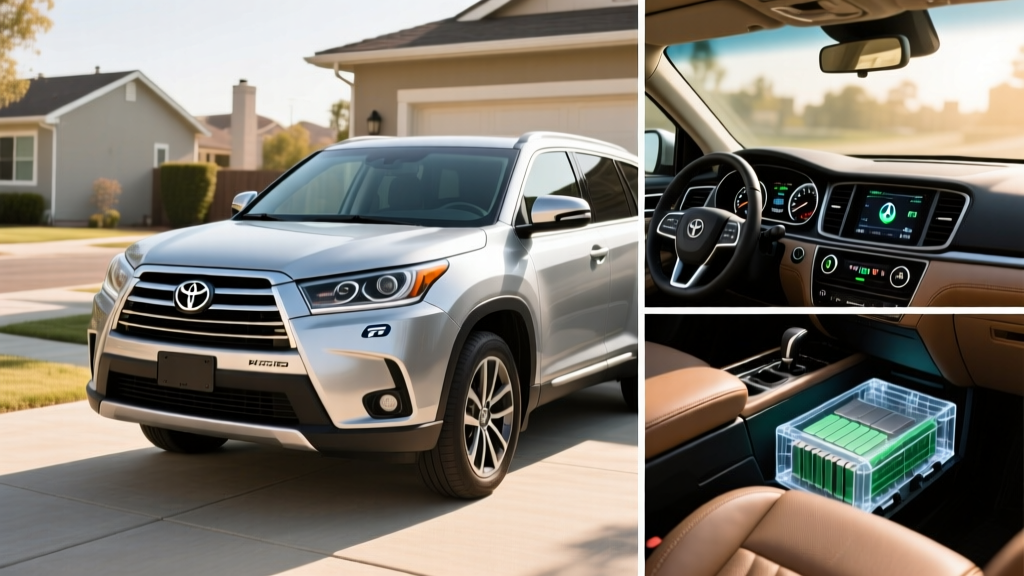
The 2006 Toyota Highlander Hybrid was one of the first mainstream hybrid SUVs to reach American driveways, pairing Toyota's proven Hybrid Synergy Drive system with a 3.3-liter V6. Nearly two decades later, buyers still search for the 06 Highlander Hybrid MPG — whether evaluating a used purchase, troubleshooting fuel economy on a current vehicle, or comparing early hybrid tech against modern alternatives. This guide provides the exact EPA figures, real-world expectations, battery longevity data, and ownership economics you need to make an informed decision in 2026.
2006 Highlander Hybrid MPG: The Official EPA Numbers
According to fueleconomy.gov, the 2006 Toyota Highlander Hybrid AWD achieves the following EPA-estimated fuel economy:
| Metric | Value |
|---|---|
| City MPG | 31 |
| Highway MPG | 27 |
| Combined MPG | 28 |
| Fuel type | Regular unleaded (87 octane) |
| Fuel tank capacity | 17.2 gallons |
| EPA-estimated total range | ~482 miles |
| Annual fuel cost (EPA est., 15k mi/yr) | ~$2,150 (at ~$3.40/gal avg) |
These numbers were exceptional for a midsize three-row SUV in 2006, when the average new vehicle achieved roughly 20 MPG combined. The Highlander Hybrid's city-dominant MPG curve — where 31 city exceeds 27 highway — is a hallmark of Toyota's series-parallel hybrid system, which relies heavily on electric-motor assist at low speeds and in stop-and-go traffic.
Real-World MPG: What Owners Actually Report
EPA estimates are laboratory-controlled. Real-world results for the 06 Highlander Hybrid vary significantly based on driving conditions, vehicle age, and battery health:
- City driving (healthy battery): 27–30 MPG — hybrids often match or slightly beat EPA city figures in moderate climates
- Highway cruising (70+ mph): 23–26 MPG — aerodynamic drag and the 3.3L V6 working solo reduce efficiency
- Cold weather (below 30°F): 22–25 MPG combined — engine runs more often for cabin heat and battery warming
- Aged battery (15+ years): 20–24 MPG combined — degraded NiMH cells reduce electric-motor assist, forcing the gas engine to work harder
The single biggest variable for a 2006 model in 2026 is traction battery condition. The original nickel-metal hydride (NiMH) pack was rated at 1.0 kWh nominal. After 18–20 years, capacity loss of 30–50% is common, directly reducing the electric motor's contribution and dragging down observed MPG. Owners who have replaced or reconditioned their hybrid battery report fuel economy closer to original EPA figures.
Hybrid Powertrain: How the System Works
The 2006 Highlander Hybrid uses Toyota's second-generation Hybrid Synergy Drive (HSD), a series-parallel full hybrid system. This is a conventional hybrid (HEV), not a plug-in hybrid (PHEV). It never needs to be plugged in — the battery recharges through regenerative braking and the gasoline engine.
| Component | Specification |
|---|---|
| Gas engine | 3.3L V6 (3MZ-FE), 208 HP @ 5,600 RPM |
| Front electric motor | 123 kW (165 HP) |
| Rear electric motor (AWD-i) | 50 kW (67 HP) |
| Combined net system output | 270 HP |
| Transmission | eCVT (electronically controlled continuously variable) |
| Drivetrain | Electronic AWD (AWD-i) — no mechanical driveshaft to rear |
| Hybrid battery | NiMH, ~1.0 kWh nominal (sealed, non-plug-in) |
| 0–60 MPH | ~7.5 seconds |
| Curb weight | ~4,500 lbs |
| Towing capacity | 3,500 lbs (when properly equipped) |
The eCVT transmission uses a planetary gearset rather than belts or pulleys, which is why Toyota's hybrid transaxles are among the most durable in the industry — there are no friction bands or clutch packs to wear out. The AWD-i system engages the rear electric motor only when slip is detected or during hard acceleration, eliminating the weight and friction losses of a traditional mechanical AWD system.
HEV vs PHEV vs EV: Where Does This Highlander Fit?
If you're comparing a used 2006 Highlander Hybrid against modern electrified options, here's how the categories break down:
No plug. No electric-only range to speak of (under 1 mile at very low speed). Gasoline-powered with electric assist. Refuel at any gas station. Typical combined MPG: 24–28.
PHEV (Plug-In Hybrid) — e.g., 2026 Toyota RAV4 Prime
Plugs in. 42 miles EPA electric-only range. 18.1 kWh battery. Gas engine for longer trips. Combined 38 MPG after battery depletes. Eligible for up to $7,500 federal tax credit (new purchase, subject to §30D sourcing and income rules).
BEV (Battery Electric Vehicle) — e.g., 2026 Hyundai Ioniq 5
Plugs in. No gasoline. 303-mile EPA range. 77.4 kWh battery. Zero tailpipe emissions. Requires home or public charging access. Eligible for up to $7,500 federal tax credit (subject to §30D rules).
The 2006 Highlander Hybrid is purely an HEV. It requires zero behavioral change from a gas-car owner — you fuel it normally, and the hybrid system works transparently to reduce consumption. The trade-off is that its efficiency gains are modest compared to a modern PHEV or BEV, and it has no electric-only driving capability for daily commutes.
Battery Lifespan, Warranty, and Replacement Costs
Original factory warranty: 8 years / 100,000 miles (hybrid battery and related components). In CARB states (CA, NY, MA, and others), coverage extended to 10 years / 150,000 miles.
Expected battery lifespan: 12–18 years or 150,000–200,000 miles under normal conditions. Many first-gen Highlander Hybrids have exceeded this with original batteries, but capacity degradation is inevitable.
Current warranty status (2026): All original factory hybrid battery warranties have expired. Any replacement is at owner expense unless covered by an extended warranty or state-specific program.
Hybrid Battery Replacement Costs in 2026
| Option | Estimated Cost | Notes |
|---|---|---|
| New OEM Toyota NiMH pack | $3,000–$4,200 (parts + labor) | Available through Toyota dealerships; longest expected lifespan |
| Reconditioned/remanufactured pack | $1,500–$2,500 (parts + labor) | Third-party suppliers like Green Bean Battery; typically 1–3 year warranty |
| Individual module replacement | $400–$900 | Only viable if 1–2 modules are weak; requires diagnostic scan tool |
| Used salvage pack | $500–$1,200 | Risky — unknown remaining life; no meaningful warranty |
A common failure mode on aging NiMH packs is individual module imbalance rather than total pack failure. A qualified hybrid technician can perform a module-level balance or targeted replacement for significantly less than a full pack swap. If you're evaluating a used 2006 Highlander Hybrid, request a hybrid battery health check — a Techstream scan will show module voltage delta and state-of-health percentage.
Is the 2006 Highlander Hybrid Reliable?
Toyota's early hybrid systems have proven remarkably durable. The 3MZ-FE V6 engine is shared with the Camry and Lexus RX of the same era and is known to exceed 250,000 miles with basic maintenance. The eCVT transaxle has no wearable friction components and rarely requires service.
Key reliability considerations specific to the 2006 Highlander Hybrid:
- Inverter coolant pump: Known failure point around 120,000–160,000 miles. Replacement cost: $400–$700. Failure can overheat the inverter and trigger limp mode.
- Hybrid battery cooling fan: Located behind the rear seat; can clog with dust/pet hair. Should be cleaned every 30,000–50,000 miles to prevent battery overheating and accelerated degradation.
- Brake actuator: The electro-hydraulic brake system (which blends regenerative and friction braking) has a higher failure rate than conventional brakes after 150,000 miles. Replacement: $1,200–$1,800.
- 12V auxiliary battery: Located in the rear cargo area; standard replacement every 4–5 years. A weak 12V battery can prevent the hybrid system from booting, mimicking a traction-battery failure.
According to NHTSA records, the 2006 Highlander Hybrid has relatively few safety recalls — primarily related to front suspension lower ball joints and curtain airbag inflators, not hybrid-system defects.
Tax Credits and Incentives
The 2006 Toyota Highlander Hybrid is not eligible for any current federal tax credit. Here's why:
- Original federal hybrid credit: Under the Energy Policy Act of 2005, the Highlander Hybrid qualified for a $2,200 federal income tax credit when new. This credit was available only to original purchasers and phased out after Toyota reached 60,000 qualifying vehicle sales in 2007. It has not been available for over a decade.
- Current §30D Clean Vehicle Credit: The IRS §30D credit applies only to new qualifying plug-in electric vehicles (PHEVs and BEVs) with minimum battery capacities. Conventional hybrids (HEVs) like the 2006 Highlander Hybrid do not qualify.
- Used EV credit (§25E): Up to $4,000 for used PHEVs and BEVs purchased from a dealer for under $25,000. HEVs are excluded.
- State incentives: A handful of states previously offered hybrid purchase rebates, but most have sunset or shifted exclusively to plug-in vehicles. Check your state's current energy office or DMV for any remaining programs.
If you're buying a used 2006 Highlander Hybrid today, expect to pay market price with no federal or state incentive offset. Average used pricing in 2026 ranges from $4,500 to $8,500 depending on mileage, condition, and hybrid battery health.
Who Should Buy the 2006 Highlander Hybrid in 2026?
Choose the 2006 Highlander Hybrid if:
- You need a three-row SUV on a tight budget (under $8,000)
- You want AWD capability without the fuel penalty of a conventional AWD V6 SUV
- You drive primarily in city/suburban conditions where hybrid efficiency shines
- You want proven Toyota reliability with no plug-in infrastructure requirements
- You're comfortable budgeting $1,500–$4,000 for a potential hybrid battery replacement
Look at a modern PHEV or BEV instead if:
- You want electric-only commuting (a PHEV like the RAV4 Prime offers 42 miles EV range)
- You want eligibility for federal tax credits ($7,500 new, up to $4,000 used EV)
- You want modern safety tech (automatic emergency braking, lane-keeping, blind-spot monitoring — none available on the 2006 Highlander)
- You plan to keep the vehicle 8+ years and want warranty-backed battery coverage
- You want significantly lower per-mile energy costs (home-charged EVs average $0.04–$0.06/mile vs $0.12–$0.15/mile for this hybrid)
Pros and Cons at a Glance
- Strong combined MPG for a V6 AWD SUV (28 EPA combined)
- Proven Toyota hybrid reliability with simple eCVT
- 3,500-lb towing — rare for hybrids of this era
- No plug-in requirement; zero behavior change from gas cars
- Low used-market entry price ($4,500–$8,500)
- Hybrid battery likely near end-of-life if original; $1,500–$4,200 replacement
- No modern ADAS features (no AEB, no lane-keeping, no backup camera standard)
- No federal or state tax credit eligibility
- Modest efficiency gains over modern hybrids (2026 Highlander Hybrid: 35 combined MPG)
- Highway MPG disappointing for its age (27 EPA, often 23–26 real-world)
Frequently Asked Questions
How many MPG does the 2006 Highlander Hybrid actually get?
The EPA rates it at 31 city / 27 highway / 28 combined MPG. In real-world driving with a healthy hybrid battery, expect 27–30 MPG in the city and 23–26 MPG on the highway. A degraded battery will reduce these figures by 3–6 MPG.
Does the 2006 Highlander Hybrid need to be plugged in?
No. This is a conventional hybrid (HEV), not a plug-in hybrid (PHEV). The battery recharges through regenerative braking and the gasoline engine. You fuel it like any other car at a gas station.
How long does the hybrid battery last, and what does replacement cost?
Original NiMH batteries typically last 12–18 years or 150,000–200,000 miles. In 2026, most surviving examples are near or past this window. A new OEM replacement runs $3,000–$4,200 installed; reconditioned packs cost $1,500–$2,500.
Is the 2006 Highlander Hybrid AWD system mechanical?
No. The AWD-i system uses a separate rear electric motor (50 kW) to power the rear wheels when needed. There is no driveshaft, transfer case, or mechanical connection between the front and rear axles. This reduces weight and mechanical losses compared to traditional AWD.
How does the 2006 Highlander Hybrid compare to the current model?
The 2026 Toyota Highlander Hybrid achieves an EPA-estimated 35 MPG combined with a 2.5L four-cylinder hybrid system producing 243 HP. That's a 25% efficiency improvement and significantly more cargo space, modern safety tech, and a new-vehicle warranty — but at a starting MSRP around $42,000 versus $5,000–$8,000 for a used 2006.
Does the 2006 Highlander Hybrid qualify for any tax credit?
No. The original $2,200 federal hybrid credit expired for Toyota in 2007, and current §30D and §25E credits apply only to plug-in vehicles (PHEVs and BEVs). No federal incentive is available for purchasing this vehicle in 2026.