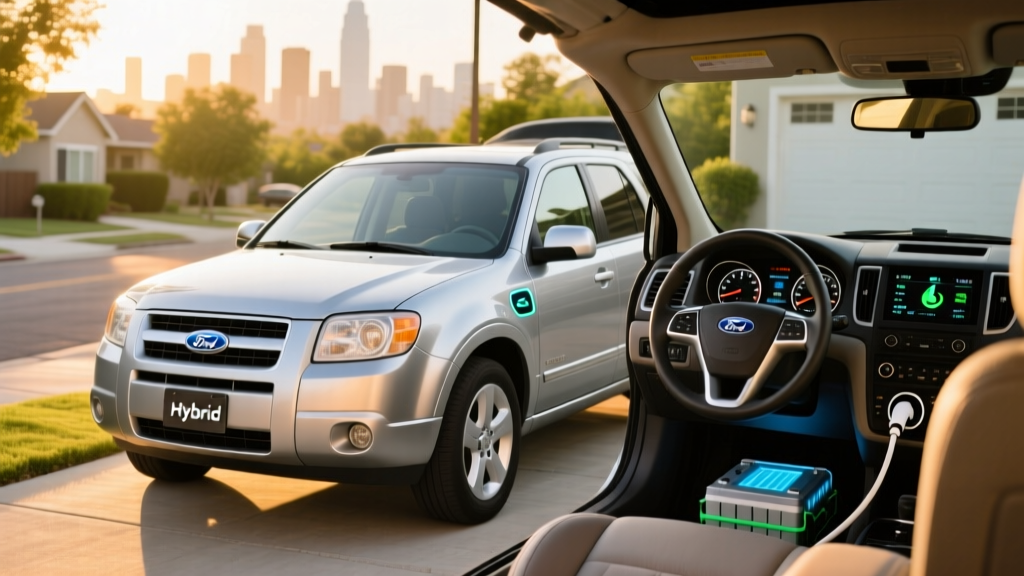
The 2006 Ford Escape Hybrid holds a unique place in automotive history: it was one of the first hybrid SUVs sold in the United States, arriving when Toyota's Prius was still the only mainstream hybrid most buyers knew. Nearly two decades later, used examples of the 2006 Escape Hybrid still circulate on the secondhand market, and owners — or prospective budget buyers — need honest data on what this early hybrid system actually delivers today.
This guide covers the 2006 Escape Hybrid's powertrain specs, real-world fuel economy, high-voltage battery longevity and replacement costs, and whether this pioneering HEV still earns a spot in your driveway versus a newer hybrid, plug-in hybrid, or full battery-electric vehicle.
2006 Ford Escape Hybrid: Core Specifications
| Specification | Detail |
|---|---|
| Vehicle Type | Conventional Hybrid (HEV) — no plug-in |
| Engine | 2.3L Atkinson-cycle inline-4 |
| Electric Motor | Permanent-magnet AC synchronous, 94 hp (70 kW) |
| Combined System Output | 155 hp |
| Transmission | eCVT (planetary gearset, not belt-driven CVT) |
| Traction Battery | 330V Nickel-Metal Hydride (NiMH), ~5.5 Ah / ~1.8 kWh |
| Drivetrain | FWD standard; AWD optional (AWD drops MPG) |
| EPA Fuel Economy (FWD) | 33 city / 29 highway / 31 combined MPG |
| EPA Fuel Economy (AWD) | 29 city / 27 highway / 28 combined MPG |
| Fuel Tank | 15.0 gallons |
| 0-60 mph | ~10.8 seconds |
| Original MSRP (2006) | ~$26,970 (base HEV trim) |
| 2026 Used Market Range | $2,500 – $6,500 depending on condition/mileage |
How Many MPG Does the 2006 Escape Hybrid Actually Get?
The EPA-rated figures for the front-wheel-drive 2006 Escape Hybrid are 33 MPG city, 29 MPG highway, and 31 MPG combined, according to fueleconomy.gov. The AWD variant drops to 29/27/28 MPG city/highway/combined due to the added weight and drivetrain losses of the rear axle.
Real-World MPG vs. EPA Sticker
Like most conventional hybrids of this era, the 2006 Escape Hybrid tends to perform close to or slightly above its EPA city rating in stop-and-go driving, where regenerative braking and electric-motor assist do the heavy lifting. Owners on fuel-tracking platforms like Fuelly report real-world averages between 28 and 33 MPG combined, with city-heavy commuters occasionally hitting 35 MPG in warm weather.
Highway driving tells a different story. At sustained 70-75 mph speeds, the gasoline engine carries most of the load, and the aerodynamic profile of a compact SUV works against efficiency. Expect 26-29 MPG on the highway in real-world conditions — a few points below the EPA highway sticker.
Cold weather also reduces fuel economy noticeably. In sub-40°F conditions, the engine runs more frequently to maintain cabin heat and battery temperature, dropping real-world combined MPG into the mid-20s.
| Driving Scenario | EPA Rating (FWD) | Real-World Expectation |
|---|---|---|
| City (stop-and-go) | 33 MPG | 31–35 MPG |
| Highway (70 mph) | 29 MPG | 26–29 MPG |
| Combined | 31 MPG | 28–33 MPG |
| Cold weather (below 40°F) | — | 24–28 MPG |
Hybrid Powertrain: How the 2006 Escape HEV System Works
The 2006 Escape Hybrid uses Ford's first-generation full-hybrid system, which was developed with significant input from Aisin (the Toyota-affiliated transmission supplier) and shares conceptual architecture with Toyota's Hybrid Synergy Drive. This is a conventional hybrid — meaning the battery charges exclusively through regenerative braking and engine-driven generation. There is no plug, no charging port, and no electric-only driving mode beyond brief low-speed creep.
Engine and Motor Specs
The gasoline side is a 2.3-liter inline-four running the Atkinson cycle, producing 133 hp and 124 lb-ft of torque on its own. The Atkinson cycle sacrifices low-end torque for greater thermal efficiency — a tradeoff the electric motor compensates for during acceleration.
The electric motor is a permanent-magnet AC synchronous unit rated at 94 hp (70 kW). Combined system output is 155 hp, which was competitive for a compact SUV in 2006 but feels modest by 2026 standards. The eCVT transmission is a planetary gearset design — fundamentally different from the rubber-belt CVTs found in some non-hybrid vehicles — and is known for durability.
- HEV (this vehicle): No plug. Battery is small (~1.8 kWh). Recharges via regen and engine. Cannot drive on electric power alone except at very low speeds for brief distances. No electric-only range rating.
- PHEV (e.g., 2026 Ford Escape PHEV): Plugs in. Larger battery (~14.4 kWh usable). Offers ~37 miles of electric-only range before the engine engages. Qualifies for potential federal tax credits depending on current-year rules.
Battery Life, Replacement Cost, and Warranty
The high-voltage NiMH traction battery is the single most important factor when evaluating a 2006 Escape Hybrid today. Ford originally warranted this battery for 8 years / 100,000 miles (and 10 years / 150,000 miles in California Air Resources Board states). That warranty has long since expired on any 2006 model.
- Original warranty: 8 yr / 100,000 mi (10 yr / 150,000 mi in CARB states) — expired
- NiMH battery expected lifespan: 150,000–200,000 miles before significant degradation
- Replacement cost (remanufactured): $2,000 – $3,500 installed
- Replacement cost (new OEM): $3,500 – $5,000+ if available
- Individual module reconditioning: $500 – $1,500 (independent hybrid shops)
Is the 2006 Escape Hybrid Battery Reliable?
NiMH batteries from this era are remarkably robust. Unlike early lithium-ion packs, NiMH chemistry degrades slowly and predictably. Many 2006 Escape Hybrids have reached 200,000+ miles on the original battery with only modest capacity loss. The most common failure mode is not total battery death but individual cell-module imbalance — one or two modules degrade faster than the rest, triggering a check-engine light and reducing fuel economy.
Specialized hybrid repair shops can recondition or replace individual modules for $500–$1,500, extending battery life at a fraction of full-pack replacement cost. A full remanufactured pack replacement runs $2,000–$3,500 installed. New OEM packs are increasingly scarce for this model year, and some dealers may no longer stock them.
When shopping for a used 2006 Escape Hybrid, request a battery health check (State of Health, or SoH, reading) from a hybrid-capable mechanic. Also check whether the battery cooling fan — located behind the rear cargo area — is free of dust and debris, as blocked airflow accelerates degradation.
Who Should Buy a 2006 Escape Hybrid in 2026?
This is a niche proposition in 2026, but it can make sense for specific buyers:
- Budget-conscious commuters who want hybrid fuel economy at a sub-$5,000 purchase price and can tolerate a 20-year-old vehicle.
- Short-trip city drivers whose stop-and-go routes maximize the hybrid system's regenerative braking advantage.
- DIY-inclined owners comfortable with hybrid battery maintenance and access to independent hybrid shops.
This vehicle is not ideal for:
- Buyers seeking modern safety features (the 2006 Escape predates standard electronic stability control, blind-spot monitoring, and automatic emergency braking).
- Anyone wanting electric-only driving range or plug-in capability.
- Those without access to a hybrid-qualified mechanic in their area.
2006 Escape Hybrid vs. Modern Alternatives
| Factor | 2006 Escape Hybrid (HEV) | 2026 Ford Escape Hybrid (HEV) | 2026 Ford Escape PHEV |
|---|---|---|---|
| Combined MPG / MPGe | 31 MPG | ~39 MPG | ~105 MPGe (elec) / 40 MPG (gas) |
| Electric-Only Range | None | None | ~37 miles |
| Plugs In? | No | No | Yes (Level 2, ~3.5 hr) |
| Combined HP | 155 hp | ~210 hp | ~210 hp |
| Federal Tax Credit | None | None | Up to $3,750 (§30D, income/MSRP limits apply) |
| Battery Chemistry | NiMH | Lithium-ion | Lithium-ion |
| Battery Warranty | Expired | 8 yr / 100,000 mi | 8 yr / 100,000 mi |
| Approx. Price | $2,500–$6,500 (used) | ~$34,000+ (new) | ~$40,000+ (new) |
Tax Credit and Incentive Eligibility
The 2006 Ford Escape Hybrid does not qualify for the current federal §30D Clean Vehicle Credit. That credit applies only to new plug-in electric vehicles (BEVs and PHEVs) meeting specific battery-sourcing, critical-mineral, MSRP cap, and buyer-income requirements as defined by the IRS.
For the 2006 model year, Ford did offer a now-expired federal tax credit of up to $2,600 under the Energy Policy Act of 2005, but this credit phased out after Ford reached its 60,000-unit hybrid sales cap — which occurred in 2009. No federal or state incentives remain available for this vehicle in 2026.
If you are considering a plug-in alternative like the 2026 Ford Escape PHEV, the §30D credit may offer up to $3,750 depending on battery component sourcing, your adjusted gross income, and the vehicle's MSRP falling under the $80,000 SUV cap. Always verify current eligibility with a tax professional before purchasing.
Ownership Costs and Practical Considerations
Fuel Cost Comparison
At 31 MPG combined and a national average of $3.40/gallon for regular unleaded (as of early 2026), the 2006 Escape Hybrid costs approximately $0.11 per mile in fuel. By comparison, the non-hybrid 2006 Escape with the 3.0L V6 averaged about 20 MPG combined — costing roughly $0.17 per mile. Over 15,000 annual miles, that's a fuel savings of about $900 per year with the hybrid.
Maintenance and Insurance
Maintenance costs are modest. The hybrid system adds complexity (inverter, electric motor, high-voltage cabling) but eliminates the traditional starter motor and alternator — both are handled by the hybrid motor/generator. Brake pads often last 80,000+ miles thanks to regenerative braking handling most deceleration.
Insurance costs are generally low due to the vehicle's age and low market value, though rates vary by state and driver profile. Expect $800–$1,400 annually for liability and comprehensive coverage.
Reliability Record
The 2006 Escape Hybrid earned an above-average reliability reputation during its production run. The eCVT planetary gearset is virtually bulletproof — it has no belts, no clutch packs, and few wear components. The gasoline 2.3L Duratec engine is simple and well-understood by mechanics. The primary reliability risk is the high-voltage battery in high-mileage examples and the electric power steering system, which was a known failure point on 2005–2007 Escape models.
Pros, Cons, and Final Verdict
Pros
- 31 MPG combined — excellent for a 2006 SUV
- Ultra-low purchase price ($2,500–$6,500)
- Proven, durable eCVT planetary gearset
- NiMH battery is robust and reconditionable
- Strong city MPG from regenerative braking
- No plug-in infrastructure needed
Cons
- Original battery warranty expired — replacement is an out-of-pocket risk
- Modest 155 hp feels slow by 2026 standards (0-60 in ~10.8 sec)
- No modern safety tech (no AEB, no blind-spot monitoring)
- Highway MPG drops below EPA sticker at sustained speed
- No electric-only range, no plug-in capability
- OEM replacement battery parts increasingly scarce
Frequently Asked Questions
How many MPG does the 2006 Ford Escape Hybrid get?
The EPA rates the FWD 2006 Escape Hybrid at 33 city / 29 highway / 31 combined MPG. The AWD version drops to 29/27/28. Real-world combined averages fall between 28 and 33 MPG depending on driving style, route, and climate.
Does the 2006 Escape Hybrid plug in?
No. This is a conventional hybrid (HEV). The battery charges only through regenerative braking and the gasoline engine. There is no charging port and no electric-only driving range.
How much does it cost to replace the hybrid battery?
A remanufactured NiMH battery pack costs $2,000–$3,500 installed. Individual module reconditioning at a hybrid specialist can cost as little as $500–$1,500. New OEM packs may no longer be available from Ford.
Is the 2006 Escape Hybrid reliable?
Yes, with the caveat that any 20-year-old vehicle requires maintenance. The eCVT transmission is extremely durable. The NiMH battery typically lasts 150,000–200,000 miles. The most common failure point is the electric power steering system, not the hybrid drivetrain.
Does this vehicle qualify for any tax credit in 2026?
No. The federal hybrid tax credit that applied to the Escape Hybrid phased out in 2009 after Ford reached its sales cap. Current §30D credits apply only to new plug-in vehicles (BEVs and PHEVs). See fueleconomy.gov for historical credit data.
Hybrid vs. PHEV vs. EV — which should I choose?
Choose a conventional HEV like this Escape Hybrid if you want better fuel economy with zero lifestyle change — no plugging in, no range planning, no charging infrastructure. Choose a PHEV if you have home charging access and want 25–40 miles of daily electric driving with a gas backup for longer trips. Choose a full BEV if you have reliable home or workplace charging, want zero tailpipe emissions, and your daily driving stays within the vehicle's range (typically 250–350 miles for modern EVs).
What should I check before buying a used 2006 Escape Hybrid?
Request a high-voltage battery State of Health (SoH) reading from a hybrid-capable scan tool. Verify the battery cooling fan is operational and unobstructed. Check for electric power steering recalls and repairs. Confirm the eCVT shifts smoothly with no shuddering. Review maintenance records for coolant changes on the inverter cooling loop.