Quick Verdict: The Pioneer That Still Has a Pulse
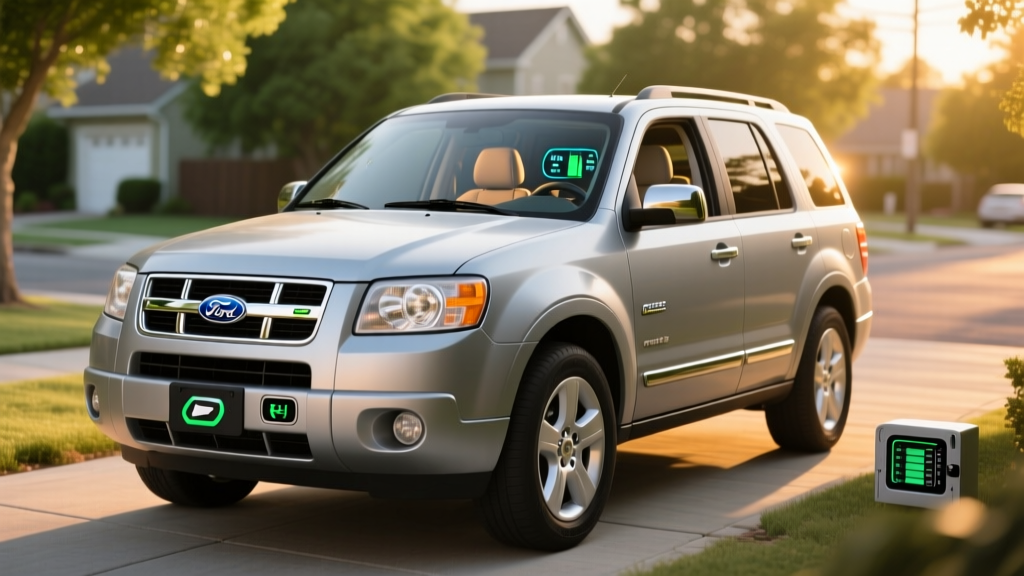
The 2006 Ford Escape Hybrid holds a unique place in automotive history: it was the first hybrid SUV sold in the United States, beating the Toyota Highlander Hybrid to market by months. Nearly two decades later, surviving examples still attract buyers looking for an ultra-cheap, fuel-efficient compact SUV. With EPA ratings of 33 MPG city and 29 MPG highway, the 2006 Escape Hybrid sips fuel at a rate that still competes with many modern non-hybrid crossovers.
But buying a 20-year-old hybrid in 2026 comes with specific risks — primarily the high-voltage battery. This guide covers every number you need: real-world MPG, battery replacement costs, powertrain specs, and whether this early HEV is a smart used buy or a money pit waiting to happen.
| Spec | Value |
|---|---|
| Powertrain Type | Conventional Hybrid (HEV) — no plug-in |
| Engine | 2.3L Atkinson-cycle 4-cylinder |
| Gas Engine Output | 133 HP @ 6,000 RPM |
| Electric Motor Output | 94 HP (permanent-magnet AC synchronous) |
| Combined System Output | 155 HP |
| Transmission | Electronically controlled CVT (eCVT) |
| Hybrid Battery | ~1.8 kWh NiMH (Nickel-Metal Hydride) |
| Drivetrain | FWD standard; e-AWD optional |
| EPA City MPG | 33 MPG |
| EPA Highway MPG | 29 MPG (FWD) / 28 MPG (AWD) |
| EPA Combined MPG | 31 MPG (FWD) |
| Fuel Tank | 16.5 gallons |
| Total Range (FWD) | ~511 miles |
| 0-60 MPH | ~10.8 seconds |
| Towing Capacity | 1,000 lbs (not recommended for heavy towing) |
| Cargo Volume | 28.1 cu ft (rear seats up) / 65.6 cu ft (folded) |
| Original MSRP (2006) | ~$29,895 (base) |
| Current Used Price (2026 est.) | $2,500 – $5,500 |
HEV vs PHEV: What the 2006 Escape Hybrid Actually Is
Before going further, it's critical to understand what this vehicle is — and isn't. The 2006 Ford Escape Hybrid is a conventional hybrid electric vehicle (HEV). It is not a plug-in hybrid (PHEV) and it is not a battery electric vehicle (BEV).
| Feature | HEV (2006 Escape Hybrid) | PHEV (e.g., 2026 RAV4 Prime) | BEV (e.g., 2026 Tesla Model Y) |
|---|---|---|---|
| Plug-in charging? | No — self-charging via regen & engine | Yes — Level 1/Level 2 | Yes — Level 1/2/DC fast |
| Electric-only range | ~0.5–1 mile at low speed | 35–42 miles | 250–330+ miles |
| Battery size | ~1.8 kWh NiMH | ~18.1 kWh Li-ion | 60–82 kWh Li-ion |
| Gas engine? | Yes — primary power source | Yes — backup after EV range | No |
| Tax credit (federal) | Not eligible (§30D is for PHEV/BEV only) | Up to $7,500 (if eligible) | Up to $7,500 (if eligible) |
| Home charger needed? | No | Recommended for daily EV use | Essential |
The Escape Hybrid's small 1.8 kWh NiMH battery charges entirely through regenerative braking and the gasoline engine. You never plug it in. The electric motor assists during acceleration, enables idle stop-start, and allows brief low-speed electric-only creeping (typically under 25 MPH for very short distances). The system is managed by Ford's version of the planetary-gear eCVT — the same architecture Toyota pioneered with the Prius, licensed to Ford.
Fuel Economy: EPA Ratings vs Real-World MPG
The EPA rates the 2006 Ford Escape Hybrid FWD at 33 MPG city / 29 MPG highway / 31 MPG combined. The AWD variant drops slightly to 31 city / 28 highway / 29 combined. These figures come from fueleconomy.gov and remain the authoritative source.
| Drivetrain | City MPG | Highway MPG | Combined MPG | Est. Annual Fuel Cost* |
|---|---|---|---|---|
| FWD | 33 | 29 | 31 | ~$1,450 |
| AWD | 31 | 28 | 29 | ~$1,550 |
*Based on 15,000 miles/year, 55% city driving, regular unleaded at ~$3.00/gal (2026 national average estimate). Your costs will vary with local fuel prices.
Real-World MPG: What Owners Actually Report
Like most hybrids, the 2006 Escape Hybrid tends to exceed its EPA city rating in stop-and-go traffic, where regenerative braking recaptures energy constantly. Owner forums and aggregated data from sources like Fuelly show real-world city driving often yields 34–36 MPG for careful drivers.
Highway driving tells a different story. At sustained 70+ MPH speeds, the hybrid system provides minimal benefit — the gas engine does nearly all the work, and the vehicle's boxy aerodynamics create substantial drag. Expect 26–28 MPG on the highway in real-world conditions, slightly below the EPA sticker. Cold weather further reduces efficiency by 10–15%, as the engine runs more frequently to provide cabin heat and warm up the catalytic converter.
Real-World Range Expectation: On a full 16.5-gallon tank, expect approximately 430–480 miles of mixed driving. Pure city driving can stretch this to 520+ miles. Highway road trips will yield closer to 400–430 miles per tank.
Powertrain Deep Dive: How the Hybrid System Works
The 2006 Escape Hybrid pairs a 2.3-liter Atkinson-cycle four-cylinder engine with a 94 HP permanent-magnet electric motor through an electronically controlled continuously variable transmission (eCVT). This isn't a belt-driven CVT like those found in Nissan or Subaru products — it's a planetary gearset that blends torque from the engine and motor with no fixed gear ratios and no clutches to wear out.
The Atkinson cycle sacrifices low-RPM torque in favor of thermal efficiency by keeping the intake valve open slightly during the compression stroke. The electric motor fills in the torque gap, providing strong low-end shove that the gas engine alone can't deliver. Combined output is 155 HP, which is adequate for city merging but leisurely for highway passing. The 0-60 MPH time of approximately 10.8 seconds feels slow by 2026 standards.
The AWD system on the Escape Hybrid is noteworthy: instead of a mechanical driveshaft, a separate rear-mounted electric motor powers the rear wheels when slip is detected. This "e-AWD" system eliminates the weight and friction losses of a conventional AWD drivetrain, though it's designed for light traction duty (rain, snow) rather than off-road use.
Battery Health, Replacement Cost, and Warranty
This is the single most important factor when evaluating any used hybrid — and for a 2006 model, it's the make-or-break question.
Original Battery Warranty: Ford covered the 2006 Escape Hybrid's NiMH battery for 8 years / 100,000 miles (10 years / 150,000 miles in CARB states including California, New York, Massachusetts, and others that adopted California emissions standards). This warranty has expired for all 2006 models.
Battery Degradation and Lifespan
NiMH batteries in early Ford and Toyota hybrids proved remarkably durable. Many 2005–2008 Escape Hybrids and Toyota Priuses have exceeded 200,000 miles on their original battery packs. The NiMH chemistry is less energy-dense than modern lithium-ion but more tolerant of temperature extremes and full-cycle abuse.
That said, at 20 years old, any original battery is living on borrowed time. Common failure modes include:
- Cell imbalance: Individual cells within the pack degrade at different rates, causing the battery management system to limit usable capacity. Symptoms include reduced MPG, more frequent engine cycling, and a dashboard warning light.
- Capacity loss: Total pack capacity drops below the threshold needed for meaningful electric assist. The vehicle still drives, but fuel economy degrades toward non-hybrid levels (22–25 MPG).
- Complete failure: Rare but possible. The vehicle will enter a limp-home mode with severely reduced power.
Battery Replacement Cost (2026 Estimates)
| Option | Cost Range | Notes |
|---|---|---|
| New OEM battery (Ford) | $3,000 – $4,000 + labor | Increasingly difficult to source; may be NLA (no longer available) from Ford |
| Remanufactured battery | $1,500 – $2,500 + labor | Most common option; companies like Green Bean Battery and Dorman offer refurbished packs with 1–3 year warranties |
| Used/salvage battery | $400 – $900 + labor | High risk — unknown remaining lifespan; typically no warranty |
| Individual cell replacement (DIY) | $200 – $500 (parts) | Requires technical skill; some hybrid shops offer this service for $800–$1,200 |
For a vehicle worth $2,500–$5,500, a $2,000+ battery replacement represents a significant percentage of the car's value. Budget accordingly. Before purchasing, have the hybrid battery's state of health (SoH) checked with a scan tool that can read individual cell voltages — many independent hybrid specialists offer this service for $50–$100.
Tax Credits and Incentives: What Applies in 2026?
The 2006 Ford Escape Hybrid does not qualify for the current federal §30D Clean Vehicle Credit. Under current IRS rules, the §30D credit applies only to new plug-in electric vehicles (BEVs and PHEVs) with sufficient battery capacity and meeting battery-sourcing and critical-mineral requirements. Conventional hybrids (HEVs) have never qualified for this credit.
When new in 2006, the Escape Hybrid did qualify for a federal income tax deduction (not a credit) for clean-fuel vehicles, but that provision expired long ago. Some states offered additional incentives at the time (HOV lane access, rebates), but these have also lapsed.
2026 Federal Tax Credit Summary for Used Buyers:
- §30D New Clean Vehicle Credit: Not applicable (HEV, not plug-in)
- §25E Used Clean Vehicle Credit: Not applicable (requires BEV or PHEV with ≥7 kWh battery; the Escape Hybrid has ~1.8 kWh NiMH)
- State/local incentives: Vary by jurisdiction — check your state's energy office or DMV for any hybrid-specific programs. Most have shifted focus to plug-in vehicles.
Reliability, Safety, and Common Issues
The 2006 Escape Hybrid benefits from Ford's generally solid build quality for this era, plus the inherent reliability of the planetary eCVT (no clutch packs, no torque converter, no traditional transmission fluid to change). The hybrid system components — inverter, motor, battery control module — have proven robust in long-term use.
Common non-hybrid issues reported by owners include:
- Power steering leaks: The hydraulic power steering rack is a known wear item at high mileage.
- Blend door actuator failure: HVAC temperature control becomes stuck; common across Ford vehicles of this era.
- Rust: Rear wheel arches, rocker panels, and the subframe in salt-belt states.
- Brake actuator: The electro-hydraulic brake system (which enables regenerative braking) can develop faults. Replacement is expensive ($1,200–$1,800).
- 12V battery drain: If the vehicle sits for extended periods, the conventional 12V battery can die, which prevents the hybrid system from booting up.
For safety, the 2006 Escape received a 4-star driver / 5-star passenger frontal crash rating from NHTSA and a Good rating in the IIHS moderate overlap front test. However, it lacks modern ADAS features — no automatic emergency braking, no lane-keeping assist, no blind-spot monitoring. By 2026 standards, its safety equipment is basic: front airbags, side curtain airbags (on later builds), ABS, and stability control.
Who Should Buy the 2006 Escape Hybrid in 2026?
Choose the 2006 Escape Hybrid if:
- Your total budget is under $6,000 and you need an SUV with decent fuel economy
- You drive primarily in city/stop-and-go conditions where the hybrid system shines
- You can verify the hybrid battery's health before purchase (or budget $1,500–$2,500 for replacement)
- You don't need modern safety tech or infotainment
- You want a simple, proven hybrid system with strong DIY community support
Look elsewhere if:
- You need highway-heavy fuel savings (a modern turbo-diesel or small turbo-gas SUV may match it on the highway)
- You want electric-only driving range (consider a PHEV like the 2026 RAV4 Prime or a used Chevrolet Volt)
- You require modern safety features (AEB, lane-keeping, adaptive cruise)
- You can't absorb a potential $2,000 battery replacement within your budget
- You live in a state with strict emissions testing that may flag an aging hybrid system
Pros
- 33 MPG city still competitive with many 2026 non-hybrid crossovers
- eCVT is one of the most reliable transmissions ever built
- Low purchase price ($2,500–$5,500)
- No plug-in charging required — works for apartment dwellers
- Cargo space (28.1 cu ft) is practical for the compact SUV class
- Strong enthusiast/DIY community for hybrid battery service
Cons
- 20-year-old battery is a major financial risk
- No federal or state tax credit eligibility
- Sluggish acceleration (10.8 sec 0-60)
- No modern ADAS or infotainment (no backup camera, no Bluetooth audio on base trims)
- Highway MPG unimpressive (26–28 real-world)
- OEM replacement battery may be discontinued from Ford
Hybrid vs PHEV vs EV: Which Fits Your Situation?
If you're cross-shopping the 2006 Escape Hybrid against other electrified options, here's a practical decision framework based on your driving pattern and charging access:
| Your Situation | Best Fit | Example Vehicles |
|---|---|---|
| No home charging, tight budget, mostly city driving | Used HEV (like 2006 Escape Hybrid) | Ford Escape Hybrid, Toyota Prius, Honda Civic Hybrid |
| Home charging available, daily commute under 40 miles, want gas backup | PHEV | Toyota RAV4 Prime, Chrysler Pacifica Hybrid, used Chevy Volt |
| Home charging available, daily driving under 250 miles, want lowest operating cost | BEV | Tesla Model Y, Hyundai Ioniq 5, used Chevy Bolt |
| No home charging, long highway commutes | Efficient gas or diesel | Modern turbo-diesel or small-turbo gasoline SUV |
The 2006 Escape Hybrid occupies a very specific niche: ultra-budget city driving with no charging infrastructure required. If that's your situation and you can verify the battery, it remains a rational choice. If you have home charging access and a larger budget, a modern PHEV or BEV will deliver dramatically lower operating costs and a far better driving experience.
Frequently Asked Questions
How many MPG does the 2006 Ford Escape Hybrid get?
The EPA rates it at 33 MPG city, 29 MPG highway, and 31 MPG combined for the FWD model. Real-world city driving often yields 34–36 MPG, while highway driving typically returns 26–28 MPG. The AWD version is rated slightly lower at 31/28/29.
Does the 2006 Escape Hybrid need to be plugged in?
No. It is a conventional hybrid (HEV), not a plug-in hybrid. The battery charges through regenerative braking and the gasoline engine. There is no charging port and no electric-only driving range beyond brief low-speed creeping.
How long does the hybrid battery last?
Many original NiMH batteries in the 2006 Escape Hybrid have lasted 150,000–200,000+ miles. At 20 years old, however, any original battery is near the end of its service life. Budget $1,500–$2,500 for a remanufactured replacement if the original pack shows signs of degradation.
What does a replacement hybrid battery cost?
A remanufactured NiMH battery pack costs $1,500–$2,500 including labor at a hybrid specialist. A new OEM battery from Ford, if still available, runs $3,000–$4,000+. Used/salvage packs are cheaper ($400–$900) but carry significant risk.
Is the 2006 Escape Hybrid reliable?
The hybrid powertrain itself — the eCVT, electric motor, and inverter — is very reliable. The conventional components (power steering, HVAC blend doors, brake actuator) are typical wear items for a 20-year-old Ford. Overall reliability depends heavily on maintenance history and battery condition.
Does the 2006 Escape Hybrid qualify for any tax credit?
No. The federal §30D Clean Vehicle Credit and the §25E Used Clean Vehicle Credit both require plug-in electric vehicles (BEV or PHEV) with minimum battery capacity. The Escape Hybrid's ~1.8 kWh NiMH battery and HEV powertrain make it ineligible for any current federal tax incentive.
How does the 2006 Escape Hybrid compare to a Toyota Prius of the same era?
The 2006 Prius (second generation) is rated at 46 MPG combined — significantly more efficient than the Escape Hybrid's 31 MPG combined. However, the Escape offers SUV cargo space (28.1 cu ft vs 14.4 cu ft in the Prius), available AWD, and a higher seating position. If fuel economy is your top priority, the Prius wins. If you need SUV utility, the Escape Hybrid has no direct rival from this era.
Can I still get parts for a 2006 Escape Hybrid?
Mechanical and body parts are widely available through aftermarket suppliers and salvage yards. Hybrid-specific components (inverter, eCVT, battery modules) are available through remanufacturers and hybrid specialists, though some OEM Ford parts may be discontinued. The strong enthusiast community and shared Toyota-licensed hybrid architecture help keep parts flowing.