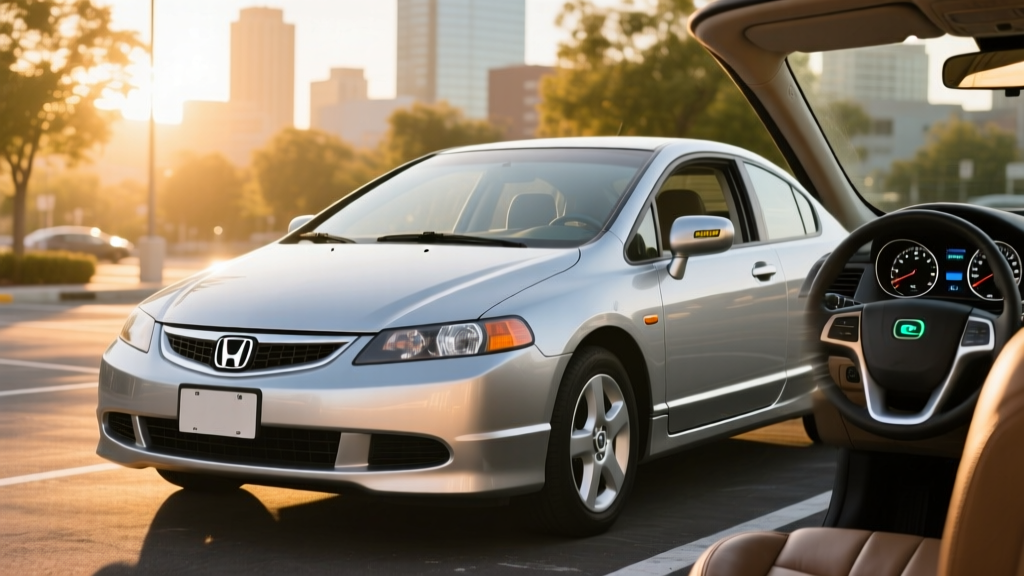
The 2005 Honda Civic Hybrid was one of the first mainstream gas-electric hybrids sold in the United States, arriving at a time when the Toyota Prius dominated the segment. Two decades later, it remains a fixture on the used-car market thanks to Honda's reputation for durability — but the integrated motor assist (IMA) battery system introduces ownership considerations that every prospective buyer needs to understand before handing over cash.
This guide breaks down the real-world fuel economy, IMA battery lifespan and replacement costs, powertrain specifications, and whether this pioneering hybrid still makes financial sense in 2026 compared to a modern hybrid, plug-in hybrid, or full battery-electric vehicle.
2005 Honda Civic Hybrid: Powertrain and Specifications
The 2005 Civic Hybrid uses Honda's Integrated Motor Assist (IMA) system — a parallel hybrid architecture fundamentally different from Toyota's Hybrid Synergy Drive. Rather than a full series-parallel system that can drive the car on electric power alone, the IMA pairs a thin electric motor sandwiched between the gasoline engine and the transmission to assist the engine during acceleration and capture energy during braking. The electric motor cannot propel the car independently at any meaningful speed.
| Specification | Value |
|---|---|
| Gasoline Engine | 1.3L i-DSI 4-cylinder, 8-valve |
| Engine Horsepower | 85 hp @ 5,700 rpm |
| Electric Motor Output | 15 kW (20 hp) |
| Combined System Output | 93 hp @ 5,700 rpm |
| Combined Torque | 122 lb-ft @ 1,000 rpm |
| Transmission | CVT (continuously variable) |
| IMA Battery Type | Nickel-Metal Hydride (NiMH) |
| IMA Battery Capacity | ~0.35 kWh (nominal) |
| Drivetrain | Front-wheel drive |
| Curb Weight | ~2,715 lbs |
| 0–60 mph (est.) | ~11.5 seconds |
The 1.3L i-DSI engine uses Honda's dual-spark-ignition design — two spark plugs per cylinder — to improve combustion efficiency at low RPMs. Combined with the 15 kW electric motor providing torque fill from near-zero RPM, the result is surprisingly adequate city acceleration despite the modest 93 hp combined output. Highway passing power, however, is where the age and displacement show; merging onto a fast freeway requires planning.
Fuel Economy: EPA Ratings vs. Real-World MPG
The 2005 Civic Hybrid carries EPA fuel-economy ratings that were impressive at launch and still respectable against modern non-hybrid compacts. Note that the EPA revised its testing methodology in 2008, so the original window-sticker numbers differed from what you'll find on current reference sites.
| Cycle | EPA Rating (Revised) |
|---|---|
| City | 47 MPG |
| Highway | 48 MPG |
| Combined | 47 MPG |
Source: fueleconomy.gov
Real-World MPG: What Owners Actually Report
Real-world fuel economy for the 2005 Civic Hybrid clusters around 40–45 MPG combined for most owners, according to crowdsourced data on Fuelly and owner forums. Several factors pull the real-world number below the EPA sticker:
- IMA battery degradation: A weakened NiMH pack provides less assist, forcing the gasoline engine to work harder — especially in stop-and-go driving where the hybrid system earns its keep.
- Highway-dominant driving: Unlike Toyota's full-hybrid system, the IMA provides minimal benefit at steady highway speeds. Expect 38–42 MPG on long freeway trips at 70+ mph.
- Cold weather: NiMH batteries lose efficiency below 40°F, and the 1.3L engine runs richer during warm-up. Winter MPG drops of 5–8 MPG are common in northern climates.
- Aging components: At 20+ years old, worn spark plugs, dirty throttle bodies, and degraded oxygen sensors can shave 2–4 MPG if maintenance has been deferred.
For city-dominant drivers with a healthy IMA battery, hitting or even slightly exceeding the EPA city rating of 47 MPG is achievable — Honda's IMA system is most effective in the stop-and-go conditions where regenerative braking keeps the small NiMH pack charged.
HEV vs. PHEV vs. EV: Where the 2005 Civic Hybrid Fits
The 2005 Civic Hybrid is a conventional hybrid (HEV) — it has no plug, no electric-only driving mode, and a battery capacity measured in tenths of a kilowatt-hour rather than the tens of kWh you'd find in a modern plug-in hybrid or EV. Understanding where it sits in the electrification spectrum helps set expectations.
HEV vs. PHEV vs. BEV — Quick Comparison
| Feature | HEV (e.g., 2005 Civic Hybrid) | PHEV (e.g., 2026 Toyota Prius Prime) | BEV (e.g., 2026 Hyundai Ioniq 6) |
|---|---|---|---|
| Plug-in Charging | No — gas only | Yes — Level 1/2 | Yes — Level 1/2/DC |
| Electric-Only Range | 0 miles | ~40–44 miles | ~270–360 miles |
| Battery Capacity | ~0.35 kWh | ~13.6 kWh | ~77.4 kWh |
| Fuel/Energy Cost per Mile | ~$0.07–0.09 | ~$0.03 (electric) / $0.08 (gas) | ~$0.03–0.05 |
| Federal Tax Credit (§30D) | Not eligible | Up to $7,500 (if eligible) | Up to $7,500 (if eligible) |
| Maintenance Complexity | Engine + small hybrid system | Engine + larger hybrid system | No engine — minimal drivetrain |
The 2005 Civic Hybrid is best understood as a fuel-economy optimization rather than an electrification stepping stone. It uses a small battery and motor to reduce gasoline consumption by roughly 30–40% compared to the conventional 2005 Civic (which rated around 30–33 MPG combined). You never plug it in, you never think about charging — you simply drive it and visit the gas station less often.
IMA Battery Lifespan, Degradation, and Replacement Cost
The single biggest ownership question for any 20-year-old hybrid is the battery. The 2005 Civic Hybrid's IMA pack is a nickel-metal hydride (NiMH) module consisting of multiple sticks wired in series. Unlike the larger, more robust Toyota Prius NiMH packs, the Civic's smaller IMA battery has a well-documented history of premature failure.
Battery Warranty & Lifespan — Key Facts
- Original Honda Warranty: 8 years / 80,000 miles (10 years / 150,000 miles in CARB states including CA, NY, MA, and others)
- Typical Real-World Lifespan: 8–12 years / 100,000–150,000 miles before noticeable degradation
- Current Status (2026): Original factory warranty is expired on all 2005 models
- Replacement Cost (OEM Honda): $2,000–$3,500 installed at a dealership
- Replacement Cost (Aftermarket/Refurbished): $800–$1,800 installed at an independent hybrid specialist
- DIY Refurbished Pack: $400–$900 for the battery sticks alone (advanced DIY only — high-voltage safety risk)
Signs of IMA Battery Degradation
Watch for these indicators when test-driving or owning a 2005 Civic Hybrid:
- IMA warning light on dash: The most direct signal — triggers a diagnostic trouble code related to battery module imbalance.
- Reduced fuel economy: A drop of 5+ MPG from baseline often indicates the battery is no longer providing meaningful assist.
- Frequent recalibrations: The IMA system periodically runs a "recal" (forced charge cycle). More than one recal per month suggests weak battery sticks.
- Background charging at stops: If the engine revs higher than normal at red lights to charge the battery, the pack is struggling to hold charge.
- SOC gauge erratic behavior: The state-of-charge display on the instrument cluster swings between full and near-empty rapidly.
Is Replacement Worth It?
At current used-car values — a clean 2005 Civic Hybrid trades for roughly $3,000–$5,500 depending on mileage and condition — a $2,500+ OEM battery replacement represents 50–80% of the vehicle's value. This makes the economics marginal. Most buyers are better served by:
- Seeking a 2005 Civic Hybrid with a recently replaced IMA battery (get documentation).
- Budgeting $1,000–$1,500 for an aftermarket replacement if the battery fails within the first year of ownership.
- Considering a conventional 2005 Civic (non-hybrid) if battery-replacement risk is a dealbreaker — you'll sacrifice ~15 MPG but eliminate the high-voltage system entirely.
Reliability and Common Issues Beyond the Battery
Outside the IMA system, the 2005 Civic Hybrid shares most of its mechanical components with the seventh-generation Civic platform, which carries a mixed reliability record. The powertrain is generally durable, but several age-related issues are worth inspecting:
- CVT transmission: Honda's early CVTs from this era can develop shudder or hesitation, particularly if the transmission fluid was never changed. A CVT fluid drain-and-fill every 30,000 miles is critical — and often neglected by previous owners.
- Motor mount wear: The engine and transmission mounts are known to deteriorate by 100,000–120,000 miles, causing vibration at idle. Replacement runs $400–$800 for a full set.
- Cracked exhaust manifold: The 1.3L i-DSI exhaust manifold is prone to cracking, triggering a check-engine light (P0420 catalyst efficiency code). Repair: $500–$900.
- Electric power steering: The EPS system on this generation can develop intermittent faults. Listen for groaning or feel for notchy steering assist during a test drive.
- 12V battery drain: The IMA system's parasitic draw can drain the standard 12V accessory battery if the car sits for more than 2–3 weeks. A battery tender is recommended for infrequent drivers.
For a comprehensive pre-purchase inspection, prioritize a mechanic with Honda hybrid experience — specifically one who can read IMA-specific diagnostic data (battery stick voltages, state-of-health percentage) rather than just generic OBD-II codes.
Tax Credits and Incentives: What Applies in 2026?
Here's the straightforward answer: the 2005 Honda Civic Hybrid does not qualify for any federal tax credit under current IRS §30D rules. The federal hybrid tax credit that existed under the Energy Policy Act of 2005 was a different provision — it offered up to $2,100 for the original purchaser and was capped by manufacturer sales volume. Honda's allocation was exhausted by mid-2006, and that credit program ended entirely years ago.
The current IRS §30D Clean Vehicle Credit (up to $7,500) applies only to new plug-in electric vehicles and fuel-cell vehicles meeting battery-sourcing, MSRP, and buyer-income requirements. Conventional hybrids (HEVs) with no plug-in capability have never qualified for §30D.
Some states offer modest incentives for used hybrid purchases or emissions-reducing vehicle registrations, but these vary widely by jurisdiction and change frequently. Check your state's department of revenue or environmental agency for current programs.
Should You Buy a 2005 Civic Hybrid in 2026?
Pros
- 40–47 MPG real-world — still competitive with 2026 non-hybrid compacts
- Low purchase price ($3,000–$5,500 used)
- No plug-in infrastructure needed
- Honda build quality in body, interior, and suspension
- Simple IMA system — fewer failure points than full hybrids
- Excellent city fuel economy with regenerative braking
Cons
- IMA battery likely at or past end-of-life — $1,000–$3,500 replacement
- No electric-only driving, no plug-in capability
- No federal or state tax credit eligibility
- Modest 93 hp — underpowered for highway merging
- CVT transmission longevity concerns if fluid was neglected
- No modern safety features (ESC optional, no AEB, no backup camera)
- Parts availability declining for IMA-specific components
Who Should Choose This Hybrid
The 2005 Civic Hybrid makes sense for a budget-conscious commuter who drives primarily in city or suburban stop-and-go traffic, has access to a trusted hybrid-aware mechanic, and can absorb a potential $1,000–$1,500 IMA battery replacement within the first year. If you're spending under $5,000 total (purchase + immediate battery replacement) and need 40+ MPG without plug-in access, it's a rational choice.
Who Should Look Elsewhere
If your priority is long-term reliability without hybrid-system risk, a conventional 2005–2011 Honda Civic (non-hybrid) delivers 30–33 MPG with zero high-voltage components. If you want modern safety, better fuel economy, and plug-in capability, a used 2017+ Toyota Prius Prime (PHEV, ~25 miles electric-only, 54 MPG hybrid) offers a dramatically better ownership experience for $12,000–$18,000.
And if you have home charging access and a budget above $25,000, a new or lightly used BEV like the Chevrolet Bolt EV or Nissan Leaf eliminates gasoline entirely with far lower per-mile energy costs — though the upfront investment is substantially higher.
Frequently Asked Questions
How many MPG does the 2005 Honda Civic Hybrid get?
The EPA rates the 2005 Civic Hybrid at 47 city / 48 highway / 47 combined MPG (revised methodology). Real-world owners typically report 40–45 MPG combined, with city-dominant drivers occasionally hitting or exceeding the EPA city figure and highway-dominant drivers seeing 38–42 MPG.
Does the 2005 Civic Hybrid need to be plugged in?
No. The 2005 Civic Hybrid is a conventional hybrid (HEV). The small NiMH IMA battery charges exclusively through regenerative braking and engine-driven generation. There is no plug, no charging port, and no electric-only driving mode.
How much does it cost to replace the IMA battery?
An OEM Honda IMA battery replacement runs $2,000–$3,500 installed at a dealership. Aftermarket or refurbished packs cost $800–$1,800 installed at an independent hybrid specialist. Given the vehicle's used value of $3,000–$5,500, an OEM replacement is rarely cost-justified.
Is the 2005 Civic Hybrid reliable?
The gasoline powertrain, suspension, and body are generally durable Honda products. The primary reliability risk is the IMA NiMH battery, which is well past its expected 8–12 year lifespan at this point. CVT transmission condition is the second major variable — insist on maintenance records showing regular CVT fluid changes.
Does the 2005 Civic Hybrid qualify for any tax credit?
No. The original 2005-era federal hybrid credit (up to $2,100) was exhausted for Honda by mid-2006 and the program has since ended. The current IRS §30D credit applies only to new plug-in electric and fuel-cell vehicles. The 2005 Civic Hybrid, as a conventional HEV, does not qualify for any federal purchase incentive.
How does the 2005 Civic Hybrid compare to a 2026 hybrid?
A 2026 Toyota Corolla Hybrid achieves an EPA 50–52 MPG combined with a modern lithium-ion battery, Toyota Safety Sense 3.0, and a full 10-year/150,000-mile hybrid battery warranty — starting around $23,500. The 2005 Civic Hybrid costs 80% less upfront but carries battery-replacement risk, no modern safety systems, and ~5 MPG lower real-world efficiency.