Quick Verdict: A Pioneer Worth Considering in 2026?
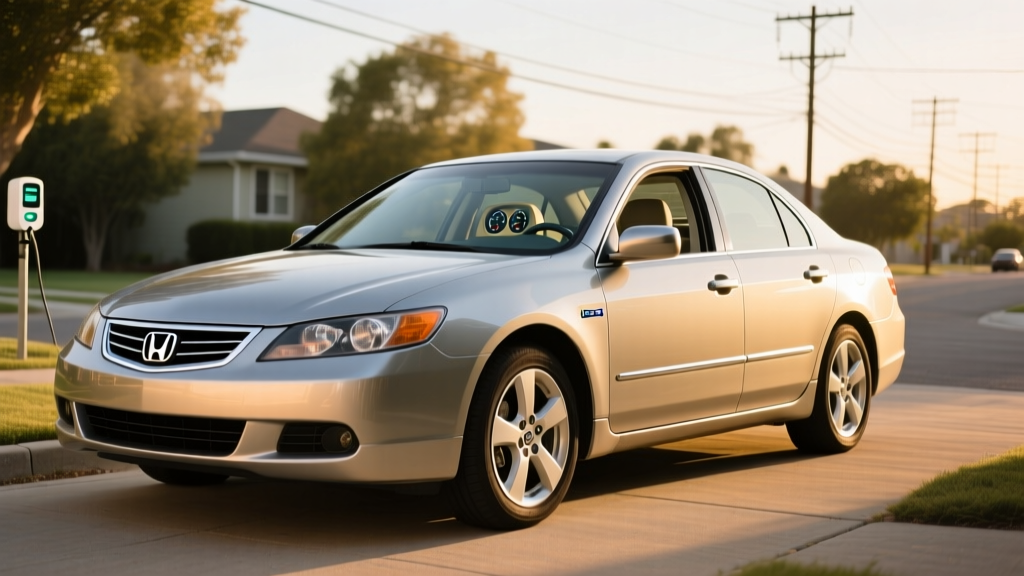
The 2005 Honda Accord V6 Hybrid was Honda's first hybrid sold in the United States and only the second hybrid sedan from a major automaker after the Toyota Prius. Two decades later, it remains a fascinating case study in early hybrid engineering — pairing a 3.0L V6 with Honda's Integrated Motor Assist (IMA) system to deliver 255 horsepower alongside meaningful fuel-economy gains over its gas-only sibling.
If you're researching this car in 2026, you're likely looking at used examples priced between $2,500 and $6,000 depending on mileage and condition. The Accord Hybrid's value proposition today is simple: V6 acceleration with four-cylinder fuel economy, Honda's legendary build quality, and a hybrid system that proved surprisingly durable. But at 20+ years old, the high-voltage battery is the elephant in the room. Here's everything you need to know before buying one.
| Spec | Value |
|---|---|
| Powertrain | 3.0L V6 + IMA electric motor |
| Combined Horsepower | 255 HP @ 6,000 RPM |
| Combined Torque | 232 lb-ft @ 5,000 RPM |
| Transmission | 5-speed automatic |
| EPA MPG (City / Hwy / Combined) | 30 / 37 / 29 (original EPA); revised to ~25 / 34 / 28 |
| Hybrid Battery | NiMH (Nickel-Metal Hydride), ~0.5 kWh |
| Drivetrain | Front-wheel drive |
| 0–60 mph | ~7.0 seconds |
| Curb Weight | ~3,500 lbs |
| Original MSRP (2005) | $30,140 |
| Used Price Range (2026) | $2,500–$6,000 |
Understanding the IMA System: HEV, Not PHEV
The 2005 Accord Hybrid is a conventional hybrid electric vehicle (HEV), not a plug-in hybrid (PHEV). This distinction matters enormously for buyers coming from modern EV discourse.
HEV vs PHEV — What's the Difference?
| Feature | HEV (This Car) | PHEV (e.g., 2026 RAV4 Prime) |
|---|---|---|
| Plug-in charging | No — never plugs in | Yes — charges from wall outlet |
| Electric-only driving | Minimal (motor assists engine) | 25–45 miles typical |
| Battery size | ~0.5 kWh NiMH | 15–20 kWh lithium-ion |
| Regenerative braking | Yes | Yes |
| Federal tax credit (new) | None (expired long ago) | Up to $7,500 via §30D (if eligible) |
| Fueling | Gasoline only | Gasoline + electricity |
Honda's IMA system uses a thin electric motor sandwiched between the engine and transmission. The motor cannot propel the car on its own at meaningful speeds — it assists the V6 during acceleration and enables cylinder deactivation (shutting down three cylinders under light load). Energy is captured through regenerative braking and stored in a small NiMH pack behind the rear seat. You never plug this car in; it generates all its own electricity.
Fuel Economy: EPA Numbers vs Real-World MPG
When the 2005 Accord Hybrid launched, Honda advertised EPA ratings of 30 city / 37 highway / 29 combined MPG. However, the EPA revised its testing methodology in 2008, and under the updated cycle, the car's ratings were retroactively adjusted to approximately 25 city / 34 highway / 28 combined. For reference, the conventional 2005 Accord V6 was rated at roughly 21 city / 30 highway / 24 combined under the same revised methodology.
| Model | City MPG | Highway MPG | Combined MPG | Source |
|---|---|---|---|---|
| 2005 Accord V6 Hybrid | 25 | 34 | 28 | EPA fueleconomy.gov |
| 2005 Accord V6 (gas) | 21 | 30 | 24 | EPA fueleconomy.gov |
Real-World MPG: What Owners Actually Report
Owner-reported data on Fuelly and Honda forums consistently shows real-world combined fuel economy in the 25–28 MPG range, which aligns closely with the revised EPA estimate. Several factors influence this:
- City driving favors the hybrid: Like most hybrids, the Accord benefits from regenerative braking and engine-off stops in traffic. Expect 26–28 MPG in mixed urban use.
- Highway driving narrows the gap: At sustained 70+ mph speeds, the IMA motor contributes less, and the hybrid's weight penalty (~150 lbs over the gas V6) partially offsets gains. Highway figures of 30–33 MPG are common.
- Cold weather impact: NiMH batteries lose efficiency in freezing temperatures. Expect a 5–10% MPG reduction in winter, consistent with most hybrid systems.
- Driving style matters more than in a gas car: Aggressive acceleration depletes the small battery quickly, forcing the V6 to work alone. Gentle, anticipatory driving maximizes regen and assist cycles.
Powertrain Deep Dive: V6 Muscle Meets Electric Assist
The 2005 Accord Hybrid's powertrain was genuinely innovative for its era. The 3.0L SOHC V6 (J30A4) produces 240 HP on its own, augmented by a 15-kW (20 HP) electric motor integrated into the flywheel housing. Combined output reaches 255 HP — actually more than the standard Accord V6 — because the electric motor fills in the torque curve at low RPMs where the V6 hasn't yet reached its power band.
The system also features Honda's Variable Cylinder Management (VCM), which deactivates the rear bank of three cylinders during cruising, deceleration, and idle. This was cutting-edge technology in 2005 and remains a key reason the hybrid achieves its efficiency advantage.
The 5-speed automatic transmission is conventional — no CVT or planetary gearset like Toyota's Hybrid Synergy Drive. This gives the Accord Hybrid a more familiar driving feel but sacrifices some of the seamless efficiency optimization that Toyota's e-CVT provides.
Hybrid Battery: Lifespan, Warranty, and Replacement Cost
Original Battery Warranty
Honda warranted the IMA battery for 8 years / 80,000 miles (10 years / 150,000 miles in CARB states like California, New York, and Massachusetts). As of 2026, every 2005 Accord Hybrid is well past its factory battery warranty.
Battery Degradation and Real-World Lifespan
The NiMH battery pack in the 2005 Accord Hybrid has a demonstrated lifespan of 120,000–180,000 miles before significant degradation forces replacement, though some units have exceeded 200,000 miles with careful maintenance. NiMH chemistry is robust and tolerant of the shallow charge-discharge cycles that Honda's battery management system enforces.
Signs of IMA battery failure include:
- Frequent "IMA" warning light on the dashboard
- Reduced assist during acceleration (the car feels sluggish)
- Rapid charge/discharge cycling visible on the dash gauge
- Decreased MPG (typically 2–4 MPG drop)
- The battery fan running loudly and continuously
Replacement Cost in 2026
| Option | Cost Range | Warranty | Notes |
|---|---|---|---|
| New OEM Honda battery | $2,000–$2,800 (parts + labor) | 3 years / 36,000 miles | May require dealer sourcing; availability declining for 2005 models |
| Remanufactured battery (e.g., Bumblebee, GreenTech) | $1,000–$1,600 (parts + labor) | 1–3 years varying | Most popular option; reuses housing with new NiMH cells |
| Used/salvage battery | $300–$700 (parts only) | None / 30 days | Highest risk — age and condition unknown |
| Grid charger reconditioning (DIY) | $100–$250 (equipment) | None | Can extend life 1–3 years on a weak but not failed pack |
For a car worth $3,000–$6,000, a $1,200–$1,600 remanufactured battery is the pragmatic choice. Factor this into your purchase negotiation if the IMA light is on or the battery hasn't been replaced.
Reliability Record and Common Issues
The 2005 Accord Hybrid benefits from Honda's mid-2000s build quality, which was among the best in the industry. The J-series V6 is a proven, durable engine. However, two decades of real-world data have revealed a few recurring issues beyond the IMA battery:
- VCM-related oil consumption: Cylinder deactivation can lead to increased oil consumption and, in some cases, carbon buildup on deactivated cylinders. Some owners disable VCM with an aftermarket module ($80–$150) to mitigate this.
- Transmission wear: The 5-speed automatic is generally reliable but should have regular fluid changes (every 30,000 miles). Neglected units may develop shudder or harsh shifts past 150,000 miles.
- Power steering hose leaks: A known issue across the 7th-gen Accord lineup; replacement hoses are readily available.
- A/C compressor: Some units fail between 120,000–160,000 miles; replacement runs $800–$1,200.
Overall, the 2005 Accord Hybrid's reliability is above average for its era, with the IMA battery being the primary hybrid-specific expense. Cars with documented maintenance histories and a battery replacement (or recent reconditioning) represent the best value.
Tax Credits and Incentives: What Applies in 2026?
The 2005 Honda Accord Hybrid originally qualified for a federal tax credit of approximately $2,600 under the Energy Policy Act of 2005 — but that credit phase-out structure has long since expired. Honda's hybrid credit allocation was exhausted by mid-2007.
As of 2026:
- Federal §30D credit: Not available. This credit applies only to new plug-in electric vehicles (BEVs and PHEVs) with qualifying battery sourcing. Conventional hybrids have never qualified under the current §30D framework. See IRS.gov clean vehicle credits for current rules.
- Used EV credit (§25E): Not available. This $4,000 credit applies only to used BEVs and PHEVs, not conventional hybrids.
- State incentives: A handful of states offer minor registration-fee reductions or HOV lane access for hybrids, but these programs have largely shifted focus to zero-emission vehicles. Check your state's DMV or energy office for specifics.
The bottom line: there are no meaningful tax credits or incentives for purchasing a 2005 Accord Hybrid in 2026. The value proposition rests entirely on the car's low purchase price, fuel savings versus the gas V6, and Honda reliability.
Who Should Buy This Car — and Who Shouldn't
Pros
- 255 HP with 28 MPG combined — strong performance-to-efficiency ratio
- Spacious midsize sedan with Honda's excellent ergonomics
- Proven J-series V6 durability
- Low purchase price ($2,500–$6,000)
- No plug-in infrastructure needed
- Smooth, conventional driving feel (no CVT drone)
Cons
- IMA battery replacement likely needed ($1,000–$2,800)
- No electric-only driving capability
- Fuel savings modest vs. modern hybrids (a 2026 Prius gets 57 MPG combined)
- No federal or state tax incentives
- Aging safety tech (no ESC standard, no advanced driver assist)
- Parts availability declining for hybrid-specific components
Choose the 2005 Accord Hybrid if:
- You need a reliable, low-cost daily driver with better fuel economy than a gas V6
- You don't have access to home or workplace charging (making a PHEV or EV impractical)
- You want a comfortable, roomy sedan and can't afford a newer hybrid
- You're mechanically inclined and comfortable addressing an IMA battery replacement
Look elsewhere if:
- You want significant fuel savings — a used 2017+ Prius or a new 2026 hybrid delivers 50+ MPG
- You want electric-only driving for short commutes (consider a used PHEV like the Chevy Volt or Prius Prime)
- You prioritize modern safety features (AEB, lane-keeping, blind-spot monitoring)
- You want warranty coverage on the hybrid system
Frequently Asked Questions
How many MPG does the 2005 Honda Accord V6 Hybrid get?
Under the revised EPA testing cycle, the 2005 Accord Hybrid is rated at 25 city / 34 highway / 28 combined MPG. Real-world owner reports typically fall in the 25–28 MPG combined range, with city driving yielding slightly better results than highway driving thanks to regenerative braking.
Does the 2005 Accord Hybrid need to be plugged in?
No. This is a conventional hybrid (HEV), not a plug-in hybrid. The battery charges entirely through regenerative braking and the gasoline engine. You fuel it like any other car — gasoline only.
Is the 2005 Honda Accord Hybrid reliable?
Yes, with caveats. The underlying Accord platform and J-series V6 are known for 200,000+ mile longevity with proper maintenance. The main reliability concern is the IMA battery, which typically lasts 120,000–180,000 miles and costs $1,000–$2,800 to replace depending on the source. At 20+ years old, budget for this expense.
What does it cost to replace the hybrid battery?
A remanufactured NiMH battery — the most popular option — costs $1,000–$1,600 installed. A new OEM battery runs $2,000–$2,800 but may be harder to source for a 2005 model. Used/salvage batteries are cheaper ($300–$700) but carry significant risk given their age.
Does this car qualify for any tax credit in 2026?
No. Federal tax credits for the 2005 Accord Hybrid expired in 2007. The current §30D new clean vehicle credit and §25E used EV credit both apply only to plug-in vehicles (BEVs and PHEVs), not conventional hybrids. There are no federal incentives for buying this car. Check your state for any residual hybrid programs, though most have shifted to zero-emission vehicle incentives.
Hybrid vs PHEV vs EV — which should I choose?
If you lack reliable access to charging (home or workplace), a conventional hybrid like this Accord is the pragmatic choice — no infrastructure needed. If you can charge at home and have a short commute, a PHEV (even a used Chevy Volt or Prius Prime) lets you drive 20–45 miles on electricity before the gas engine kicks in. If you have home charging, a predictable daily route under 250 miles, and want zero tailpipe emissions, a full EV eliminates gasoline entirely. The 2005 Accord Hybrid makes sense specifically for budget-conscious buyers who want fuel savings without any charging logistics.
Can the IMA system be removed or disabled?
Some owners perform an "IMA delete" — removing the battery pack and disabling the system to avoid replacement costs. This eliminates the hybrid assist (reducing power to the gas engine's 240 HP), triggers a check-engine light, and may cause the car to fail emissions inspections in states that require OBD-II compliance checks. We don't recommend it for a street-driven car.