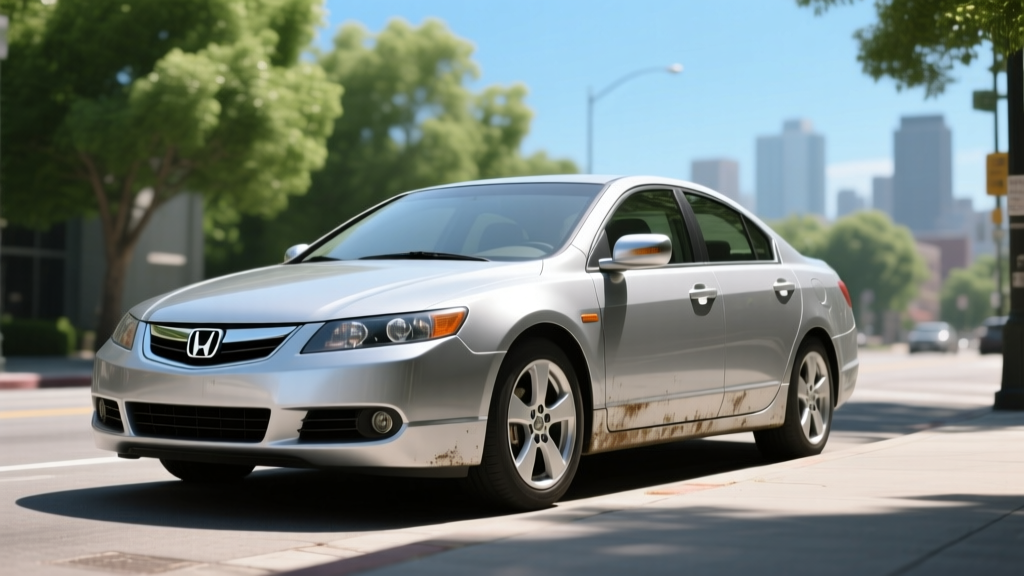
The 2005 Accord Hybrid: Honda's First Hybrid Sedan Revisited
Before the current wave of plug-in hybrids and 300-mile EVs, Honda took a different approach to electrification. The 2005 Honda Accord Hybrid was one of the first mainstream midsize sedans to pair a gasoline engine with an electric motor assist — and it did so without ever needing to be plugged in. As a conventional hybrid (HEV), it generated its own electricity through regenerative braking and the engine itself, storing energy in a compact nickel-metal hydride (NiMH) battery pack.
If you're researching the 2005 Accord Hybrid as a potential used purchase, this guide covers everything you need: real-world fuel economy, the Integrated Motor Assist (IMA) system specs, battery longevity and replacement costs, and how this early hybrid stacks up against modern alternatives.
HEV vs PHEV: Where the 2005 Accord Hybrid Fits
The 2005 Accord Hybrid is a conventional hybrid (HEV). It has no plug, no electric-only driving mode, and no external charging capability. It cannot be compared to a plug-in hybrid (PHEV) like the 2026 Honda Clarity or Toyota RAV4 Prime, which offer 25-42 miles of electric-only range and require a charging outlet. The Accord Hybrid's electric motor assists the gasoline engine — it never drives the car independently for any meaningful distance.
2005 Accord Hybrid Fuel Economy: EPA vs Real World
Fuel economy was the primary reason buyers chose the Accord Hybrid over the standard four-cylinder or V6 Accord. Here's what the EPA rated it at, along with what owners actually report:
| Metric | City | Highway | Combined |
|---|---|---|---|
| EPA Rating | 30 MPG | 37 MPG | 33 MPG |
| Real-World Owner Average | 27–31 MPG | 33–38 MPG | 28–33 MPG |
Source: fueleconomy.gov
The 2005 Accord Hybrid's EPA combined rating of 33 MPG was a meaningful improvement over the standard 2005 Accord V6 (approximately 22 MPG combined) and competitive with the four-cylinder Accord (about 26 MPG combined). In real-world driving, many owners report achieving close to the EPA numbers in mixed driving, though aggressive acceleration and sustained high-speed highway driving can push figures toward the lower end.
One advantage of Honda's IMA system: unlike some early hybrids that performed poorly on the highway, the Accord Hybrid's aerodynamic sedan body and efficient V6 allowed it to maintain strong highway MPG figures — a trait Honda hybrids have generally kept across generations.
Powertrain and IMA System Specifications
The 2005 Accord Hybrid used Honda's Integrated Motor Assist (IMA) system — a parallel hybrid architecture where a thin electric motor is sandwiched between the engine and transmission. It's fundamentally different from the power-split systems used by Toyota (Prius, Camry Hybrid) and cannot drive the car on electric power alone at any meaningful speed.
| Engine | 3.0L V6, SOHC i-VTEC with Variable Cylinder Management (VCM) |
| Engine Power | 240 HP @ 6,000 RPM (engine alone) |
| Electric Motor | IMA permanent-magnet motor, ~15 kW (20 HP) |
| Combined System Output | 255 HP @ 6,000 RPM |
| Combined Torque | 232 lb-ft @ 5,000 RPM |
| Transmission | 5-speed automatic |
| Drivetrain | Front-wheel drive |
| Hybrid Battery | NiMH (Nickel-Metal Hydride), ~0.6 kWh usable |
| 0–60 MPH | ~7.0 seconds (estimated) |
| Plug-In Capable? | No — conventional HEV, no external charging |
The standout feature was Variable Cylinder Management (VCM), which could deactivate three of the six cylinders under light-load cruising conditions. Combined with IMA motor assist during acceleration and regenerative braking during deceleration, this was Honda's recipe for V6 power with near-four-cylinder fuel economy.
Hybrid Battery: Longevity, Degradation, and Replacement Cost
The most common concern for any used hybrid buyer is battery health. The 2005 Accord Hybrid uses a relatively small NiMH pack (roughly 0.6 kWh usable capacity) located behind the rear seat. Because it's a conventional hybrid, this battery is never deeply discharged or charged to full — Honda's battery management system keeps it in a narrow state-of-charge window to maximize lifespan.
Original Battery Warranty
Honda originally warranted the IMA battery for 8 years or 80,000 miles (10 years / 150,000 miles in California Air Resources Board states). By 2026, all original factory warranties have expired on 2005 model-year vehicles.
Battery Replacement Cost in 2026
If you're buying a 2005 Accord Hybrid today, budget for a potential battery replacement:
- Remanufactured IMA battery: $1,000–$1,800 (parts only)
- New OEM Honda IMA battery: $2,000–$3,000+ (if still available from Honda)
- Installation labor: $200–$500 at an independent shop; $400–$800 at a dealership
- Total replacement cost: $1,200–$3,800 depending on source and shop
Many 2005 Accord Hybrids still running in 2026 have had at least one battery replacement. When inspecting a used example, ask for documentation of IMA battery service. A dashboard IMA warning light or a "check hybrid system" message indicates the battery needs attention. Some owners have also used aftermarket reconditioning services for $600–$1,000, though results vary.
Other Hybrid System Reliability Notes
Beyond the battery, the IMA system on the 2005 Accord is generally robust. The electric motor itself rarely fails. The more common issues are:
- 12V auxiliary battery: Like all cars, the standard 12V battery needs replacement every 4–6 years. In the Accord Hybrid, a weak 12V battery can cause IMA system error codes even when the hybrid battery is fine.
- VCM-related oil consumption: The cylinder-deactivation system can lead to increased oil consumption in high-mileage examples. Check oil levels regularly and look for fouled spark plugs on the deactivated cylinders.
- IMA recalibration: Some owners report the IMA system requiring periodic recalibration, which can often be triggered by a specific driving cycle (full charge/discharge routine).
Who Should Buy the 2005 Accord Hybrid in 2026?
Two decades after its debut, the 2005 Accord Hybrid occupies a specific niche in the used car market. Here's a decision framework:
Choose the 2005 Accord Hybrid If:
- You want a cheap commuter sedan (typically $2,500–$5,500 used) with better fuel economy than a standard V6 Accord
- You have no access to home or workplace charging (no plug needed)
- You want Honda reliability in a full-size sedan with a spacious trunk and comfortable ride
- You drive mostly city/suburban miles where hybrid efficiency shines
Look at a Modern Hybrid or PHEV Instead If:
- You want modern safety features (the 2005 Accord predates standard AEB, lane-keep, blind-spot monitoring)
- You want 40+ MPG combined — modern hybrids like the 2026 Honda Accord Hybrid achieve 44–48 MPG combined
- You want electric-only driving for short commutes (a PHEV offers 25–50 miles EV-only)
- You want a full EV with zero tailpipe emissions and 250+ miles of range
Hybrid vs PHEV vs EV: Which Is Right for You?
The 2005 Accord Hybrid is a conventional HEV. If you're cross-shopping it against modern electrified vehicles, here's how the three categories compare:
| Feature | HEV (e.g., 2005 Accord Hybrid) | PHEV (e.g., 2026 RAV4 Prime) | BEV (e.g., 2026 Tesla Model 3) |
|---|---|---|---|
| Plug Required? | No | Yes (Level 1 or 2) | Yes (Level 2 or DC fast) |
| Electric-Only Range | None | 25–50 miles | 250–350+ miles |
| Combined MPG / MPGe | 33 MPG | 38–94 MPGe | 120–140 MPGe |
| Used Price (2026) | $2,500–$5,500 | $28,000–$45,000 | $22,000–$45,000 |
| Federal Tax Credit (New) | None | Up to $7,500 (§30D) | Up to $7,500 (§30D) |
| Home Charging Needed? | No | Recommended | Essential |
For buyers who cannot install a charger at home and need the lowest possible upfront cost, a used HEV like the 2005 Accord Hybrid remains practical. For those with charging access and a larger budget, a modern PHEV or BEV delivers dramatically lower operating costs and far more advanced technology.
Does the 2005 Accord Hybrid Qualify for Any Tax Credit?
No. The 2005 Honda Accord Hybrid does not qualify for any current federal tax credit. Under IRS §30D rules, the federal clean vehicle credit applies only to new qualifying plug-in electric vehicles (PHEVs and BEVs) — not conventional hybrids, and not used vehicle purchases of this model year. The used EV credit (§25E, up to $4,000) also requires a plug-in vehicle (PHEV or BEV) and has income and price caps.
Some states historically offered rebates for hybrid purchases, but most of those programs have expired or shifted exclusively to plug-in vehicles. Check your state's current incentive database for any remaining hybrid-specific programs, but do not expect a credit for a 2005 model-year conventional hybrid purchase in 2026.
For current federal EV tax credit rules, consult the IRS Clean Vehicle Credit page and verify eligibility with a tax professional.
Pros and Cons of the 2005 Accord Hybrid
Pros
- Strong V6 performance (255 HP combined) with hybrid fuel economy
- No plug-in charging required — works with existing fueling habits
- Spacious midsize sedan interior with large trunk
- Honda build quality; widely available parts and service
- Very low used purchase price ($2,500–$5,500)
- Regenerative braking extends brake pad life
Cons
- IMA battery replacement likely needed at this age ($1,200–$3,800)
- No electric-only driving capability
- Dated safety technology (no AEB, no lane-keeping, no backup camera standard)
- VCM system can cause oil consumption issues at high mileage
- 33 MPG combined is modest by 2026 hybrid standards (modern Accord Hybrid: 44–48 MPG)
- No federal or state tax credit eligibility
Frequently Asked Questions
How many MPG does the 2005 Accord Hybrid get?
The EPA rates the 2005 Honda Accord Hybrid at 30 MPG city, 37 MPG highway, and 33 MPG combined. Real-world owner reports cluster around 28–33 MPG combined, with city driving often hitting or exceeding the EPA city rating thanks to regenerative braking and cylinder deactivation at low speeds.
Can the 2005 Accord Hybrid drive on electric power only?
No. The IMA system is a motor-assist design. The electric motor supplements the V6 engine during acceleration but cannot propel the car independently at any meaningful speed or distance. This is fundamentally different from a PHEV or full EV.
Is the 2005 Accord Hybrid reliable?
The powertrain is generally reliable, with the V6 engine and 5-speed automatic being proven Honda components. The main reliability concern is the IMA hybrid battery, which is now 20+ years old on most examples. Budget $1,200–$3,800 for a battery replacement if one hasn't been done. The VCM cylinder-deactivation system can also cause oil consumption at high mileage.
What does it cost to replace the hybrid battery?
A remanufactured IMA battery for the 2005 Accord Hybrid costs $1,000–$1,800 for the part, plus $200–$800 in labor depending on the shop. Total replacement typically runs $1,200–$3,800. New OEM batteries from Honda may cost more if still available.
Does the 2005 Accord Hybrid qualify for a tax credit?
No. The 2005 Accord Hybrid is a conventional (non-plug-in) hybrid and does not qualify for the federal §30D clean vehicle credit or the §25E used EV credit. Both programs require plug-in vehicles (PHEV or BEV). No state incentives currently apply to this model year and powertrain type in most jurisdictions.
How does the 2005 Accord Hybrid compare to a modern hybrid?
A 2026 Honda Accord Hybrid achieves 44–48 MPG combined — roughly 35–45% better fuel economy — while offering more power, modern safety features (AEB, lane-keep, adaptive cruise), and a full hybrid warranty. However, a new Accord Hybrid starts around $33,000, while a used 2005 Accord Hybrid can be found for $2,500–$5,500.
Should I buy a 2005 Accord Hybrid or a newer used hybrid?
If your budget is under $6,000 and you accept the risk of an IMA battery replacement, the 2005 Accord Hybrid offers decent value. If you can stretch to $10,000–$15,000, a 2014–2018 Honda Accord Hybrid or Toyota Camry Hybrid will deliver 45+ MPG combined with a more modern feature set and likely more remaining battery life.
Final Assessment: Is the 2005 Accord Hybrid Worth Buying?
The 2005 Honda Accord Hybrid is a piece of electrification history — Honda's first hybrid sedan, offering V6 power with meaningful fuel savings. In 2026, it serves as an ultra-budget commuter option for buyers who need a no-plug-required sedan and can tolerate the risk of aging hybrid components.
At $2,500–$5,500, the purchase price is compelling, but factor in a potential $1,200–$3,800 IMA battery replacement and the reality that 33 MPG combined is easily beaten by any modern hybrid. If you find a well-maintained example with a recently replaced battery, it's a reasonable short-term commuter. If you're planning to keep a car for 5+ years, a newer used hybrid or a modern PHEV/BEV will serve you better with lower long-term maintenance risk and substantially better efficiency.