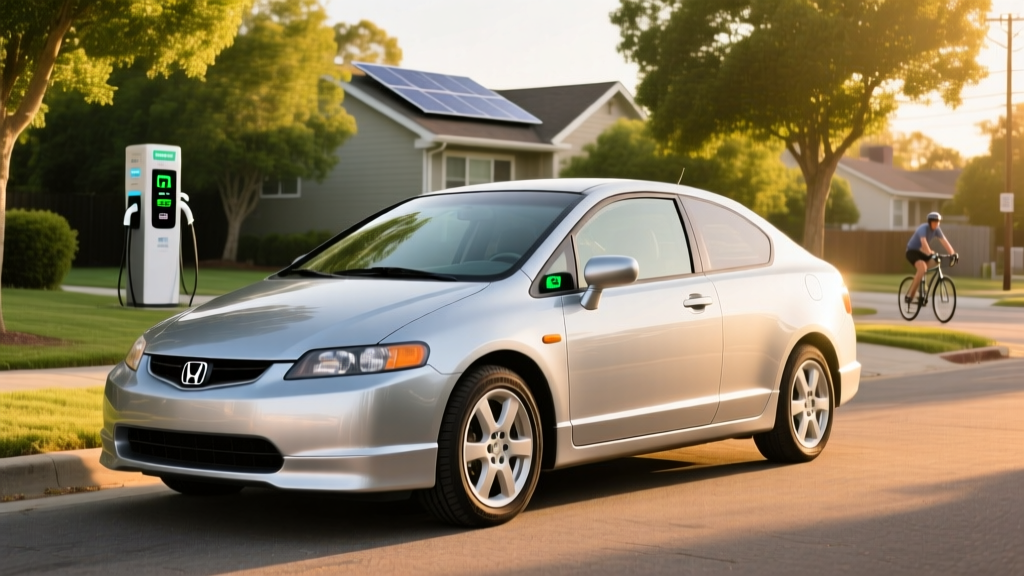
More than two decades before plug-in hybrids and 400-mile EVs, a teardrop-shaped, two-seat coupe quietly rewrote the rules of fuel economy. The first-generation Honda Insight — launched as a 2000 model and sold through 2006 — remains one of the most fuel-efficient gasoline-electric vehicles ever put into production. For shoppers searching 2001 Honda Insight hybrid MPG data, the numbers still impress: an EPA-estimated 61 mpg city and 70 mpg highway on the manual-transmission variant, figures that rival modern plug-in hybrids running on gasoline alone.
But buying a 25-year-old hybrid in 2026 is a different calculus than buying a new electrified vehicle. The nickel-metal hydride (NiMH) IMA battery pack is the single biggest variable in ownership cost and drivability. This guide covers the original Insight's fuel economy, powertrain, battery longevity, replacement economics, and how it stacks up against today's hybrids and EVs for a used-car buyer.
2001 Honda Insight Hybrid MPG: EPA vs. Real World
The 2001 Insight came in two transmission variants, and the EPA ratings differ meaningfully between them. Here are the official figures from fueleconomy.gov:
| Transmission | City MPG | Highway MPG | Combined MPG | Fuel Tank | Est. Total Range |
|---|---|---|---|---|---|
| 5-speed manual (w/ lean burn) | 61 | 70 | 63 | 10.6 gal | ~668 mi |
| CVT automatic | 53 | 58 | 56 | 10.6 gal | ~594 mi |
The manual-transmission model achieved its legendary numbers partly through Honda's lean-burn engine technology, which runs an extremely air-rich fuel mixture under light-load conditions. The CVT variant, while still exceptional, sacrificed some efficiency for drivability.
How the Original Insight's IMA Hybrid System Works
The Insight uses Honda's Integrated Motor Assist (IMA) system — a conventional hybrid (HEV), not a plug-in hybrid (PHEV). This is an important distinction:
HEV vs. PHEV: What's the Difference?
Conventional Hybrid (HEV): The Insight's IMA system pairs a small gasoline engine with a thin electric motor sandwiched between the engine and transmission. A compact NiMH battery pack stores energy recovered from regenerative braking and deceleration. The car never plugs in — all energy ultimately comes from gasoline. The electric motor assists during acceleration and enables idle stop, but cannot propel the car on electricity alone for meaningful distances.
Plug-in Hybrid (PHEV): Modern PHEVs like the Toyota RAV4 Prime carry a much larger battery (typically 15–20 kWh) that can be charged from a wall outlet, enabling 25–50 miles of pure electric driving before the gas engine engages. The original Insight is not a PHEV.
Powertrain Specifications
| Component | Specification |
|---|---|
| Engine | 1.0L 3-cylinder, 12-valve, lean-burn capable (manual) |
| Engine Power | 67 hp @ 5,700 rpm |
| IMA Electric Motor | 10 kW (13 hp), brushless DC |
| Combined Peak Output | 73 hp @ 5,700 rpm (with IMA assist) |
| Torque | 67 lb-ft (engine) + 36 lb-ft (motor) |
| Battery Pack | NiMH, ~6.5 Ah / ~0.9 kWh nominal, 120 cells |
| Curb Weight | 1,850 lbs (manual) |
| 0–60 mph | ~11.0 seconds (manual) |
The Insight's ultra-light aluminum monocoque chassis and extreme aerodynamics (Cd of 0.25) are as responsible for its efficiency as the hybrid system. At 1,850 pounds, it weighs roughly half of a modern midsize sedan, which means the small powertrain doesn't have to work hard.
IMA Battery Lifespan, Degradation & Replacement Cost
This is the defining question for anyone considering a 2001 Insight in 2026. The original NiMH IMA battery pack was warranted for 8 years / 80,000 miles in most states (10 years / 150,000 miles in CARB states like California). That factory warranty expired long ago, and every surviving Insight is operating on either its original degraded pack or a replacement.
Signs of IMA Battery Degradation
- IMA warning light on the dashboard — indicates the system has detected a fault or capacity below threshold
- Reduced fuel economy — owners commonly report drops from 60+ mpg to 40–45 mpg with a failing pack
- Loss of regenerative braking — the car relies more on friction brakes, increasing wear
- Frequent recalibrations — the battery gauge drops and recharges erratically
- 12V battery drain — a failing IMA pack can cause the DC-DC converter to overwork the 12V system
Replacement Options and Costs
| Option | Cost Range | Warranty | Notes |
|---|---|---|---|
| Remanufactured NiMH pack (Bumblebee, Hybrid Automotive) | $1,200–$2,000 | 1–3 years | Most common choice; tested and balanced cells |
| New OEM Honda pack | $2,500–$3,500 (if available) | 3 yr / 36,000 mi | Honda has largely discontinued new IMA packs for Gen 1 |
| Grid charger + rebalance (DIY) | $150–$350 | None | Extends life of mildly degraded packs; not a fix for dead cells |
| Aftermarket lithium conversion (LiBCM) | $1,800–$2,800 | Varies | Lighter, more capacity; requires technical skill or installer |
The Lithium Battery Conversion Module (LiBCM) is a popular enthusiast upgrade that replaces the aging NiMH cells with lithium modules, often improving IMA assist performance and adding a modest amount of usable capacity. It's well-regarded in the Insight community but requires comfort with aftermarket modifications.
2001 Insight vs. Modern Hybrids and EVs: What Has Changed
The Insight was revolutionary in 2001, but the electrified vehicle landscape has transformed. Here's how it compares to representative modern options across key metrics:
| Vehicle | Type | Combined MPG / MPGe | Electric Range | 0–60 mph | Est. Used / New Price |
|---|---|---|---|---|---|
| 2001 Honda Insight (MT) | HEV | 63 mpg | N/A | ~11.0s | $3,000–$7,000 (used) |
| 2025 Toyota Prius LE | HEV | 57 mpg | N/A | 7.2s | $29,445 (new) |
| 2025 Toyota Prius Prime | PHEV | 52 mpg / 127 MPGe | 44 mi | 6.6s | $34,045 (new) |
| 2025 Hyundai Ioniq 6 SE | BEV | 140 MPGe | 361 mi | 5.1s | $38,650 (new) |
The 2001 Insight's EPA combined 63 mpg still edges out the latest Prius in pure gasoline efficiency. But the modern Prius delivers that efficiency with 200 combined horsepower, five seats, modern safety features, and a full factory warranty. The Prius Prime PHEV adds 44 miles of electric-only range, which for many commuters means near-zero gasoline use on daily drives.
Who Should Still Consider the 2001 Insight?
Buy the 2001 Insight If:
- You want the lowest possible gasoline cost on a sub-$7,000 budget
- You're a hypermiler or efficiency enthusiast who values the driving experience
- Your commute is low-speed, steady-state — ideal for the IMA system
- You're comfortable with a 2-seat, minimal-cargo vehicle
- You can budget $1,500–$2,500 for an IMA battery replacement if needed
Look at a Modern Hybrid or EV If:
- You need back seats, cargo space, or modern crash safety (airbags, ESC, AEB)
- You want a factory warranty and zero battery-replacement risk
- You qualify for the federal §30D tax credit (up to $7,500 for new PHEVs/BEVs that meet sourcing, MSRP, and income requirements)
- Your daily commute fits within a PHEV's electric-only range (25–50 mi)
- You want DC fast charging or Level 2 home charging convenience
Does the 2001 Insight Qualify for Any Tax Credit?
No. The 2001 Honda Insight does not qualify for any current federal or state EV/PHEV tax credit. The IRS §30D Clean Vehicle Credit applies only to new plug-in electric vehicles (BEVs and PHEVs) that meet battery sourcing, critical mineral, MSRP cap, and buyer income requirements. Conventional hybrids (HEVs) like the Insight have never qualified for §30D.
The original Insight did qualify for a modest federal tax deduction for clean-fuel vehicles when it was new (roughly $2,000–$3,400 depending on the tax year), but that provision expired decades ago. Some states offered additional incentives in the early 2000s (California's HOV lane access, for example), but those have also lapsed for this model.
For budget-conscious buyers, the Insight's advantage is purely in the purchase price and fuel savings — not in tax incentives. At $3,000–$7,000 on the used market and 60+ mpg, the total cost of ownership can be remarkably low if the IMA battery is healthy.
Ownership Costs: Fuel, Insurance & Maintenance in 2026
Running a 2001 Insight today involves a unique cost profile compared to modern vehicles:
| Category | 2001 Insight (MT, healthy IMA) | 2025 Toyota Prius LE |
|---|---|---|
| Fuel (12,000 mi/yr @ $3.40/gal) | ~$648 (63 mpg combined) | ~$716 (57 mpg combined) |
| Insurance | $600–$900 (low-value vehicle) | $1,400–$1,800 |
| Maintenance | $400–$800 (aging components) | $300–$500 (under warranty) |
| Depreciation | Minimal ($200–$500/yr) | $2,500–$3,500/yr |
| IMA Battery Reserve | $1,500–$2,500 one-time | N/A (hybrid battery under warranty) |
The Insight's annual fuel bill is genuinely among the lowest of any gasoline-burning car ever sold. At 63 mpg combined, you'd burn roughly 190 gallons per year at 12,000 miles — about $648 at national average prices. That's competitive with some PHEVs running partly on gasoline.
However, maintenance costs on a 25-year-old vehicle are unpredictable. Beyond the IMA battery, watch for: aging motor mounts, worn CV joints, corroded wiring harness connectors, failing A/C compressors, and the CVT transmission (on automatic models), which has a known history of premature failure and limited replacement availability.
Reliability Verdict: What Breaks and What Lasts
The 2001 Insight's 1.0L three-cylinder engine is fundamentally robust — it's a low-stress, low-output design that rarely suffers catastrophic mechanical failures. Honda's build quality from this era is well-regarded. The primary reliability concerns are:
- IMA battery (NiMH): The #1 failure point. Budget for replacement or reconditioning.
- CVT transmission: The automatic CVT is known for failures above 100,000 miles. Manual transmission models are far more reliable.
- 12V battery: The Insight's IMA system depends on the 12V battery for ECU boot-up. A weak 12V can prevent the car from starting even if the IMA pack is fine.
- Catalytic converter: Lean-burn operation can cause carbon buildup over time. Replacement converters for the Insight are expensive due to low production volume.
- Electric power steering: Early EPS units can develop faults; replacement is costly.
For maximum reliability, the manual-transmission Insight with a fresh or recently replaced IMA battery is the configuration to seek. It eliminates the CVT failure risk and maximizes fuel economy.
Frequently Asked Questions
How many MPG does the 2001 Honda Insight hybrid get?
The EPA rates the 2001 Honda Insight at 61 mpg city / 70 mpg highway / 63 mpg combined for the 5-speed manual variant, and 53 mpg city / 58 mpg highway / 56 mpg combined for the CVT automatic. Real-world results vary with IMA battery health, driving style, and temperature — expect 50–65 mpg in typical use with a healthy battery pack.
Is the 2001 Honda Insight a plug-in hybrid?
No. The 2001 Insight is a conventional hybrid (HEV) using Honda's Integrated Motor Assist (IMA) system. It cannot be plugged in and has no electric-only driving range. All energy comes from gasoline, with the electric motor providing acceleration assist and regenerative braking recovering energy to the small NiMH battery.
What does it cost to replace the IMA battery?
A remanufactured NiMH IMA battery pack typically costs $1,200–$2,000 installed. A lithium conversion (LiBCM) runs $1,800–$2,800. Grid charging and cell rebalancing can extend a mildly degraded pack for $150–$350 but won't fix cells that have failed outright. New OEM packs are largely unavailable from Honda for this model year.
Can I still get parts for a 2001 Honda Insight?
Mechanical parts (brakes, suspension, engine components) are generally available through aftermarket suppliers, as the Insight shares some components with other Honda models of the era. IMA-specific parts — battery packs, the IMA motor, and the IPU (Intelligent Power Unit) — are sourced primarily from specialty hybrid shops, enthusiast forums (InsightCentral.net), and salvage yards. Availability is narrowing as the car ages.
Is the 2001 Insight safe by modern standards?
The 2001 Insight was not crash-tested by NHTSA or IIHS in a comprehensive way, and it lacks modern safety features like electronic stability control, side curtain airbags, automatic emergency braking, or lane-keeping assist. Its aluminum monocoque is structurally sound, but its tiny size and light weight (1,850 lbs) put it at a significant disadvantage in collisions with modern vehicles. It is best suited as a commuter or secondary vehicle, not a primary family car.
How does the Insight compare to a used Prius of the same era?
The 2001–2003 Toyota Prius (first-gen, NHW11) was rated at 52 mpg combined — lower than the Insight's 63 mpg. However, the Prius offered four doors, four seats, a usable trunk, and Toyota's more robust Hybrid Synergy Drive system, which proved more durable long-term. The Prius's NiMH battery replacements are more widely available and less expensive. If practicality matters, the early Prius is the more usable daily driver; if maximum mpg is the goal, the Insight wins.